

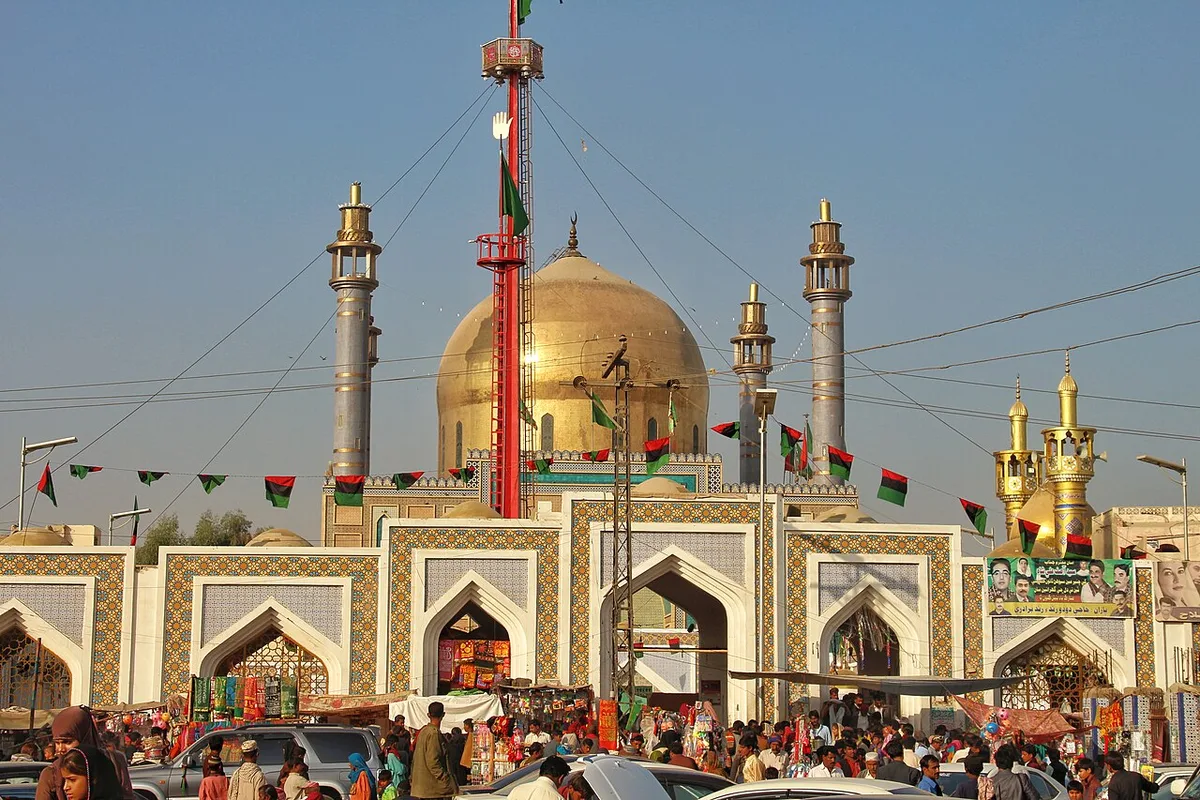
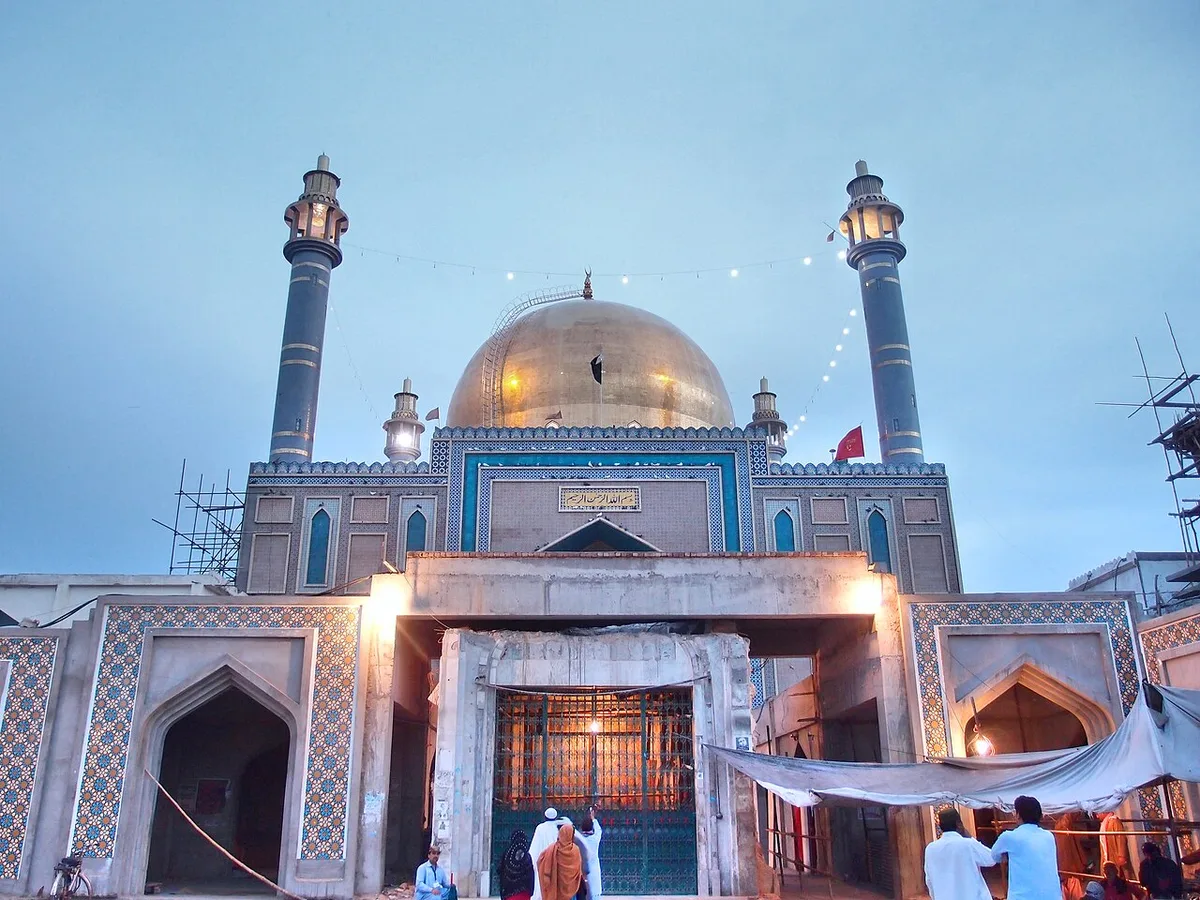
Sehwan Sharif is a small town in Jamshoro district, Sindh, on the west bank of the Indus. It lies about 130 kilometres northwest of Hyderabad. Most people know it for one building: the shrine of the thirteenth century Sufi saint Lal Shahbaz Qalandar, whose gilded dome can be seen from the Indus Highway long before you reach the town.
In this article (34)
- Sehwan Sharif Timeline: Key Dates at a Glance
- Who Was Lal Shahbaz Qalandar, Also Called Usman Marwandi?
- Birthplace, Family and the Disputed Dates
- The Meaning of Lal, Shahbaz and Qalandar
- Arrival in Sehwan and His Teaching Life
- Ancient Sehwan: Sivistan, Sindomana and the Alexander Question
- Sindomana and the Alexander Connection
- Sehwan Fort, Also Known as Kafir Qila
- Sehwan Under Arab, Sultanate and Mughal Rulers
- Architecture of the Shrine and the Rulers Who Built It
- Tughlaq Era Foundations in the 1350s
- Tarkhan, Mughal, Kalhora and Talpur Additions
- The Golden Gate: Two Accounts of Its Origin
- Collapse of 1994 and the Rebuilt Gilded Dome
- Dhamal and the Naqqara: The Daily Ritual at Sehwan
- The Urs of Lal Shahbaz Qalandar in the Islamic Calendar
- Dama Dam Mast Qalandar: History of a Famous Song
- Interfaith Traditions at the Shrine of the Qalandar
- Visiting Sehwan Sharif Today: A Practical Guide
- Route from Karachi and Hyderabad on the N55
- Dress Code and Etiquette at the Shrine
- Advice for Women Visitors and Families
- Crowds, Best Time to Visit and Safety
- Nearby Places: Manchar Lake, Ranikot and Sehwan Fort
- Manchar Lake, a Huge Natural Freshwater Lake
- Ranikot Fort, the Great Wall of Sindh
- Sehwan Fort and the Old Town Shrines
- Frequently Asked Questions About Sehwan Sharif
- Where exactly is Sehwan Sharif located?
- When is the urs of Lal Shahbaz Qalandar held?
- Who built the shrine of Lal Shahbaz Qalandar?
- Can non Muslims and women visit the shrine?
- Is Sehwan Fort really connected to Alexander?
- Sources and Further Reading on Sehwan Sharif
Sehwan Sharif is far older than the shrine. Its fort mound holds layers that archaeologists date back to the last centuries before the common era. Arab, Ghaznavid, Sultanate, Mughal, Kalhora and Talpur rulers all passed through or held it, because Sehwan sits where the Kirthar and Lakki hills squeeze the road between upper and lower Sindh.
This guide has two halves. The first covers the history: who the saint was, what is known about old Sehwan, who built the shrine, and how the dhamal, the urs and the song “Dama Dam Mast Qalandar” became part of the place. The second half is practical: the road from Karachi and Hyderabad, how to behave inside the shrine, advice for women and families, crowds, weather and safety, and three places nearby.
Many dates in this story are disputed. Where sources disagree, this article gives both versions and names the source. Religious traditions and miracle stories are reported as what devotees believe, not as historical fact.
Sehwan Sharif Timeline: Key Dates at a Glance
| Date | Event | Source and note |
|---|---|---|
| Last centuries BCE | Earliest layers of the fortified hill (Purana Qila) are occupied | French excavations 1996 to 2002, summarised by Michel Boivin |
| 326 BCE | Alexander’s campaign against Sambos, ruler of Sindomana | Arrian and Strabo; the link with Sehwan is a later identification and is debated |
| 711 to 713 CE | Muhammad bin Qasim takes Sehwan | Sources give different years inside this range |
| 1026 CE | Mahmud of Ghazni captures the town | Standard accounts of Sehwan’s history |
| 1177 or about 1143 | Birth of Usman Marwandi, later Lal Shahbaz Qalandar | 1177 in most modern accounts; 538 AH (about 1143) in some Sindhi traditions |
| 1267 or 1274 | Death of the saint in Sehwan | A scholarly encyclopedia entry gives 665 AH (1267) or 673 AH (1274) |
| 1353 to 1356 | First dome and domed galleries built in the reign of Firoz Shah Tughlaq | Inscription dated 757 AH (1356), cited by University of Sindh researchers |
| 1585 to 1612 | Mirza Jani Beg Tarkhan and his son Mirza Ghazi Beg enlarge the tomb | Both died before the work was finished |
| 1630 to 1639 | Nawab Dindar Khan completes the building and paves the courtyard with glazed tiles | University of Sindh paper gives 1630 to 1634; other accounts give 1639 |
| 1759 | Ghulam Shah Kalhoro installs an alam and a carved door | Same University of Sindh paper |
| 1822 | Mir Karam Ali Talpur adds a silver gate and railing around the grave | Same paper |
| 1960 | Auqaf Department takes over management | Same paper |
| 1973 to 1975 | Major works under Zulfikar Ali Bhutto; golden doors installed | Two accounts of who gave the doors (see below) |
| 25 July 1994 | The old dome collapses; rebuilding begins | Same paper; six people died |
| 16 February 2017 | Suicide bombing during evening dhamal | Dawn; dhamal resumed the next evening |
Who Was Lal Shahbaz Qalandar, Also Called Usman Marwandi?
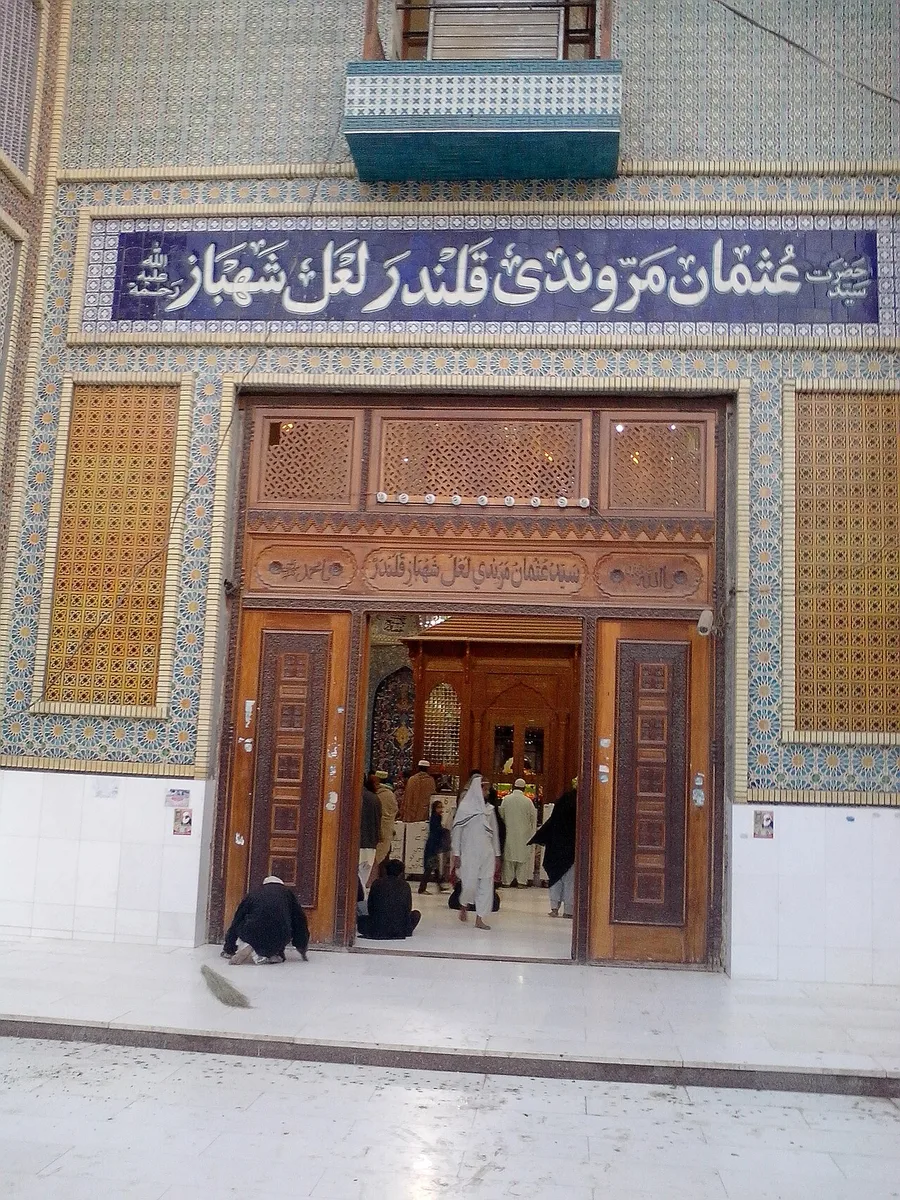
The saint’s given name was Usman Marwandi (in Arabic form, Sayyid Uthman al Marwandi). A Persian inscription above the entrance to his tomb chamber names him as “Uthman Marandi Qalandar La’l Shahbaz”, according to the French historian Michel Boivin, who documented the shrine for the Max van Berchem Foundation.
Birthplace, Family and the Disputed Dates
Most accounts say he came from Marwand. Many place it near Tabriz in what is now Iranian Azerbaijan. A 2014 Dawn feature describes it as about 40 miles from Tabriz. Some Pakistani newspaper reports instead place Marwand in present day Afghanistan. No source settles this, so both versions are given here.
His birth year is also uncertain. Most modern summaries give 1177. A Sindhi tradition repeated in the same Dawn feature gives 538 AH, which is about 1143. For his death, a scholarly encyclopedia entry on Sufism gives two possible years: 665 AH (1267) or 673 AH (1274). The date 1274 is the one used by the French archaeological team and by most writers.
He is described as a Sayyid whose family had roots in Baghdad, and as a contemporary of Jalaluddin Rumi. Devotional books also link him with three famous saints of Multan and Punjab, Bahauddin Zakariya, Fariduddin Ganjshakar and Jalaluddin Bukhari, as the “Chahar Yar” or four friends. That friendship is a well loved tradition, but the books that report it were written long after his lifetime.
The Meaning of Lal, Shahbaz and Qalandar
Each part of his popular name has a meaning. Lal means red or ruby. Tradition says he wore red, and red cloth is still the colour of his devotees. Shahbaz is a royal falcon, a Persian image for a high soaring soul. Qalandar is a title for a wandering dervish who lived outside ordinary social rules, owned little and followed an ecstatic form of Sufism.
Hindus in Sindh have known him by other names. The encyclopedia entry mentioned above records that he was called Shah Husayn, and that some Hindus saw him as an incarnation of Raja Bhartari or of Udero Lal. The name Jhulelal is also used for him today, a point discussed in the interfaith section below.
Arrival in Sehwan and His Teaching Life
According to Boivin, Usman Marwandi came to Sehwan late in life, at a time when Mongol invasions were pushing scholars and dervishes out of Iran and Central Asia. Some accounts say he first visited Sindh much earlier, around 1196. Local tradition says he set up a khanqah (a Sufi lodge), taught at a madrasa in the town and wrote several treatises, named in some accounts as Mizan us Surf, Aqd and Zubdah. These details come from the traditional biography rather than from records of his own time.
After his death, Boivin writes, a cult grew slowly around his grave. Only over several centuries did the name Lal Shahbaz Qalandar replace his given name in popular use.
Ancient Sehwan: Sivistan, Sindomana and the Alexander Question
Old names for the town include Sivistan and Siwistan. Some writers link Sivistan to the god Shiva and translate it as “abode of Shiva”. Others connect it to an ancient people called the Sivi, and one local historian credited the founding to a group he called the Sewi. These are competing explanations, and none can be proved from the evidence we have.
Sindomana and the Alexander Connection
Greek historians such as Arrian and Strabo describe Alexander’s campaign against a ruler named Sambos, whose capital was Sindomana, in 326 BCE. Colonial officers and writers later identified Sindomana with Sehwan, and the fort became known locally as “Alexander’s fort”.
Scholars are more careful today. In a 2023 study, the historian Rachel Mairs points out that none of the ancient historians give enough detail to place Sindomana at Sehwan, and she traces how the Alexander story spread among British officers in the nineteenth century. The French excavators did reach layers from around Alexander’s time, but Boivin notes that no remains linked to Alexander himself were found.
Sehwan Fort, Also Known as Kafir Qila
North of the town stands a large earthen mound known as Sehwan Fort, Kafir Qila (fort of the unbelievers) or Ulti Basti (the upturned town). The Sindh antiquities department describes it as roughly 400 by 200 metres and about 18 metres high. It is made of earth packed with pottery pieces, broken brick, bone, charcoal and ash, which shows people lived on it for a very long time.
The same department says nothing Greek has been found there apart from an occasional coin, and it notes the view of the archaeologist N. G. Majumdar that the standing fort belongs to the Muslim period. Between 1996 and 2002 a French mission led by Monique Kervran dug seven seasons on the mound and identified a long sequence of phases. Finds were placed in a museum at Sehwan.
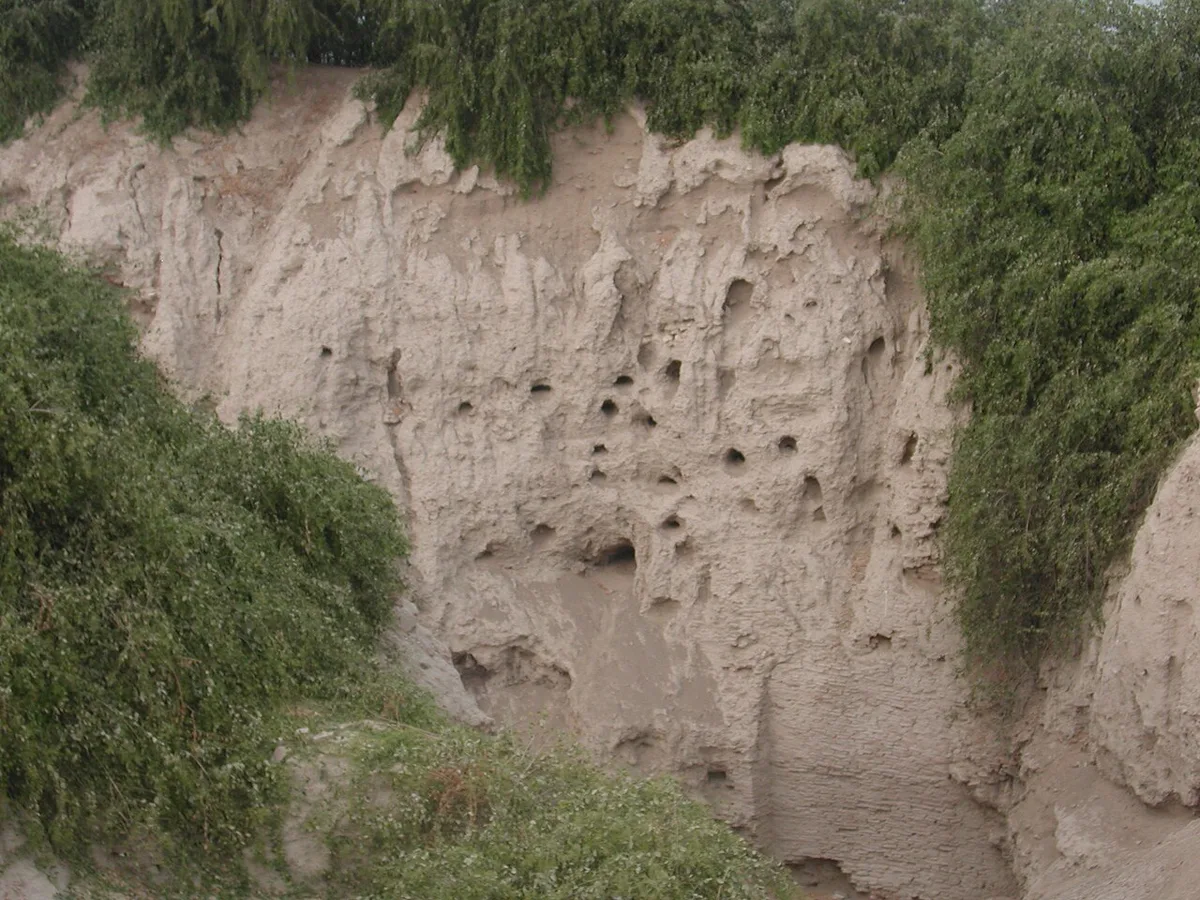
The name Ulti Basti comes from a folk tale. It says a cruel ruler called Raja Chopat (also spelled Charbat) lived in the fort and harmed Bodla Bahar, a close disciple of the saint, and that the saint’s anger turned the town upside down. This is a story told by devotees; archaeology explains the mound as the result of centuries of building and decay.
Sehwan Under Arab, Sultanate and Mughal Rulers
Sehwan was taken by Muhammad bin Qasim during the Arab campaign of 711 to 713 and by Mahmud of Ghazni in 1026. Later it was held in turn by the Soomra, Samma, Arghun and Tarkhan rulers. The Mughal emperor Humayun failed to take it in 1542 on his way to Umarkot, but it passed to Akbar’s empire in the 1590s. In the eighteenth century it was part of the lands of the Kalhora dynasty of Sindh, and then of the Talpur Mirs.
Architecture of the Shrine and the Rulers Who Built It
A 2012 paper by Abdul Fatah Daudpoto and Mashooq Ali Khowaja of the University of Sindh is one of the most detailed modern accounts of the building. Its opening point is useful: almost every ruler of Sindh added something to the tomb, so it is hard to name a single builder.
Tughlaq Era Foundations in the 1350s
The paper says the first dome was raised in 754 AH (1353) by order of Sultan Firoz Shah Tughlaq of Delhi. An inscription dated 757 AH (1356) records cupolas and domes built by a local governor, Ikhtiar al Din Malik, with seven arches and six small domes. Firoz Shah is also said to have granted land to the shrine’s servants so they could look after it. The Moroccan traveller Ibn Battuta passed through Sehwan in the 1330s, and the paper notes that he described the grave as a venerated place.
Tarkhan, Mughal, Kalhora and Talpur Additions
Mirza Jani Beg Tarkhan began a much larger building between about 1585 and 1591 but died before it was finished. His son Mirza Ghazi Beg continued between about 1600 and 1612 and also died before completion. Nawab Dindar Khan, governor of Sehwan under the Mughals, finished the work, paved the courtyard and used glazed kashi tiles. The University of Sindh paper dates his work to 1630 to 1634; other accounts give 1639.
Later rulers left their own marks. Ghulam Shah Kalhoro installed an alam (a banner linked to Hazrat Abbas) and a carved door in 1759. Mir Karam Ali Talpur added a silver gate and a railing around the grave in 1822, and Mir Ghulam Ali Talpur covered four pillars in silver. Until 1994, Dawn notes, the tomb kept the red brick and blue tile look of the Talpur era.
The Golden Gate: Two Accounts of Its Origin
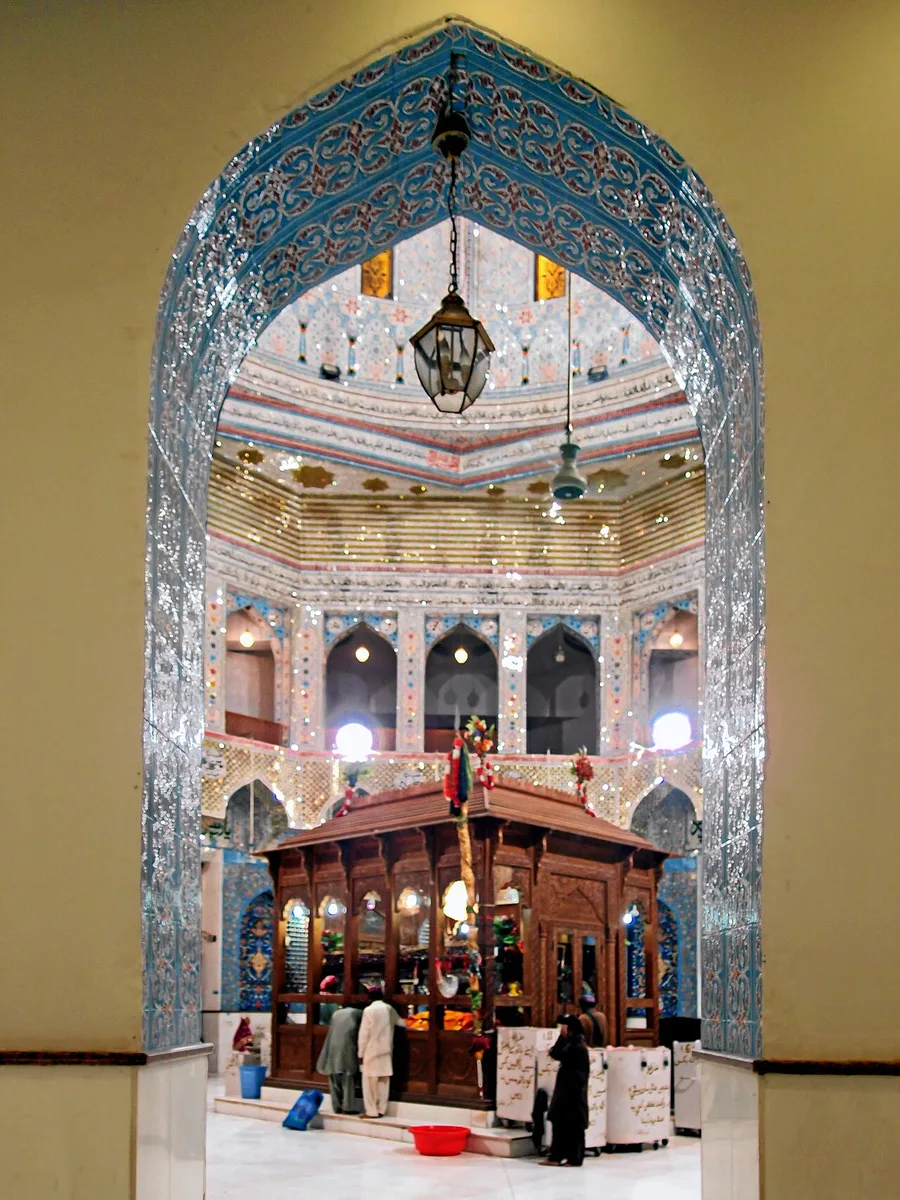
The pair of gold plated doors is one of the shrine’s best known features, and there are two versions of where they came from. The University of Sindh paper lists them among the works of 1973 under Zulfikar Ali Bhutto and says the doors were designed in Iran and imported by the Pakistani government. In a documentary screened in Karachi, the shrine custodian Syed Mehdi Shah Sabzwari said the door was given in 1975 by the Shah of Iran, Mohammad Reza Pahlavi, to honour the saint’s Iranian roots.
Both accounts agree that the doors came from Iran in the mid 1970s, in the Bhutto years. They differ on whether the gift came from the Shah or from Pakistan’s own government. Some popular accounts speak of two golden doors, one from each source. Visitors today can see devotees tying threads to the frame of the golden gate while making a wish, a practice Dawn photographed during the 2023 urs.
Collapse of 1994 and the Rebuilt Gilded Dome
On 25 July 1994 the old dome collapsed and six people died. The government then ordered the whole tomb to be taken down and rebuilt. According to Dawn, Prime Minister Benazir Bhutto wanted it rebuilt on the pattern of Rumi’s shrine. The new dome has 192 panels covered with gold leaf. It is often given as about 110 feet high and 56 feet wide.
Work went on for years. The University of Sindh paper describes a second phase for a separate dhamal courtyard and a third phase for parking, shops, a guest house, toilets and Sunni and Shia mosques. Its authors also say the new building has little in common with the older Sindhi style, and they call for local tile work and calligraphy to be used in later work. That debate between a grand modern shrine and the older Sindhi look is still part of the building’s story.
Dhamal and the Naqqara: The Daily Ritual at Sehwan
Dhamal (also written dhamaal) is a devotional dance done to the beat of large kettle drums called naqqara or naubat. Writing in The News on Sunday, the critic Sarwat Ali says the naubat is played twice in every twenty four hours, at dawn and at dusk, and that dhamal follows it each time. Dawn reports that the evening dhamal starts at sunset.
The rhythm starts slowly and builds to a fast crescendo. Dancers stamp, spin, raise their arms and swing their heads, and some fall into a trance. Devotees believe the saint himself began this practice in the thirteenth century. There is no written record from his time to confirm that, so it is best described as a belief handed down orally.
Sarwat Ali notes that dhamal was once linked with a group of shrine servants who did cleaning and upkeep. He names a custodian, Syed Haji Fateh Ali Sabzwari, as the person who organised it as a formal institution, and he records the view of the scholar Ghulam Hussain Haider Sindhi that Faqir Nadir Ali Shah also shaped it. The 2018 documentary reported by Dawn interviewed a naqqara player who said he plays the drum as an act of worship, and a shehnai player whose family had played at the shrine for generations.
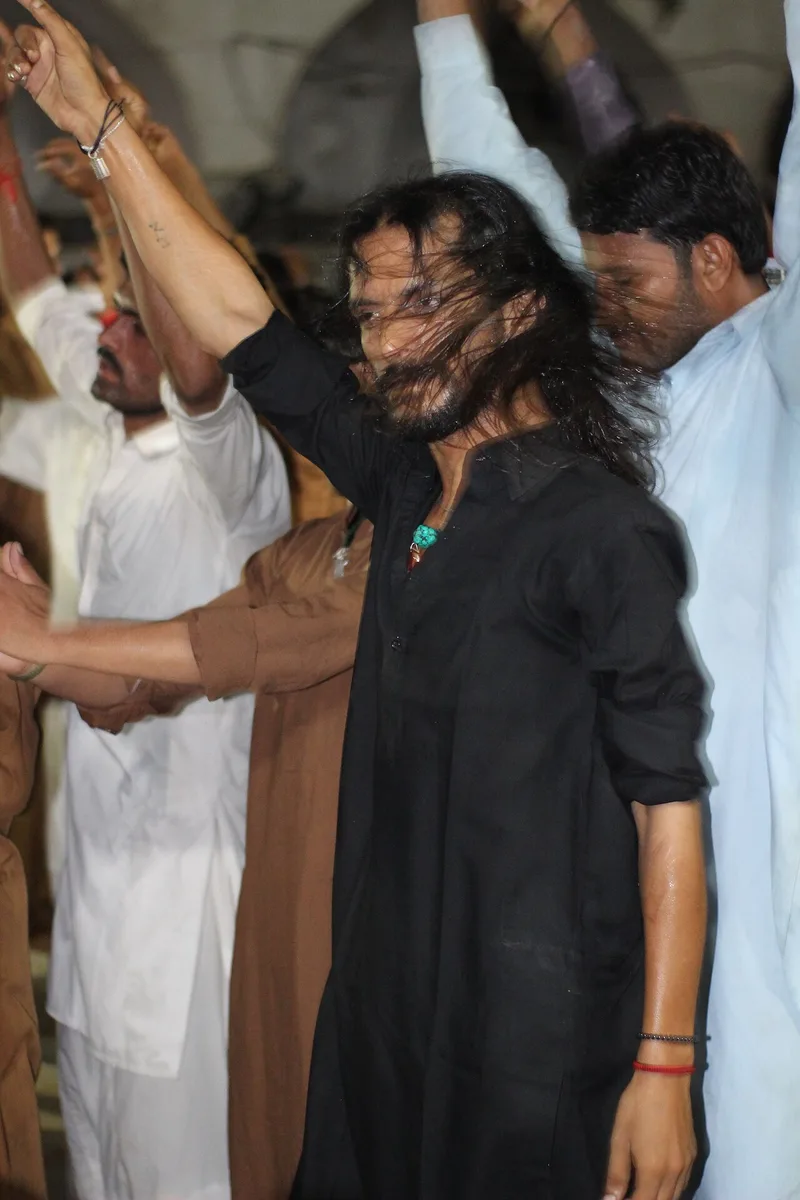
Men and women both take part. The shrine’s courtyard is divided by ropes into separate areas for each. Many dancers wear red or black, and some malangs (wandering dervishes) have long matted hair and wear many beads and rings. Researchers have pointed out that this look resembles that of Shaivite yogis, which fits Sehwan’s long history as a centre of Shaivite devotion.
The Urs of Lal Shahbaz Qalandar in the Islamic Calendar
The urs marks the saint’s death anniversary. Urs means wedding, because Sufis see death as the soul’s union with God. The celebration is held over three days from 18 Sha’ban, the eighth month of the Islamic lunar calendar.
Because the Islamic year is about eleven days shorter than the solar year, the urs moves earlier in the Gregorian calendar each year. It can fall in any season. Check the current year’s date with the Sindh Auqaf Department or recent news before planning a visit. Dawn reported the 772nd urs in early March 2024, and the Express Tribune reported the 774th in February 2026.
Crowd estimates vary widely. Dawn put the crowd on the second day of the 2024 urs at about half a million people, and the Express Tribune cited unofficial estimates of 500,000 to 700,000 in 2014. Other reports give figures of one million or more, but these are not backed by any published count.
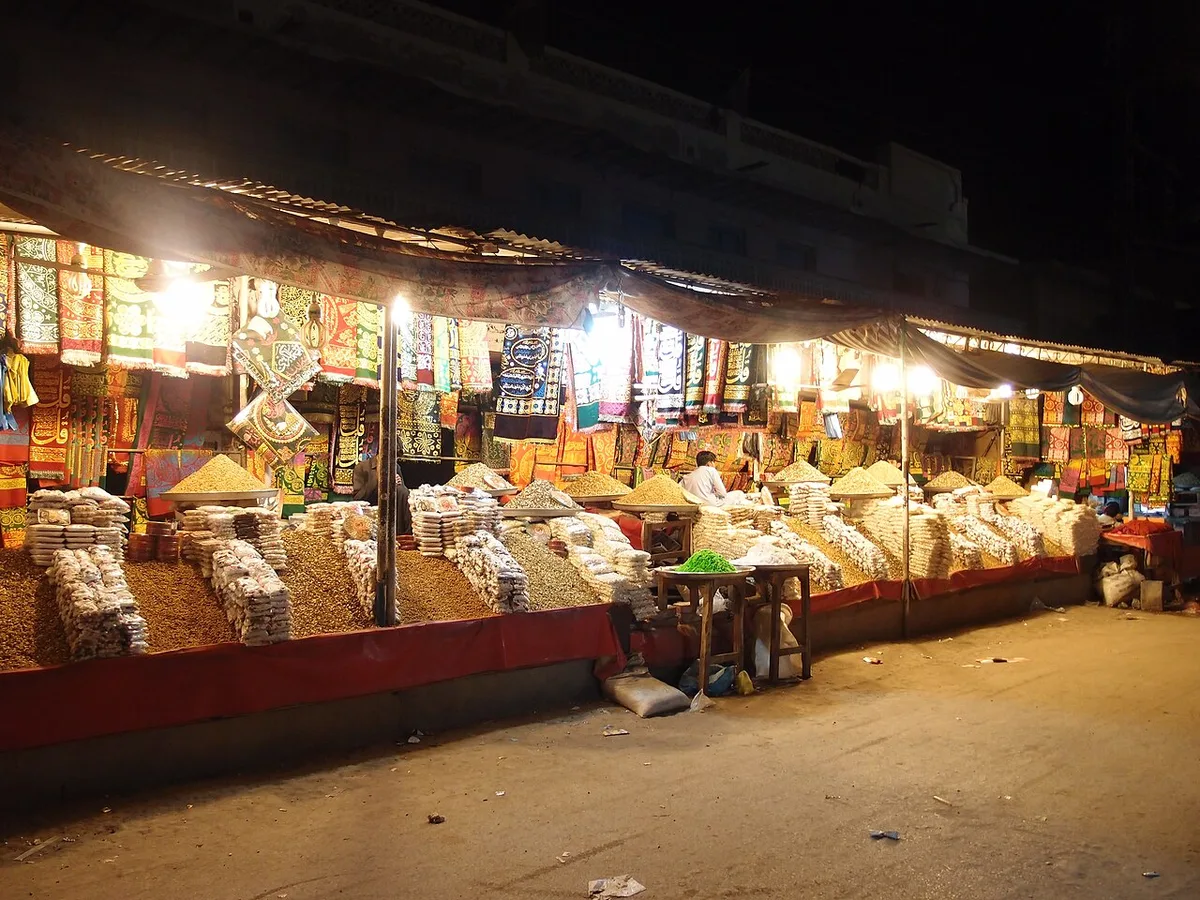
The urs programme has religious and social parts. A key ritual is the mehndi (henna) procession on the second day. In 2008 Dawn described it as a procession from a kafi (dervish lodge) in the town to the shrine. A chadar (an embroidered sheet) is carried and laid on the grave, and in recent years the Sindh governor or chief minister has laid one at the official opening or closing. Folk singers, Sindhi wrestling known as malakhro, and markets fill the town around the shrine.
Dama Dam Mast Qalandar: History of a Famous Song
“Dama Dam Mast Qalandar” is the best known devotional song linked with the saint. Its title is usually translated as “every breath for the ecstasy of the Qalandar”. It mentions Sehwan, Lal and Jhulelal, and it also praises Hazrat Ali.
Its origin is unclear. Shrine tradition credits an early version to the thirteenth century poet Amir Khusrau and a reworking to Bulleh Shah in the eighteenth century. No written copy or recording is known from before the 1950s, so these attributions cannot be checked.
The modern melody has a better documented history. The Pakistani composer Master Ashiq Hussain set a version for the 1956 film Jabroo. The poet Saghar Siddiqui is said to have brought him the edited text. In 1969 Noor Jehan sang it in the film Dillan Dey Saudey, and that version made the tune famous across Pakistan.
The folk singer Reshma also became well known for singing it. Many others recorded it, including Abida Parveen, the Sabri Brothers, Aziz Mian, Runa Laila of Bangladesh and the rock band Junoon. Nusrat Fateh Ali Khan created a separate song, “Dam Mast Qalandar Mast Mast”, in 1991, with a new melody built on the same idea.
The song also entered politics. Zulfikar Ali Bhutto visited the shrine often, and the song was played at his party’s rallies until it became an unofficial anthem of the Pakistan Peoples Party.
Interfaith Traditions at the Shrine of the Qalandar
Sehwan is often cited as a place where Muslim and Hindu devotion meet. Before Partition Sehwan Sharif had a large Hindu population. Several traditions still show that shared past.
Hindus took part in the urs mehndi ritual for generations, and the 2008 Dawn report quotes a Hindu woman who had attended it for twenty years. Hindu families still keep a few duties at the shrine. In 2017 a Hindu custodian, Lal Gul Das, told The Wire that his family looks after the Hindu rites there, such as lighting lamps and placing the sacred cloth on the grave. The name Jhulelal, used for a Sindhi Hindu deity of the river, is also used for the saint. Boivin argues that Sindhi Hindus used the name first, and that it was linked to the saint mainly through the song.
Another belief, recorded by the British writer C. A. Kincaid in 1925, holds that the saint was a later form of Raja Bhartari (Bhartrihari), a king who gave up his throne to become a Shaivite ascetic at Sehwan. These are matters of faith and folklore, and they are shared by devotees rather than proven by historians.
The shrine also has strong Shia features. The alam of Hazrat Abbas, the red chadars with the names of the Prophet’s family, and Muharram processions are part of its year. Sunni, Shia, Hindu and other visitors come to the same courtyard. The same mix of saint, song and poetry runs through other parts of Sindhi culture, and through the shrine at Bhit Shah of Shah Abdul Latif Bhittai.
Visiting Sehwan Sharif Today: A Practical Guide
The shrine is open to visitors of all faiths. The notes below cover the road, behaviour inside, and planning around crowds and heat. Rules and timings can change, especially during the urs or after security alerts, so check local news before you travel.
Route from Karachi and Hyderabad on the N55
The Indus Highway (N55) starts at Kotri, on the west bank opposite Hyderabad, and runs north along the river to Sehwan, Dadu and Larkana. The National Highway Authority lists it as the Kotri to Larkana and Peshawar route.
- From Karachi: take the M9 motorway towards Hyderabad, cross to the Jamshoro and Kotri side, and join the N55 northbound.
- From Hyderabad: cross the Indus to Jamshoro and follow the N55 north. Sehwan Sharif is about 130 kilometres away.
- On the way: the road passes the town of Sann, the turn for Ranikot Fort, and Manjhand and Amri before reaching Sehwan.
The Asian Development Bank has funded work to add a second carriageway on the Petaro to Sehwan section, so expect construction zones and some single lane stretches. Driving in daylight is the safer choice.
Dress Code and Etiquette at the Shrine
- Wear loose, modest clothes that cover the arms and legs. Women usually cover their hair with a dupatta or scarf, and many men cover their heads too.
- Remove your shoes before entering the courtyard and tomb area, as at any mosque or shrine.
- Walk around the grave calmly. Do not push to reach the railing, even if others do.
- Ask before photographing people, especially women and devotees in a trance. Inside the tomb chamber, follow any instructions from shrine staff.
- Do not join the dhamal circle as a spectator for fun. Watch from the side unless you mean to take part.
- Keep your voice low and avoid arguing about beliefs. The shrine welcomes people of very different views.
Advice for Women Visitors and Families
Women visit the shrine in large numbers and take part in prayers and dhamal in their own roped area. Researchers note that women have more freedom of movement around this shrine than in many public spaces in rural Sindh. Women offering water to devotees, and groups of female singers, are also part of shrine life.
Even so, the courtyard and lanes become extremely crowded, particularly on Thursday evenings and during the urs. Families with children should agree a meeting point, keep phones charged and avoid the densest crowd near the grave at dhamal time. Visiting in the morning is calmer.
Crowds, Best Time to Visit and Safety
Crowds: the shrine is busy every day, but Thursday evenings and the three days of the urs are the busiest. Hotels and transport fill up quickly during the urs.
Weather: Sehwan is very hot in summer. Dawn reported a temperature of 46 degrees Celsius in the town on the day the shrine reopened in August 2020. The cooler months, roughly November to February, are more comfortable for travel. Floods in 2022 also damaged large parts of Sehwan Sharif, so check road conditions after a heavy monsoon.
Safety: security has been tighter since 2017, so expect checks at the shrine gates. Carry your CNIC or passport. Keep valuables to a minimum, watch for pickpockets in crowds, and drink bottled water in the heat.
Nearby Places: Manchar Lake, Ranikot and Sehwan Fort
Sehwan works well as a base for a short heritage trip in Jamshoro and Dadu districts. Three places are within easy reach.
Manchar Lake, a Huge Natural Freshwater Lake
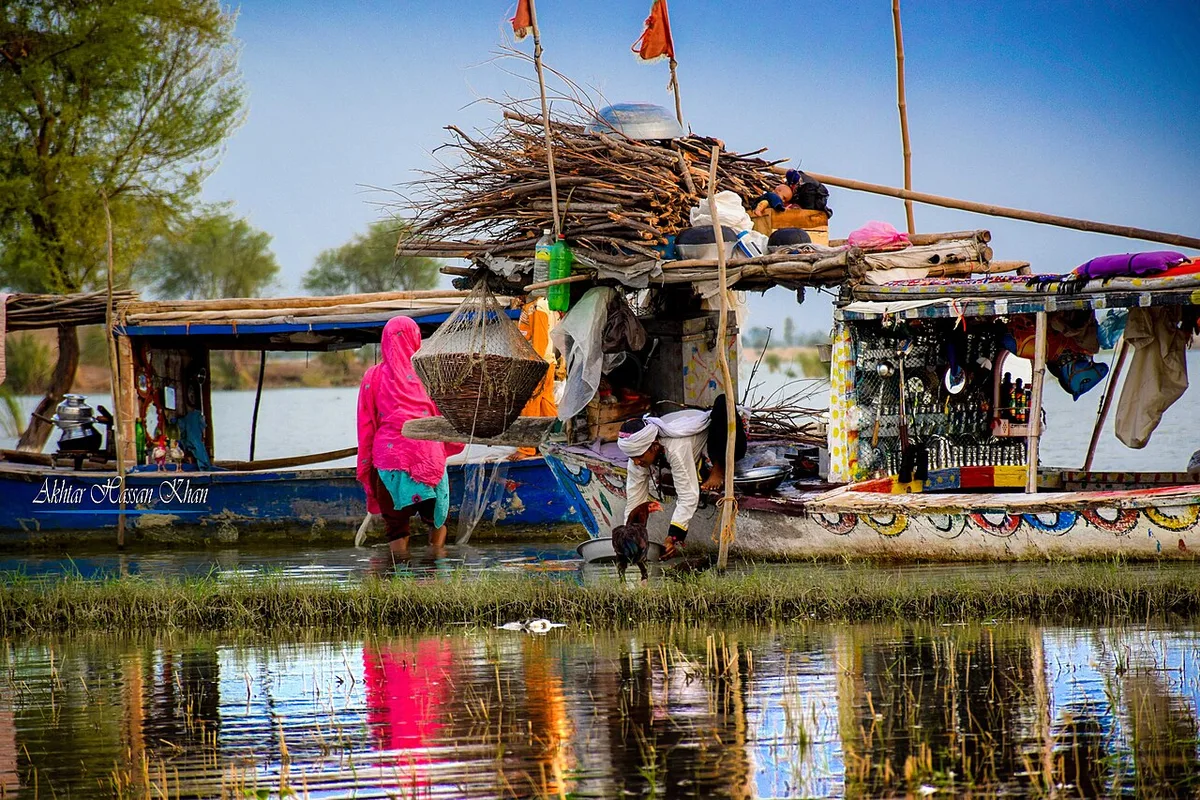
Manchar Lake lies about 18 kilometres west of Sehwan. Our Manchar Lake guide covers its history, birds and boat people. The Sindh Irrigation Department describes it as the largest natural freshwater lake in Pakistan. Its size changes greatly with the seasons and rains. Official figures range from a few dozen square kilometres in dry periods to around 500 in the monsoon.
The lake is home to the Mohana fishing community, some of whom have lived on wooden houseboats for generations. Dawn and other papers have reported for years on pollution entering the lake through drainage works, which has hurt fish catches and the people who depend on them.
Ranikot Fort, the Great Wall of Sindh
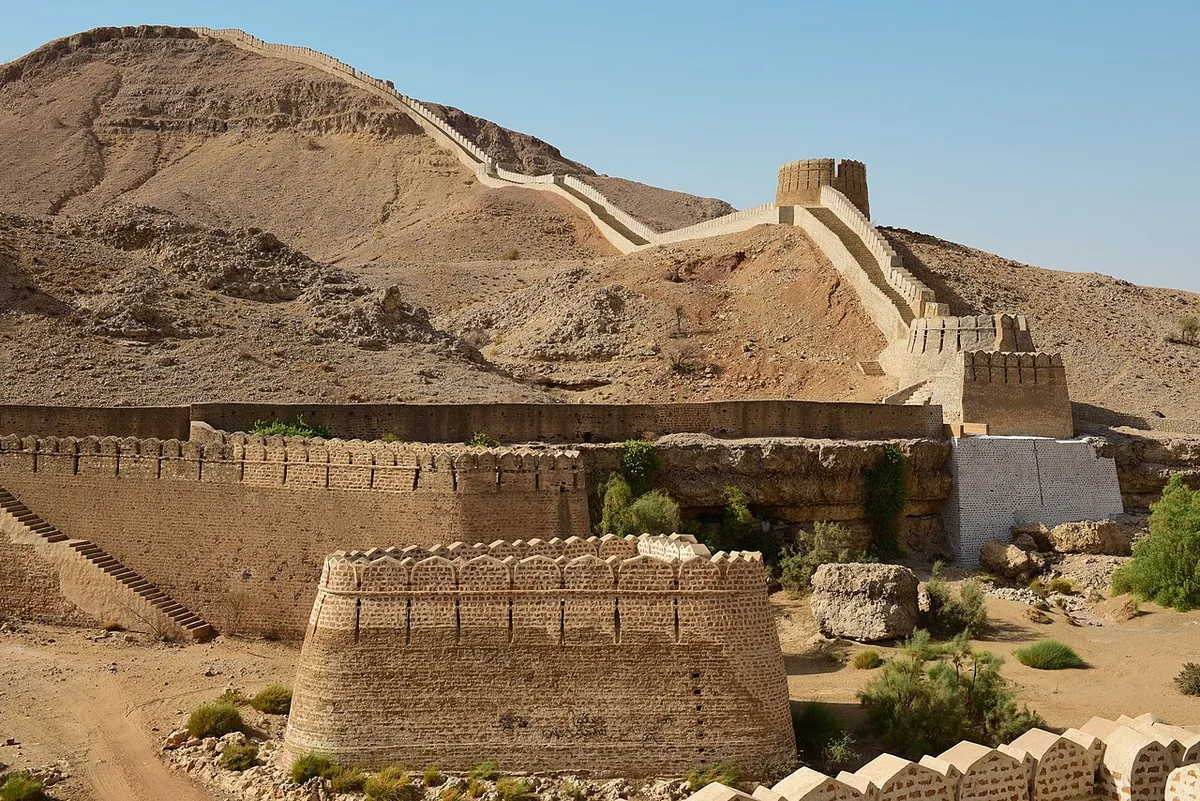
On the way from Hyderabad to Sehwan, a side road from near Sann leads to Ranikot Fort. Its stone walls run for many kilometres across the Kirthar hills. Who first built it is still debated, but much of what stands today is linked to the Talpur period. Ranikot has been on UNESCO’s tentative list for Pakistan since 1993. Being on the tentative list is not the same as being a World Heritage Site.
Sehwan Fort and the Old Town Shrines
Sehwan Fort is a short walk north of the shrine. There is little standing masonry, but the top gives a wide view of the town and the golden dome. Around Sehwan Sharif are smaller shrines of the saint’s followers, such as Bodla Bahar, whose dargah is known for its own evening dhamal.
Travellers with a full day and a 4×4 vehicle sometimes go on from Sehwan toward Johi and Wahi Pandhi to reach Gorakh Hill Station in the Kirthar range. The Sindh Investment Department notes that a road from Sehwan to Johi makes this route about 20 kilometres shorter than going through Dadu.
Frequently Asked Questions About Sehwan Sharif
Where exactly is Sehwan Sharif located?
Sehwan Sharif is in Jamshoro district, Sindh, on the west bank of the Indus. It is about 130 kilometres northwest of Hyderabad on the Indus Highway (N55).
When is the urs of Lal Shahbaz Qalandar held?
The urs is held for three days from 18 Sha’ban in the Islamic calendar. Its Gregorian date moves about eleven days earlier each year, so check the date announced for the current year.
Who built the shrine of Lal Shahbaz Qalandar?
The first dome dates to about 1353 to 1356, in the reign of Firoz Shah Tughlaq. Tarkhan, Mughal, Kalhora and Talpur rulers added to it, and the present building was largely rebuilt after the dome collapsed in 1994.
Can non Muslims and women visit the shrine?
Yes. People of all faiths visit, and women take part in prayers and dhamal in a separate roped area. Modest dress and respectful behaviour are expected.
Is Sehwan Fort really connected to Alexander?
That is a local tradition. Ancient writers mention a town called Sindomana, but historians say they do not give enough detail to prove it was Sehwan, and no remains linked to Alexander have been found on the mound.
Sources and Further Reading on Sehwan Sharif
- Daudpoto and Khowaja, Tomb of Lal Shahbaz Qalandar: Design and Remodeling, Grassroots (University of Sindh), 2012
- Michel Boivin, Artefacts of devotion: monuments and relics of Sehwan Sharif, Max van Berchem Foundation, 2009 (French)
- Rachel Mairs, Legacies of Alexander in Colonial Sindh: Richard Francis Burton and a Greek Pot at Sehwan, 2023
- Encyclopedia of Indian Religions, entry on La’l Shahbaz Qalandar, Springer, 2018
- Directorate General of Antiquities, Government of Sindh, Sehwan Fort
- Dawn, Message of Lal Shahbaz Qalandar is universal, October 2018
- Dawn, Devotees resume dhamal at Lal Shahbaz Qalandar shrine, February 2017
- Dawn, Delay in completion of Sehwan shrine project worries devotees, October 2008
- Dawn, Sehwan made by faqirs of Qalandar, December 2013
- Dawn, Qalandar shines over Sehwan, July 2014
- Dawn, Thousands gather for Urs of Lal Qalandar, August 2008
- Dawn, Devotees converge on Sehwan as the urs begins, March 2023
- Dawn, Sehwan hosts half a million pilgrims on second day of Qalandar urs, March 2024
- Dawn, Shrine welcomes visitors after five months, August 2020
- Express Tribune, Sehwan thrums as devotees gather for 774th urs, February 2026
- Express Tribune, Hazrat Lal Shahbaz Qalandar’s urs comes to an end, June 2014
- Sarwat Ali, The rhythm of devotion, The News on Sunday, February 2025
- Wikipedia, Shrine of Lal Shahbaz Qalandar
- Wikipedia, Dama Dam Mast Qalandar
- Sindh Irrigation Department, Manchar Lake
- UNESCO World Heritage Centre, Rani Kot Fort tentative list entry
- National Highway Authority, national highway network map and route list (PDF)
- Asian Development Bank, Petaro to Sehwan additional carriageway monitoring report, 2019 (PDF)

Leave a Comment