

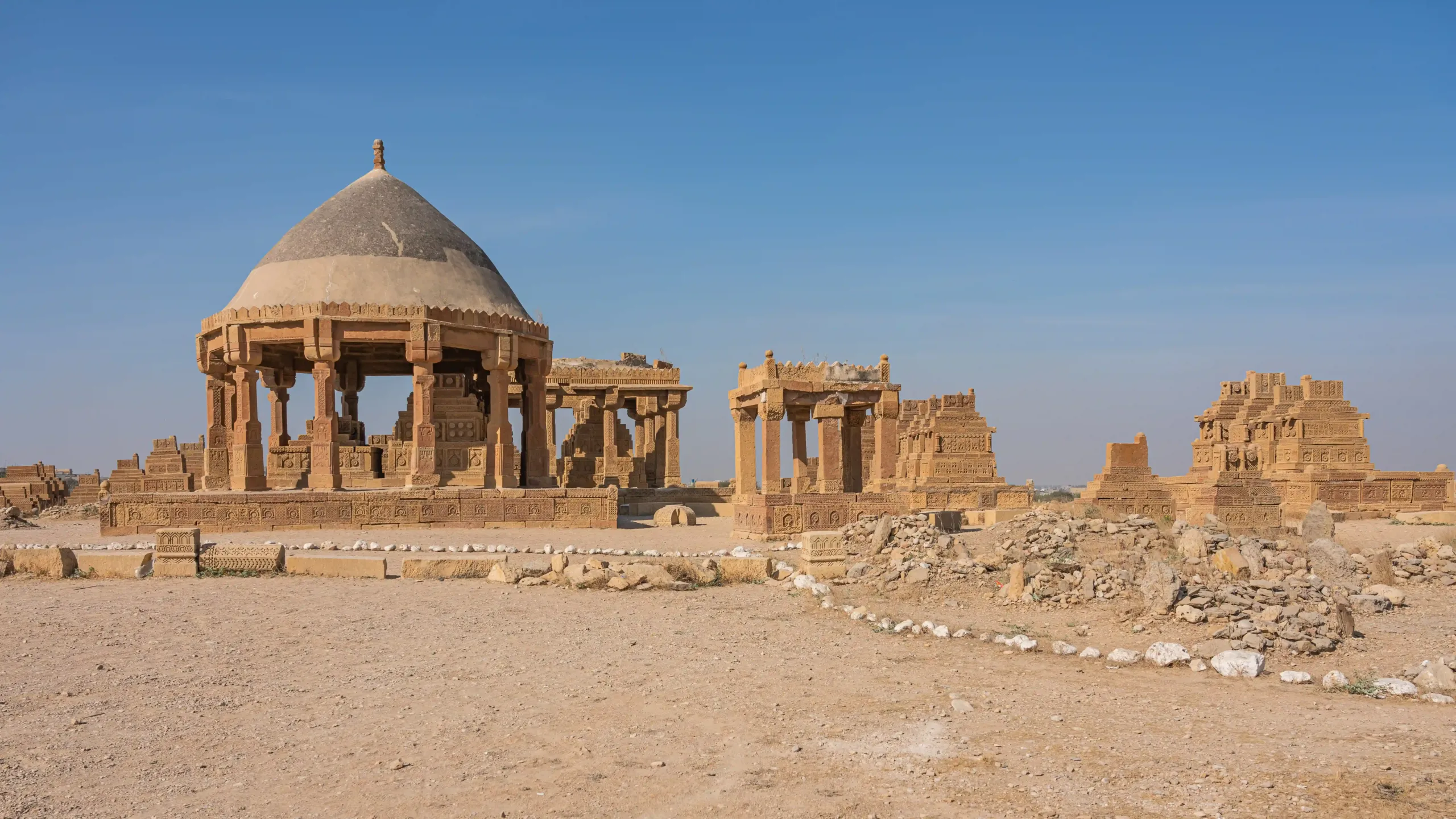
Thirty kilometres east of Karachi the apartments thin out and the ground turns rough. Then a low ridge appears, and on it stand graves that look like small houses. Some stand alone. Others sit in rows on shared platforms, each topped with a carved turban of stone. This is Chaukhandi.
In this article (26)
- Inside this guide to the Chaukhandi Tombs near Karachi
- Chaukhandi Tombs at a glance and the basic facts worth knowing
- Where the name Chaukhandi comes from and why scholars still argue
- The Jokhio tribe and the families actually buried at Chaukhandi
- How the tombs were dated when only one grave carries a year
- Discovery, early surveys and two centuries of research at the site
- How a Chaukhandi grave is actually built, slab by slab
- The sandstone, the chisels and the craft behind the carving
- How to read the carvings on a man’s grave and on a…
- What the Arabic and Persian inscriptions tell historians
- How Chaukhandi fits the wider tradition of carved graves in Sindh
- UNESCO listing status, conservation work and the threats that remain
- Driving distances from Chaukhandi to the main cities of Sindh
- Visiting the Chaukhandi Tombs, with timing, tickets and etiquette
- Why the Chaukhandi Tombs still matter today
- Common questions about the Chaukhandi Tombs answered
- Where exactly are the Chaukhandi Tombs?
- Are they a UNESCO World Heritage Site?
- Who built them?
- How old are the tombs?
- How do you tell a man’s grave from a woman’s grave?
- What does the name Chaukhandi mean?
- When should I visit?
- Is photography allowed?
- Related reading on PakSindh
- Sources and further reading
Travel writers love the place. Archaeologists are more careful, and their caution is worth borrowing. Size is not the point here. Makli dwarfs it. What makes the Chaukhandi Tombs matter is the carving, and what that carving records about people who left almost no written trace of themselves.
Inside this guide to the Chaukhandi Tombs near Karachi
- The basic facts about the site
- Where the name comes from
- Who is actually buried here
- How the graves were dated
- Early surveys and later research
- How one grave is put together
- Sandstone, chisels and craft
- Reading the carved symbols
- The inscriptions and their value
- How Chaukhandi fits the wider tradition
- UNESCO status and conservation
- Distances from Sindh cities
- Plan your visit
- Why the site still matters
- Questions people keep asking
Chaukhandi Tombs at a glance and the basic facts worth knowing
| Item | Detail |
|---|---|
| Location | Malir district, eastern Karachi, near Landhi, beside the National Highway |
| Coordinates | 24.8639 N, 67.2714 E |
| Period | Fifteenth to eighteenth century |
| Only dated grave | AH 1169, read as AD 1756 |
| Communities | Jokhio, Burfat, Jakhra, Sindhi Shaikh and Kalmati Baloch |
| Material | Buff sandstone, cut in shallow and deep relief |
| Status | Protected monument and UNESCO Tentative List entry 1287, since 1993 |
| Custodian | Culture, Tourism, Antiquities and Archaeology Department, Government of Sindh |
Four things are worth carrying away. The tombs are tribal, not royal. They carry no arches and no domes, which is the reason so many are still standing after centuries of earthquakes. Only one grave is dated, so everything else hangs on comparison with Makli. And no, despite what half the travel blogs say, this is not a World Heritage Site. It sits on the tentative list and has sat there since 1993.
Where the name Chaukhandi comes from and why scholars still argue
Ask five specialists what Chaukhandi means and you will get four answers. That is not a scandal. It tells you how thin the documentary record is out here.
Mumtaz Hassan, writing in 1968, took the word apart. Chaw, four, and khundi, corner or pillar. On his reading the name describes the four posts of an umbrella canopy over a grave, which would make it a generic term, not a place. Ali Ahmad Brohi landed in much the same spot, reading it as a domed pavilion open at the sides.
Shaikh Khurshid Hasan disagreed, and he had been publishing on this ground for two decades. For him the word is simply a place name. The evidence he leans on is an inscription on the grave of Jam Murid bin Haji, where Chaukhandi sits right next to the name of the dead man.
Kaleem Lashari reads the same line another way. Sahib e Chaukhandi, owner of the Chaukhandi. N. A. Baloch then added a fourth possibility. In ordinary Sindhi speech, he pointed out, a chaukhandi is the four walled enclosure raised out of respect around the grave of a revered person. Following him, the word names the enclosure and not the tomb at all.
Salome Zajadacz Hastenrath, whose survey remains the standard work, doubted that any of this could be settled. She noticed that the graves here are square, unlike the round and oval forms also found across Sindh and Balochistan. Squareness, though, is a weak peg to hang a name on. So she used the phrase as a label for any grave resembling those at the cemetery near Landhi, wherever it happens to stand. That is the safest reading, and it is the one this article follows.
The Jokhio tribe and the families actually buried at Chaukhandi
Chaukhandi is usually described as the family graveyard of the Jokhio tribe, a Sindhi community counted among the descendants of the Samma. Others lie here too. Burfat, Jakhra and Sindhi Shaikh graves are present, and Kalmati Baloch families were buried on the same ground.
The Express Tribune reported in 2020 that the site holds Jokhio families and Saloch warriors. Look at the weapons cut into so many slabs and that description starts to feel right.
Older writers used a different label, Baloch tombs, and applied it to every carved grave in lower Sindh. Zajadacz Hastenrath pushed back, on geographical grounds. These cemeteries are scattered across country that contains only a sliver of Baloch settlement. A name that implies a tribal explanation the map does not support is a name that misleads.
The layout, meanwhile, says plenty. Big canopied monuments stand among clusters of plain slabs. Groups of up to eight graves share one raised platform, which speaks of family plots rather than single burials. Nothing here resembles a royal mausoleum. The hierarchy is tribal and familial, and it is written in stone rather than in text.
How the tombs were dated when only one grave carries a year
The usual range handed around is the fifteenth to eighteenth century. That range conceals a genuine problem.
One grave carries a date. Just one. And the mason wrote the numerals of AH 1169 backwards, which gives AD 1756. Everything else has been dated by comparison, mostly against monuments at Makli Necropolis near Thatta.
The comparison is not guesswork. Zajadacz Hastenrath photographed fifty cemeteries, from the Hub River in the west to the Tando Muhammad Khan area in the east. She sorted the tombs by form, built a relative sequence, then tied that sequence to dated buildings. The tomb of Jam Nizamuddin II. The mausoleum of Isa Khan Tarkhan the Younger.
Her verdict was that the type grew out of ordinary lower Sindhi graves into tall, heavily carved monuments, peaking in the first half of the seventeenth century. She called the result a most original contribution to Islamic sepulchral architecture. The Encyclopaedia of Islam treats her survey as the only systematic study of its kind, which is high praise and a quiet complaint about the rest of the field.
Two cautions, then. Local tradition puts the first burials well before the Mughals, and one widely repeated summary claims the cemetery has existed since pre Islamic times. No dated grave backs that up. Separately, Mirza Mahad Baig and G. G. Filippi have argued for Rajput influence, pointing to the monolithic slabs, the step shaped pedestals and the plain facades. A reasonable hypothesis. Not a proven fact, and it should be labelled as one.
Discovery, early surveys and two centuries of research at the site
The earliest trace is a letter. J. Macleod wrote to H. B. E. Frere in 1851, and that is where the paper trail begins.
Real attention came later. In 1917 H. D. Baskerville, Assistant Collector at Thatta, opened a stone chamber, found nothing inside, and used the empty box to dismiss the theory of above ground burial. Five years later the tombs near Landhi were brought under the Ancient Monuments Preservation Act of 1904.
Earlier work had already set the terms. J. P. Vogel studied Hinidan, Karpasan, Gundar and Manghopir. He identified the graves as Muslim from their Arabic inscriptions and from their alignment, since the body lies on the right shoulder facing Mecca and the long axis therefore runs roughly north to south with the head at the north.
Henry Cousens gave the monuments a chapter in The Antiquities of Sind. He rejected the above ground burial idea by pointing at the openings in the lower casket, and he drew the first comparisons with Makli, with the tomb of Mian Ghulam Shah Kalhoro at Hyderabad, and with the rider stones of Kathiawar and Kutch.
Then the site went quiet. After partition it took a minister to stir things. I. H. Qureshi raised it with the Department of Archaeology. E. J. W. Bunting and a small team made rubbings of the carvings and exhibited them abroad, which is how the place entered international scholarship. Her book on Sindhi tombs and textiles appeared in 1967. Hasan’s monographs, spread across 1976 to 1996, built the epigraphic base that later work still leans on.
How a Chaukhandi grave is actually built, slab by slab
Start at the base. Six upright slabs. Two long ones run down the sides and mark the length of the body, two short ones close head and foot.
On top goes a second casket. Again six slabs, all smaller, set the same way. That is where the familiar stepped profile comes from, and once you have seen it you cannot unsee it on every grave in the cemetery.
Four or five flat slabs cap the box. Then the last piece, standing upright, its northern end often cut into a knob. Some people call that knob a crown. Others call it a turban. The grave of a man usually carries it; the grave of a woman usually does not.
Grander versions add a plinth and a cornice. The grandest add an open canopy on pillars, and those are the ones photographers run to.
Two structural details deserve a moment. The tombs are trabeated, meaning they depend on stacked and fitted slabs rather than arches and domes. That single choice explains their survival through earthquakes that cracked brick monuments elsewhere in Sindh. The other detail is the perforated lower casket. Cousens spotted those openings and used them against the idea of a sealed burial chamber. Ventilation, drainage, symbolism, nobody can say for certain. What they do is give the base a lightness that the solid upper slabs flatly deny.

The sandstone, the chisels and the craft behind the carving
The stone is buff sandstone. Soft enough to work when it comes fresh out of the quarry, hard enough to hold an edge once it has sat in the sun. Local accounts point to the quarries at Jungshahi in Thatta district, and the colour here fits that source.
Climate did the preserving. Rain is scarce, humidity is low, the heat is steady. Surfaces that would have crumbled in a wetter province are still sharp. Where the stone has gone, it has usually gone at the base, where salt climbs out of the soil and attacks the bedding planes.
The carving is relief work, cut with chisels and punches in two registers. Medallions, niches and canopies sit in deep relief, so they throw shadows and stay readable from a distance. Bead strings, twisted rope borders, geometric lattices, those are incised. You need raking light to see them at all, which is why noon is the worst hour to visit and late afternoon the best.
A 2024 study by Shazia Abro, Saima Gulzar and Shahrukh Noman documented the technique on site. Their conclusion: Islamic and indigenous Sindhi practice fused here, with geometric and floral patterns cut at a level of skill rarely matched in the region now. They also recorded something less comfortable. Deterioration is fast, helped along by neglect, difficult access and hard weather.

How to read the carvings on a man’s grave and on a woman’s grave
This decoration is not ornament in the modern sense. It is a set of signs, and the signs can be read.
Men’s graves. A carved turban or crown at the head. Below it, weapons: swords, daggers, shields, bows, arrows. Many slabs carry a horseman, sometimes with a spear, sometimes in a hunting scene with animals in flight. The turban paired with an upright weapon is thought to echo an older Rajput habit of marking a fallen soldier where he fell, his sword set upright and his turban on top of it.
Women’s graves. Jewellery instead of weapons. Necklaces, earrings, rings, bangles, anklets, carved as though laid flat on the slab. Some of these forms match ornaments still worn in Sindh today, which makes the slabs useful to ethnographers as well as to art historians.
Geometry and flora. Rosettes, stars, interlocking hexagons, chevrons, rope borders, stylised lotus. The 2024 study reads the lotus as purity and rebirth, the peacock as immortality. Those readings come from wider South Asian iconography, not from anything written on site, so hold them lightly. Human figures are mostly avoided, in keeping with Islamic convention. The horseman is the standing exception, and he is treated heraldically rather than realistically.

What the Arabic and Persian inscriptions tell historians
Several graves carry text. Arabic mostly, Persian sometimes. The usual contents are a name, a patronymic, a Hijri date, and then either a verse of the Quran or a line of devotional poetry. Plain angular script, well suited to stone.
For a historian these lines outrank the ornament. They hand over names and genealogies for communities that kept few records, and they tie the tombs to the tribal history of lower Sindh. Which is the whole argument against letting carved slabs leave the site. Move them and you have not moved decoration. You have moved primary documents.
How Chaukhandi fits the wider tradition of carved graves in Sindh
This cemetery belongs to a family of sites running from the Hub River to Tando Muhammad Khan, and past that into Balochistan and Gujarat. The standard survey counted more than twenty. It estimated that two hundred to three hundred might exist. Manghopir, Hinidan, Karpasan, Gundar and the enclosure on Tharro Hill all belong to the same group.
Makli is the obvious comparison and the contrast earns its keep. Makli is urban, imperial, cosmopolitan. Samma rulers, Arghun governors, Tarkhan nobles, Mughal officials, in brick and glazed tile as well as stone.
Chaukhandi is rural, tribal, consistent. One material. One structural idea. One decorative grammar, repeated across several hundred graves with endless small variation. Makli shows what the rulers of Sindh could command. Chaukhandi shows what tribal masons could do with a chisel and a narrow repertory. Both belong to the same story, which is why the heritage map of Sindh treats them as companions rather than rivals.

UNESCO listing status, conservation work and the threats that remain
In 1993 the tombs went onto the UNESCO Tentative List as entry 1287, submitted by the Pakistan National Commission for UNESCO. Tentative listing is not inscription. This is not a World Heritage Site, and any blog telling you otherwise is wrong.
Under the Eighteenth Amendment, control passed to Sindh. Records, funds and technical staff did not pass with it, as the province’s Director General of Antiquities explained in 2020. Before the transfer the cemetery had no defined boundary. No wall either.
So slabs were stolen. Sandstone went off for building. Developers pressed at the edges and the adjoining land ended up in litigation. Local families began burying their dead among the historic graves, which is entirely understandable and quietly destructive.
The response came in stages. A boundary wall and a watchman went up around the undisputed portion. Conservation began in May 2020, was meant to finish in June, and slid to September when the pandemic shut everything down. The 2024 study still found deterioration rapid, and recommended community involvement, sustainable tourism, interpretative signage and guided tours.
The threats are specific, which makes them easier to argue about. Salt crystallisation eats the base courses. Winter rain and summer heat cycle through the stone. Vandalism and theft take carved surfaces away for good. Encroachment takes the ground. Each one is cheaper to prevent than to repair. That is the standard case for paying for maintenance instead of restoration, and it applies here without modification.

Driving distances from Chaukhandi to the main cities of Sindh
The tombs sit on the corridor that carries most road traffic out of Karachi towards Thatta, Hyderabad and upper Sindh. Published road distances are measured from Karachi. The third column knocks off the 29 km you have already driven to reach the site.
Those figures are planning estimates, not separately surveyed route lengths. Use them for planning and nothing more.
| City | Road distance from Karachi | Approximate from Chaukhandi | Usual corridor |
|---|---|---|---|
| Karachi city centre | Site is 29 km out | 29 km | National Highway via Landhi |
| Thatta | About 102 km | About 73 km | National Highway, onward to Makli |
| Hyderabad | About 162 km | About 133 km | National Highway |
| Badin | About 208 km | About 180 km | Badin road, east of the Indus |
| Mirpur Khas | About 229 km | About 200 km | Via Hyderabad, then east |
| Sanghar | About 257 km | About 228 km | National Highway via Hyderabad |
| Shaheed Benazirabad | About 265 km | About 236 km | National Highway via Hyderabad |
| Umerkot | About 307 km | About 280 km | Via Mirpur Khas |
| Sehwan Sharif | About 284 km | About 255 km | Indus Highway north of Hyderabad |
| Khairpur | About 426 km | About 397 km | Indus Highway and National Highway |
| Sukkur | About 451 km | About 422 km | National Highway |
| Larkana | About 452 km | About 423 km | Indus Highway via Jamshoro |
Routes change the numbers. So does the bridge you take over the Indus and the mood of Karachi traffic. Drive down from Larkana, Sukkur or Sehwan and you will usually join the corridor at Hyderabad, approaching the tombs from the north. The arithmetic above follows that approach rather than a straight line on a map.
Visiting the Chaukhandi Tombs, with timing, tickets and etiquette
Malir district, near Landhi, on the National Highway. Half an hour to an hour from the city centre depending on traffic. The site is small. An hour covers it, two if you are photographing the carving properly.
November to February is the comfortable window. Arrive early, or come in the last two hours of light. When the sun is low the shallow relief lifts off the stone. At noon those same surfaces read as grey and flat.
Shade is scarce. Drinking water is not reliable. Carry both.
Tickets come from the gate and the rates change, so confirm current charges on the spot instead of trusting a blog written five years ago. Dress modestly. This is still consecrated ground for local families, and climbing on canopies or slabs does exactly the damage the conservation teams spend years undoing.
Chaukhandi pairs well with other sites in a single day. Ranikot Fort sits to the north. Kot Diji at Khairpur covers the upper Sindh leg. Mohenjo daro takes you deeper into the past. Add Makli and the Shah Jahan Mosque at Thatta and you have the imperial counterpart to this tribal cemetery. Staying inside the city, the Manora lighthouse and fort and the Mukhi House in Hyderabad finish the circuit nicely.

Why the Chaukhandi Tombs still matter today
Three arguments carry the case. They are short ones.
Documentary. The inscriptions name people who appear nowhere else in the written record. The carvings describe weapons, ornaments and trades belonging to communities that kept no archive. Lose the stones and the history leaves with them.
Artistic. These masons faced a narrow problem. Make a grave monumental without arches, without domes, without imported material. They answered with a structural idea of great economy and a decorative language of surprising range. Nobody has seriously challenged the verdict that the result is an original contribution to Islamic funerary architecture.
Civic. A protected site with a wall, a watchman, a maintenance budget and a trickle of informed visitors survives. A site without them does not. That is the entire conservation argument, and it holds here as well as anywhere in Sindh.
Common questions about the Chaukhandi Tombs answered
Where exactly are the Chaukhandi Tombs?
In Malir district, eastern Karachi, near Landhi beside the National Highway, about thirty kilometres from the city centre.
Are they a UNESCO World Heritage Site?
No. They have sat on the UNESCO Tentative List of Pakistan since 1993 as entry 1287. Tentative listing is a nomination stage, not an inscription.
Who built them?
They are generally attributed to the Jokhio tribe. Burfat, Jakhra, Sindhi Shaikh and Kalmati Baloch graves are also present. The masons themselves are unnamed.
How old are the tombs?
The working range is the fifteenth to eighteenth century. Only one grave is dated, to AH 1169 or AD 1756. Everything else rests on stylistic comparison with monuments at Makli.
How do you tell a man’s grave from a woman’s grave?
Men’s graves carry a carved turban or crown plus weapons, horses and riders. Women’s graves carry carved jewellery: necklaces, earrings, bangles, rings.
What does the name Chaukhandi mean?
Scholars disagree. Four pillars, a domed pavilion, the four walled enclosure around a revered grave, or simply the name of the place. None of these has been proved.
When should I visit?
November to February, early morning or late afternoon, when low sunlight pulls the shallow relief out of the stone.
Is photography allowed?
Photography of the monuments is normal and welcome. Do not climb on the tombs, do not move stones, and do not photograph mourners without asking.
Related reading on PakSindh
- Makli Necropolis: a guide to the city of the dead at Thatta
- The Talpur dynasty and the Mirs of Sindh
- Kot Diji Fort at Khairpur, history and architecture
- Ranikot Fort, the great wall of Sindh
- Tharparkar, history and culture of the desert
- Sindhi culture, an overview
- More heritage sites of Sindh
Sources and further reading
- UNESCO World Heritage Centre, Chaukhandi Tombs, Karachi, Tentative List, reference 1287, submitted 14 December 1993.
- Salome Zajadacz Hastenrath, Chaukhandigraber: Studien zur Grabkunst in Sind und Balochistan, Wiesbaden, 1978; English edition, Karachi, 2003.
- Shaikh Khurshid Hasan, Chaukhandi Tombs in Pakistan, Royal Book Company, Karachi, 1996.
- Henry Cousens, The Antiquities of Sind, Archaeological Survey of India, Calcutta, 1929.
- Shazia Abro, Saima Gulzar and Shahrukh Noman, stone carving techniques at Chaukhandi, Journal of Development and Social Sciences, 2024.
- Razzak Abro, restoration of the historic tombs begins, The Express Tribune, 4 June 2020.
- Ali Ahmad Brohi, History on Tombstones: Sind and Baluchistan, Sindhi Adabi Board, Jamshoro, 1986.
- Chaukhandi tombs, background reading and bibliography.
- Photographs of Chaukhandi, Wikimedia Commons.
All photographs are by independent photographers and are used under free licences with attribution to the photographer and to Wikimedia Commons.

Leave a Comment