

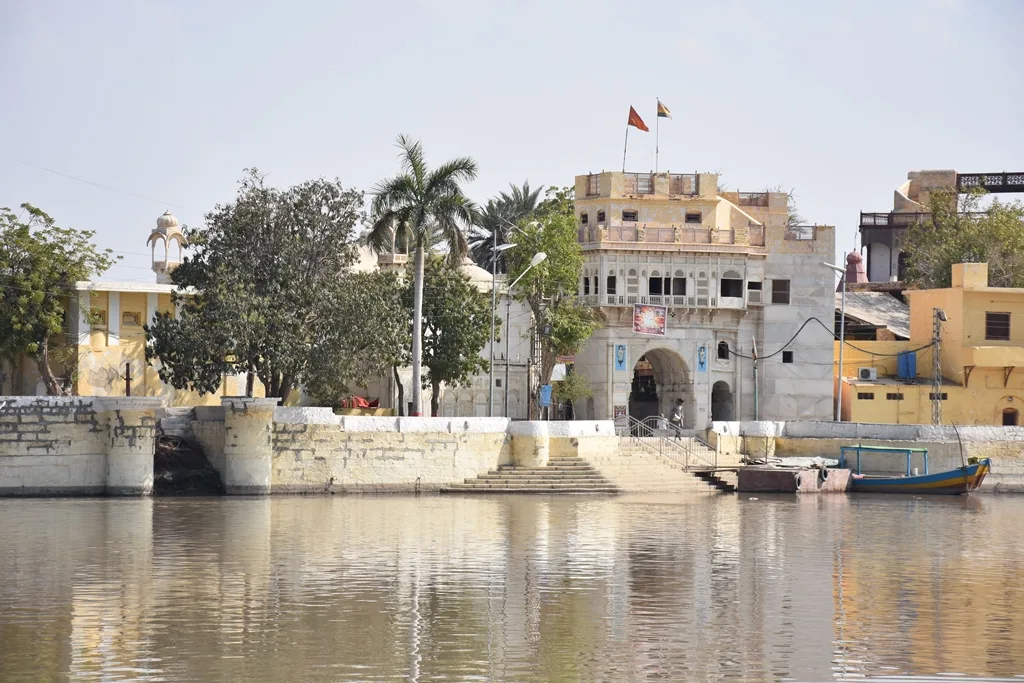
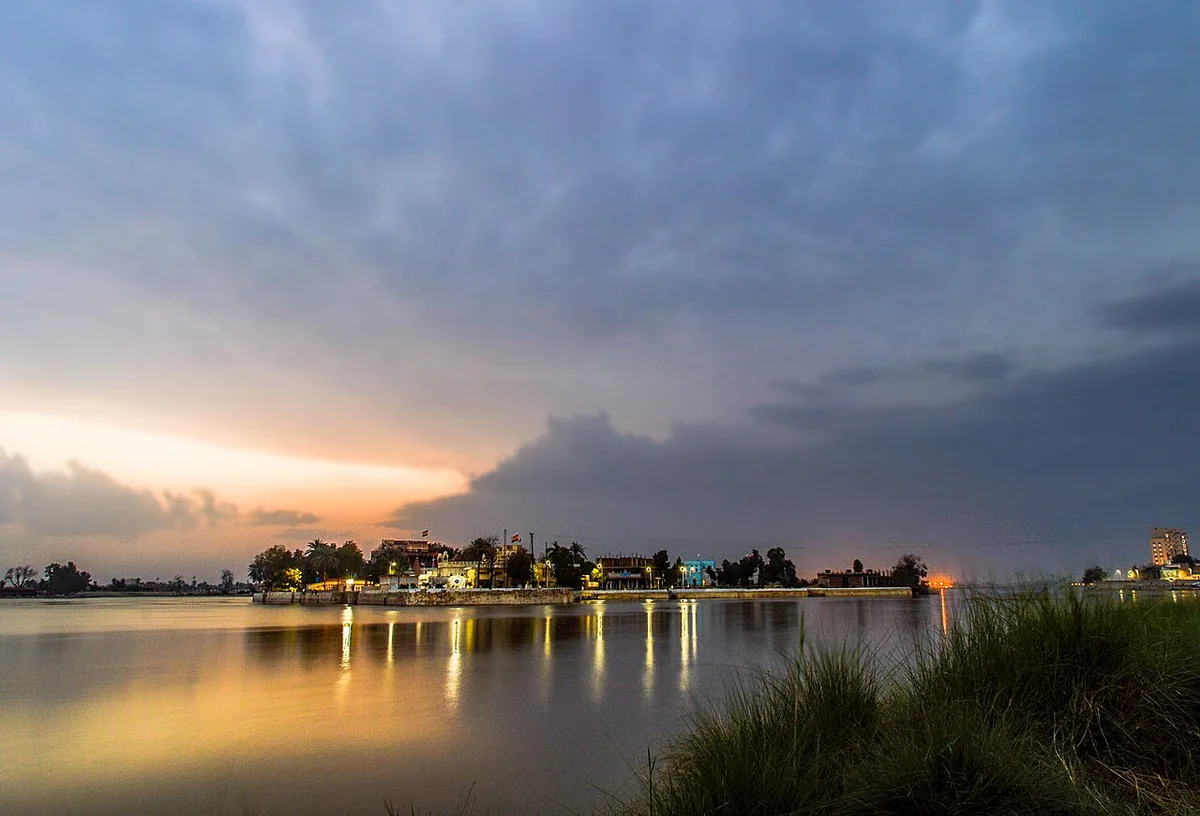
Stand on the Sukkur bank of the Indus in the early morning and look toward the middle of the river. Between the palms you will see a long row of white and buff buildings, small domes, flags on poles and a landing where wooden boats wait. This is Sadh Belo, an island shrine that has been a place of worship for about two hundred years and is often called the largest Hindu temple complex in Pakistan.
In this article (25)
- Sadh Belo Temple Key Facts at a Glance
- Where the Island Sits on the Indus at Sukkur
- The Names Menak Parbat, Sadh Belo and Sadhu Bela
- Baba Bankhandi and the Founding in 1823
- The Kamandal Story and the Free Kitchen
- Who the Udasis Were and Why It Matters
- How the Shrine Grew Under the Mahants
- The Kumbh Mela Leaflet and Big Ambitions
- Architecture of the Sadh Belo Temple Complex
- The White Marble Darbar of Baba Bankhandi
- Jharokas, Arches and Carved Balconies
- Marble Panels of Heaven, Hell and Music
- Temples, Samadhis and the Library
- Partition and the Hard Years After 1947
- Floods, Repairs and Care of the Complex Today
- The Annual Mela of Baba Bankhandi Maharaj
- Visiting Sadh Belo, Permits, Boats and Timing
- Why Sadh Belo Still Matters for Sindh Today
- Frequently Asked Questions about Sadh Belo
- Who founded the Sadh Belo temple in Sukkur?
- When was the main marble darbar built?
- Is Sadh Belo a Hindu or a Sikh shrine?
- Can non Hindus visit Sadh Belo island?
- When is the Bankhandi Maharaj mela held?
- Who looks after the Sadh Belo complex now?
The Sadh Belo temple was not founded by a king or a rich trader. It began with a teenage ascetic who arrived in Sukkur in 1823, lit a sacred fire on a wooded island and stayed for the rest of his life. His followers later built marble halls, temples, a library and kitchens around that fire. Below I go through the island’s past, the Udasi monks who ran it, its marble architecture, what happened to it after 1947, and some tips if you plan to cross over yourself.
Sadh Belo Temple Key Facts at a Glance
| Location | Island in the Indus River between Sukkur and Rohri, Sindh |
| Other names | Sadh Bela, Sadhu Bela, Menak Parbat (older name) |
| Founder | Baba Bankhandi Maharaj, an Udasi ascetic |
| Founded | 1823, when Bankhandi settled on the island |
| Main darbar built | 1889 or 1899 (sources differ), under Sant Harnam Das |
| Tradition | Udasipanth, linked to Baba Sri Chand, son of Guru Nanak |
| Main material | White marble from Rajasthan, with buff sandstone |
| Two islets | Sadh Belo (temples, kitchen) and Deen Belo (samadhis, park) |
| Caretaker today | Evacuee Trust Property Board |
| Main festival | Three day mela for Baba Bankhandi, usually in June |
Where the Island Sits on the Indus at Sukkur
Sukkur sits on the right bank of the Indus and Rohri on the left. In between, the river splits around a few rocky islands. The best known is Bukkur, with its old fort. Sadh Belo lies just downstream of Bukkur, separated from it by a short stretch of water. From the landing at Sukkur the boat ride takes only a few minutes.
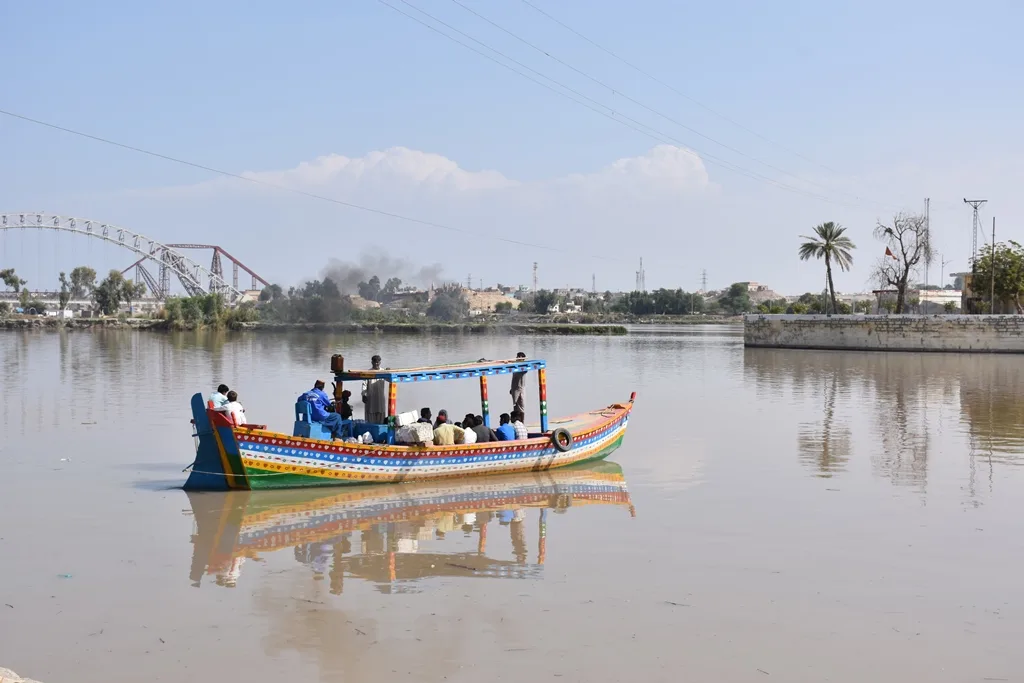
Strictly speaking there are two islets here, joined to each other, and the shrine uses both. According to anthropologist Zahida Rehman Jatt, writing in Dawn, the larger part, Sadh Belo itself, holds the kitchen, verandahs and most of the temples. The smaller part, called Deen Belo, holds the samadhis (memorials) of past heads, a park and the Rishi Nol mandir.
Jatt also describes the view from the boat. On one side she could see the arches of the Lansdowne Bridge, and on the other the island shrine of Zinda Pir Khwaja Khizr. In one short crossing, a visitor passes a railway bridge from the British period, a Muslim shrine and a Hindu temple complex. That mix says a lot about the history of this stretch of river.
How big is the island? Reports give different answers. A 2017 feature in Daily Times and a 2022 report in the Express Tribune both put the temple grounds at about nine acres. Historian Zaffar Junejo, writing in The Friday Times, cites a 1912 survey that gave the whole island a much larger figure. My guess is that the survey measured every bit of sand and shoal around both inlets, while the newspapers only counted the walled temple area.
The Names Menak Parbat, Sadh Belo and Sadhu Bela
Before Bankhandi came, the island was known as Menak Parbat. It was mostly trees and scrub. A temple official told the Express Tribune in 2022 that Menak Parbat is named in the Rig Veda. I could not find a scholar who backs this up, so I would read it as local belief.
The name in use today comes from Sindhi. Sadh means a holy man or ascetic, and belo means a riverside forest. So Sadh Belo is usually explained as “the woods of the sage”. In Urdu and Hindi writing you will often see Sadhu Bela or Sadh Bela, which are the same name in a different spelling.
There is one other story. A 1965 souvenir book on Sukkur, cited on Wikipedia, says the island was named after an Arab commander called Saeed who was once posted there. This version has few supporters, and most writers follow the “woods of the sage” meaning.
Baba Bankhandi and the Founding in 1823
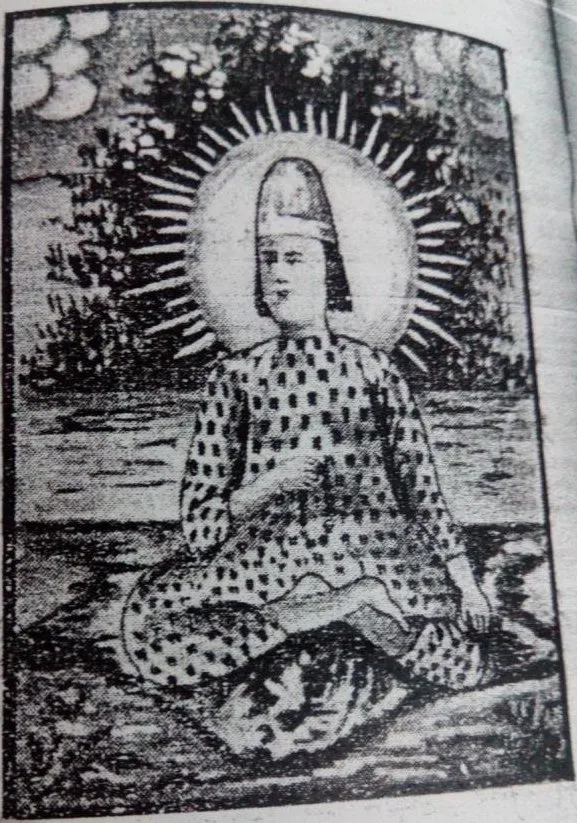
The founder of Sadh Belo was Baba Bankhandi Maharaj. His birth name is given as Balchand Sharma. Dawn and the Express Tribune say he came from Nepal. A Daily Times columnist adds a second option, Kero Khetar near Delhi. Everyone agrees on the year: he reached Sukkur in 1823, at about fifteen years of age.
Sukkur at that time was a busy river town on the trade route of the Indus. Sindh was ruled by the Talpur Mirs, and the area around Sukkur and Rohri was home to many Hindu trading families. You can read more about that period in our article on the Talpur dynasty of Sindh.
The young ascetic chose the empty island and set up his dhuni, the sacred fire that Udasi monks keep burning. He lived there alone for many years. Reports say he died at the age of about sixty, which means he spent most of his life on the island. Local people came to call him the sage of the woods, and the island took its new name from him.
The Kamandal Story and the Free Kitchen
One story about Bankhandi is told at Sadh Belo to this day. It is said that the goddess Annapurna, the Hindu goddess of food and grain, came to him in a dream. She gave him a metal water pot called a kamandal and promised that as long as it stayed in the complex, the kitchen would never run short of grain.
Whatever one makes of the dream, the kitchen is real. The langar at Sadh Belo became famous for feeding everyone who came. Junejo, citing old records, writes that before Partition the shrine served three meals a day to between 900 and 1,000 pilgrims, including about 300 sadhus. A temple to Annapurna still stands on the island, close to the place where the kitchen fires burned.
Who the Udasis Were and Why It Matters
To understand Sadh Belo you need to know a little about the Udasipanth, the order Bankhandi belonged to. The Udasis trace their line to Baba Sri Chand, the elder son of Guru Nanak, founder of the Sikh faith. Sri Chand did not follow the path of the Sikh Gurus who came after his father. Instead he started an order of monks who gave up family life and property.
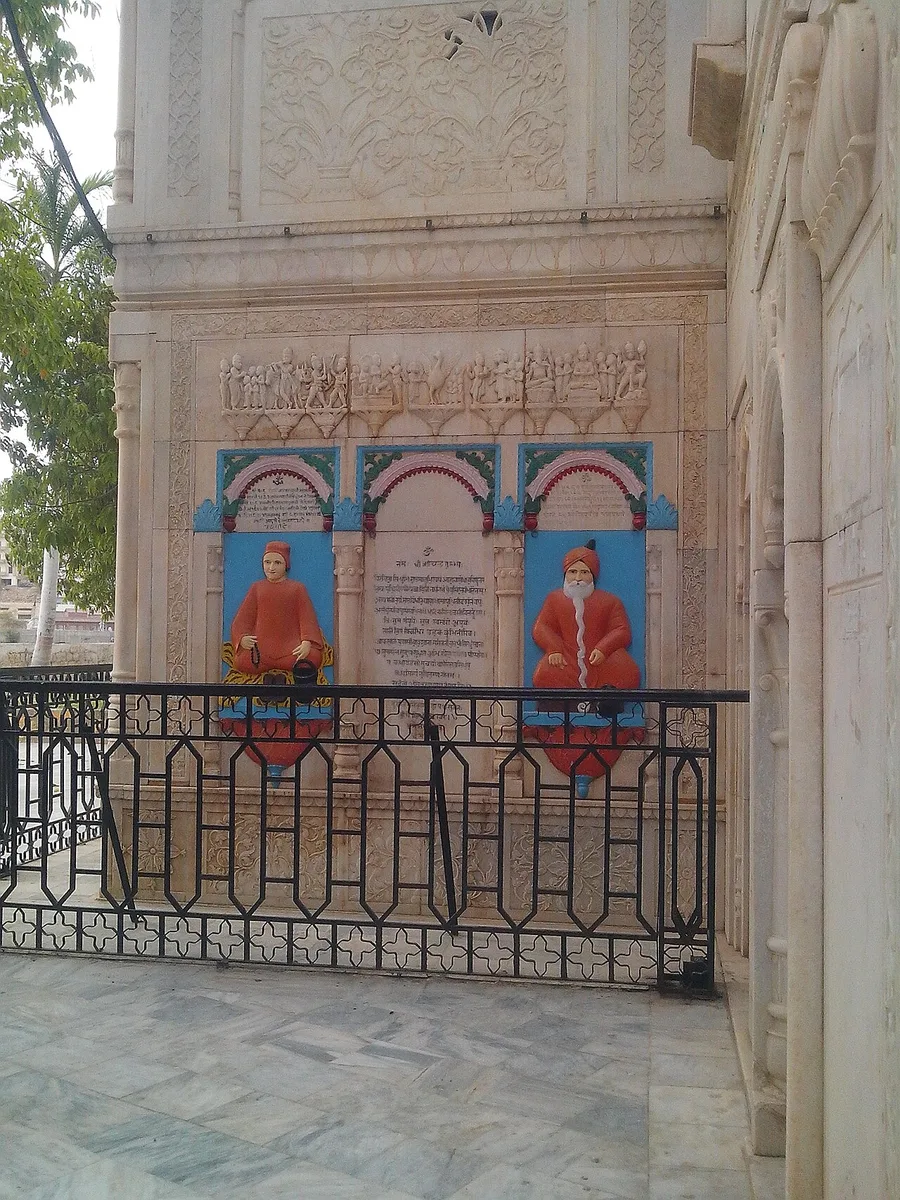
Udasi roughly means someone who has turned away from worldly ties. Udasi monks stay unmarried, live simply and spend their time on yoga, meditation and prayer. Their worship is a blend you will not find in many places. They honour the Guru Granth Sahib, the Sikh holy book, and they also worship Hindu gods such as Shiva, Vishnu, Ganesh and Durga. At Sadh Belo, the shrines hold copies of both the Granth Sahib and the Bhagavad Gita.
For a long time the Udasis were the caretakers of many Sikh gurdwaras in Punjab. They grew strong under Maharaja Ranjit Singh. Late in the nineteenth century, however, the Singh Sabha movement began to argue that Udasi customs had drifted away from Sikh teaching and that the gurdwaras should return to Sikh control. After a long campaign, the Sikh Gurdwaras Act of 1925 placed the gurdwaras of Punjab under an elected committee, and the Udasis lost most of their old role there.
Sindh was different. Here the Udasi centres drew most of their followers from Sindhi Hindu families, and many of them kept going into the twentieth century. Sadh Belo became the most important of them all. When Jatt was doing her research on Udasis across Sindh, the people she met kept asking whether she had been to Sadh Belo yet, because they saw it as the main centre of the order in the province.
How the Shrine Grew Under the Mahants
After Bankhandi died, the island passed to a chain of disciples. Each head was called the gaddi nashin, or the one who sits on the seat. Among the early names, sources mention Swami Achal Prasad, Swami Mohan Das and Swami Harnarain Das Udasin. The eighth head, Sant Harnam Das, is the one most closely linked with the buildings we see today.
Picking a new gaddi nashin is not a casual affair even now. In 2022 the president of the local Hindu Panchayat told the Express Tribune that the person must be honest, devoted and celibate, because he is meant to have nothing to do with worldly life. At that point the eleventh head, Swami Vish Darsh, had just been chosen after the tenth head died in Haridwar, India.
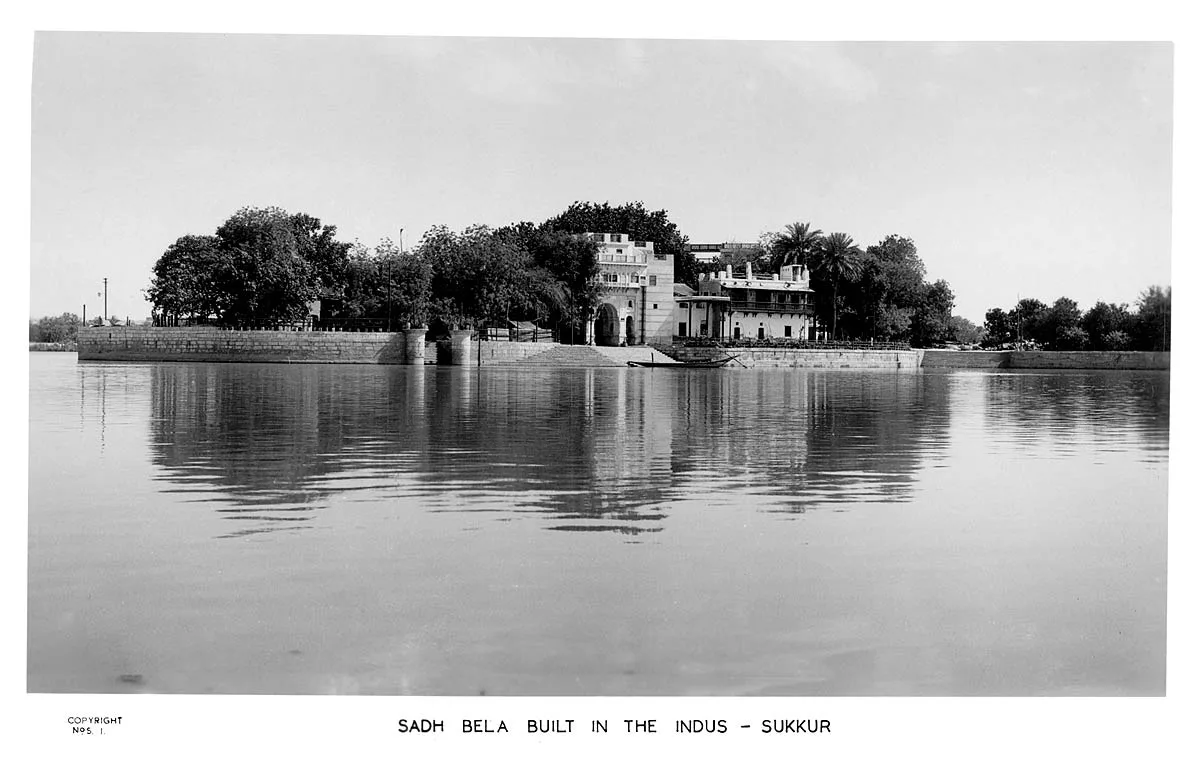
Under the mahants, the island filled up with buildings. There were temples to Annapurna, Hanuman, Ganesh and Shiva, a shrine for Baba Sri Chand, rooms for monks, separate dining halls for men and women, a library and a garden. Monks copied manuscripts in Hindi and Gurmukhi. In the 1940 postcard view above you can make out the trees, the white walls and the low line of buildings sitting right at the water’s edge.
The Kumbh Mela Leaflet and Big Ambitions
One small document shows how confident the shrine had become by the early twentieth century. Junejo describes an undated leaflet titled A Short Account of the Ideas and Growth of Shri Sadhbella Tirth, Sukkur. It argued that a Kumbh Mela should be held at Sadh Belo on the banks of the Indus.
The leaflet claimed that such gatherings had once taken place on the Indus long ago, and that the Indus was a greater river than the Ganges or the Yamuna. It is not clear whether the writers wanted Sadh Belo to replace an existing Kumbh site or to be added as a fifth one. The idea never became reality, but it shows how highly the mahants and their followers rated their island.
Architecture of the Sadh Belo Temple Complex
Most visitors remember Sadh Belo for its white marble. Seen from the river, the main buildings rise straight out of the water on stone platforms. Up close, almost every wall, arch and balcony carries carved detail. The style is close to the temple and haveli architecture of Rajasthan, which makes sense because much of the stone and, according to some reports, the craftsmen came from there.
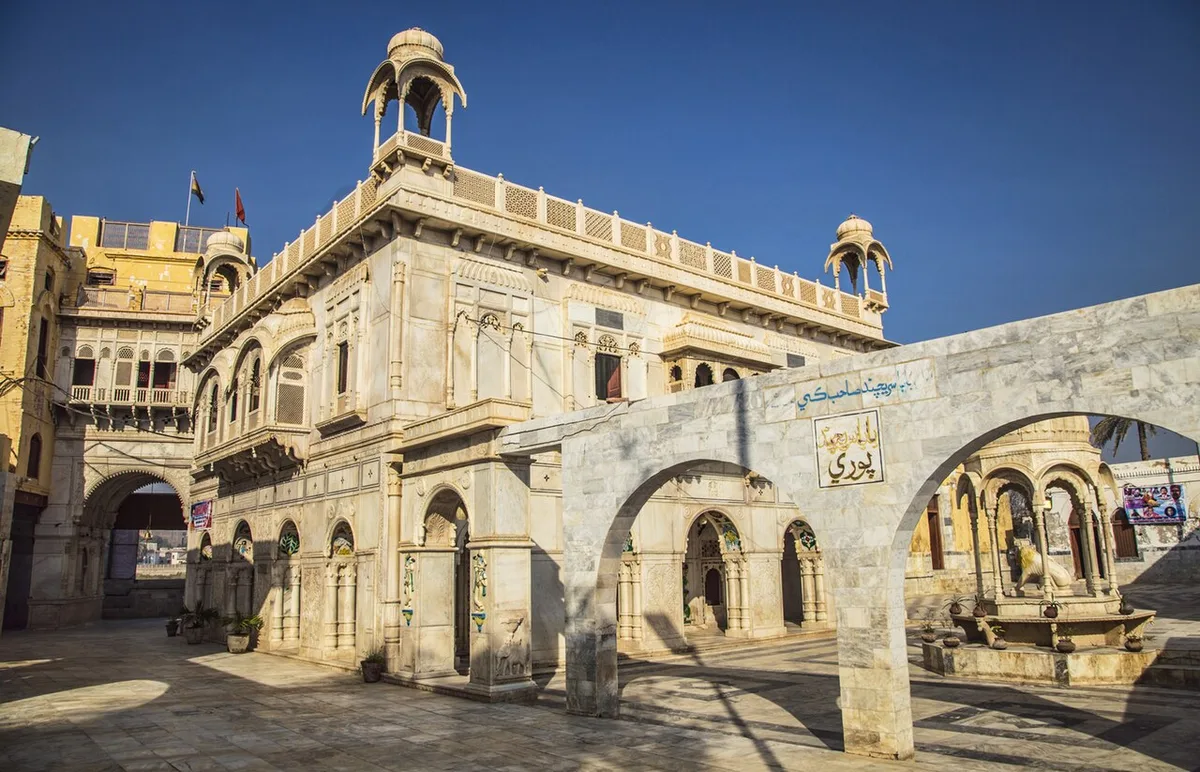
Nobody drew a master plan for Sadh Belo. Each mahant put up the shrine he wanted, in the spot he liked, and the result piled up over a hundred years or so. As a result it feels more like a small walled town than a single temple. Courtyards lead to verandahs, verandahs lead to shrines, and narrow passages open onto views of the river.
The White Marble Darbar of Baba Bankhandi
The centre of the complex is the darbar of Baba Bankhandi, the hall built over the place linked to the founder. Sources disagree on its date. The Express Tribune gives 1899, while Daily Times, Live History India and The Friday Times give 1889. Both dates point to the same builder, Sant Harnam Das.
According to the 2017 description by Shaikh Abdul Rasheed in Daily Times, the darbar is a square building with two archways, one opening to the east and one to the south. It is built of white marble brought from Jaipur in Rajasthan. Rasheed notes that the marble keeps the inside cool even in the fierce Sukkur summer.
Jharokas, Arches and Carved Balconies
The eastern and southern walls of the darbar carry fine jharokas. A jharoka is a projecting balcony with a small roof, carved screens and brackets underneath. In Rajasthan these were used so that people inside could look out without being seen. At Sadh Belo they also catch the river breeze.
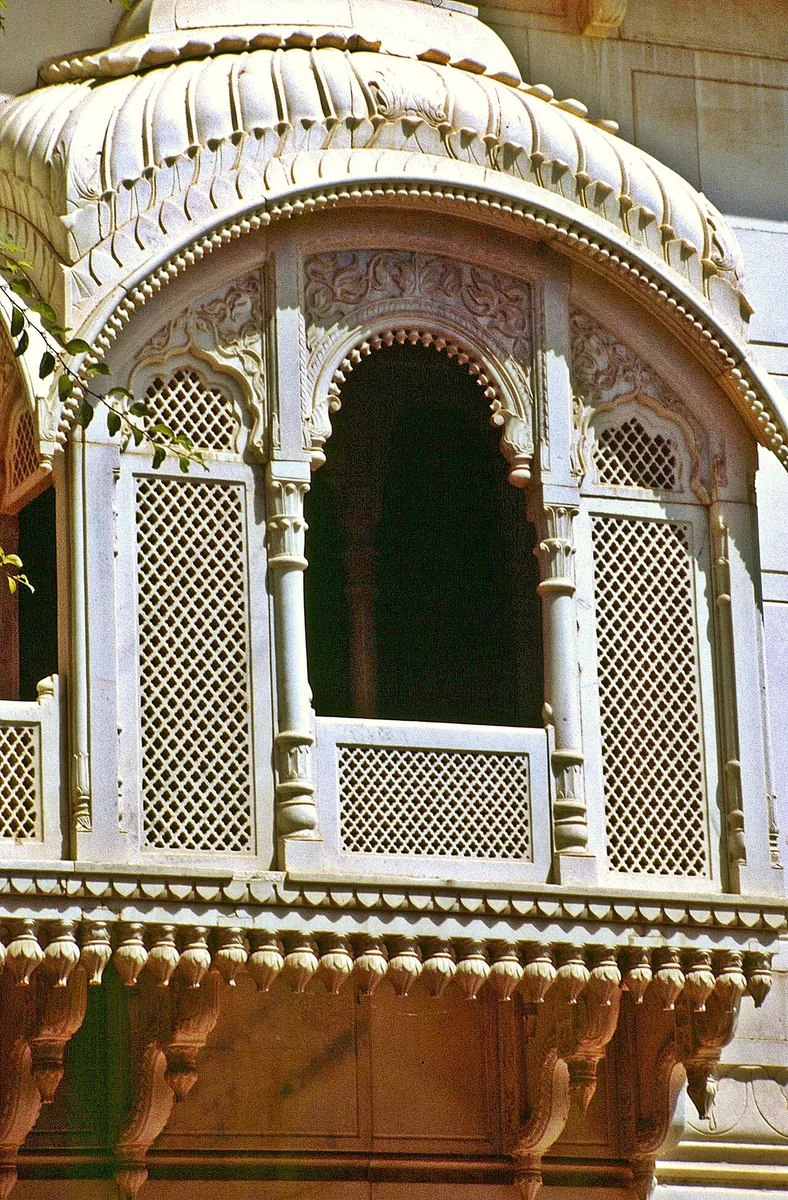
Across the complex you will also see pointed and scalloped arches, slim marble columns and small domed kiosks called chhatris on the rooftops. Some of the woodwork, such as doors and balcony frames, has survived as well. Jatt wrote that the wooden balconies, marble columns and staircases still seem to carry the sounds of the monks who once lived there.
Marble Panels of Heaven, Hell and Music
The most striking pieces of art at Sadh Belo are its carved marble panels. Daily Times counts eight large white panels on the northern and western walls of the darbar, each showing scenes from Hindu belief.
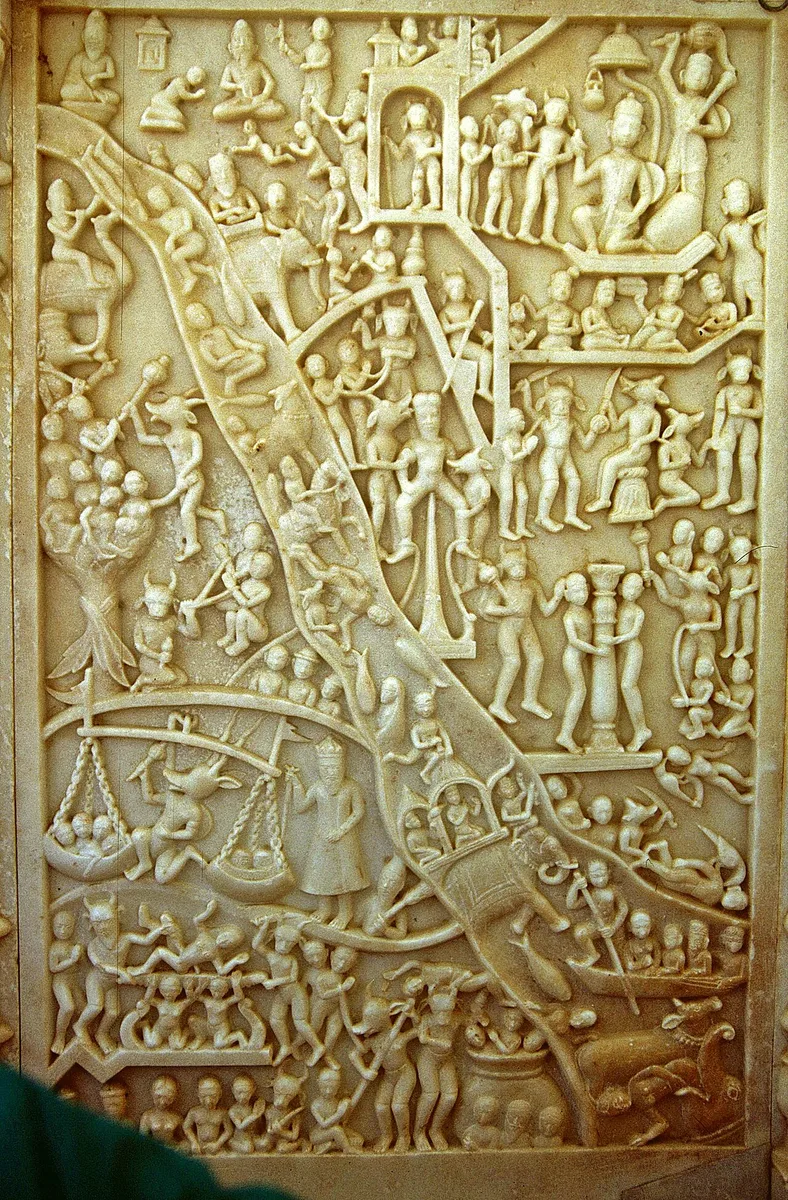
On one slab you see narka, the Hindu hell, with sinners getting their punishment; Junejo counts seven burning levels in it. Next to it is heaven, drawn much more quietly. Above these, three scenes show forms of Vishnu, including Vishnu as a fish saving the holy books from a flood, and Vishnu saving an elephant from a crocodile.
Another panel on the northern wall shows musicians and dancers. The players hold instruments such as the sitar, a bowed string instrument and drums. Below them a woman dances with three musicians playing drum and cymbals. Inside the curve of the southern arch there are small carvings of Krishna dancing, with women around him. These panels give a rare look at how music and dance were shown in Sindhi temple art of the late nineteenth century. Readers who like stone carving may also enjoy our piece on the Chaukhandi tombs and their carving.
Temples, Samadhis and the Library
Besides the darbar, the island holds about eight more shrines. The Daily Times list includes temples to Mata Annapurna, Hanuman, Ganesh and Shiva, a Sri Chand temple, a Rama Pir temple and a group of twelve samadhis. Wikipedia counts nine temples in all. On Deen Belo, the samadhis of past mahants stand in a quiet garden, some under small domed kiosks.
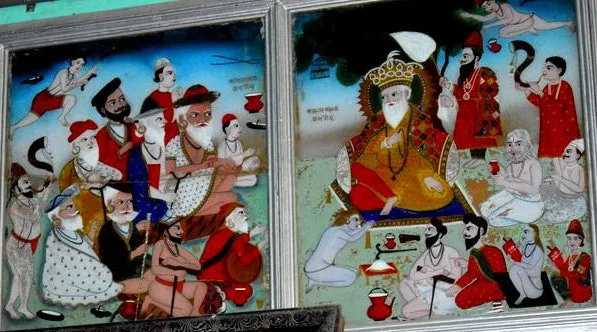
The library once held a large collection of religious books and manuscripts. Paintings hang on its walls, including one showing Guru Nanak in talk with Hindu holy men, which fits the mixed Sikh and Hindu spirit of the Udasis. Jatt went in 2017 and wrote that the books were thick with dust and nobody was reading there.
Partition and the Hard Years After 1947
The golden years of Sadh Belo ended with Partition in 1947. Large numbers of Sindhi Hindus left for India, including many of the monks and the families that had funded the shrine. With the donors gone, money for the kitchen and repairs dried up fast, and far fewer pilgrims made the trip.
Writing in The Friday Times, Junejo sets out a timeline built from newspaper reports and archive papers. He writes that police raided the temple on 19 November 1948, and that cash and valuables were taken and sacred books and images damaged. The mahant at the time, Harmandas, wrote to India’s Ministry of External Affairs about the raid.
Things did not improve in 1949. On 29 May that year a senior monk, Bawa Ganeshdas, wrote to the Indian High Commissioner about falling income. By October he had asked the Sukkur Commissioner to take over the management of the complex, because most of the sadhus wanted to leave for India. An Indian record from November 1949 says that 40 to 50 mahants and sadhus had already left.
A new worry came in February 1953, when a Sukkur official proposed turning Sadh Belo into an art and culture centre with a boat club. Sindhi Hindu groups in Gwalior, Agra, Kanpur, Indore, Delhi and Bombay protested in 1955, asking that the shrine be kept as a place of worship. The plan did not go ahead. The seat of the gaddi nashin moved to the Sadhu Bela ashram at Mahalaxmi in Mumbai, and the head now travels to Sukkur for the yearly festival.
Floods, Repairs and Care of the Complex Today
Since Partition the island has belonged, on paper, to the Evacuee Trust Property Board. This federal board looks after temples, gurdwaras and land left behind by Hindus and Sikhs who went to India. Jatt wrote in 2018 that the board keeps it well, though the old life of the Udasi monks is clearly missed.
Then came the 2010 flood, the worst in living memory along the Indus. According to Daily Times, water broke through a section of the outer wall about 20 feet wide and spread across the island. Buildings and the boundary wall were damaged, and the floors became uneven. Repairs were carried out after President Asif Ali Zardari released funds in 2013.
Floods are a lasting risk for any building in the middle of the Indus. The platforms and thick outer walls of Sadh Belo were made with this in mind, but rising water and silt still need constant watch. For the people who look after the shrine, conservation is not a one time job but a yearly task. Other heritage buildings of Sindh face the same problem, as our report on Kot Diji Fort near Khairpur shows.
The Annual Mela of Baba Bankhandi Maharaj
The biggest event of the year at Sadh Belo is the death anniversary of Baba Bankhandi, held over three days, usually in June. In 2022 it ran from 14 to 16 June and marked the 159th anniversary. Hindu families come from Jacobabad, Shikarpur, Larkana, Karachi and many other towns, and some pilgrims travel from India.
The Express Tribune report from that year gives a clear picture. Pilgrims gather at a camp on the Sukkur bank and buy return boat tickets, which cost Rs 20 for adults and Rs 10 for children in 2022. Normally two motor boats serve the island, but that year organisers hired about 25 to cope with the crowds. Police and divers stood by for safety.
Inside, the Sadh Belo Parbandhak Committee gives free food, water and lodging for the three days. The temple can hold more than thirty thousand people. Families who want privacy can ask for one of the eighty rooms, and whoever turns up first gets one. Everyone else sleeps out in the open, with men on one side and women on the other. Well off devotees bring pots of cooked food, sweet milk and juice to share.
Almost everyone the Tribune reporter met had a reason to be there. A father from Jacobabad hoped to get over a long illness, and a dry dates trader brought two pots of food to thank Baba Bankhandi for a good year. The chants of “Baba Bankhandi Maharaj ki Jai” mix with the name of Jhulelal, the river saint loved by Sindhi Hindus. This blend of faiths is part of the wider Sindhi culture of the region.
Visiting Sadh Belo, Permits, Boats and Timing
Sadh Belo is an active place of worship, not a museum. You cannot just turn up and walk in. Visitors who are not Hindu can usually go, but they are asked to register at the camp on the Sukkur bank first. Reports over the years mention that permission is handled by the local Hindu Panchayat and the temple administration, and some travellers have been turned away on days when the office was closed.
A few practical points help a visit go well:
- Sort out permission first at the camp or office on the river bank, before you look for a boat.
- Go early in the day. The light on the marble is soft in the morning, and the heat is easier to bear.
- Dress modestly and remove your shoes where asked.
- Ask before you photograph anyone at prayer; some shrines do not allow cameras at all.
- Take care on the boats. Do not board an overloaded boat, especially during the June mela.
- Skip the monsoon months of July and August if you can, when the river runs high and fast.
Winter, from November to February, is the most comfortable season. If you are planning a longer trip in upper Sindh, Sukkur and Rohri can be combined with Kot Diji and Khairpur. Lovers of old Hindu merchant buildings may also like our article on Mukhi House in Hyderabad.
Why Sadh Belo Still Matters for Sindh Today
Sadh Belo is important for several reasons. It is one of the few large Hindu religious complexes still in use in Pakistan. It is also a reminder that the Udasi tradition, which joined Sikh and Hindu ideas, once had a strong home in Sindh. And its marble work is among the finest religious art of the British period in the province.
The island also keeps alive a memory that many Sindhis share across the border. Families in India still travel back for the mela, and the head of the order still comes from Mumbai to open it. The poet Elsa Kazi, who lived in Sindh, called it “the islet of delight”, with saints and temples white. For many people in Sukkur, Muslim and Hindu alike, it is simply part of the view from home, sitting in the river as it has for two centuries.
Like the poetry of Shah Abdul Latif Bhittai, the island speaks to a Sindh where different faiths have lived side by side for a long time. If the marble cracks and the library rots, Sindh loses a piece of that story along with it.
Frequently Asked Questions about Sadh Belo
Who founded the Sadh Belo temple in Sukkur?
It was founded by Baba Bankhandi Maharaj, an Udasi ascetic who arrived in Sukkur in 1823 at about fifteen years of age and settled on the island for the rest of his life.
When was the main marble darbar built?
The darbar was built by Sant Harnam Das, the eighth head of the shrine. Some sources give the year as 1889 and others as 1899.
Is Sadh Belo a Hindu or a Sikh shrine?
It belongs to the Udasi order, which traces its roots to Baba Sri Chand, son of Guru Nanak. Its shrines honour Hindu gods and also keep the Guru Granth Sahib, and most of its devotees today are Sindhi Hindus.
Can non Hindus visit Sadh Belo island?
Yes, in most cases, but visitors should register and get permission at the camp or office on the Sukkur bank before taking a boat. During the June mela and on tense days, security is tighter.
When is the Bankhandi Maharaj mela held?
The three day festival for the founder’s death anniversary is usually held in June. Free food and lodging are given to pilgrims during the event.
Who looks after the Sadh Belo complex now?
The Evacuee Trust Property Board manages the site, with help from the local Hindu Panchayat and the Sadh Belo Parbandhak Committee during festivals.

Leave a Comment