

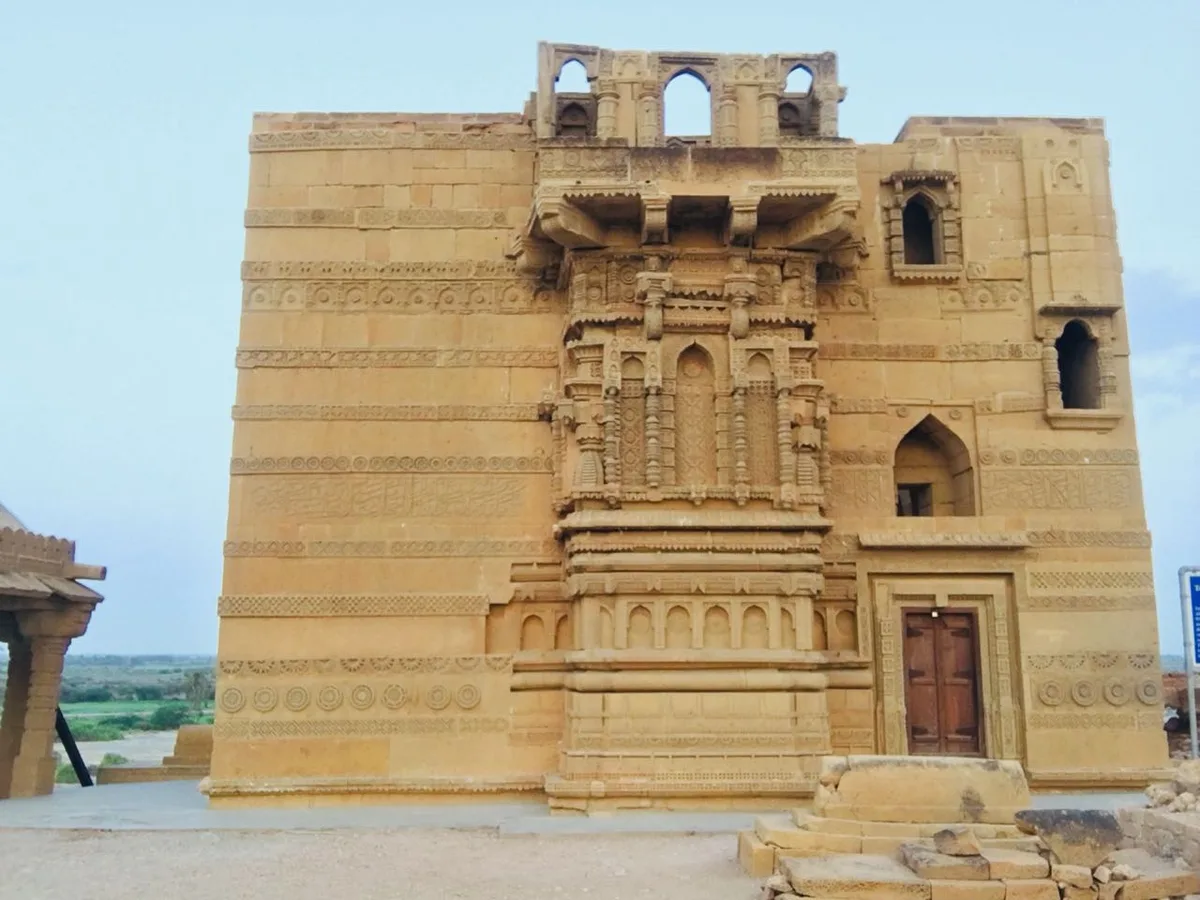
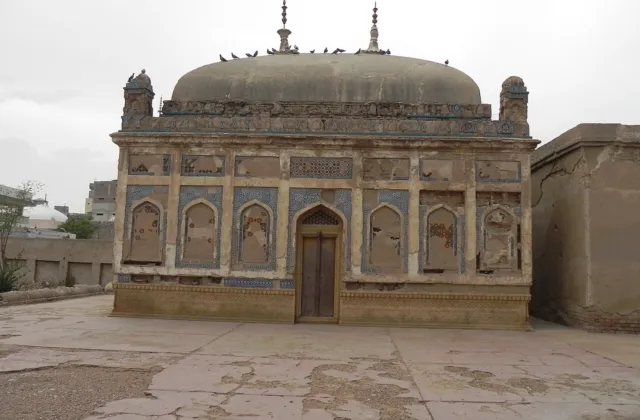
Drive about a hundred kilometres east of Karachi and the road climbs onto a low, dusty ridge covered with tombs. This is Makli Hill above Thatta, and near its northern end stands a square building of yellow stone, carved from top to bottom and open to the sky. It is the grave of Jam Nizamuddin II, the ruler Sindhis still call Jam Nindo, and the best place to start the story of the Samma dynasty.
In this article (26)
- Samma Dynasty Key Facts at a Glance
- Who the Sammas Were and Where They Came From
- How the Sammas Took Power from the Soomras
- Surviving the Delhi Sultans and Firuz Shah Tughluq
- Thatta, Samui and Kalan Kot, the Samma Capitals
- The Fifteenth Century Jams before Nizamuddin
- Jam Nizamuddin II and the Start of His Reign
- Why His Reign Is Called the Golden Age of Thatta
- Peace, Justice and a Ruler Who Disliked War
- Canals, Farming and the Wealth of the Land
- Thatta as a Trading City on the Indian Ocean
- Scholars, Sufis and Learning at the Court
- Darya Khan and the First Arghun Threat
- The Tomb of Jam Nizamuddin at Makli
- Carved Bands, Lotus Medallions and Quranic Text
- The Gujarat Style Balcony on the West Wall
- A Tomb That Was Never Roofed
- Succession War and the Fall of the Sammas
- The Samma Legacy in Sindhi Poetry and Memory
- Why Jam Nizamuddin Still Matters for Sindh
- Frequently Asked Questions about the Samma Dynasty
- Who founded the Samma dynasty of Sindh?
- Who was Jam Nizamuddin II or Jam Nindo?
- Where is Jam Nizamuddin buried?
- How did the Samma dynasty come to an end?
- What does the title Jam mean in Sindh?
The Sammas ruled lower Sindh for close to two centuries, from the fall of the Soomras in the fourteenth century to the Arghun invasion in 1520. Their most famous Jam reigned for almost fifty years, and his time is still described in Sindh as a golden age of Thatta. In this article I look at where the Sammas came from, how they survived the Delhi sultans, what made Jam Nizamuddin’s reign special, how the dynasty ended, and what it left behind in stone, trade and poetry. Where the old chronicles disagree, and they often do, I say so.
Samma Dynasty Key Facts at a Glance
| Ruled | Lower Sindh, at times up to Bhakkar, Sehwan and parts of Kutch |
| Began | About 1335 or 1351 (sources differ), under Jam Unar |
| Ended | Thatta taken by Shah Beg Arghun in December 1520 |
| Capital | Samui below Makli Hill, then Thatta |
| Royal title | Jam |
| Greatest ruler | Jam Nizamuddin II (Jam Nindo), December 1461 to 1508 or 1509 |
| Main port | Lahori Bandar in the Indus delta |
| Best known monument | Tomb of Jam Nizamuddin II, Makli (UNESCO World Heritage, 1981) |
| Followed by | Arghuns, then Tarkhans, then Mughal governors |
Who the Sammas Were and Where They Came From
The Sammas were one of the oldest and largest tribes of the lower Indus. They already appear in the Chach Nama, the account of the Arab conquest, among the local people who met Muhammad bin Qasim in the eighth century. You can read about that period in our article on Muhammad bin Qasim and the conquest of Sindh.
Later writers gave the tribe many family trees. Historians at Akbar’s court said the Sammas claimed descent from Jamshid, the legendary king of Persia, and that their title Jam preserved that memory. A Sindhi chronicle of 1767 offers Arab forefathers instead. Then, in the 1800s, British officers like James Tod pinned them to Krishna’s Yadava clan. None of these stories can be proven. What we can say with some confidence is that the Sammas were a local Sindhi people, Muslim by the time they took power, and closely tied to the Suhrawardi Sufi saints of Uch and Multan.
The family also spread beyond Sindh. The Jadeja rulers of Kutch and the Jam Sahibs of Nawanagar in Gujarat traced their origin to the Sammas. That link helps explain why Samma politics was always tangled up with Kutch and Gujarat.
How the Sammas Took Power from the Soomras
Before the Sammas, lower Sindh was held by the Soomra dynasty, who ruled under the loose authority of the Delhi Sultanate. In the 1330s and 1340s Soomra power was weakening, and the Sammas moved into the gap.
We have one eyewitness from those years. The Moroccan traveller Ibn Battuta reached the Indus in September 1333 and, at Sehwan, saw the end of a revolt led by a chief he calls Wunar, who was given the title Malik Firuz. Was this Wunar our Jam Unar, the first Samma king in the chronicles? The Indian scholar S. H. Hodivala said yes. Others doubt it. The translator H. A. R. Gibb left the question open.
The year the dynasty began is also uncertain. Some scholars put it around 1335 or 1336. The eighteenth century Tuhfat al Kiram gives 1351, the year Sultan Muhammad bin Tughluq died on the Indus near Thatta while campaigning in Sindh. The trouble is that the chronicles give the length of each reign but very few fixed dates, so every list has to be rebuilt by working backwards.
Surviving the Delhi Sultans and Firuz Shah Tughluq
The biggest test for the young dynasty came in the 1360s, when the Delhi sultan Firuz Shah Tughluq marched against Thatta twice. Our best account comes from the court writer Shams i Siraj Afif, whose father was on the campaign.
According to Afif, Firuz brought about 90,000 cavalry and 480 elephants down the Indus. Famine and sickness among the horses weakened the army, and the Sindhis seized many of the Delhi boats. Firuz pulled back towards Gujarat, and his guides led the army into the Rann of Kutch, where it was lost for so long that no news reached Delhi for six months. People in Thatta joked that one sultan had already died chasing them and another had now run away from them.
Firuz came back after refitting in Gujarat. This time the Sammas, short of food, asked for peace through the Sufi saint Sayyid Jalaluddin Bukhari of Uch. They paid four lakh tankas and promised tribute. Two Samma leaders were taken to Delhi, where they lived in comfort, but members of the family stayed in charge at Thatta. Afif also notes that both armies in this war were Muslim, which tells us the Sammas had accepted Islam well before some later writers claimed.
Real independence came at the end of the century. When Timur’s armies took Multan and Uch in 1397 and 1398, the Delhi Sultanate broke apart. After that, as the chronicle Tarikh i Masumi puts it, Sindh “remained subject to its own kings”.
Thatta, Samui and Kalan Kot, the Samma Capitals
The first Samma seat was at Samui, at the foot of Makli Hill, a few kilometres from today’s Thatta. Later the court settled in Thatta itself. One chronicle credits Jam Nizamuddin with founding Thatta, but that cannot be right as it stands, because Barani and Afif already name Thatta as the seat of the Jams in the 1350s and 1360s. It is more likely that Jam Nizamuddin rebuilt or enlarged the city.
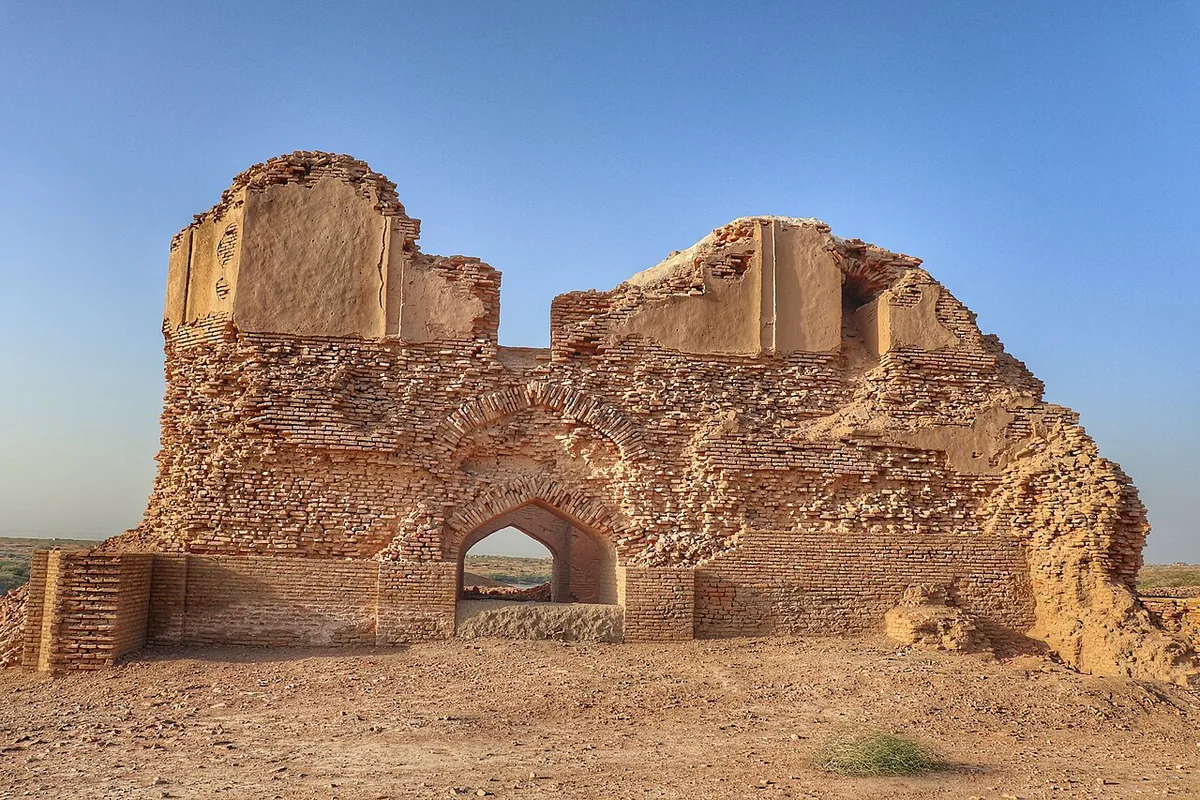
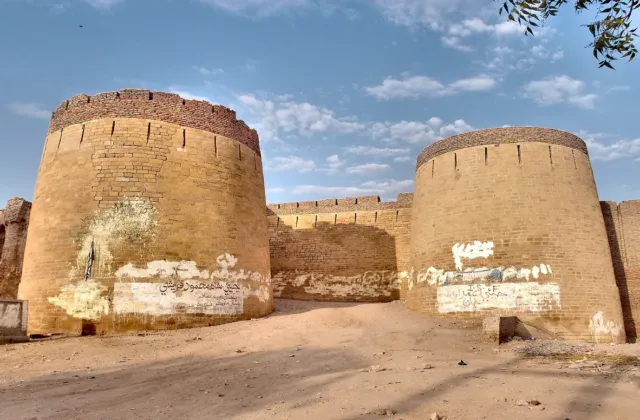
South of Thatta lie the ruins of Kalan Kot, a large fort of brick and stone. Sources used by the historian H. M. Elliot link it with a Samma fort called Tughluqabad. Today its broken walls and arches stand above a small lake, and they are one of the few places where you can still see the outline of Samma military building outside Makli.
The Fifteenth Century Jams before Nizamuddin
For most of the fifteenth century the Samma rulers are known to us as little more than names and reign lengths. Jam Tughluq, for example, ruled for about twenty eight years, put his brothers in charge of Sehwan and Bhakkar, and punished Baloch raiders in the north. Other reigns were very short. One Jam held the throne for a day and a half, and a chamberlain named Mubarak ruled Thatta for three days before he was pushed out.
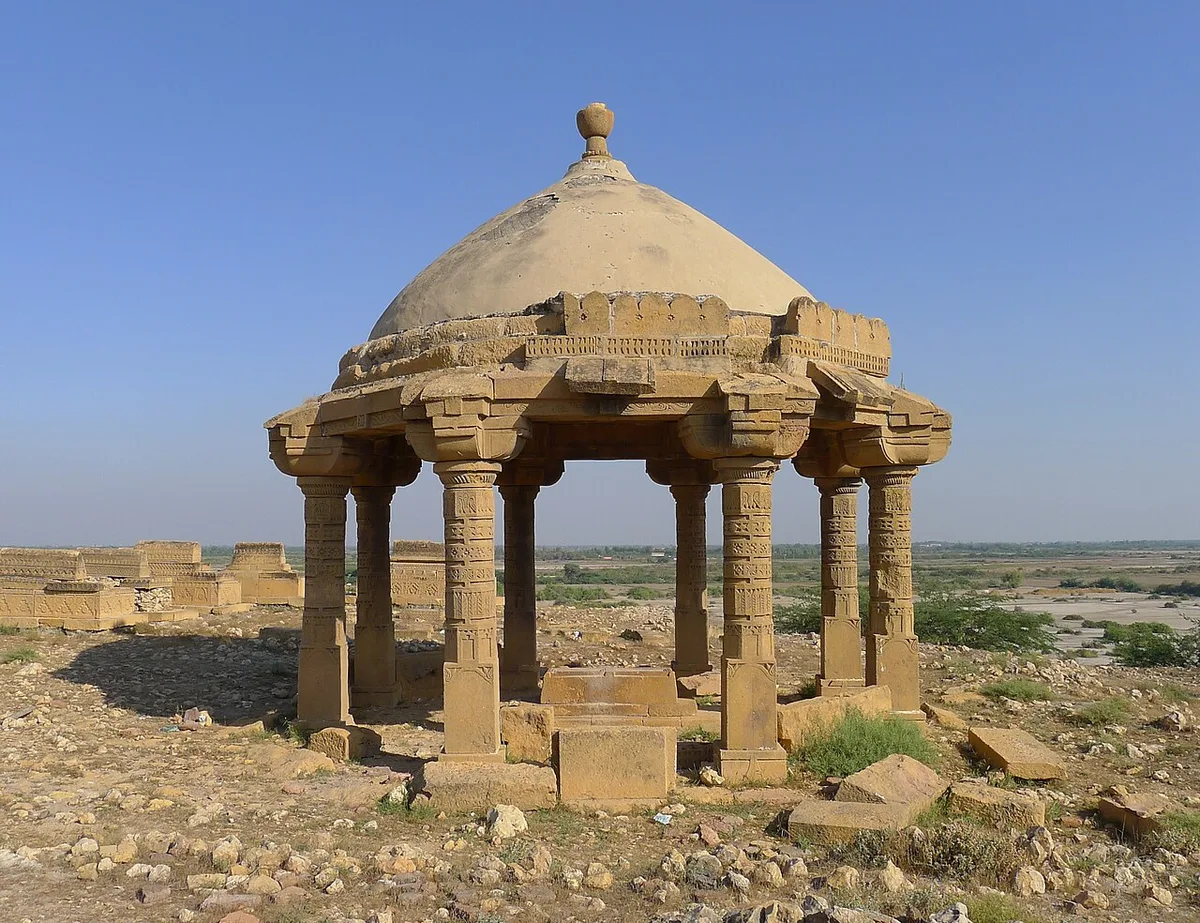
Two things stand out from these years. The Sammas built friendly ties with the new Sultanate of Gujarat, and they began burying their dead on Makli Hill in tombs that mixed local stone carving with Islamic forms. Small canopy tombs, with a dome resting on carved pillars, are typical of this early Samma style.
The rulers just before Nizamuddin are remembered kindly. The chronicles say Jam Sanjar, who ruled for about eight years, gave alms every Friday and raised the pay of his officials. One story tells how he summoned a judge of Bakhar who took bribes from both sides in every case. The qazi owned up at once, and complained that he sat in court all day while his wife and children went hungry at home. Sanjar burst out laughing, then doubled down on the fix: a raise for the qazi and better pay for every important post in the kingdom.
Jam Nizamuddin II and the Start of His Reign
Jam Nizamuddin II, known in Sindhi as Jam Nindo or Jam Nanda, came to the throne in December 1461. The Tarikh i Masumi gives the exact date as the 25th of Rabi al Awwal in the year 866 of the Hijri calendar, and says he was chosen by agreement of “the learned and the good, the soldiers and the peasants”. Before he became ruler he had been a student who spent much of his time in colleges and Sufi lodges.
His first act as Jam was to lead an army north to Bhakkar, where he stayed for about a year clearing the roads of robbers who had been troubling traders and villagers. After that, by most accounts, he ruled from Thatta for more than four decades. UNESCO gives his reign as 1461 to 1509, while other writers end it in 1508. The chronicles disagree even more, giving him anything from 32 to 73 years on the throne, so the shorter modern figures are the safer ones to use.
Why His Reign Is Called the Golden Age of Thatta
It is easy to repeat the phrase golden age without asking what it means. For Jam Nindo I would point to three things you can actually check in the sources: decades without a major war, a cloth and shipping trade that reached Hormuz, and a court where scholars were welcome.
Peace, Justice and a Ruler Who Disliked War
Battles are rare in the chronicle pages for these years. One well known story in the Tarikh i Masumi has the Jam visiting his stables, stroking his horses and telling them he had no wish to ride them into battle, because all the rulers around his borders were Muslims and there was no reason to fight them. The scholar Annemarie Schimmel called him “the most enlightened” of the Jams.
Still, a pinch of salt helps. Writing in Dawn in June 2026, the researcher Masood Lohar points out that chronicles and folklore often praise rulers more warmly when hard times follow them, and the Sammas did fall soon after Nindo’s death. Even so, he notes that Jam Nindo’s good name has stayed unusually steady across centuries of Sindhi memory.
Canals, Farming and the Wealth of the Land
A strong state in Sindh always depended on water. A study of the Tarikh i Masumi by Humera Naz in the journal Pakistan Perspectives notes that the Samma rulers paid close attention to farming. Under Jam Nizamuddin, his commander Darya Khan and a Hindu minister named Chagla were sent to the Sehwan area to dig a canal called the Saavi, which watered the lands of the Gaha tribe.
I find this one line more telling than any praise poem. It shows a court that trusted a Hindu official with a major public work, and a ruler who understood that his revenue came from fields as much as from ports.
Thatta as a Trading City on the Indian Ocean
The historian Sanjay Subrahmanyam, in his study of the Portuguese, Thatta and the external trade of Sind, writes that the fifteenth century saw a real growth in farming and manufacturing in lower Sindh. Thatta became a centre of cloth making, using raw cotton brought down the river from the Bhakkar area. He also notes that Samma territory was at its widest under Jam Nanda.
Goods left Sindh through Lahori Bandar, the port in the Indus delta, and most of them went west to the great trading island of Hormuz in the Persian Gulf. By the 1540s, a few decades after the Sammas fell, Portuguese records show that trade from Sindh made up about 7 to 10 percent of the customs income at Hormuz. The Portuguese chronicler Diogo do Couto, describing Thatta in the 1550s, called it one of the largest and richest cities of the East. That wealth was built on the trade networks that grew up in the Samma period.
Scholars, Sufis and Learning at the Court
Jam Nindo enjoyed the company of scholars. The Tarikh i Masumi says he spent much time discussing questions of science and religion with learned men. A famous teacher from Shiraz, Maulana Jalaluddin Muhammad, planned to move to Thatta. He died before he could travel, but some of his students settled there.
Sufis were part of this world too. Saints such as Shaikh Hammad Jamali and Shaikh Isa Langoti lived and taught in Thatta in the Samma period, and both are linked with early Persian verse in Sindh. Power in Samma Sindh needed the blessing of these holy men as much as it needed an army.
Darya Khan and the First Arghun Threat
The most important man at Jam Nindo’s court, after the Jam himself, was Darya Khan. His early life is told in different ways. The Tarikh i Tahiri says he came to the court as a slave boy named Kabula, that the Jam raised him, gave him the title Mubarak Khan and loved him more than his own children. In the Tuhfat al Kiram the two names belong to one man, the Jam’s adopted son; Firishta, writing in the Deccan, splits them into two people.
Late in Nindo’s reign, trouble came from the northwest. Shah Beg Arghun, ruler of Kandahar, sent an army that raided villages around Sibi. Darya Khan led the Samma army against it and won a clear victory. Shah Beg’s brother, Abu Muhammad Mirza, was killed, and according to the Tarikh i Masumi no further attack was made on Sindh during Jam Nizamuddin’s lifetime.
The Tomb of Jam Nizamuddin at Makli
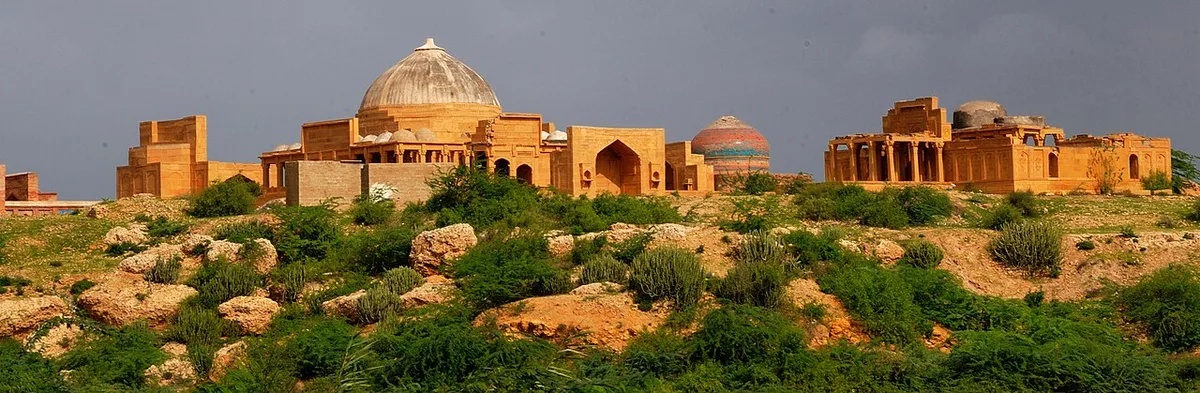
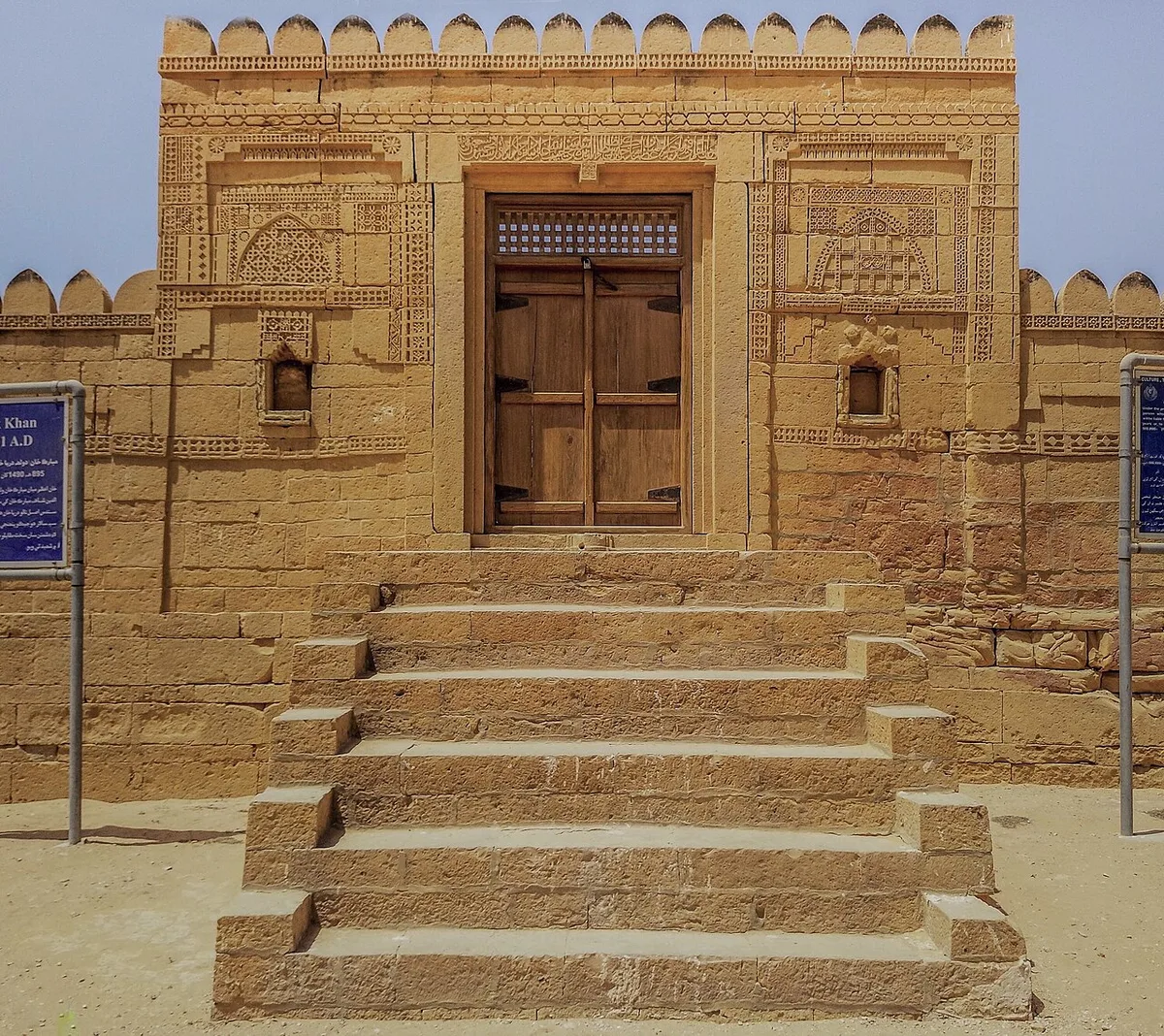
When Jam Nindo died, around 1508 or 1509, he was buried on Makli Hill. His tomb is now the signature building of the Samma dynasty and one of the most admired monuments in Sindh. Our full guide to the Makli Necropolis covers the rest of the hill.
UNESCO added the Historical Monuments at Makli to the World Heritage List in 1981. Its official listing describes about half a million tombs and graves spread over roughly 10 square kilometres, and names the tomb of Jam Nizamuddin II among the outstanding stone monuments of the site.
Carved Bands, Lotus Medallions and Quranic Text
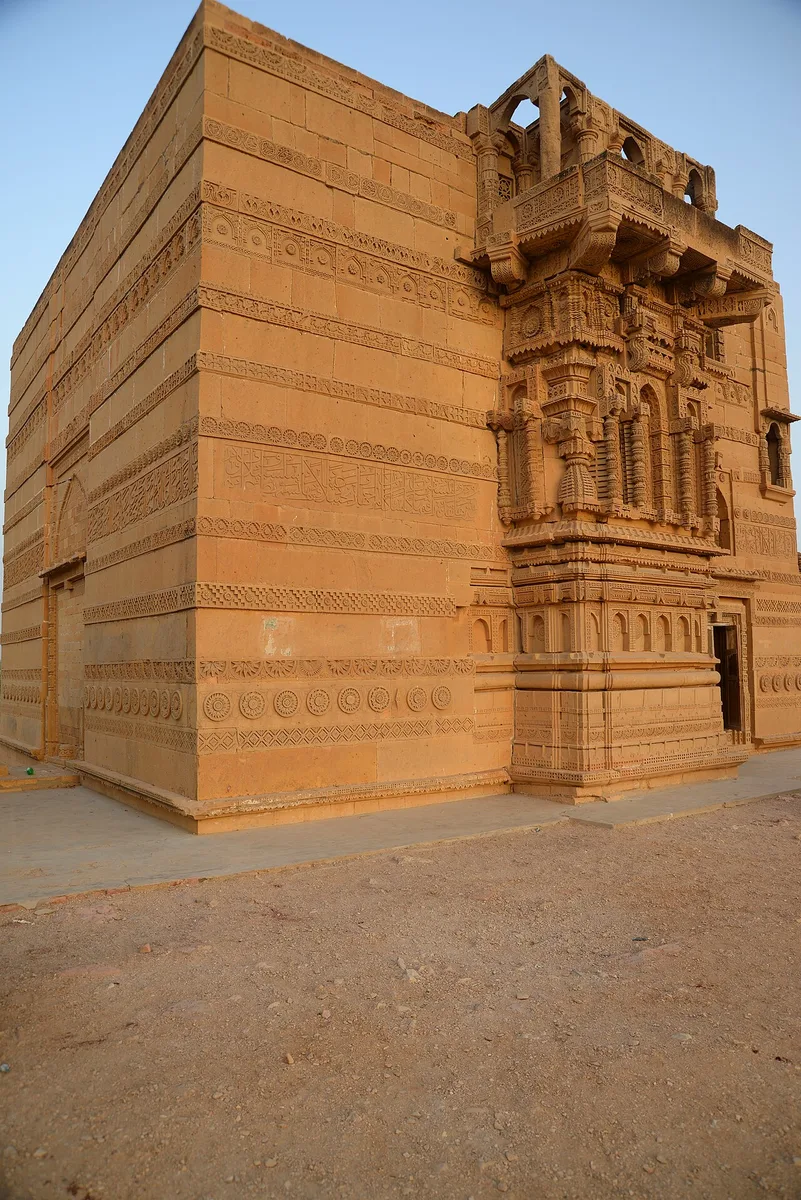
The tomb is square, built of local yellow sandstone. A 2025 report by the Sindh government to UNESCO gives its size as about 11.2 by 11.3 metres and its height as about 8.5 metres. The archaeologist Henry Cousens, writing in 1929, counted twelve bands of carving running around the outside walls. They include diamond shapes, lotus flowers, geometric patterns and lines of Quranic text.
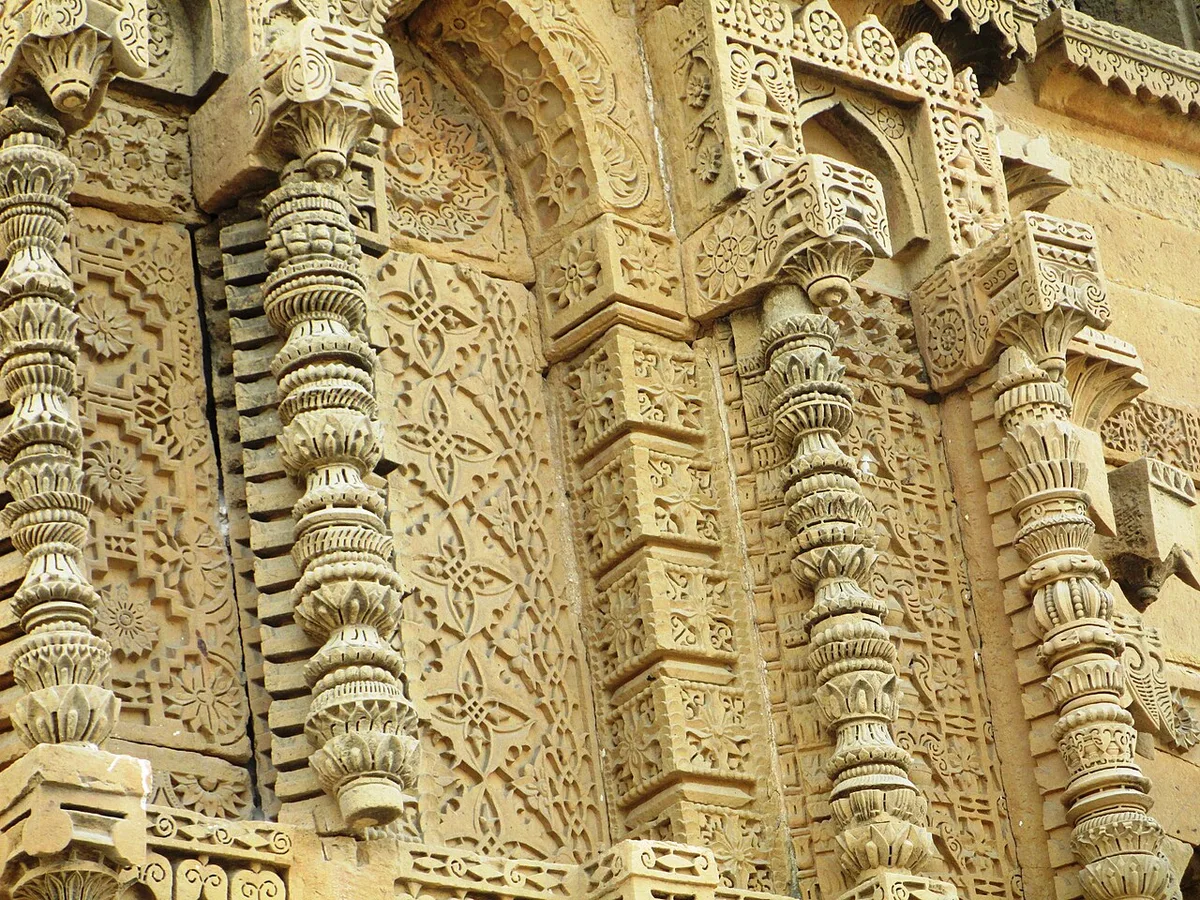
Stand close to the wall and the effect is almost like woven cloth. The carvers repeated small motifs again and again, but changed the rhythm from one band to the next, so the eye keeps moving up the wall. Similar thinking in stone can be seen later at the Chaukhandi tombs near Karachi.
The Gujarat Style Balcony on the West Wall
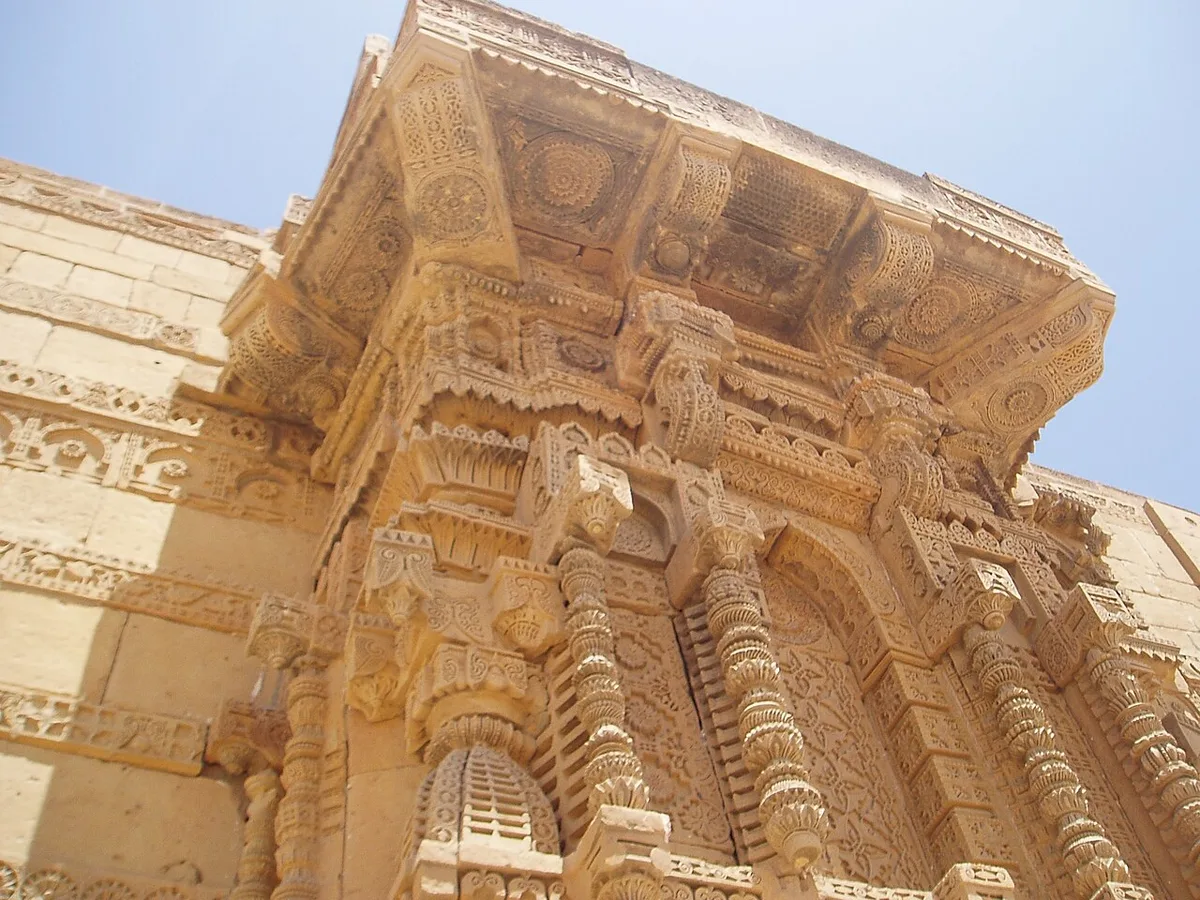
The most famous feature is a carved balcony that projects from the west wall, directly behind the mihrab inside. Its brackets, small pillars and little roof are very close to what you see in the Hindu temples of Gujarat. ICOMOS, reporting to UNESCO in December 1980, saw obvious links to Gujarat but added that it was “in no way a question of simple copies”. Many scholars believe craftsmen from Gujarat worked on it.
A Tomb That Was Never Roofed
Step inside and you look straight up at the sky. Carved arches in the corners turn the square room into an octagon, as if ready to carry a dome, but no roof was ever built. Cousens believed a dome was planned and that work simply stopped. The Sindh government report of 2025 says otherwise; in its view these walls could never have held up the weight of a masonry dome, and the masons knew beams better than vaults. Another view links the unfinished state to the political trouble that followed the Jam’s death.
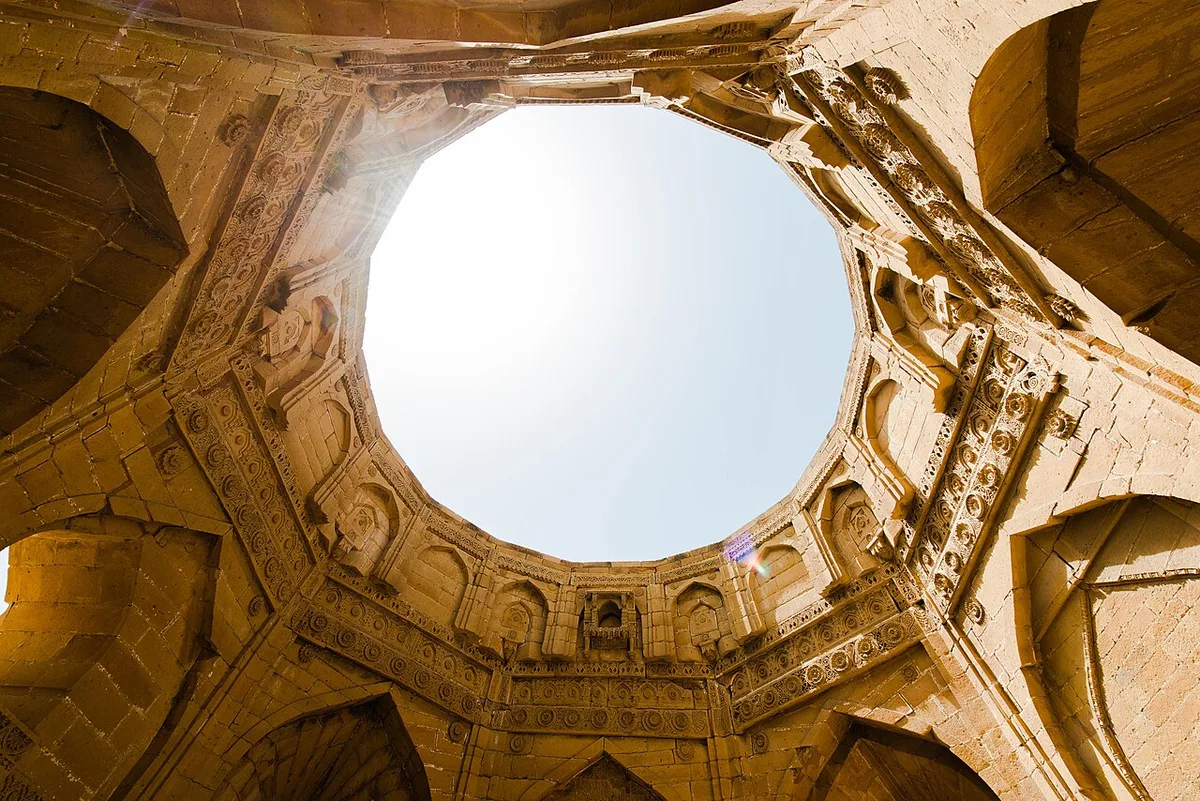
The tomb is also at risk. Its walls have cracks and lean because the slope beneath it is eroding. UNESCO’s committee warned in 2016, 2017 and 2019 that Makli could be placed on the List of World Heritage in Danger, mainly because of this tomb. It was never put on that list, but crack monitors have been fitted and the main crack was still active in 2025.
Succession War and the Fall of the Sammas
Jam Nindo’s son, Jam Firoz, was still young when his father died. A cousin, Jam Salahuddin, claimed the throne and turned to Sultan Muzaffar of Gujarat, who was related to him by marriage. Darya Khan placed Firoz on the throne, but Firoz soon left the work of government to others. Salahuddin returned with Gujarati troops and held Thatta for about eight months before Firoz came back.
Meanwhile Shah Beg Arghun, pushed out of Kandahar by Babur, needed new land. In December 1520 his army crossed the Indus near Thatta at a ford shown to them by a local man. In the battle that followed on the Khanwah canal, Darya Khan was killed, and Thatta was plundered for days. Sindhi writers later hid the date in a riddle. The Persian words Kharabi i Sind, the ruin of Sind, add up to 927 when each letter is given its number value, and 927 AH is the year Thatta fell.
Firoz first submitted and was allowed to rule part of lower Sindh under the Arghuns. When Shah Beg died in 1522, Firoz rose again, was defeated by Shah Beg’s son Shah Husain, and fled to Gujarat. He lived on at the Gujarat court and, according to the Cambridge History of India, was killed by Mughal troops in 1535. With him the line of the Samma Jams came to an end. Thatta passed to the Arghuns, then to the Tarkhans, and from 1592 to Mughal governors, who later built the Shah Jahan Mosque in the city.
The Samma Legacy in Sindhi Poetry and Memory
The Sammas live on most warmly in poetry. Two of the great romances that Shah Abdul Latif Bhittai retold in his Risalo are set among Samma rulers.
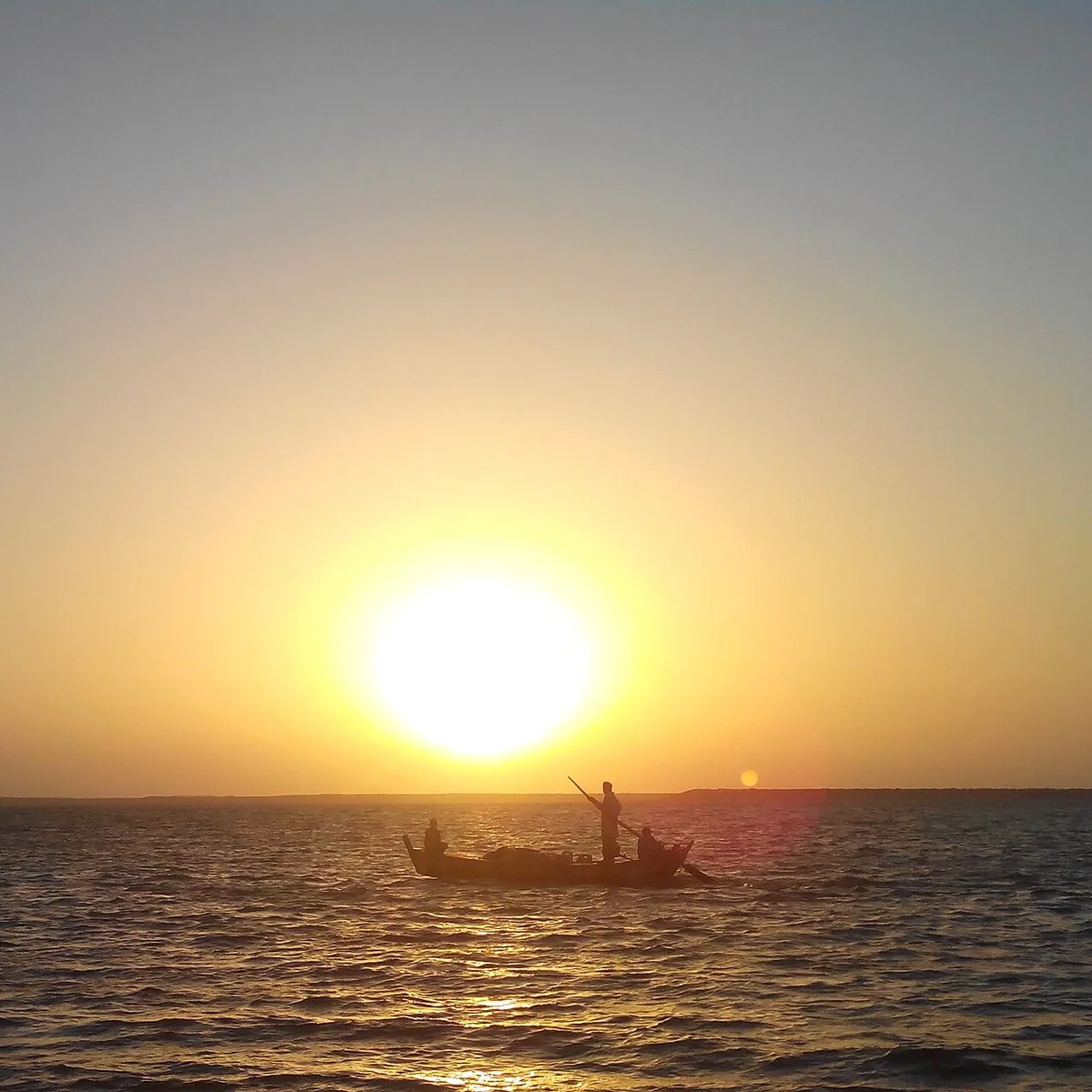
In the story of Noori and Jam Tamachi, a Samma prince falls in love with Noori, a fisherman’s daughter from Keenjhar Lake near Thatta, and makes her his queen. Shah Latif tells it in Sur Kamod, where the poor fisher girl who never boasts ends up loved above the proud ladies of the palace. Visitors to Keenjhar today are still shown a shrine in the lake linked with her name. The story of Lila and Chanesar, in which a queen trades her husband’s love for a necklace, was dated by Schimmel to the time of a Samma ruler called Jam Chanesar. Schimmel also mentions a tradition that Shaikh Hammad Jamali recited a Sindhi verse in praise of Jam Tamachi, which would place the first known Sindhi verse around 1375.
There is also a quieter legacy. Masood Lohar links the trading world of Samma Thatta with the rise of new merchant communities in Sindh and Gujarat. And the Samma name itself survives in many Sindhi families today, from Samo families across Sindh to the Jadeja houses of Kutch.
Why Jam Nizamuddin Still Matters for Sindh
Look at Jam Nindo’s Sindh and you see a local king running his own state from Thatta, sending cloth by sea to Hormuz, beating back an army from Kandahar, and paying carvers to build in a style found nowhere else. It was a period when a Hindu minister could dig a canal for a Muslim ruler, when scholars from Persia wanted to move to the Indus delta, and when Sufi saints and kings shared the same hill of tombs.
The stone tomb on Makli Hill is the most direct record of that time we still have. And it is cracking. If you visit Thatta, give the tomb more than a quick photograph. Walk around all four sides, look at how each band of carving changes, and then step inside to look up at the open sky where the roof was never built.
Frequently Asked Questions about the Samma Dynasty
Who founded the Samma dynasty of Sindh?
The chronicles name Jam Unar as the first Samma ruler. He took power from the Soomras some time between about 1335 and 1351. Nobody has settled the exact year.
Who was Jam Nizamuddin II or Jam Nindo?
He was the most famous Samma ruler, who came to the throne in December 1461 and ruled from Thatta until about 1508 or 1509. His reign is remembered for peace, trade and learning.
Where is Jam Nizamuddin buried?
He is buried on Makli Hill near Thatta, in a square carved stone tomb that is part of the UNESCO World Heritage Site of Historical Monuments at Makli.
How did the Samma dynasty come to an end?
Shah Beg Arghun took Thatta in December 1520 after a battle in which Darya Khan was killed. The last Jam, Firoz, was driven out around 1522 and later died in Gujarat.
What does the title Jam mean in Sindh?
Jam was the title of the Samma rulers and chiefs. Mughal era historians linked it to the Persian king Jamshid, but its real origin is not known.

Leave a Comment