

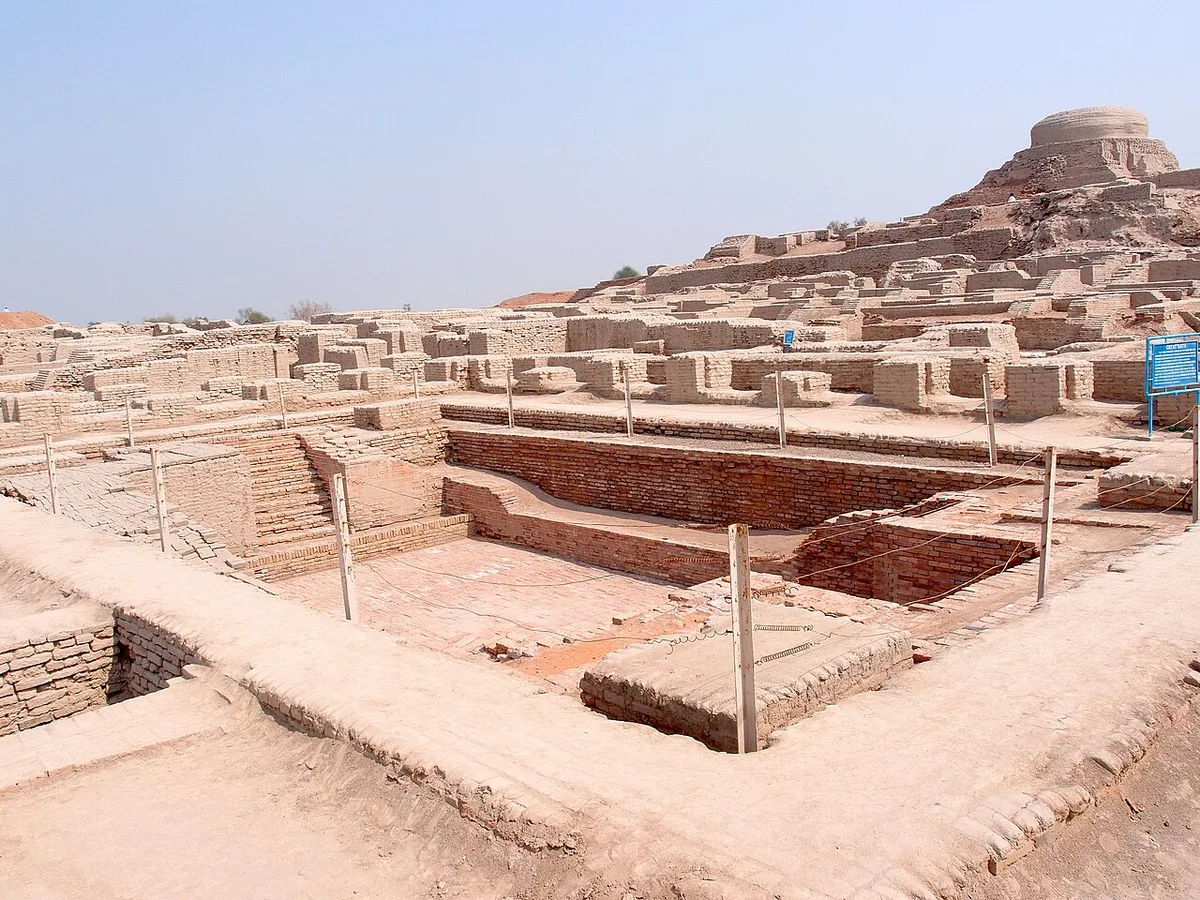
Every child in Sindh hears about Moen jo Daro at school. Fewer of us learn how big the culture behind it really was. The Indus Valley Civilisation, called سنڌو وادي (Sindhu Wadi) in Sindhi, was a Bronze Age society that built planned cities along the Indus and its neighbouring rivers about 4,500 years ago.
In this article (35)
- What Was the Indus Valley Civilisation?
- How the Indus Valley Civilisation Was Discovered
- Dating the Early, Mature and Late Harappan Phases
- The Early Harappan Phase in Sindh
- The Mature Harappan Cities
- The Late Harappan Phase and After
- How Far the Indus Valley Spread Across South Asia
- Major Cities and Sites of the Indus Valley Civilisation
- Mohenjo Daro on the Indus Near Larkana
- Harappa and the Name Harappan
- Chanhudaro, Kot Diji and Amri in Sindh
- Lothal, Dholavira, Rakhigarhi and Ganweriwala
- Town Planning, Bricks and the Famous Drainage System
- The Great Bath of Mohenjo Daro and Its Possible Purpose
- Crafts of the Indus People: Seals, Beads and Statues
- Steatite Seals and the Unicorn Motif
- Carnelian Beads and Craft Workshops
- The Priest King and the Dancing Girl
- Trade With Mesopotamia and the Land of Meluhha
- The Indus Script That Nobody Can Read Yet
- Farming, Cotton and Life Along the Indus River
- What Did the Indus People Believe?
- Why Did the Indus Cities Decline?
- Climate Change and a Weaker Monsoon
- Shifting Rivers and the Ghaggar Hakra Debate
- Why the Aryan Invasion Theory Lost Support
- The Link Between Sindh Today and the Indus Valley
- Visiting Mohenjo Daro From Karachi or Larkana
- Frequently Asked Questions About the Indus Valley
- How old is the Indus Valley Civilisation?
- Why is it also called the Harappan civilisation?
- Who discovered Mohenjo Daro in Sindh?
- Has anyone deciphered the Indus script?
- Did Aryan invaders destroy Mohenjo Daro?
- Sources and Further Reading on the Indus Valley
Its people baked bricks of a standard size, laid covered drains under their streets, carved tiny stone seals and traded with Mesopotamia by sea. Then, after a few centuries, their big cities emptied out. Nobody has yet read their writing.
In this article I bring together what archaeologists know about the civilisation as a whole: how it was found, how old it is, how far it spread, its main cities, its crafts and trade, the script, farming, religion, and the debate over its decline. Where scholars disagree, I have tried to show the main views side by side.
What Was the Indus Valley Civilisation?
The Indus Valley Civilisation is also called the Indus civilisation or the Harappan civilisation, after Harappa, the first site to be dug. Britannica describes it as the earliest known urban culture of the Indian subcontinent and one of the world’s three earliest civilisations, with Mesopotamia and Egypt.
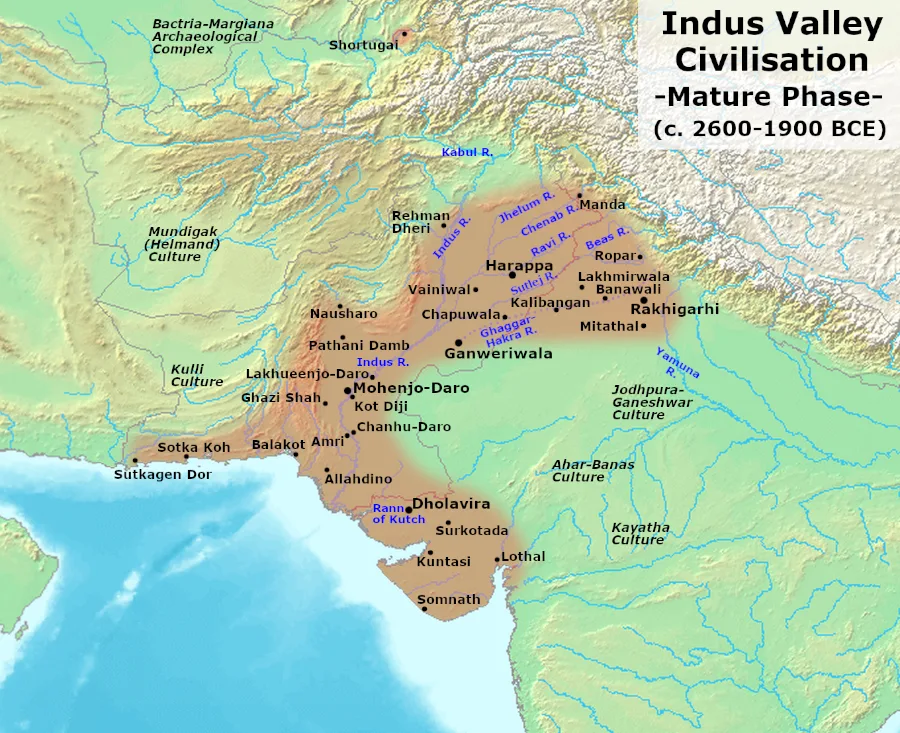
Of those three, it covered the largest area. Its remains have been found from Sutkagen Dor near the Makran coast of Balochistan to the Yamuna basin north of Delhi, and south to the Gulf of Khambhat in Gujarat, according to Britannica’s entry on the Indus civilization.
Most of its people were farmers. Alongside them lived craft workers, traders and, it seems, some kind of ruling class, although we still do not know what that ruling class called itself or how it governed.
How the Indus Valley Civilisation Was Discovered
The mounds at Harappa in Punjab had been noticed by travellers in the 1800s, and odd little seals with unknown signs had turned up there. Real digging began in the early 1920s.
Daya Ram Sahni excavated at Harappa from about 1920 to 1921. In 1922 Rakhal Das Banerji began digging at Mohenjo Daro in Larkana District, Sindh, and found seals much like those from Harappa, even though the two sites lie some 400 miles apart.
Sir John Marshall, then Director General of the Archaeological Survey of India, saw that both sites belonged to one culture. He announced the find to the world in The Illustrated London News on 20 September 1924, and he credited Banerji’s work at Mohenjo Daro and Sahni’s at Harappa, as Harappa.com’s archive of that issue shows.
For Sindh this matters a great deal. Banerji’s work at Mohenjo Daro showed that one of the oldest planned cities in the world stood on our own soil, near the right bank of the Indus.
Dating the Early, Mature and Late Harappan Phases
Archaeologists usually split the story into three broad phases. The exact years shift a little from one book to another, so treat the dates below as approximate.
The Early Harappan Phase in Sindh
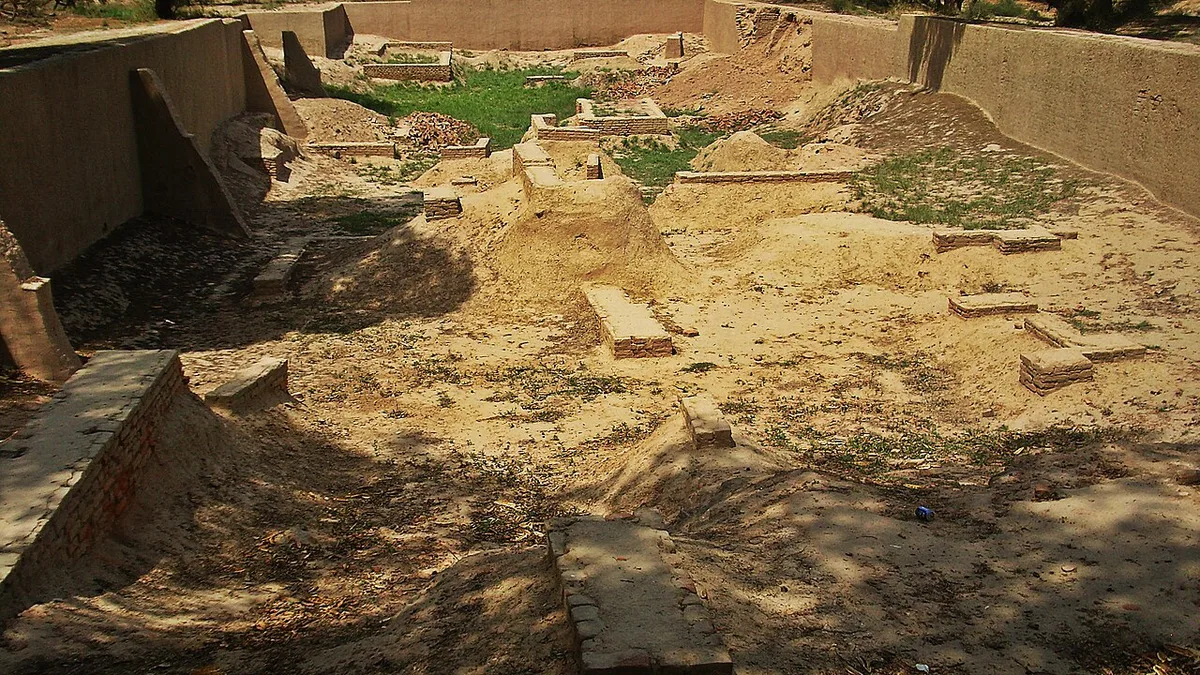
The Early Harappan phase is often placed at about 3300 to 2600 BCE. In Sindh two sites are central to it. At Amri, on the west bank of the Indus about 160 km south of Mohenjo Daro, N. G. Majumdar found in 1929 a settlement older than the Harappan one above it. Jean Marie Casal later dug there from 1959 to 1962 and dated the early levels to roughly 3600 to 3300 BCE.
The other is Kot Diji in Khairpur District. F. A. Khan of the Pakistan Department of Archaeology excavated it in 1955 and 1957 and found a walled town with its own style of pottery, now called Kot Dijian, lying below the Harappan levels.
New work at Mohenjo Daro itself has added to this picture. In March 2026 Dawn reported that fresh radiocarbon dates show the first mud brick city wall there was built around 2700 to 2600 BCE, at the end of the Kot Diji phase, on top of an even older Kot Dijian settlement.
The Mature Harappan Cities
The Mature Harappan phase, when the big cities flourished, is dated by Britannica to about 2600 to 1900 BCE. This is the period of the Great Bath, the standard bricks, the seals and the script.
The Late Harappan Phase and After
After about 1900 BCE the large cities shrank and many were left. Writing and seals went out of use. Smaller, more regional cultures continued, and some southern sites lasted further into the second millennium BCE. UNESCO, for example, gives Dholavira in Gujarat a span of about 3000 to 1500 BCE.
How Far the Indus Valley Spread Across South Asia
Most of the core territory lies in today’s Pakistan: Sindh, Punjab and parts of Balochistan. Large parts also lie in northwest India, in Gujarat, Rajasthan, Haryana and Indian Punjab.
UNESCO’s description of Dholavira counts “more than 1,000 Harappan sites discovered so far”. They range from tiny farming villages to large walled cities.
Major Cities and Sites of the Indus Valley Civilisation
Out of all these sites, scholars usually single out five as the largest cities: Mohenjo Daro, Harappa, Ganweriwala, Rakhigarhi and Dholavira. Smaller towns such as Chanhudaro, Kot Diji, Amri and Lothal tell us a lot about crafts and daily life.
Mohenjo Daro on the Indus Near Larkana
Mohenjo Daro lies about 28 km from Larkana. UNESCO, which listed the ruins as a World Heritage Site in 1980, calls them the best preserved urban settlement of their age in South Asia, covering about 240 hectares, of which only about a third has been excavated.
The city has a raised western mound, often called the citadel, and a larger lower town laid out in blocks. I have written a full guide to its history and the Great Bath in our post on Mohenjo Daro history and the visitor guide, so here I will keep it short.
Harappa and the Name Harappan
Harappa stands on an old bed of the River Ravi in Punjab. Recent work there has mapped at least five mounds, some ringed by large walls. A building once called a granary is now thought by some researchers to have been a large hall with air ducts, as Harappa.com explains.
Chanhudaro, Kot Diji and Amri in Sindh
Chanhudaro, about 80 miles south of Mohenjo Daro, was a small town given over to craft work. Bead making, shell cutting and seal making all took place there, and bronze carts found at Chanhudaro look almost identical to ones from Harappa.
Kot Diji sits at the foot of the Rohri Hills, below a much later Talpur fort. You can read about the fort and the ancient town beneath it in our article on Kot Diji Fort in Khairpur. Amri, in Jamshoro District, is the type site of the early Amri culture.
Lothal, Dholavira, Rakhigarhi and Ganweriwala
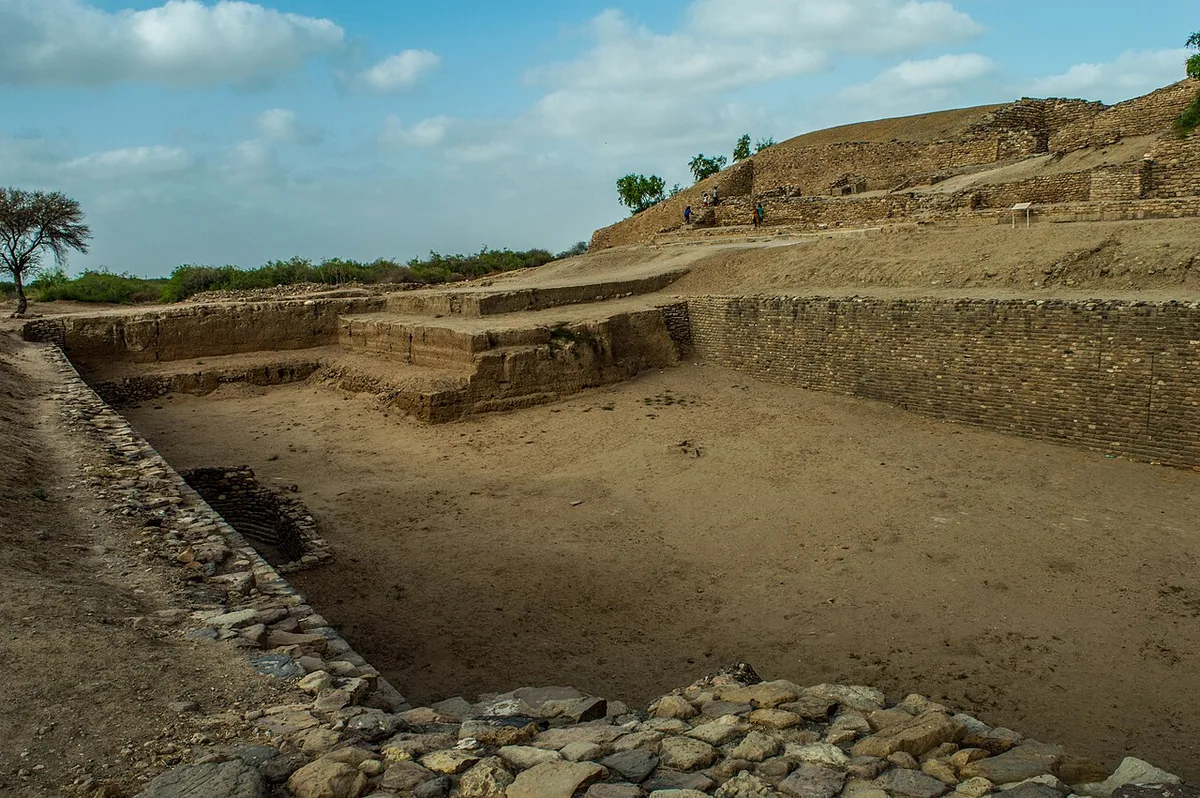
Lothal in Gujarat had a bead factory and a Persian Gulf type seal. Its long brick basin was described by its excavator S. R. Rao as a dockyard. Other scholars have argued that it was a water reservoir, and the debate has not fully closed.
Dholavira, on Khadir island in the Rann of Kutch, is known for stone architecture and a chain of reservoirs. It became a UNESCO World Heritage Site in 2021, and a large signboard of Indus signs was found there.
Rakhigarhi in Haryana is one of the largest sites. Some archaeologists, such as Vasant Shinde, have argued that it covers about 350 hectares and is larger than Mohenjo Daro, but site size depends on how many mounds are counted.
Ganweriwala in Cholistan, Pakistan, lies roughly halfway between Harappa and Mohenjo Daro. It was surveyed by M. R. Mughal in the 1970s, who estimated about 80 hectares. It has never been properly excavated.
The table below sums up the main sites. Scroll sideways on a phone to see every column.
| Site | Location | Main period | Key finds |
|---|---|---|---|
| Mohenjo Daro | Larkana, Sindh, Pakistan | Early and Mature Harappan | Great Bath, drains, Priest King, Dancing Girl, many seals |
| Harappa | Sahiwal, Punjab, Pakistan | Early to Late Harappan | City walls, large hall once called a granary, seal workshop |
| Chanhudaro | Nawabshah area, Sindh, Pakistan | Mature Harappan | Bead, shell and seal workshops, bronze carts |
| Kot Diji | Khairpur, Sindh, Pakistan | Early and Mature Harappan | Walled early town, Kot Dijian pottery |
| Amri | Jamshoro, Sindh, Pakistan | Early Harappan onwards | Amri pottery, mud brick houses |
| Ganweriwala | Cholistan, Punjab, Pakistan | Mature Harappan | Large unexcavated mound |
| Lothal | Gujarat, India | Mature and Late Harappan | Brick basin (dockyard or reservoir), bead factory |
| Dholavira | Kutch, Gujarat, India | About 3000 to 1500 BCE | Stone walls, reservoirs, large sign inscription |
| Rakhigarhi | Hisar, Haryana, India | Early to Mature Harappan | Several mounds, among the largest sites known |
Town Planning, Bricks and the Famous Drainage System
What surprises most visitors is the order of the cities. At Mohenjo Daro, UNESCO notes, buildings stand along streets that cross at right angles, and the plan includes wells, soak pits and a covered drainage system.
Bricks were made in fixed proportions across a huge area. Weights were also standardised. Britannica points out that chert cube weights follow a regular system and that measuring scales were found in the excavations, which suggests strong control of some kind over a wide region.
National Geographic notes that wells were found all over Mohenjo Daro and that nearly every house had a bathing area and drainage. Waste water ran from the houses into brick lined drains along the streets. For me, this is the most practical side of the civilisation, because it shows the planners cared about clean water inside ordinary homes.
The Great Bath of Mohenjo Daro and Its Possible Purpose
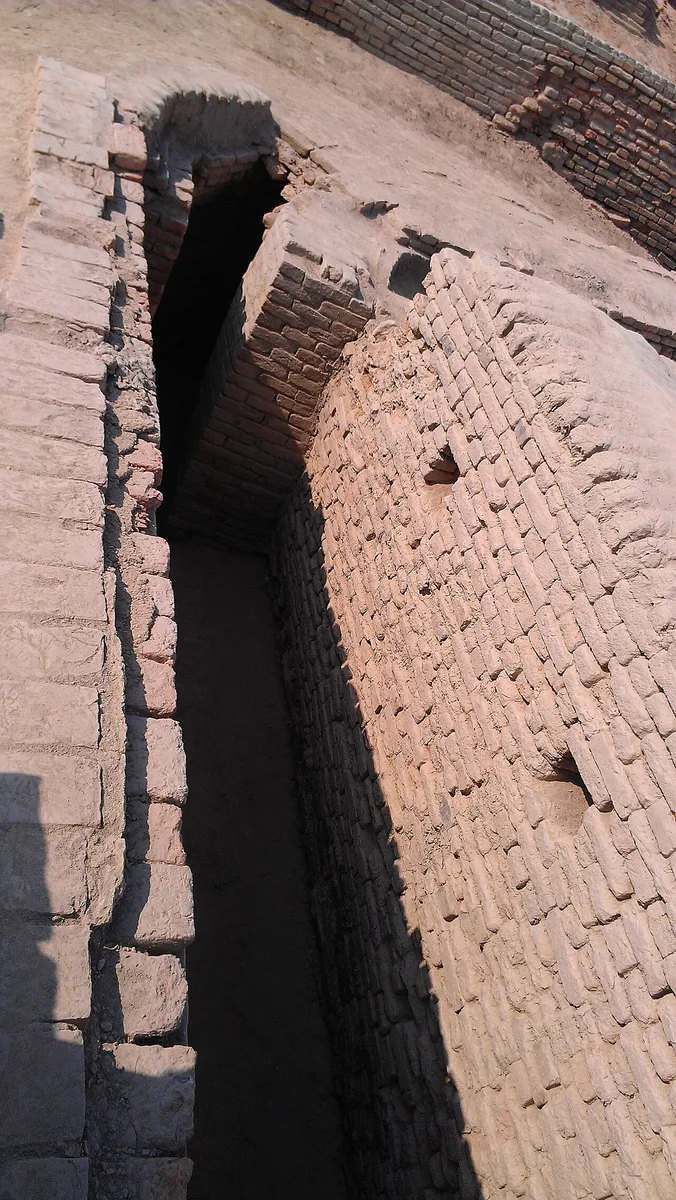
The Great Bath sits on the western mound of Mohenjo Daro. Harappa.com gives its size as about 12 metres north to south, 7 metres wide and 2.4 metres deep. Two flights of steps lead down into it from the north and the south.
The builders set fine bricks on edge in gypsum plaster and laid a thick layer of bitumen behind the walls to stop leaks. A well in a nearby room may have supplied water, and a large drain carried it away.
Nobody knows for sure what it was used for. Most scholars think it served some religious purpose linked to washing and purity. That idea fits the evidence well, but it remains an interpretation, because no text tells us what happened there.
Crafts of the Indus People: Seals, Beads and Statues
Steatite Seals and the Unicorn Motif
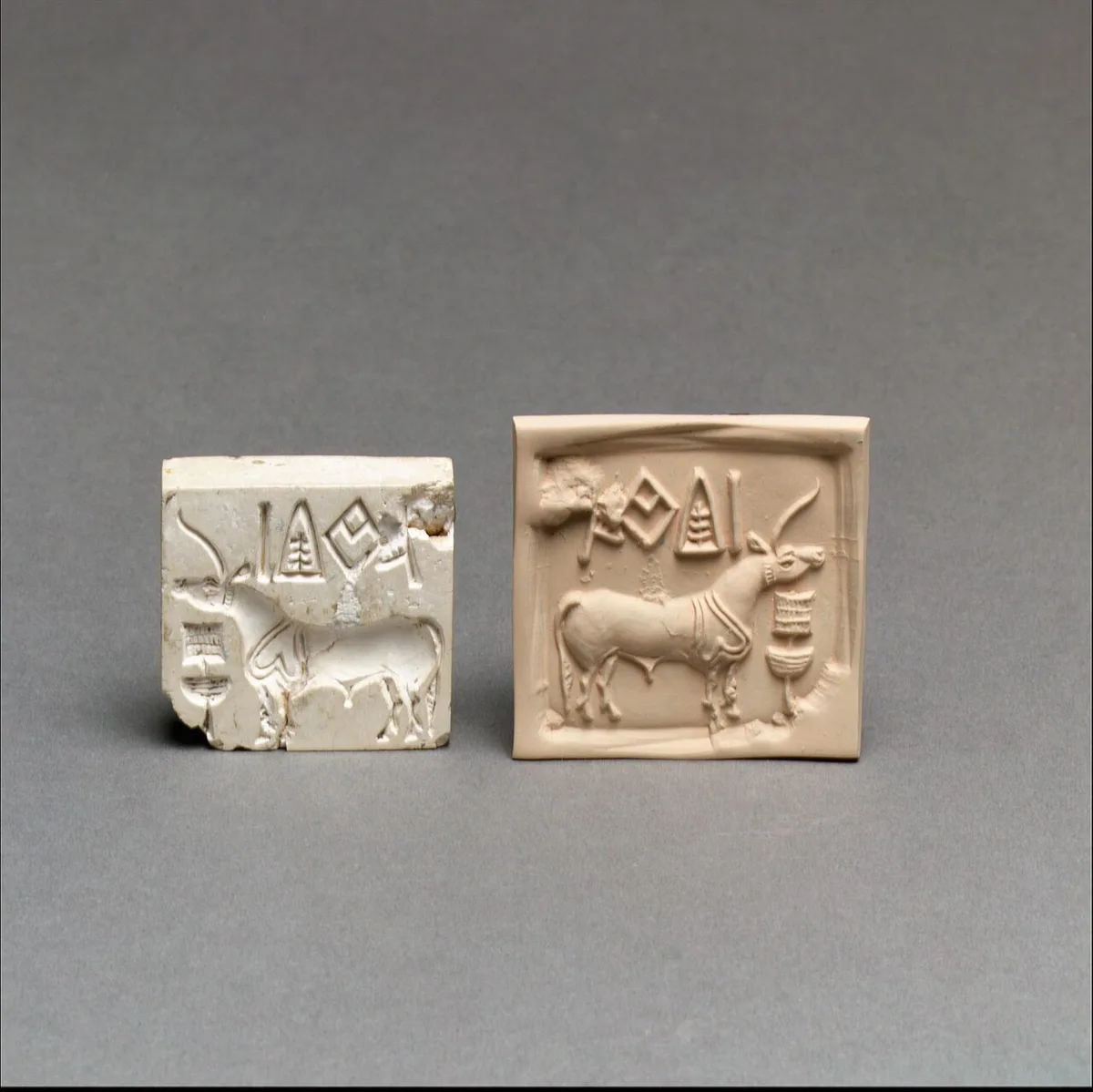
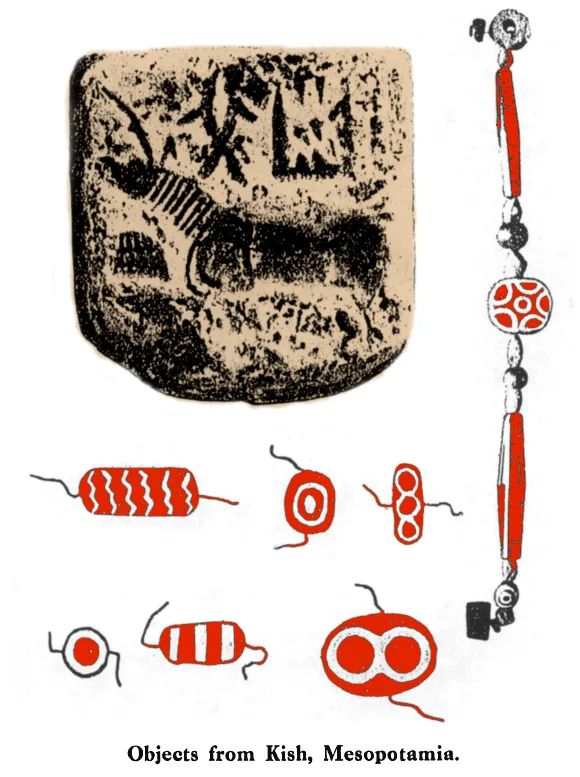
The best known objects are small square Indus seals cut from steatite, a soft stone. Most show a humpless bull with one horn, often called the “unicorn”, standing before an object that some read as an incense burner or a manger. Others show the humped bull, elephant, rhinoceros or tiger.
Many seals carry a short line of script. Clay sealings with cord marks on the back show that seals were pressed onto bundles of goods, so they likely served in trade as well as perhaps being charms.
Carnelian Beads and Craft Workshops
Indus craft workers were very skilled with stone. Britannica singles out long carnelian beads drilled with great accuracy and etched carnelian beads with white designs. They also worked shell, ivory, faience, copper and bronze.
Flint blades found in large numbers at Mohenjo Daro came from quarries near Sukkur and Rohri, which shows that local Sindhi stone fed the city’s tool supply.
The Priest King and the Dancing Girl
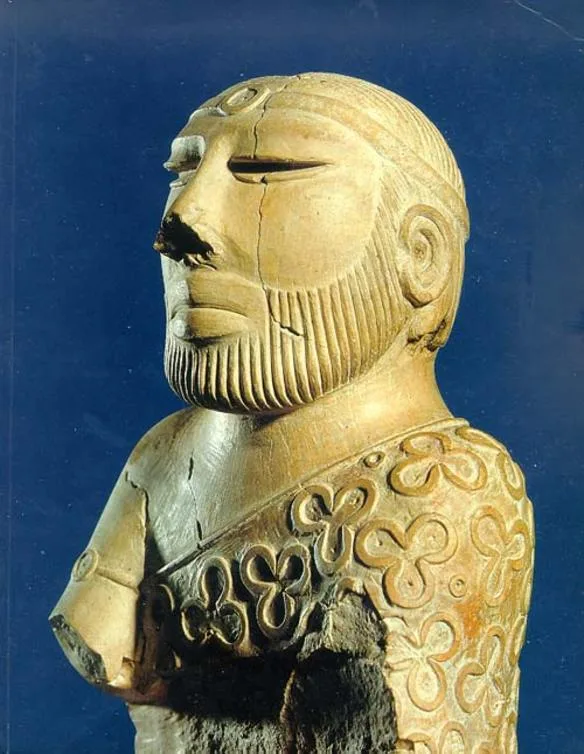
Two small figures from Mohenjo Daro have become symbols of the whole culture. The Priest King is a steatite bust of a bearded man wearing a robe with a trefoil pattern. It is about 17.5 cm high and is kept in the National Museum of Pakistan, Karachi. The name is a modern label. As Jonathan Mark Kenoyer told National Geographic, there is no evidence that the man was a priest or a king.
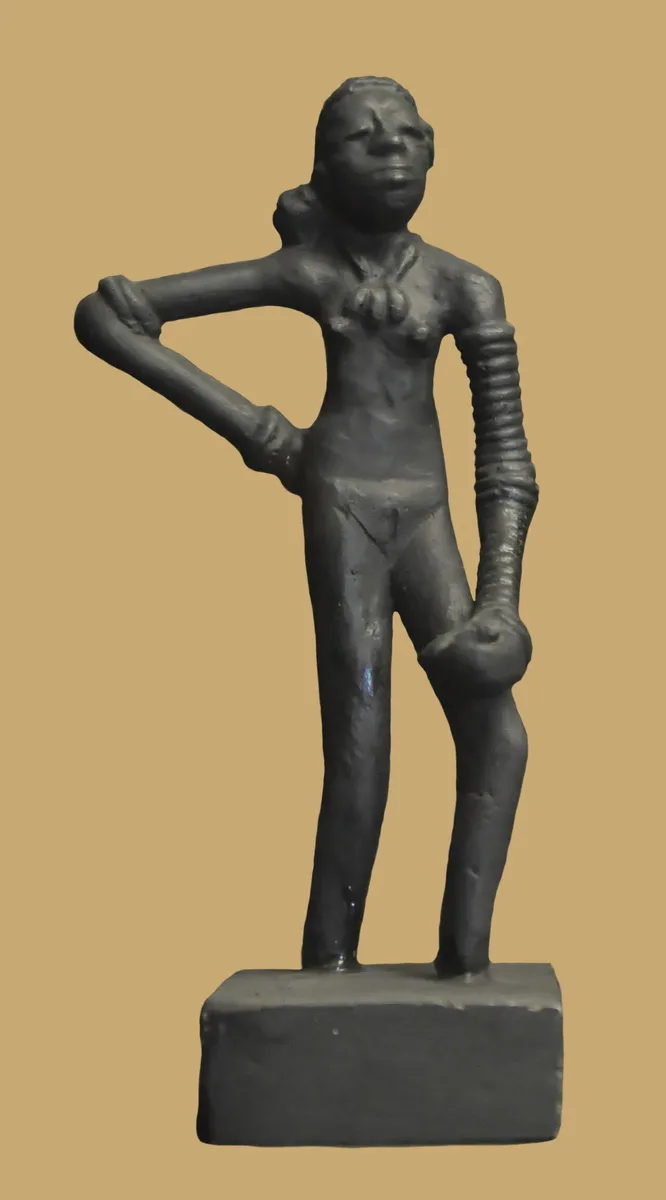
The Dancing Girl is a bronze figurine about 10.5 cm tall, cast by the lost wax method. She stands with one hand on her hip and the other arm covered in bangles. The original is in the National Museum, New Delhi, and replicas are shown in museums elsewhere.
Trade With Mesopotamia and the Land of Meluhha
Mesopotamian texts speak of a land called Meluhha. Most scholars identify it with the Indus region. Britannica notes that references to Meluhhan trade appear in texts from about 2350 to 1794 BCE, and that the trade probably began around 2600 BCE.
Indus seals have been found at Ur and other Mesopotamian cities. Goods sent west may have included timber, ivory, carnelian beads, pearls and shell inlays. In return came silver, tin, woollen cloth and grain. Over time the island of Dilmun, today’s Bahrain, became a middle point for this trade.
UNESCO also records evidence at Dholavira of trade with Mesopotamia and the Oman peninsula, which the ancient texts call Magan.
The Indus Script That Nobody Can Read Yet
The Indus script is still undeciphered. Around 2,000 short inscriptions are known, most only a few signs long, and the longest about 20 signs. Scholars count more than 500 different signs.
It was mostly written from right to left. We do not know what language it recorded. Some researchers, including the Finnish scholar Asko Parpola, have argued for a link to the Dravidian family of languages, but Britannica stresses that despite many claims there is still no general agreement.
The biggest problem is that no bilingual text has been found, nothing like the Rosetta Stone that helped scholars read Egyptian hieroglyphs. Until one turns up, every reading remains a proposal.
Farming, Cotton and Life Along the Indus River
The river was the base of everything. The Indus flood soaked the plains each year and left fresh silt, and farmers grew wheat and barley in the cool season. Field peas, mustard, sesame and dates have also been found.
Mohenjo Daro has given some of the earliest known evidence of cotton cloth. People kept humped and shorthorn cattle, dogs, cats and fowl, and Britannica adds that they possibly kept buffalo, camels and pigs as well.
A 2012 study in PNAS led by Liviu Giosan found that the Harappans did not build large canal systems. They relied on the yearly floods instead, which made them sensitive to changes in rainfall.
What Did the Indus People Believe?
Because the script is unread, ideas about Indus religion come from objects alone. Terracotta female figures are common, and Britannica notes that many scholars read them as goddess images, perhaps a mother goddess, although some small figures were probably toys.
One famous seal shows a seated figure with a horned headdress surrounded by animals. John Marshall called it a “proto Shiva” in 1931. Later scholars such as Doris Meth Srinivasan disputed this, and on Harappa.com the archaeologist Richard Meadow writes that we have no real idea of the image’s meaning because no reading can be checked.
No large temple has been identified with certainty. The Great Bath is the building most often linked with ritual. My own view is that we should keep these readings open and avoid tying the Indus people too firmly to any later religion.
Why Did the Indus Cities Decline?
From about 1900 BCE the large cities lost people and many were abandoned. Scholars now usually see this as a slow change that differed from place to place, not a single collapse. Several causes have been put forward.
Climate Change and a Weaker Monsoon
Many researchers link the decline to a drier climate. The 2012 PNAS study found that as the monsoon weakened, rivers fed by rain dried up or became seasonal, floods became less reliable, and people moved east toward wetter areas in Punjab, Haryana and Uttar Pradesh. Some scientists connect this to a wider dry period around 4,200 years ago, though the exact role of that event is still debated.
Shifting Rivers and the Ghaggar Hakra Debate
Rivers in this region change course. Harappa.com notes that the Indus may once have flowed west of Mohenjo Daro and now flows to its east. The Ghaggar Hakra system, along which many sites lie, is now mostly dry.
Some writers identify the Ghaggar Hakra with the Sarasvati river of the Rigveda. The PNAS team argued that it was fed by the monsoon rather than by Himalayan glaciers during Harappan times. Other studies disagree on the details, so this remains an open question.
Why the Aryan Invasion Theory Lost Support
In 1947 Mortimer Wheeler suggested that groups of skeletons at Mohenjo Daro were victims of a massacre by invading Aryans. In 1964 George F. Dales of the Penn Museum challenged this in his article “The Mythical Massacre at Mohenjo Daro”. He showed that the skeletons did not all date to one period, that none were found on the citadel, and that there was no burnt layer or sign of a final battle.
Later study of the bones by Kenneth Kennedy, cited by Kenoyer, found clear signs of injury on only one of about 42 individuals. Today most archaeologists agree that there is no evidence of an armed invasion destroying the Indus cities. Questions about later movements of people and languages into South Asia are a separate debate.
The Link Between Sindh Today and the Indus Valley
Sindh takes its very name from the river, and the river gave its name to the civilisation. For many Sindhis the Indus Valley is part of who we are, and I share that feeling.
Some links are concrete. Dales noted in 1964 that bullock carts used around Mohenjo Daro looked just like the ancient clay cart models found there. Farmers along the river still depend on its water, and the flint of the Rohri hills was used in Harappan times as well.
Other links are popular ideas rather than proven facts. Many people compare the trefoil pattern on the Priest King’s robe with the block printed Sindhi ajrak. The likeness is easy to see, but no unbroken line of evidence has been shown across 4,000 years, so I would call it a beautiful comparison, not a proven descent. Our wider guide to Sindhi culture covers the living traditions in more detail.
Visiting Mohenjo Daro From Karachi or Larkana
Most visitors reach Mohenjo Daro by road from Larkana, the nearest city. From Karachi it is a long journey north. UNESCO puts the site about 510 km from Karachi.
A site museum near the entrance shows pottery, seals, terracotta animals and replicas of famous pieces, and a car once used by John Marshall is kept on display, according to a March 2026 Dawn travel report. From the museum you can walk up to the Great Bath, the stupa mound and the lower city with its wells and drains.
The Sindh tourism department has also run special train trips from Karachi to the site, with stops at Sehwan on the way. Summer in Larkana is very hot, so I would plan a visit in the cooler months and start early in the morning. Please do not climb on the walls. UNESCO lists salt damage and rising groundwater as serious threats to the fragile bricks.
Frequently Asked Questions About the Indus Valley
How old is the Indus Valley Civilisation?
Its Mature urban phase is usually dated to about 2600 to 1900 BCE. Its roots go back further, to Early Harappan towns such as Amri and Kot Diji, which date from around 3300 BCE or earlier.
Why is it also called the Harappan civilisation?
Harappa in Punjab was the first site to be excavated, in the early 1920s. Archaeologists often name a culture after the first site where it was identified, so the whole culture came to be called Harappan.
Who discovered Mohenjo Daro in Sindh?
Rakhal Das Banerji began excavating Mohenjo Daro in 1922. Sir John Marshall, head of the Archaeological Survey of India, announced the discovery of the new civilisation in 1924.
Has anyone deciphered the Indus script?
No. Many people have claimed to read it, but no reading has won general acceptance among scholars. The inscriptions are short and no bilingual text has been found.
Did Aryan invaders destroy Mohenjo Daro?
The evidence does not support this. Archaeologists such as George Dales showed that the so called massacre skeletons came from different periods and that there was no destruction layer. Most scholars now point to climate, river changes and shifts in trade.
Sources and Further Reading on the Indus Valley
- UNESCO World Heritage Centre, Archaeological Ruins at Moenjodaro
- UNESCO World Heritage Centre, Dholavira: a Harappan City
- Britannica, Indus civilization
- Britannica, Indus civilization: craft, script, trade and decline
- Harappa.com, The Rediscovery of the Ancient Indus Civilization, 1924
- Harappa.com, A Brief Introduction to the Ancient Indus Civilization
- Harappa.com, The Great Bath of Mohenjo Daro
- Harappa.com, Amri: A Pre Harappan Site in Sindh
- Harappa.com, scholars on the so called proto Shiva seal
- George F. Dales, The Mythical Massacre at Mohenjo Daro, Expedition Magazine, 1964
- Woods Hole Oceanographic Institution, Climate Change Led to Collapse of Ancient Indus Civilization, Study Finds, 2012
- Giosan and others, Fluvial landscapes of the Harappan civilization, PNAS, 2012
- Jonathan Mark Kenoyer, Cultures and Societies of the Indus Tradition (PDF)
- National Geographic, Rediscovering the lost city of Mohenjo Daro
- Museums of India, Dancing Girl record, National Museum New Delhi
- Ashoka University, The Harappan City of Rakhigarhi
- Indian Express, Story of Lothal and new proof on its dockyard
- Dawn, Fresh studies trace Mohenjo Daro’s urban roots to 3300 BC, March 2026
- Dawn, A train journey into the silence of Mohenjo Daro, March 2026

Leave a Comment