

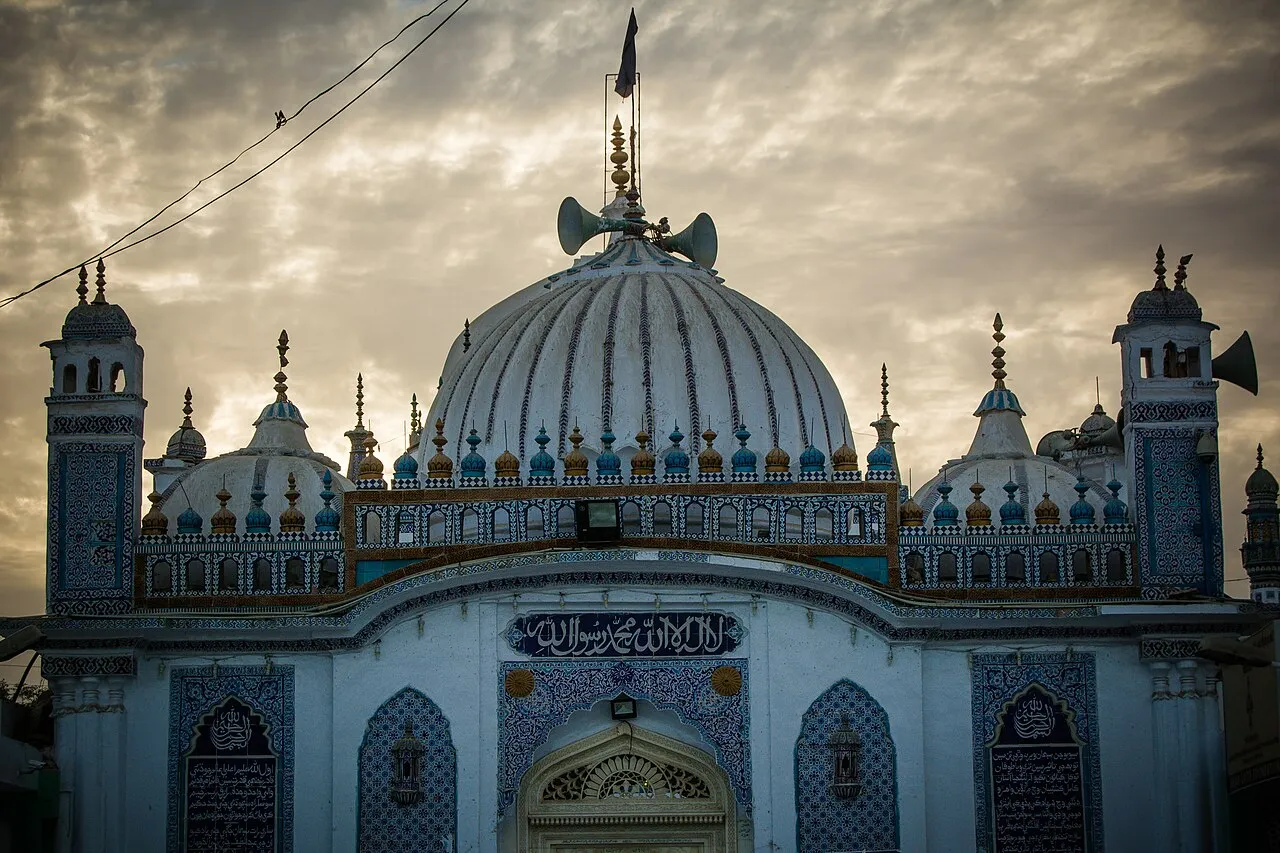
Every evening at Bhit Shah, as the light fades over the white dome of the shrine, a group of fakirs in black robes sit down in the courtyard with long-necked string instruments. They begin to sing verses that were first composed almost three hundred years ago, in the same place and in the same musical modes. The verses are by Shah Abdul Latif Bhittai, the Sufi poet whom many Sindhis regard as the greatest writer in their language and the voice of Sindh itself.
In this article (13)
- Shah Abdul Latif Bhittai at a glance
- What we know about his life
- Childhood and education
- Years of travel
- Marriage, followers and Bhit
- Shah Jo Risalo: how the poems survived
- The surs
- The heroines of the Risalo
- The shrine at Bhit Shah
- The urs
- Latif’s message and legacy
- Visiting Bhit Shah
- Sources and further reading
Latif’s collected poetry, the Shah Jo Risalo, is still recited in homes, sung at shrines and quoted in everyday speech. This article looks at what we know about his life, how his poetry was preserved, what makes it distinctive, and how his shrine became one of the most important cultural centres in Pakistan.
Shah Abdul Latif Bhittai at a glance
| Born | c. 1689 or 1690, Hala Haweli, near present-day Hala, Sindh |
| Died | 14 Safar, 1752, at Bhit, near Hala. Buried at Bhit Shah, Matiari District. |
| Family | Son of Syed Habib Shah. Descended from the Sufi poet Shah Abdul Karim of Bulri. |
| Main work | Shah Jo Risalo (The Message of Shah), poetry in Sindhi, traditionally arranged in 30 surs |
| Era | Late Mughal period and the rule of the Kalhora dynasty in Sindh |
| Also known as | Bhittai (the one of Bhit), Lakhino Latif, Latif Ghot |
| Urs | Held each year from 14 Safar at Bhit Shah |
What we know about his life
Very little was written about Latif during his lifetime. The earliest written details come from the Thatta historian Mir Ali Sher Qani, a younger contemporary, in works such as Tuhfat al-Kiram. Most of the rest comes from oral tradition, collected in the late nineteenth and early twentieth centuries by scholars such as Mirza Qalich Beg. Some details, especially the romantic ones, should therefore be read with care.
Childhood and education
Latif was born around 1689 into a family of Syeds at Hala Haweli. His family later moved to the nearby town of Kotri Mughal, where he grew up. A popular belief says that he had little formal education. However, his verses use Arabic and Persian vocabulary, refer to the Quran and show a close knowledge of the Persian mystic poet Rumi. Most scholars therefore conclude that he was well educated, even if he chose to write in the everyday Sindhi of the people.
Years of travel
As a young man, Latif left home and travelled for about three years. Tradition says he joined groups of wandering jogis and sanyasis. His poems mention many places: Ganjo Takar near Hyderabad, Thatta and the coast, the pilgrimage site of Hinglaj in the mountains of Balochistan, Lahut in Lasbela, the Karoonjhar hills of Nagarparkar, the Thar desert, Jaisalmer and the Kutch region. These journeys gave him the landscapes and the people that fill his poetry. You can read more about one of those landscapes in our article on Tharparkar.
Marriage, followers and Bhit
After his return, Latif married Saida Begum, from an Arghun noble family of Kotri Mughal. She died a few years later. He did not remarry and had no surviving children. His piety and his poetry attracted a growing following. Tradition says this brought him the hostility of some local nobles, and of the Kalhora ruler Mian Noor Muhammad, who later became an admirer.
Around ten years before his death, Latif moved to a sand mound a few kilometres from Hala, where he built a mosque and lived with his disciples. The mound (bhit) gave him the name Bhittai and the town its name, Bhit Shah. He died there in 1752 at the age of about 63. A tomb was built over his grave on the orders of the Kalhora ruler Mian Ghulam Shah Kalhoro.

Shah Jo Risalo: how the poems survived
Latif did not write a book. His verses were sung and memorised by his followers, especially the fakirs who sang with him. After his death, his poetry was gathered from these singers and copied by hand. A manuscript known as the Ganj (Treasure), prepared in 1793, is among the most important early copies.
The first printed edition was published in 1866 at Leipzig, in Germany, by the German scholar Ernest Trumpp, with support from the Government of India. A popular edition followed in Bombay in 1867. Later editions by Tarachand Shaukiram, Mirza Qalich Beg, Kalyan Advani and, above all, Dr Nabi Bakhsh Khan Baloch tried to separate Latif’s genuine verses from later additions. Dr Baloch spent decades on this work, and his edition is now widely used as a standard text.
The surs
The Risalo is not arranged by date or theme in the usual sense. It is divided into chapters called surs, from a word for a musical mode. Each sur is meant to be sung in a particular melody. The traditional arrangement has 30 surs. Some older collections had more, but scholars removed several whose language and style did not match Latif’s. Their names include Kalyan, Yaman Kalyan, Sohni, Sassui Abri, Marui, Momal Rano, Sorath, Sarang, Asa, Ramkali and Kedaro.
The poems mostly take the form of short verses called bait and longer sung pieces called vai. Many verses can be understood on two levels at once: as a human story of love and longing, and as a Sufi lesson about the soul’s search for God.
The heroines of the Risalo
One of Latif’s most original choices was to tell the stories of Sindh’s folk romances through the eyes of their women. Seven heroines, often called the Sat Suriyun or seven queens, are especially famous:
- Sassui, who crosses the mountains on foot in search of her husband Punhu after his brothers carry him away.
- Sohni, who swims the Indus every night on a clay pot to meet her beloved, until the night the pot is swapped for an unbaked one.
- Marui, a village girl from Thar who is held in the palace of Umar Soomro but refuses his wealth and stays loyal to her people.
- Momal, the princess of Kak Mahal whose story with Rano is one of loss through misunderstanding.
- Noori, a fisher girl whose humility wins the love of the Samma king Jam Tamachi.
- Lilan, who trades her husband’s love for a necklace and spends the rest of the story regretting it.
- Sorath, the queen in the tale of Rai Diyach and the minstrel Bijal.
These women are not passive. They travel, endure and make hard choices, and Latif uses their struggle as an image of the seeker’s path. This is one reason his poetry still speaks strongly to readers today.

The shrine at Bhit Shah
The shrine stands on the same mound where Latif spent his last years. Its white dome and blue and white glazed tiles are typical of Sindhi shrine architecture. The inner chamber, with its painted and mirrored decoration, holds his grave. Next to it are a mosque and the graves of family members and disciples. A small lake, Karar, lies nearby.
The shrine is famous for its music. The tradition known as Shah Jo Raag is performed by fakirs who sing the surs of the Risalo in their set melodies. They accompany themselves on the tamboro, a long-necked string instrument that tradition credits Latif with developing. Performances take place every night, and especially on Thursday evenings. The singing has been passed down within families of fakirs for generations.
The urs
Each year, Latif’s urs begins on 14 Safar, the anniversary of his death in the Islamic calendar. It lasts several days and draws large crowds from across Sindh and beyond. Alongside prayers and devotional music, the event includes a literary conference on Latif’s poetry, music performances and a traditional fair. The Government of Sindh normally announces a public holiday in the province for the main day of the urs.

Latif’s message and legacy
Latif’s poetry speaks of love, humility, patience and the unity of all people before God. It often criticises pride, greed and empty ritual. He also wrote with deep affection for Sindh: its river, its deserts, its fishermen, weavers and herders. One of his best-known prayers, from Sur Sarang, asks God to keep Sindh prosperous and the whole world in plenty:
“Sain sada kayen mathe Sindh sukar, dost mitha dildar, alam sabh abad kayen.”
“O Lord, may You always keep Sindh in plenty; sweet beloved Friend, may You make the whole world flourish.” (PakSindh translation)
His influence reaches far beyond religion. Later Sindhi poets, from Sachal Sarmast to Shaikh Ayaz, drew on his work. Scholars such as H. T. Sorley, Annemarie Schimmel and Christopher Shackle have introduced him to readers in English. In 2018 a new complete English translation by Shackle was published in the Murty Classical Library of India. For many Sindhis, though, Latif is not a subject of study but part of daily life: a verse remembered at a wedding, a line sung on the radio or a phrase used to settle an argument. Learn more about that living culture in our article on Sindhi Saqafat.
Visiting Bhit Shah
- Getting there: Bhit Shah is in Matiari District, close to the National Highway between Hyderabad and Hala, about an hour’s drive north of Hyderabad.
- When to go: The evening raag is the highlight. Visit during the urs for the full festival atmosphere, or at another time if you prefer a quieter visit.
- Etiquette: Dress modestly, remove your shoes before entering the shrine, and ask before photographing the fakirs or other pilgrims.
- Nearby: Hala, famous for its ajrak, glazed pottery and woodwork, is a short drive away.
Related on PakSindh: The Talpur dynasty, who took power in Sindh a generation after Latif’s death, and Makli Necropolis, the great cemetery of Thatta.
Sources and further reading
- Ernest Trumpp (ed.), The Diwan of Abd-ul-Latif Shah, known by the name of Shaha jo Risalo, Leipzig, 1866. Digitised by the Bavarian State Library. digitale-sammlungen.de
- N. A. Baloch (ed.), Shah Jo Risalo, Culture Department, Government of Sindh, and Sindhi Adabi Board editions.
- H. T. Sorley, Shah Abdul Latif of Bhit: His Poetry, Life and Times, Oxford University Press, 1940.
- Annemarie Schimmel, Pain and Grace: A Study of Two Mystical Writers of Eighteenth-Century Muslim India, Brill, Leiden, 1976.
- Christopher Shackle (trans.), Shah Abdul Latif: Risalo, Murty Classical Library of India, Harvard University Press, 2018.
- BhittaiPedia, timeline of the compilation and publication of Shah Jo Risalo. bhittaipedia.org
- Motilal Jotwani, Shah Abdul Latif: His Life and Work, University of Delhi, 1975.

Leave a Comment