

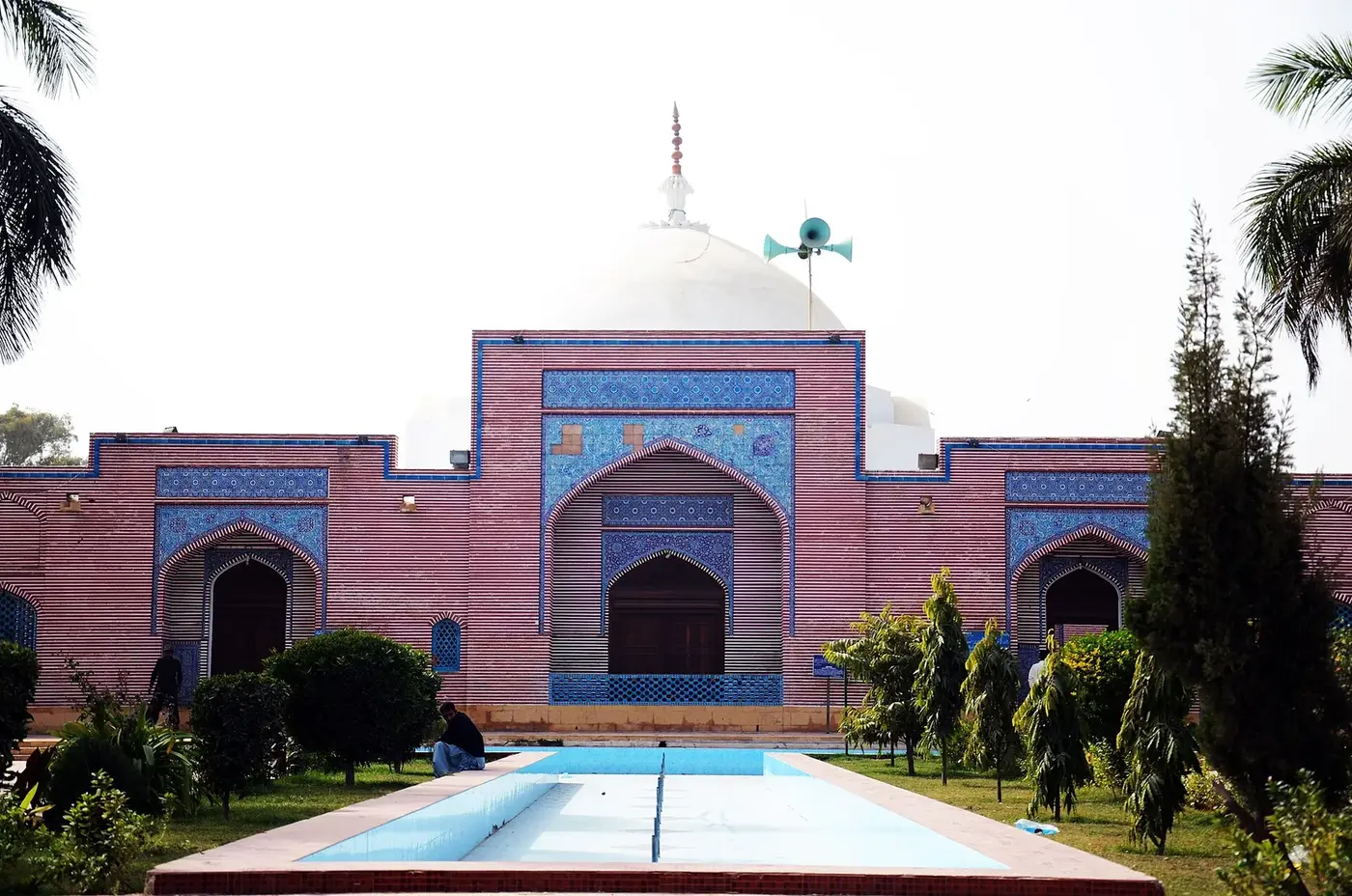
Perched on the eastern outskirts of Thatta, a short distance from the ridge of the Makli Necropolis, stands what many architectural historians of South Asia consider the finest surviving example of glazed tile work in the subcontinent. The Shah Jahan Mosque, known locally as the Jamia Masjid of Thatta and in Sindhi as Shahjahani Masjid, was built in the middle of the seventeenth century with funding from the Mughal emperor Shah Jahan. It is still the main congregational mosque of the town, and every Friday worshippers fill its long brick arcades, much as they have for more than three and a half centuries.
In this article (26)
- Key Facts at a Glance
- Location and Urban Setting
- The Emperor and His Debt of Gratitude
- The Central Asian Context
- Construction Timeline and Later Additions
- A Plan Borrowed From the Caravanserai
- Ninety Three Domes and No Minarets
- Geometric Brickwork in the Timurid Manner
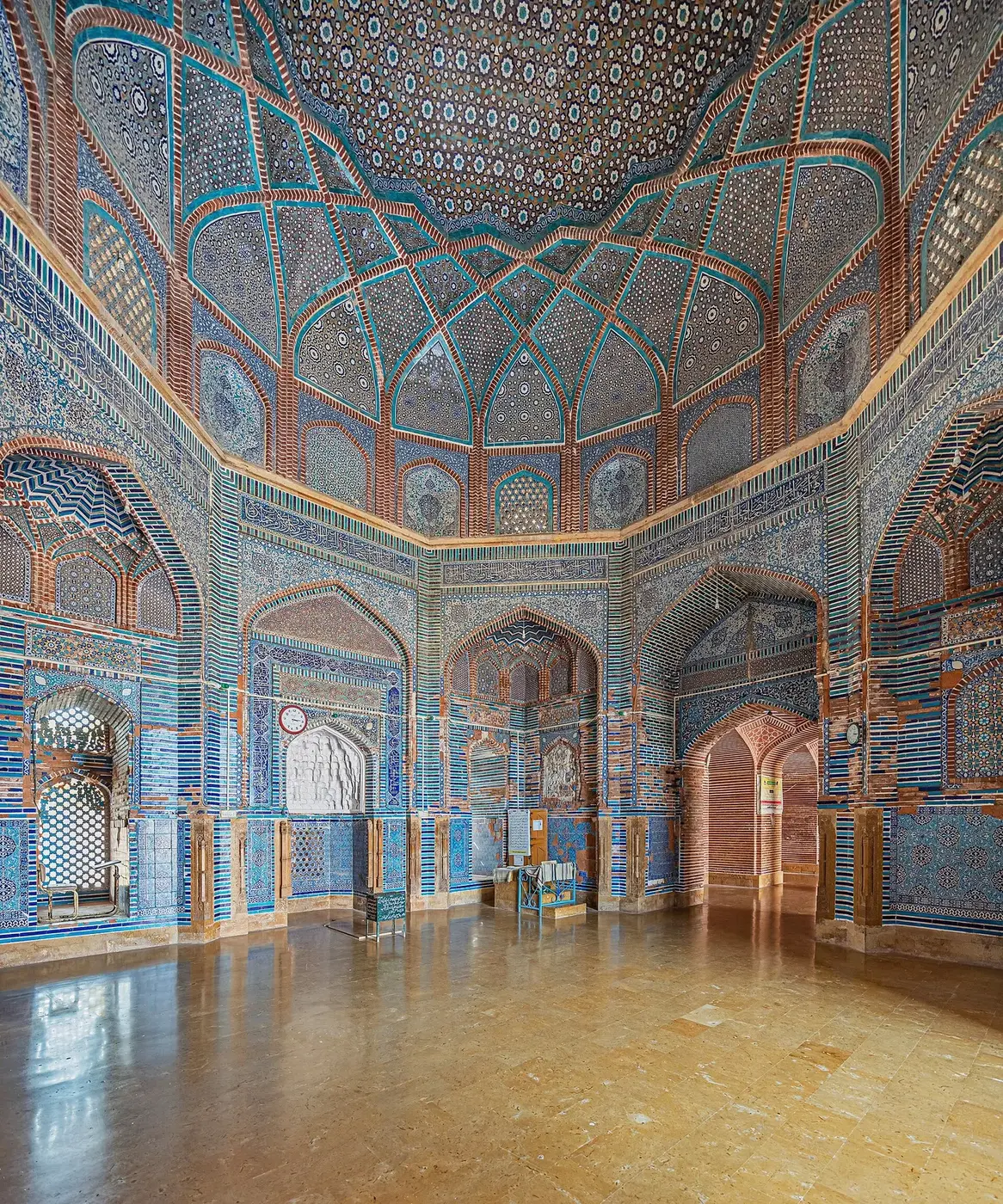
- The Finest Tile Work in South Asia
- The Starry Dome of the Prayer Chamber
- Light, Screens and the Mihrab
- Acoustics That Need No Amplification
- Place in the Wider Story of Mughal Architecture
- Conservation and Heritage Status
- Visiting the Shah Jahan Mosque
- Approximate Road Distances from Thatta
- Frequently Asked Questions
- Who built the Shah Jahan Mosque in Thatta?
- Why did Shah Jahan build a mosque in Thatta?
- How many domes does the mosque have?
- What makes its tile work special?
- Is the mosque a UNESCO World Heritage Site?
- Does the mosque have minarets?
- How far is the mosque from Karachi?
- Conclusion
- References and Further Reading
The building tends to surprise first time visitors. Many people travelling from Karachi, roughly one hundred kilometres to the southwest, expect something like the monuments of Delhi, Agra and Lahore, with their red sandstone and white marble. What they find instead feels closer to the Central Asian cities of Bukhara and Samarkand, or even to Isfahan. The mosque is a low, sprawling structure of fired brick, crowned by dozens of domes and dressed in glazed tiles of cobalt, turquoise, manganese violet and white. This article looks at the history behind the building, the reasons for its unusual design, its materials and craftsmanship, its celebrated acoustics and the effort to preserve it.
Key Facts at a Glance
| Other names | Jamia Masjid of Thatta, Shahjahani Masjid |
|---|---|
| Location | Eastern Thatta, Sindh, Pakistan, about 100 km east of Karachi |
| Coordinates | 24°44′50″N, 67°55′41″E |
| Construction | 1644 to 1647 CE, eastern wing added around 1658 or 1659 |
| Patron | Mughal emperor Shah Jahan (reigned 1628 to 1658) |
| Supervising governor | Nawab Abul Baqa Amir Khan |
| Materials | Fired red brick on a stone plinth, glazed tiles in cobalt, turquoise, manganese violet and white |
| Domes | 93 (UNESCO and most scholars); some local sources say about 100 |
| Courtyard | About 169 by 97 feet (52 by 30 metres) |
| Overall size | About 305 by 170 feet (93 by 52 metres) |
| Style | Mughal, with strong Timurid, Safavid and Sindhi elements |
| Custodian | Culture, Tourism, Antiquities and Archaeology Department, Government of Sindh |
| Status | UNESCO Tentative List since 14 December 1993 |
Location and Urban Setting
To understand why an emperor would pay for such a grand mosque in lower Sindh, it helps to picture Thatta as it was at the time. Long before Hyderabad and Karachi rose to prominence, Thatta was the leading town of the region. It had been the capital of the Samma dynasty and later of the Arghun and Tarkhan rulers, whose families came originally from Central Asia. Its position near the mouth of the Indus made it a centre of trade. European travellers of the period described a busy city of weavers, merchants, scholars and boatmen, connected by the river to the interior and by sea to the Persian Gulf.
In 1592 the armies of Emperor Akbar annexed Sindh, and Thatta became the seat of a Mughal province. The Tarkhans were no longer the ruling house, yet many of them kept positions of power as governors and officials. Their taste in building came from the Timurid world, with its love of brick and glazed tile. That taste can still be seen on Makli Hill, where huge tombs were raised over several centuries, and it helped shape the architecture of the great mosque in the town below.
Then, in the eighteenth century, the Indus moved. Its course drifted away from Thatta and the river trade went with it. The Kalhora rulers eventually made Hyderabad their capital instead. The mosque, however, stayed at the centre of town life. It lies only a few kilometres from Makli Hill, a UNESCO World Heritage Site since 1981, and the two places are best seen together; the tombs on the hill and the mosque below came out of the same craft traditions, sometimes from the same families of builders and tile makers.
The Emperor and His Debt of Gratitude
The origin of the mosque is usually traced to a turbulent period in the life of Prince Khurram, the future Shah Jahan. During the 1620s he rebelled against his father, Emperor Jahangir, and spent several years moving across the empire to stay ahead of imperial forces. According to local tradition, he found refuge in Thatta and was treated with great kindness by its people. Once he became emperor, he decided to build a magnificent mosque to thank them.
Not every historian accepts this story at face value. During the revolt, Khurram’s forces actually tried to take Thatta and failed, and the gratitude account turns up far more often in later local writing than in the court chronicles of the 1620s. It is perhaps best read as part of the mosque’s popular memory. That memory still matters, because it explains why people in Sindh have always regarded the building as a gift from the emperor.
There may have been a more practical motive too, one suggested by the art historian Catherine Asher. In 1637 a violent storm struck the region and left Thatta badly damaged. A large public building commissioned in the years that followed would have given work to local builders and craftsmen and helped the town recover. The two explanations do not conflict, since imperial projects in the Mughal world often served religious, political and public purposes at once.
Interestingly, Shah Jahan was not in Sindh while the mosque was being built, and there is no evidence that he oversaw the work in person. Even so, the quality of the tile work, the intricate brickwork and the sheer size of the complex show that this was an imperial project, funded and planned at the highest level of the state.
The Central Asian Context
The dates also line up with Shah Jahan’s campaign of the mid 1640s to recover Balkh and, beyond it, the old Timurid lands around Samarkand. The emperor took great pride in his Timurid ancestry, and scholars such as Arash Khazeni have linked the strongly Central Asian look of the Thatta mosque to this political moment.
Construction Timeline and Later Additions
Persian inscriptions inside the building state that the main body of the mosque was constructed between 1644 and 1647. Sindh’s Directorate General of Antiquities says the man who actually started the job, in 1644, was the governor Nawab Abul Baqa Amir Khan, working on the emperor’s instructions. His name appears in more than one spelling, and one heritage listing calls him Gul Aqa Amir Khan. An eastern wing came later. The Antiquities Department dates it to 1658, while Ahmad Nabi Khan and other writers give 1659, by which time Aurangzeb had deposed his father. One date may mark when the wing was begun and the other when it was done. Either way, the mosque has always carried the name of the emperor who ordered it.
Thatta also remembers a story about the foundations. When early work on the site kept failing, the governor’s advisers are said to have suggested that the first bricks be laid by men so pious they had never sinned. Such men were asked to come quietly at night and set a brick each, and by morning around 450 bricks were in place. A descendant of Amir Khan told this story to the news agency AFP in 2016. Nobody can verify it, of course, but it shows how closely the building is tied to ideas of piety in local memory. You will also hear in Thatta that the mosque cost nine lakh rupees. Maybe so, but nothing in the published inscriptions says it.
There is a well known local legend about the orientation of the prayer niche, or mihrab. It is said that the builders first aligned the building incorrectly towards Mecca, and that the error was corrected through the prayers of the Sufi saint Makhdum Lutfullah, whose shrine stands in the town of Hala. The records tell a plainer story: the mihrab was actually rebuilt about a hundred years after the original construction. Still, the legend shows how deeply the mosque became part of the religious life of Sindh.
Major repairs took place over the centuries. In 1692 Aurangzeb ordered work on the building, and in 1812 the Talpur ruler Mir Murad Ali Khan carried out further repairs. Those campaigns kept the mosque standing. Not every later repair was as skilful, though.
Later interventions were less fortunate. In the 1970s a rebuilding scheme swapped out a lot of original material. Local scholars and officials say the tiles suffered, and so did the acoustics. In a 2016 AFP report, the director of the Sindh Archaeology Department said no conservation specialist had been consulted for that work. The same report described stones bearing Quranic verses being taken from the entrance arch to Karachi, where they were eventually set into a replica arch at the National Museum.
A Plan Borrowed From the Caravanserai
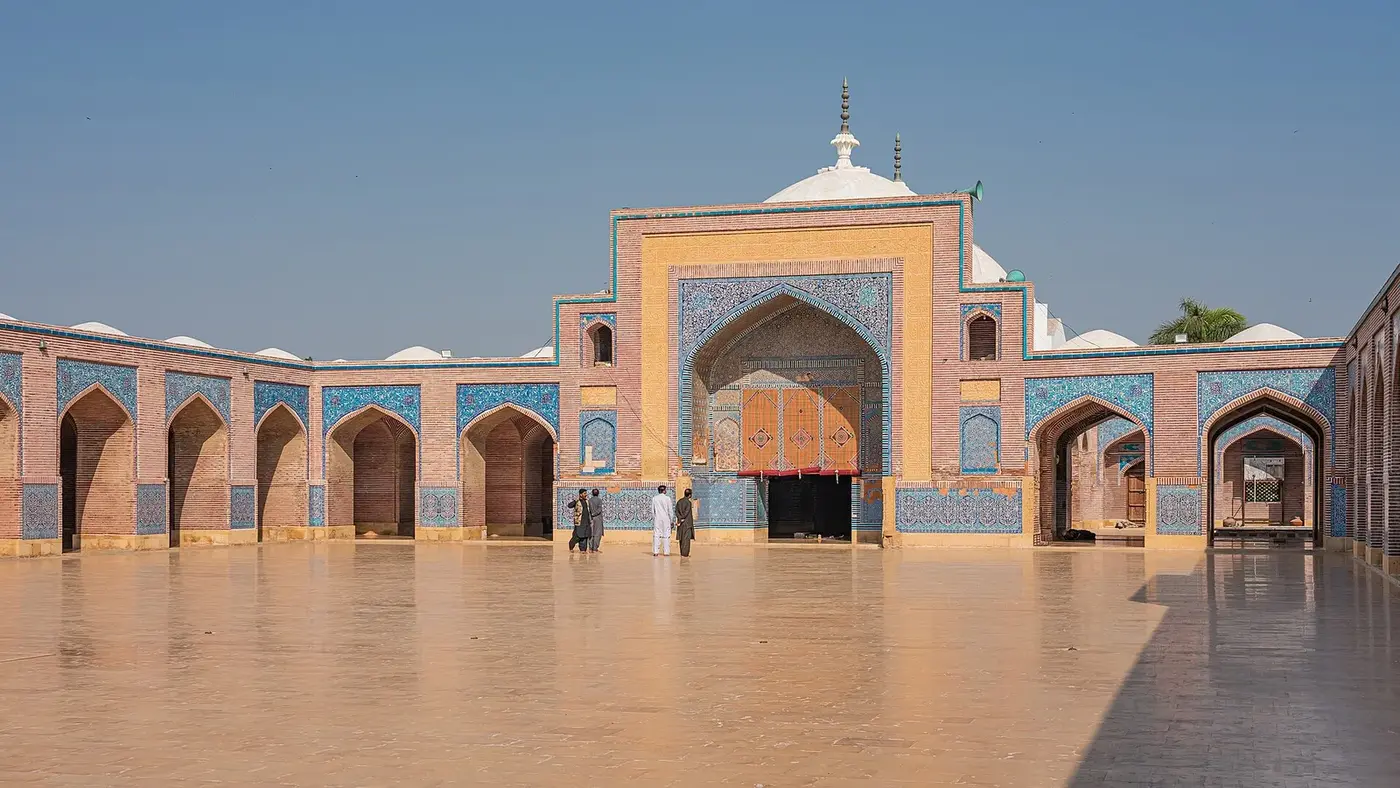
Most imperial mosques of the Mughal heartland, such as the Jama Masjid in Delhi and the Badshahi Mosque in Lahore, are arranged around a vast open courtyard in front of a lofty prayer hall framed by towering minarets. The mosque at Thatta follows an entirely different plan. It recalls a caravanserai, the fortified rest house found along the Persian and Central Asian trade routes. At its heart is a courtyard enclosed by ranges of domed chambers and arcaded galleries. The whole complex sits on a stone plinth, and with its heavy square piers and walls close to a foot thick in places, it looks from the street more like a fort than a mosque.
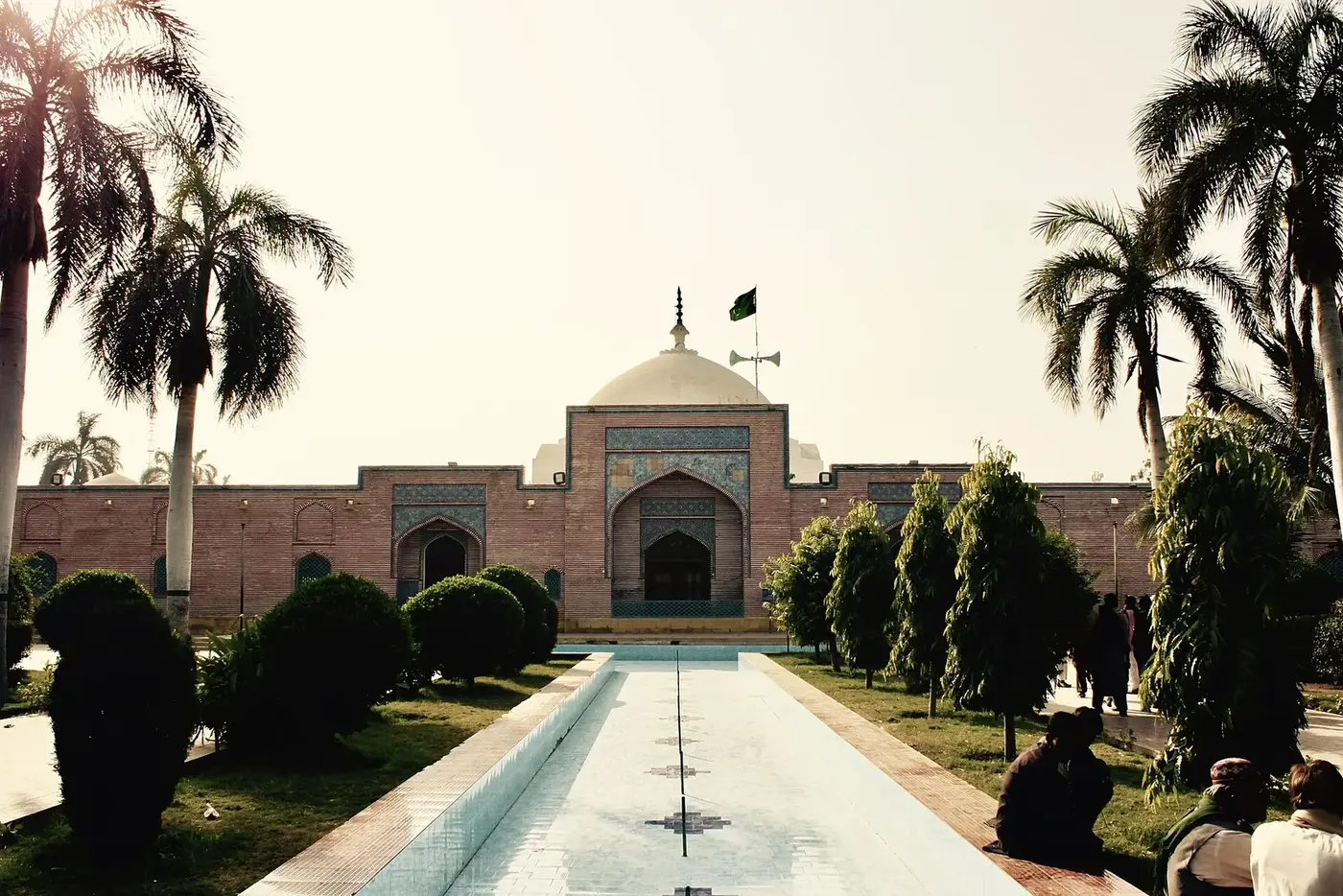
The layout follows the traditional Iranian four iwan design. An iwan is a vaulted hall open at one end, and here there is one in the middle of each side of the courtyard. The main prayer hall lies on the western side, facing Mecca. The courtyard measures about 169 by 97 feet, or roughly 52 by 30 metres, and is surrounded by aisled galleries with 33 arches. Overall the building measures roughly 305 feet from east to west and 170 feet from north to south, about 93 by 52 metres. Visitors enter the complex through a garden laid out on the Persian charbagh plan.
A possible model existed closer to home as well, as Asher has pointed out. The small Humayun Mosque at Kachhpura near Agra uses a conservative Timurid design, which may have influenced the planners at Thatta. Wherever the idea came from, the mosque doesn’t shout. It turns inward, quiet and enclosed, nothing like a parade ground for imperial power.
Ninety Three Domes and No Minarets
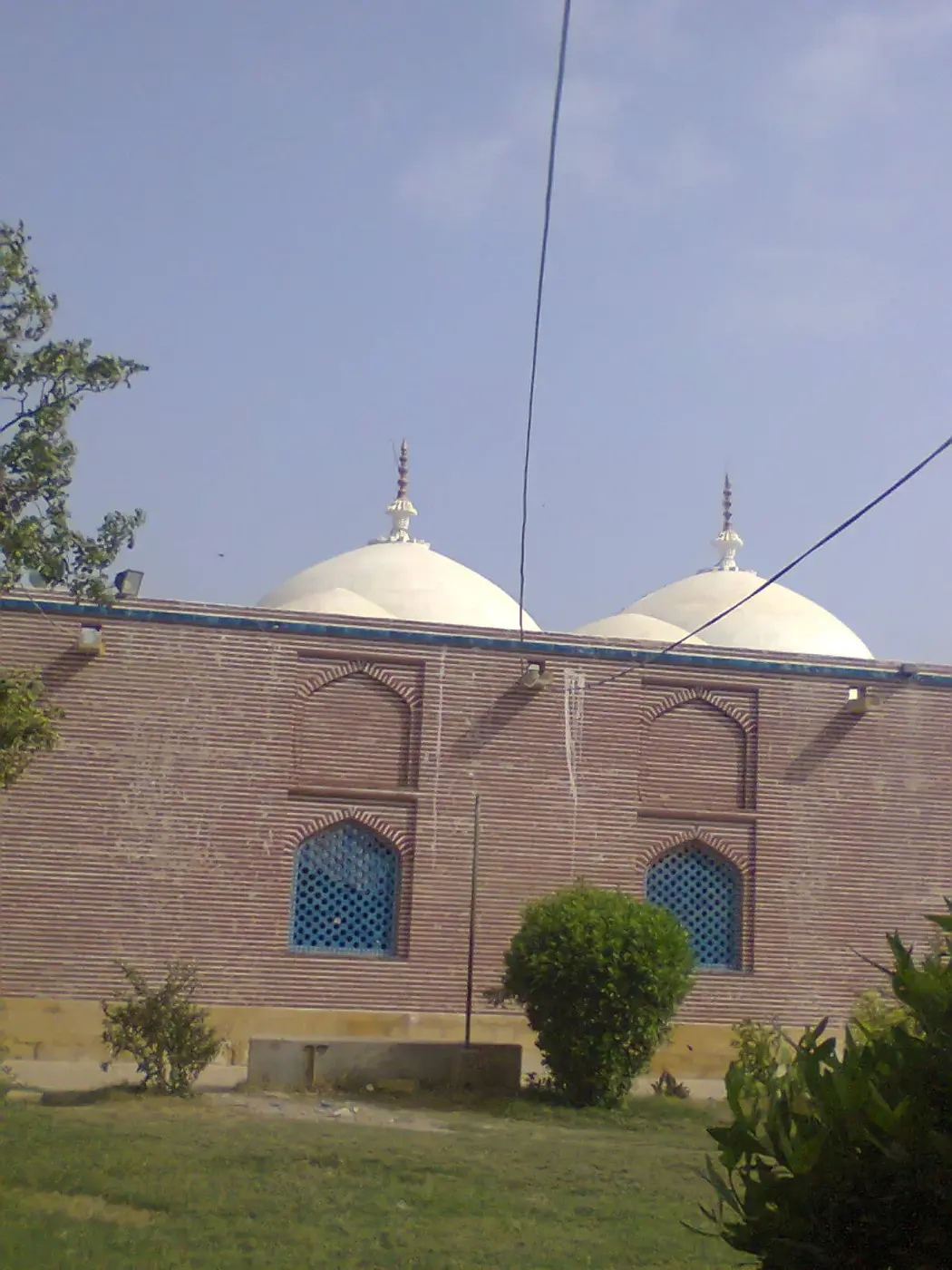
The roofline is the most distinctive feature of the mosque. There are 93 domes in all, the number given in the UNESCO entry and in most scholarly work, and more than on any other single building in Pakistan. Some local sources, including a page of the Sindh Antiquities Department, give a figure of about 100; the difference probably depends on whether the small subsidiary domes and those of the eastern wing are counted. The biggest sits over the prayer hall. Smaller ones cap each bay of the galleries around it, so the skyline rises and falls in a steady rhythm.
The domes do more than decorate. They roof the separate bays of the galleries, shade the interior from the fierce Sindhi sun and, as described below, shape the way sound travels through the building.
The absence of minarets is equally remarkable. By this period the minaret had become a standard element of imperial mosques across much of the Mughal world, yet at Thatta it was left out entirely. Leaving them out says a good deal about the weight of regional and Central Asian taste here, and it is the main reason the mosque looks so low and horizontal.
Geometric Brickwork in the Timurid Manner
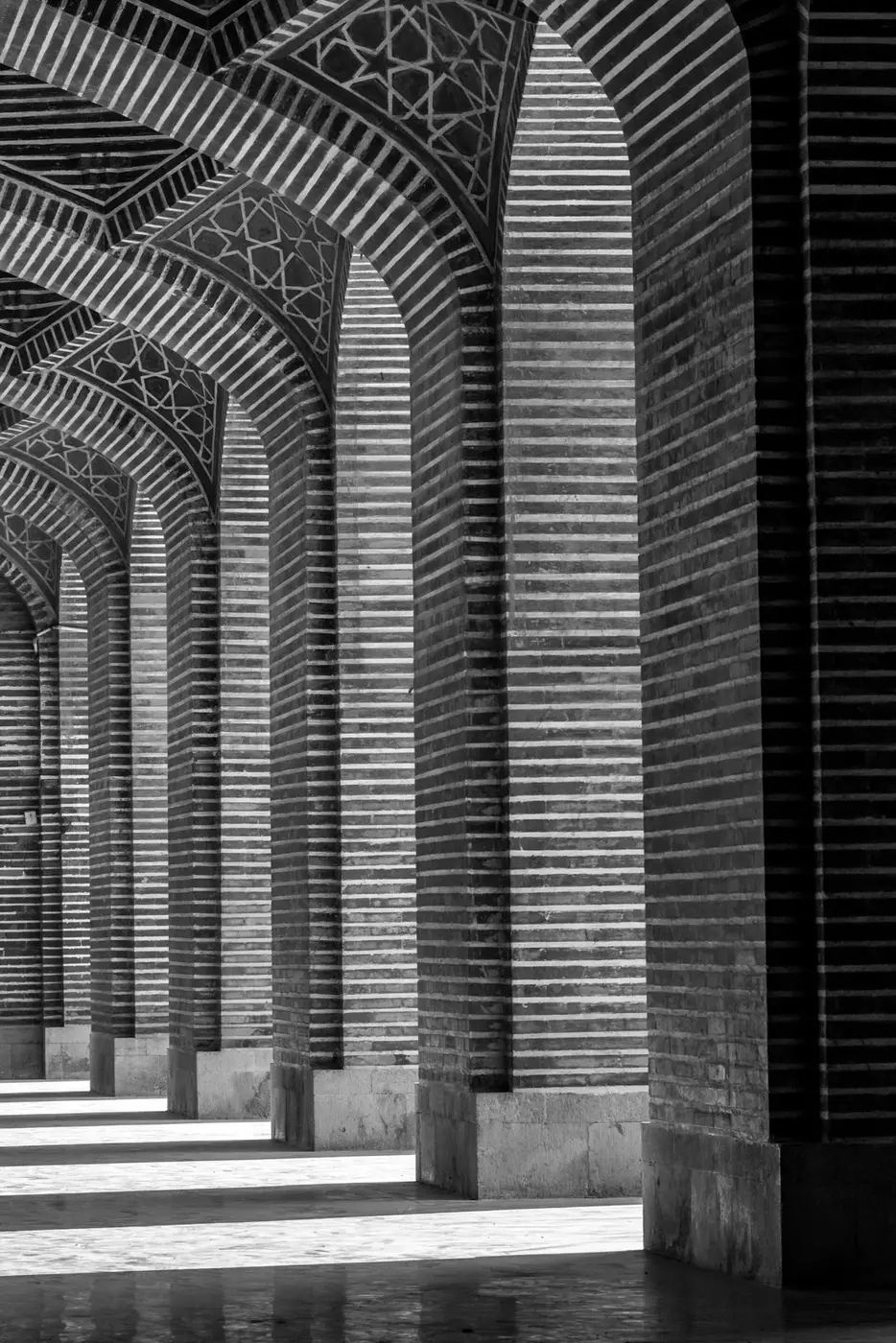
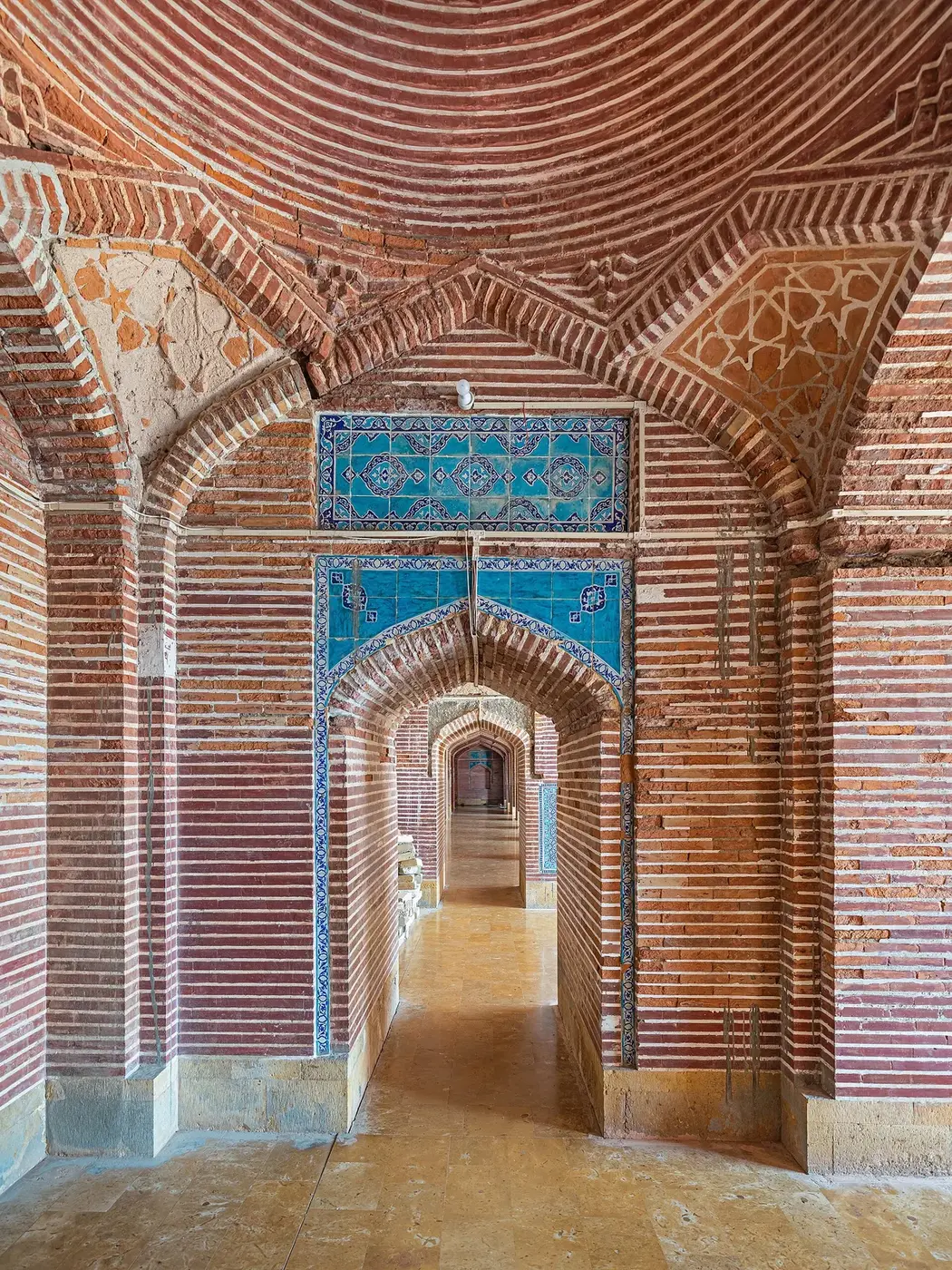
Fired brick is the main building material throughout the structure. It has long been the traditional material of the Indus valley, where good building stone is scarce. What makes the brickwork here exceptional is its decorative use, since the bricks are laid in deliberate geometric patterns rather than hidden behind plaster.
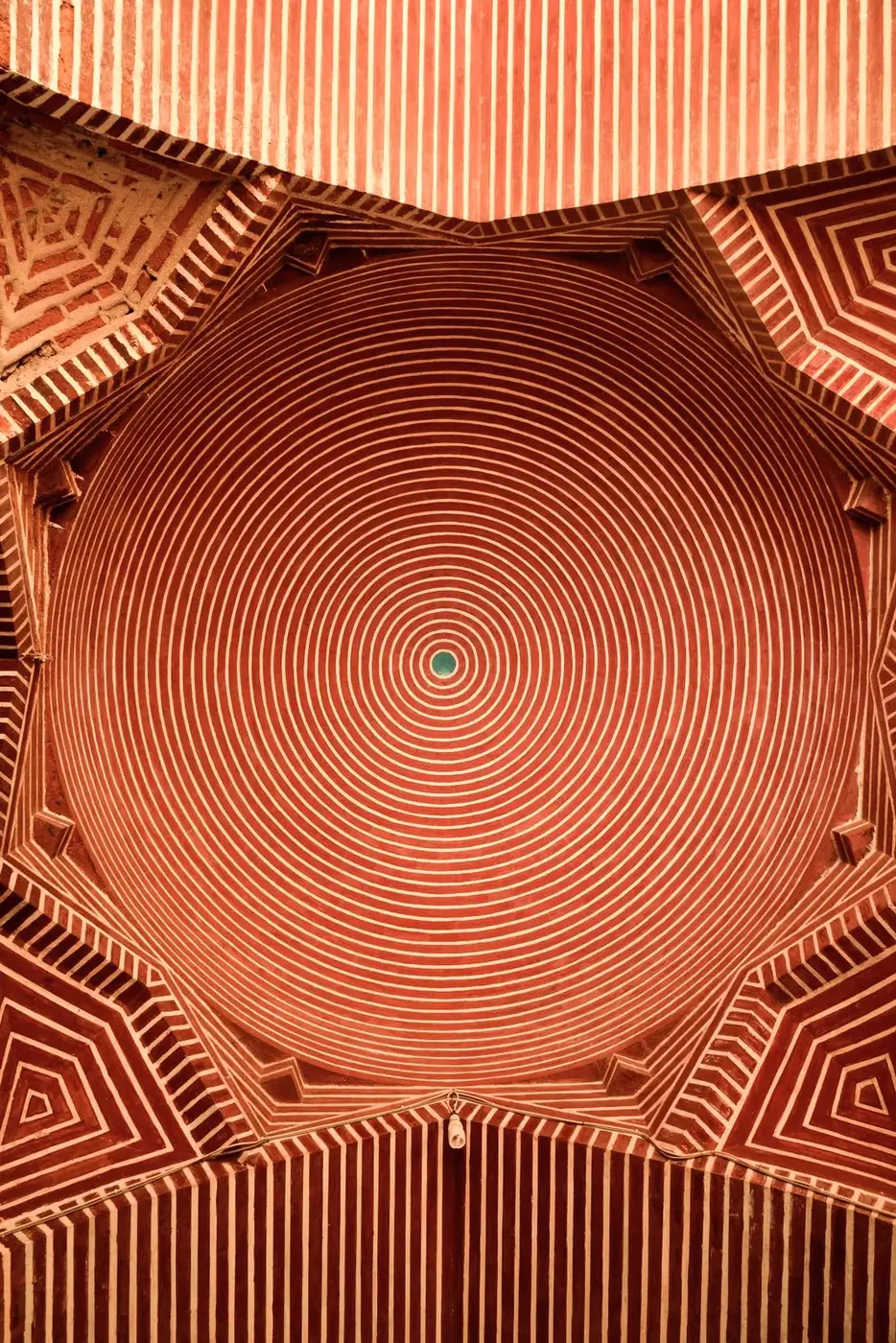
This treatment is unusual in Mughal mosques and shows the influence of Timurid architecture brought to Sindh by the Arghun and Tarkhan elites. Local Sindhi builders, who had long borrowed from Persia, added their own habits to the mix. The arcades around the courtyard are particularly impressive, as receding arches, piers and vaults form long corridors of light and shadow. The undersides of many side domes carry concentric rings of brick that draw the eye towards a single central point.
The Finest Tile Work in South Asia
Most writers on the subject call this the richest display of tile work anywhere in South Asia. Tiles cover the portals, the spandrels of the arches, the interior walls and the inner surfaces of the domes. Only a handful of colours appear: deep cobalt blue, turquoise, manganese violet and white, plus the odd accent of another shade.
The technique differs from that of Lahore, the other great centre of tile work in the Shah Jahan period. At the Wazir Khan Mosque, built only a few years earlier, artisans generally used one colour per tile and assembled the pieces into mosaics, and the walls also carry painted frescoes. Thatta has no frescoes. Instead, many individual tiles carry more than one colour and are painted with floral and geometric designs. Art historians link this practice to the kashi tradition, named after the Persian city of Kashan, and see clear Safavid influence in the placement and layout of the panels.
The tiles are generally believed to have been made in Sindh itself. Several sources point to the workshops of Hala, a town long known for glazed pottery, where the blue and white kashi craft still survives today.
Calligraphy is another important feature. Tile inscriptions run along the walls, and some panels bear the signatures of the craftsmen who made them, recorded as Abdul Ghafur and Abdul Sheikh. A Persian couplet is inscribed on the eastern dome, and the main prayer chamber keeps a list of the imams who have led prayers there since the building was finished in 1647. Signatures and lists like these are valuable. They remind us that such monuments were the work of named individuals and organised workshops, and they make the mosque an important source for the study of Thatta’s calligraphers, a subject M. A. Ghafur explored in The Calligraphers of Thatta.
The Starry Dome of the Prayer Chamber
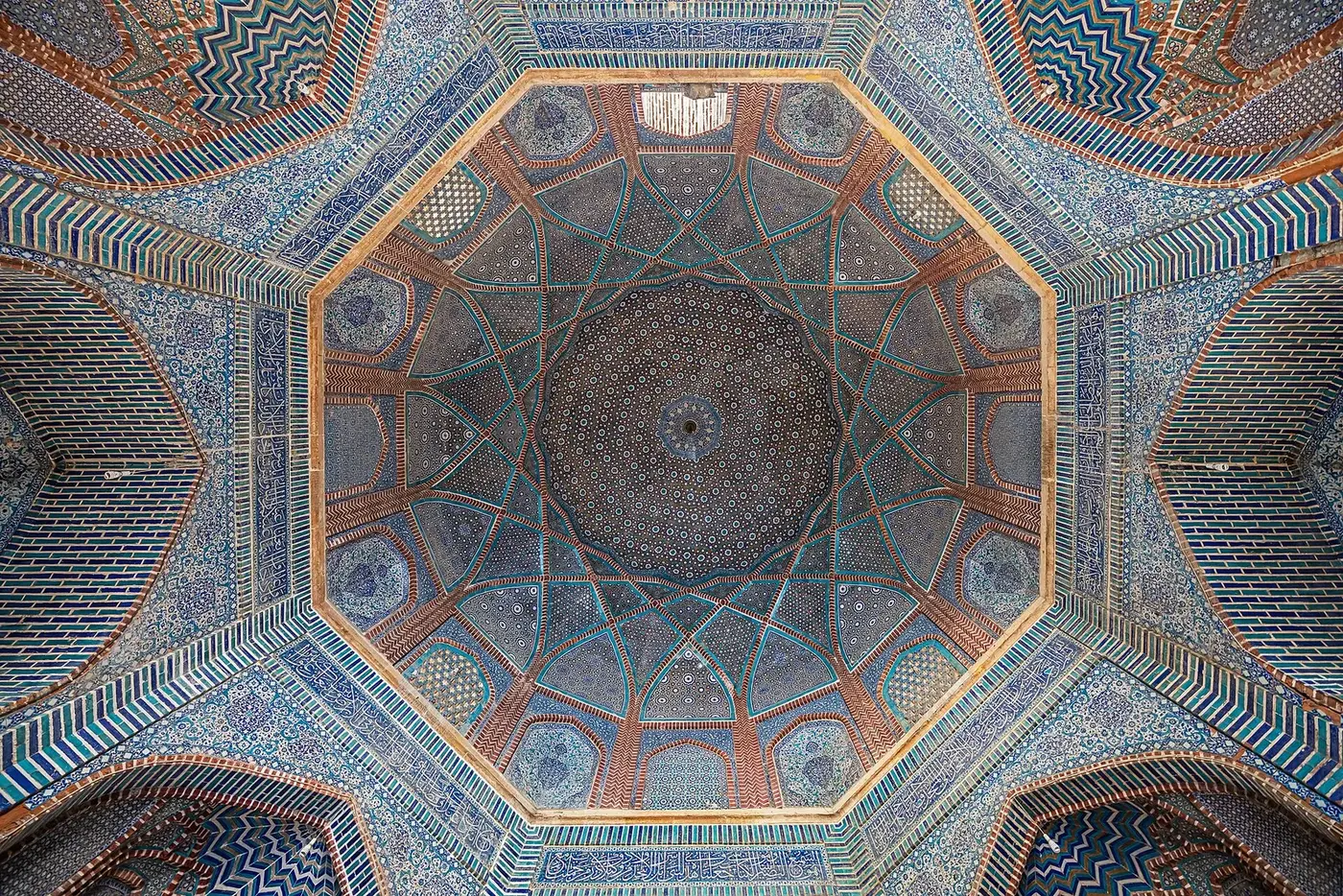
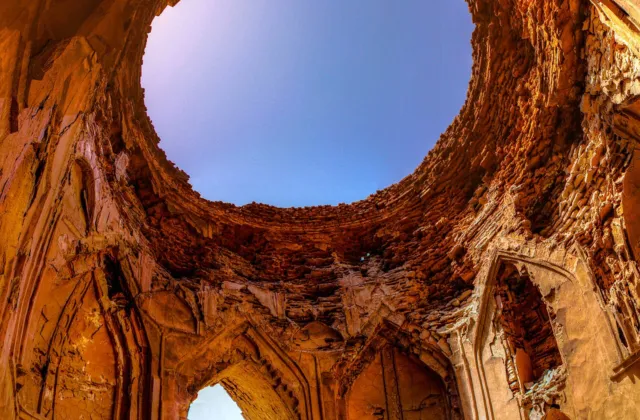
Perhaps the most visually striking part of the building is the interior of the main dome. It is covered with blue and white tiles arranged in star shaped patterns that radiate from the apex. Many people read it as a picture of the night sky, which suits a room built for prayer. Looking up, you begin to notice how complex the pattern really is; the interlocking polygons and stars seem to go on forever.
Light, Screens and the Mihrab
Daylight reaches the prayer hall through arched openings and carved lattice screens called jali. The mihrab itself is set within such screens, a feature more often seen on Mughal tombs than in mosques. Through the screens the tiles glow rather than glare, and the room stays cooler. Little niches up near the roof let air and daylight in while keeping the sun out. Thick brick handles the rest. In May and June Thatta often passes 40 degrees Celsius, yet the inner chambers stay noticeably cooler than the courtyard.
Acoustics That Need No Amplification
Long before loudspeakers, the builders of the Thatta mosque solved the problem of carrying the voice of the prayer leader across a large, subdivided space. Its acoustics are famous; a prayer said in the main hall can be heard all over the complex. The UNESCO description credits the many domes with a strong echo that lets prayers recited before the mihrab reach every part of the building. Reports quoting the caretaker say that a person speaking at one end can be heard at the other once the voice passes roughly 100 decibels, and that the mosque was meant to let about 20,000 worshippers follow the imam. No formal acoustic study backs these numbers up; they come from caretakers and newspapers, so a little caution is wise. The curved domes, the hard glazed surfaces and the evenly spaced arcades all seem to play a part. For many visitors, testing this with a quiet word or a soft recitation is one of the most memorable moments of the visit.
Place in the Wider Story of Mughal Architecture
Shah Jahan is best known for the Taj Mahal and for his marble pavilions in Agra, Delhi and Lahore. The mosque at Thatta reveals a less familiar side of his patronage. The court did not force its metropolitan style on a far province. It worked in the local idiom of brick and glazed tile instead. Some scholars connect its strong Timurid flavour to the emperor’s Central Asian campaign of the 1640s, when he tried to recover the ancestral Timurid lands around Samarkand.
Its importance can be summed up in a few points.
- It is one of the few major imperial Mughal monuments in Pakistan outside Lahore.
- The court worked with Sindhi tile makers and bricklayers rather than bringing red sandstone and marble from the north.
- Its tile work is the richest in the subcontinent and records the Sindhi kashi tradition at its height.
- Its exposed geometric brickwork ties the Mughal world directly to Timurid Central Asia.
- It is still in daily use, and on Fridays and at Eid its courtyard fills with worshippers.
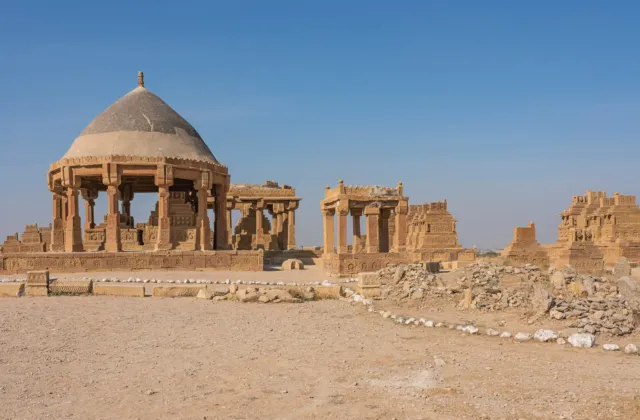
Seen alongside the Wazir Khan Mosque and the Badshahi Mosque, the Thatta mosque shows how varied Mughal architecture could be. Read together with the tombs of Makli and the carved graves at Chaukhandi, it also helps explain Sindh as a meeting point of Persian, Central Asian and local traditions.
Conservation and Heritage Status
On 14 December 1993 the mosque was added to Pakistan’s tentative list for UNESCO World Heritage status. The neighbouring Makli Necropolis is already a World Heritage Site, so together the two form one of the most historically important landscapes in the country.
The mosque is under real pressure today. The most serious is rising damp, as moisture and salts from the soil seep into the porous brick in the low lying Indus delta. When the moisture evaporates, the salts crystallise beneath the glazed surfaces, and the tiles loosen and flake. Monsoon rain, harsh heat and thousands of feet every week make matters worse. Critics have observed that conservation here has not reached the standard applied to the major Mughal monuments of Lahore, and that some earlier repairs used unsuitable materials and poorly matched tiles. Some work has been done to drain groundwater from the site. Conservators tend to prefer lime mortar for repairs because it breathes and lets the damp out. Cement does the opposite, sealing salty water inside the brick, and the decay gets faster. The site is in the care of the Culture, Tourism, Antiquities and Archaeology Department of the Government of Sindh, and its long term survival depends on careful, scientifically informed conservation.
Visiting the Shah Jahan Mosque
Thatta lies about 100 kilometres from Karachi along the National Highway (N5), and the drive usually takes about two hours. The mosque is in the town itself, a few minutes from Makli Hill. Many people combine the mosque with a visit to Makli Hill or Keenjhar Lake, and with a stop at the Chaukhandi Tombs on the outskirts of Karachi along the way. November to February is the most comfortable time to visit, as summer temperatures can be very high.
Because the mosque is still an active place of worship, visitors should dress modestly and remove their shoes before entering the prayer areas. Try to avoid prayer times, which are especially busy at midday on Fridays. Women should cover their heads. Non Muslim visitors are welcome outside prayer times, provided shoulders and knees are covered. You can usually take photographs in the courtyard and galleries. Ask first, though, before pointing a camera at anyone who is praying. Avoid using flash inside the prayer hall. A local guide from Thatta can demonstrate the acoustics and point out inscriptions that are easy to miss. And please do not touch, lean on or scratch the tiles, which are already fragile. The colours look their best in the early morning and late afternoon.
Approximate Road Distances from Thatta
| Destination | Approximate distance | Usual route |
|---|---|---|
| Makli Necropolis | 3 to 5 km | Thatta town road |
| Keenjhar Lake | about 20 km | National Highway (N5) towards Hyderabad |
| Banbhore | about 35 km | National Highway (N5) towards Karachi |
| Chaukhandi Tombs | about 70 km | National Highway (N5) towards Karachi |
| Karachi | about 100 km | National Highway (N5) |
| Hyderabad | about 110 km | National Highway (N5) via Keenjhar Lake |
These figures are rounded, and your route may differ. Visiting arrangements change from time to time, so it is worth confirming with the Sindh Culture Department or a local guide in Thatta.
Frequently Asked Questions
Who built the Shah Jahan Mosque in Thatta?
The mosque was commissioned by the Mughal emperor Shah Jahan. The main part was built between 1644 and 1647, under the supervision of the provincial governor, recorded by the Sindh Antiquities Department as Nawab Abul Baqa Amir Khan.
Why did Shah Jahan build a mosque in Thatta?
Tradition holds that he built it to thank the people of Thatta for sheltering him when, as Prince Khurram, he took refuge there during his rebellion against Jahangir. It may also have been meant to help the town recover from a devastating storm in 1637.
How many domes does the mosque have?
UNESCO and most scholarly sources give 93 domes. Local guides sometimes say 100, because they count the small domes as well.
What makes its tile work special?
It is regarded as the most elaborately tiled building in South Asia. The tiles are cobalt blue, turquoise, manganese violet and white, many tiles carry several colours, and the style reflects Persian kashi work and Safavid design.
Is the mosque a UNESCO World Heritage Site?
Not yet. It has been on the UNESCO tentative list since 1993, while the nearby Makli Necropolis is a full World Heritage Site.
Does the mosque have minarets?
No. Unlike most large Mughal mosques, it has no minarets; the emphasis falls on its domes and tiled iwans.
How far is the mosque from Karachi?
About 100 kilometres, or roughly two hours by road along the National Highway.
Conclusion
The Shah Jahan Mosque is more than a beautiful building. It records a moment when the Mughal court chose to honour a provincial city in that city’s own architectural language. Its brick and glazed tile carry skills that link Sindh to Persia and Central Asia, and its domes, arcades and shimmering panels still draw scholars, pilgrims and travellers. Preserving it for future generations is a duty shared by heritage institutions and by everyone who values the history of Sindh.
References and Further Reading
- UNESCO World Heritage Centre, Shah Jahan Mosque, Thatta, Tentative List entry, submitted 1993.
- Directorate General of Antiquities, Government of Sindh, Jami Mosque, Thatta Town.
- Catherine B. Asher, Architecture of Mughal India, The New Cambridge History of India, Cambridge University Press, 1992.
- Arash Khazeni, Sky Blue Stone, The Turquoise Trade in World History, University of California Press, 2014.
- Ahmad Nabi Khan, Islamic Architecture in South Asia, Pakistan, India, Bangladesh, Oxford University Press, 2003.
- Yasmeen Lari, Traditional Architecture of Thatta, Heritage Foundation, Karachi, 1989.
- Kamil Khan Mumtaz, Architecture in Pakistan, Concept Media, Singapore, 1985.
- M. A. Ghafur, The Calligraphers of Thatta, Indus Publications, 2004.
- Ihsan H. Nadiem, Makli, The Necropolis at Thatta, Sang e Meel Publications, Lahore, 2000.
- Henry Cousens, The Antiquities of Sind, Archaeological Survey of India, Calcutta, 1929.
- Anna Suvorova, Muslim Saints of South Asia, Routledge, 2004.
- Naimat Khan, “In Pakistan’s Thatta, a mosque that is a marvel of engineering”, Arab News, 8 November 2019.
- Ashraf Khan (AFP), “Fading splendour of Pakistani Mughal mosque”, May 2016.
All photographs come from Wikimedia Commons. The photographer and licence for each image are named in its caption.

Leave a Comment