

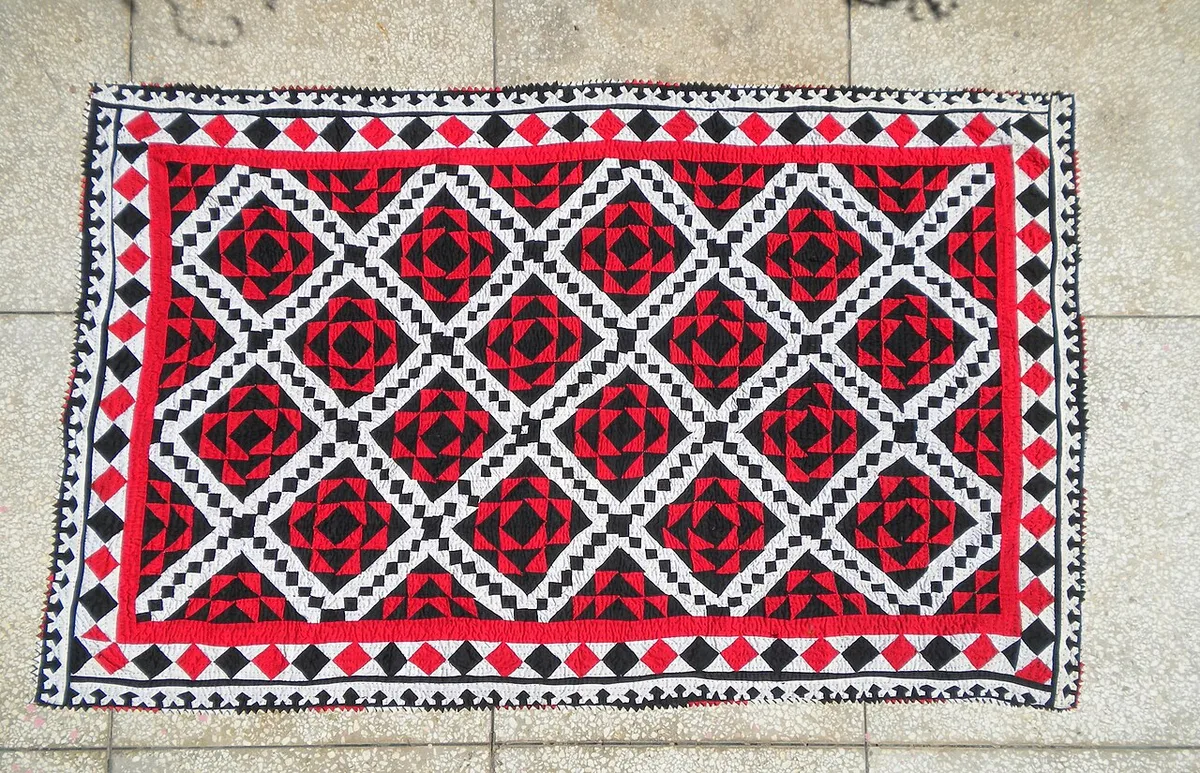
A Ralli quilt is a hand stitched cotton quilt made by women in Sindh and the Thar Desert, and in the lands just around them. It is built from old cloth, scraps and new colour, and it covers beds, cots and floors in thousands of village homes. The name, the methods and the patterns below come from museum records, a published study and newspaper reports, all linked in the text.
In this article (24)
- What a Ralli Quilt Is and Where the Name Comes From
- How Old Are Sindhi Ralli Patterns, and What Shows It
- Links With Ancient Pottery of the Indus Region
- Stone Carvings at Chaukhandi and Other Tombs
- Early Trade Records and Museum Pieces
- How a Ralli Quilt Is Made, Layer by Layer
- The Back, the Filling and the Top
- Quilting Together on a Reed Mat
- Three Main Styles of Ralli Work
- Patchwork Rallis Made From Small Pieces
- Appliqué and Cutwork Rallis (Tukwari)
- Embroidered Rallis of the Saami and Jogi
- The Women Who Make Ralli Quilts in Sindh
- Motifs and Patterns Found on Ralli Quilts
- Colours and Dyes Used in Ralli Quilts
- Regional Variations Across Sindh and Thar
- Lower Sindh, Badin and the Thar Desert
- Middle Sindh Around Hyderabad and Sanghar
- Upper Sindh, Sukkur and Ghotki
- Beyond Sindh, Cholistan and Rahim Yar Khan
- Rallis in Daily Life in Sindhi Villages
- Rallis in Dowry, Weddings and Family Wealth
- Ralli Quilts at Exhibitions and in the Market Today
- Sources and Further Reading on the Ralli Quilt
Quilt researcher Patricia Ormsby Stoddard, whose introduction to Ralli Quilts: Traditional Textiles from Pakistan and India (2003) is summarised in an essay on the Quilt Index, says rallis are made in Sindh, Balochistan and southern Punjab in Pakistan and in Rajasthan and Gujarat in India. Sindh sits at the centre of this ralli belt, and this guide stays mostly with Sindh and Thar.
What a Ralli Quilt Is and Where the Name Comes From
Stoddard writes that the word comes from the local verb ralanna, meaning to mix or connect. The same quilt is called ralli, rilli, rilly, rallee or rehli, depending on who is speaking. A 2023 paper by Anum Rauf and Asma Kamal in the Journal of Design and Textiles gives the root as ralana and the same meaning.
That is a fair description of the work, since a ralli is many pieces of cloth joined into one useful thing. Stoddard gives the usual size as about seven feet long and four or five feet wide, which is enough to cover one adult on a string bed.
She also says the women who make them come from many groups. Some live in farming villages, some in settled towns and some move with their herds. Both Muslim and Hindu families make rallis, and so do farmers, herders, craftsmen and landowning households.
On this site, the Sindhi Culture guide places the ralli beside the cap, the ajrak and the embroidered dress as everyday parts of Sindhi life. This article looks at the quilt alone.
How Old Are Sindhi Ralli Patterns, and What Shows It
No one can name the year the first ralli was sewn. Cotton rots, and a quilt used every night wears out in a few years. Stoddard notes that a quilt kept in the family stack for guests can last for generations, but a daily quilt seldom survives long enough to be dated.
So the history of the ralli is mostly read from its patterns. Researchers set them beside things that last longer than cotton, mainly carved stone and painted clay from the same region.
Links With Ancient Pottery of the Indus Region
Stoddard points to painted pottery of the region, most of it from about 2000 to 800 BC. Checkerboards, lines, triangles and more complex grids appear both on these pots and on modern rallis. Some pots carry small fingerprints in the paint, and archaeologists have taken this as a sign that women may have painted them.
She adds that painted pottery seems to give way to plain wares in the first millennium BC, while the old designs carry on in rallis and embroidery. Her suggestion is that mothers may have taught these designs to daughters over a very long time. She asks this as an open question and does not claim it is proven. The wider story of that early world is told in our article on the Indus Valley Civilisation.
Stone Carvings at Chaukhandi and Other Tombs
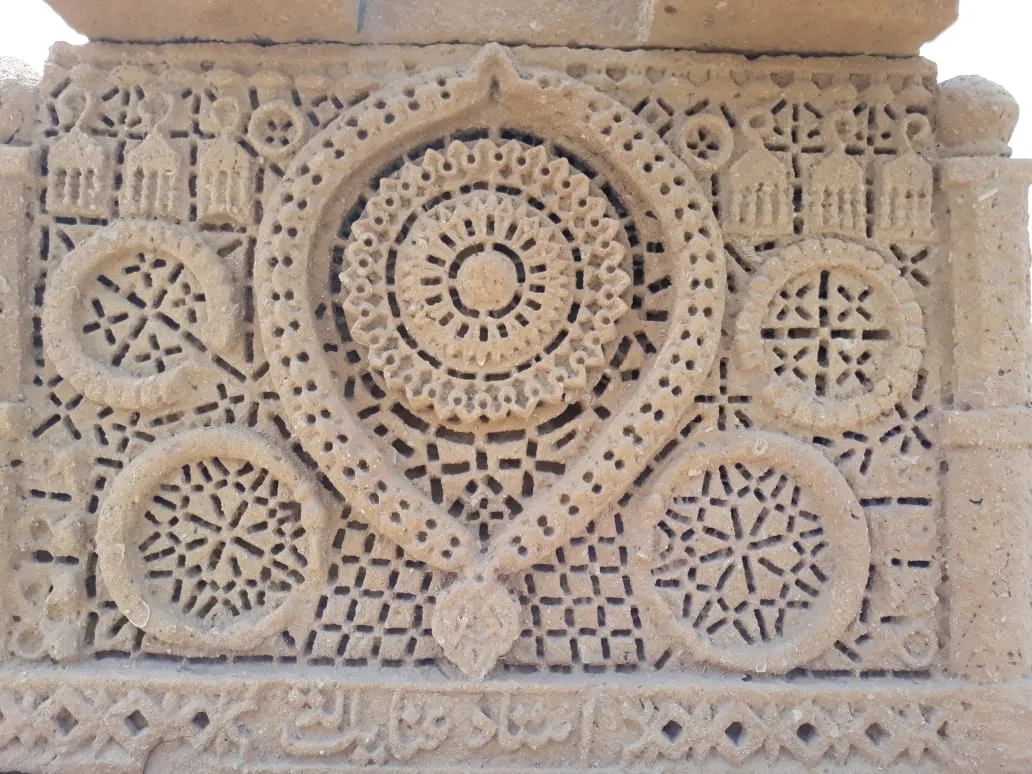
The second link is in stone. Stoddard notes that the carved desert tombs of Sindh and Balochistan, made over about 400 years from the middle of the fifteenth century, show motifs very close to quilt blocks. Some carved lines even look like rows of stitching.
The 2023 study reports the same view from curators and local people, who said ralli designs were taken from the tombs at Chaukhandi near Karachi. You can compare the two for yourself in our piece on the Chaukhandi tombs and their stone carving.
Early Trade Records and Museum Pieces
Very little was written down about rallis in the past. Stoddard does point to trade records of the early 1500s that list quilts among goods sent from western India to Europe. Those lists show quilting in the wider region at that time, but they give no detail of a Sindhi ralli.
A few older quilts are now kept in museum stores. The Victoria and Albert Museum in London holds an embroidered rilli from Thatta dated to about 1900. Its catalogue entry describes coloured cotton thread on black cotton with a green back, and says the stitch represents the scales of a snake. It measures 203 by 163 centimetres and was given by the family of the late Justice Feroze Nana.
The British Museum holds a cotton ralli acquired in Pakistan, numbered As1976,03.3. Its curator’s notes record a patchwork front with a running arrow border and an old block printed ajrak shoulder cloth used for the back. The notes say its black and white design recalls tilework and that it could come from anywhere in Sindh or the Thar.
How a Ralli Quilt Is Made, Layer by Layer
Every ralli has three parts: a back, a filling and a decorated top. The International Quilt Museum’s online exhibit World Quilts, The Ralli Story says each of these parts tells something about the woman who made it.
The Back, the Filling and the Top
The back is often an old head shawl. Stoddard writes that a shawl is usually big enough once about six inches of extra cloth is added along the top and one side. Old tie dye cloth or a worn ajrak is also common. The British Museum ralli described above has exactly such an ajrak back, and our article on Sindhi Ajrak explains how that printed cloth is made.
Most backs are green. According to the World Quilts exhibit, women usually dye the backing cloth that colour, though around Rahim Yar Khan in Punjab they choose orange instead. When a quilt is meant as a gift, a new piece of solid green cloth may be bought for the back.
The filling is made of three to five layers of worn cloth or cotton fibre, according to Stoddard. The museum exhibit adds that it is built from scraps too small or too weak to use on the top, and that more layers are added for a warmer quilt. The filling is first held to the back with long tacking stitches, which are pulled out later.
The top carries the design. Much of its cloth comes from old shalwar kameez, dyed to the colour the maker wants. Traditionally only plain, solid colours are used on the top.
Quilting Together on a Reed Mat
One woman usually pieces the top on her own. When it is ready, she calls female relatives and friends to help sew the layers together. The World Quilts exhibit gives the local name for this gathering as rallee vijhanu, the laying of the ralli.
Stoddard describes the scene. The quilt lies on a reed mat on the ground and no frame is used. Women sit on opposite sides, pull the layers tight and stitch straight, parallel rows with thick coloured thread. On a fine quilt the rows can be as close as one eighth of an inch.
Dawn reporters saw the same habit at a 2017 exhibition, where women described sitting in a circle on the floor with the ralli spread between them while they chatted or hummed. Some women, the same Dawn report adds, would rather do all of it by themselves.
Edges are turned under or bound with stitching. For special quilts, makers add tassels at the corners, or sequins and small mirrors on the surface.
Three Main Styles of Ralli Work
Stoddard sorts rallis into three basic styles: patchwork, appliqué and embroidery. Many quilts mix two of them. In both patchwork and appliqué rallis, blocks of the same colour are often set in diagonal lines across the quilt, which she calls a distinguishing feature of ralli design.
The 2023 study, drawing on the craft writer Noorjehan Bilgrami, gives two local names. Appliqué rallis are called tukwari, and patchwork rallis are called chutkinwari or kata ralli.
Patchwork Rallis Made From Small Pieces
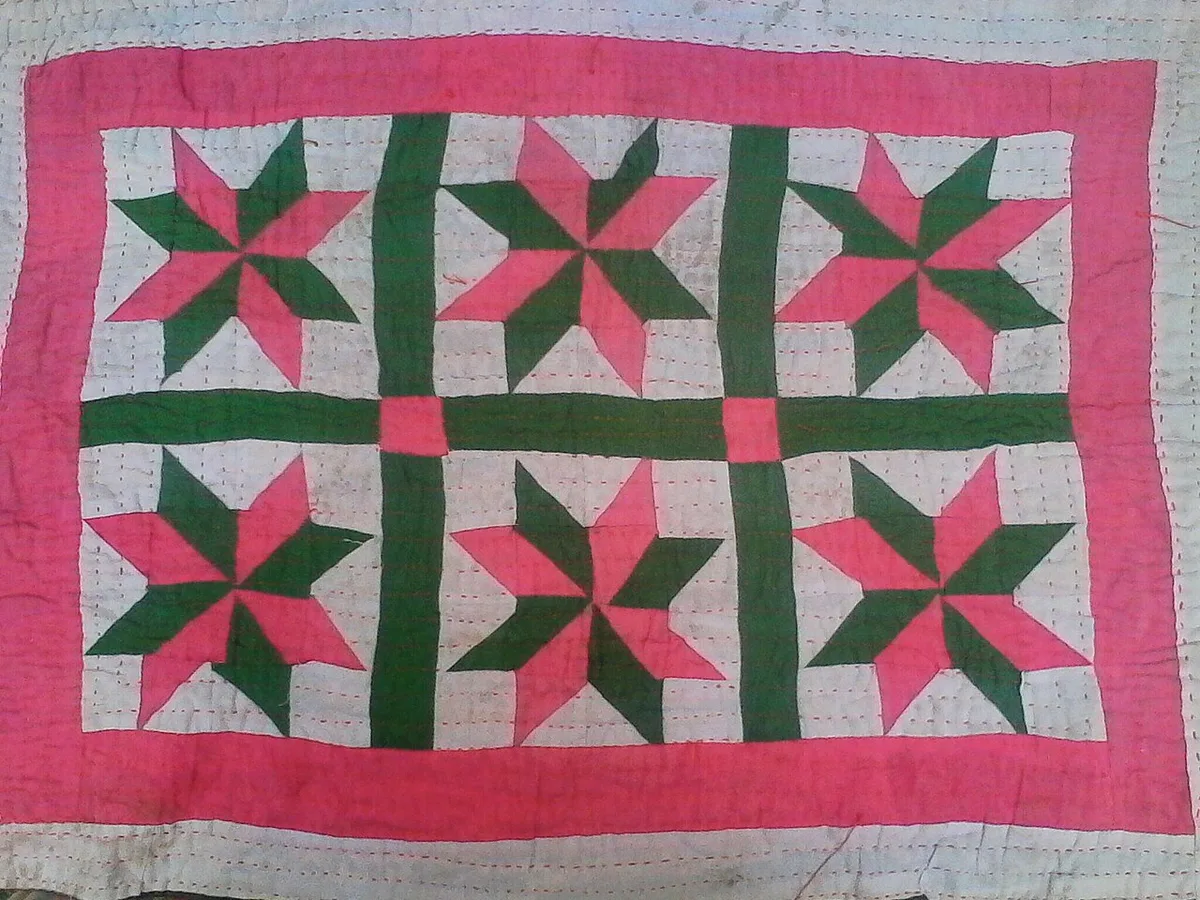
Stoddard says patchwork rallis are the most common quilts on village beds across Sindh. The pieces are torn or cut into squares and triangles from hand dyed cloth. Squares turned on point and long runs of triangles give these quilts a sense of movement.
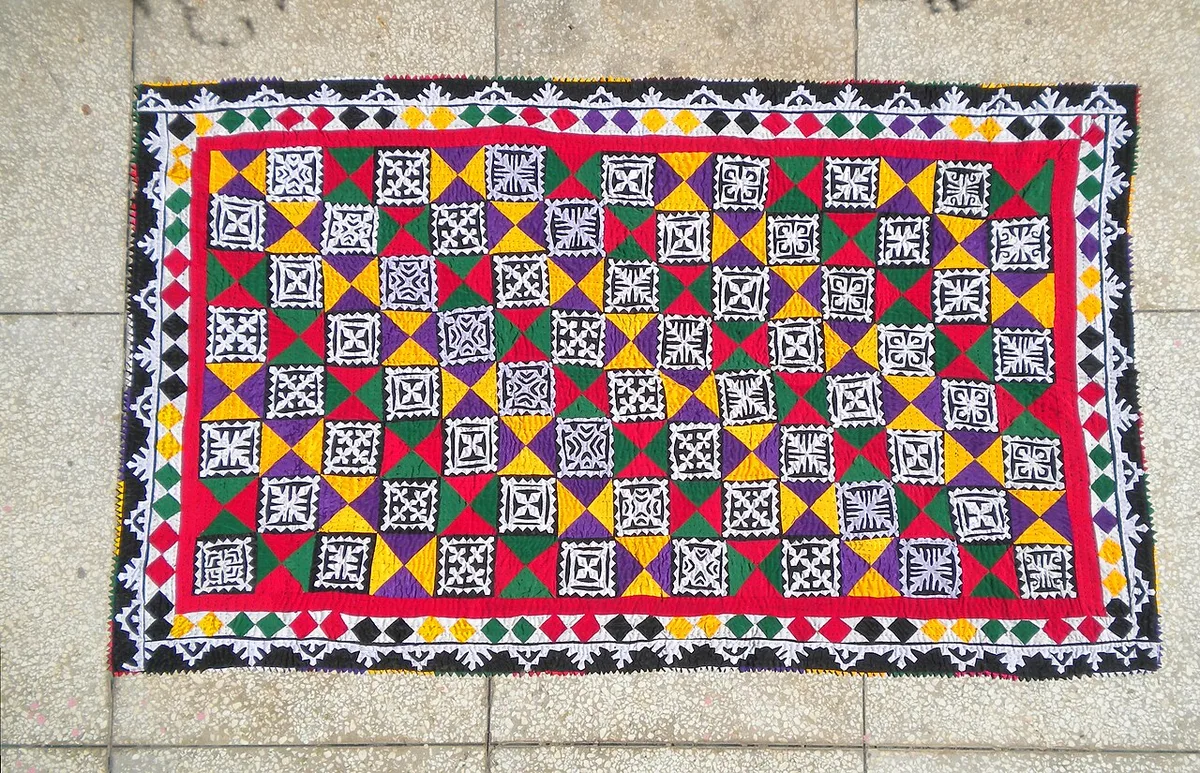
Some patchwork patterns have a second use. Stoddard records one layout that serves as a board for a chess type game called tukri, and another, in a cross shape, used for the game chopar. When one geometric block repeats over the whole quilt, makers call it farsh, the word for a tiled floor.
The simplest patchwork quilt has a plain centre and a striped border. These are called lassi or simple rallis and are treated as everyday quilts.
Appliqué and Cutwork Rallis (Tukwari)
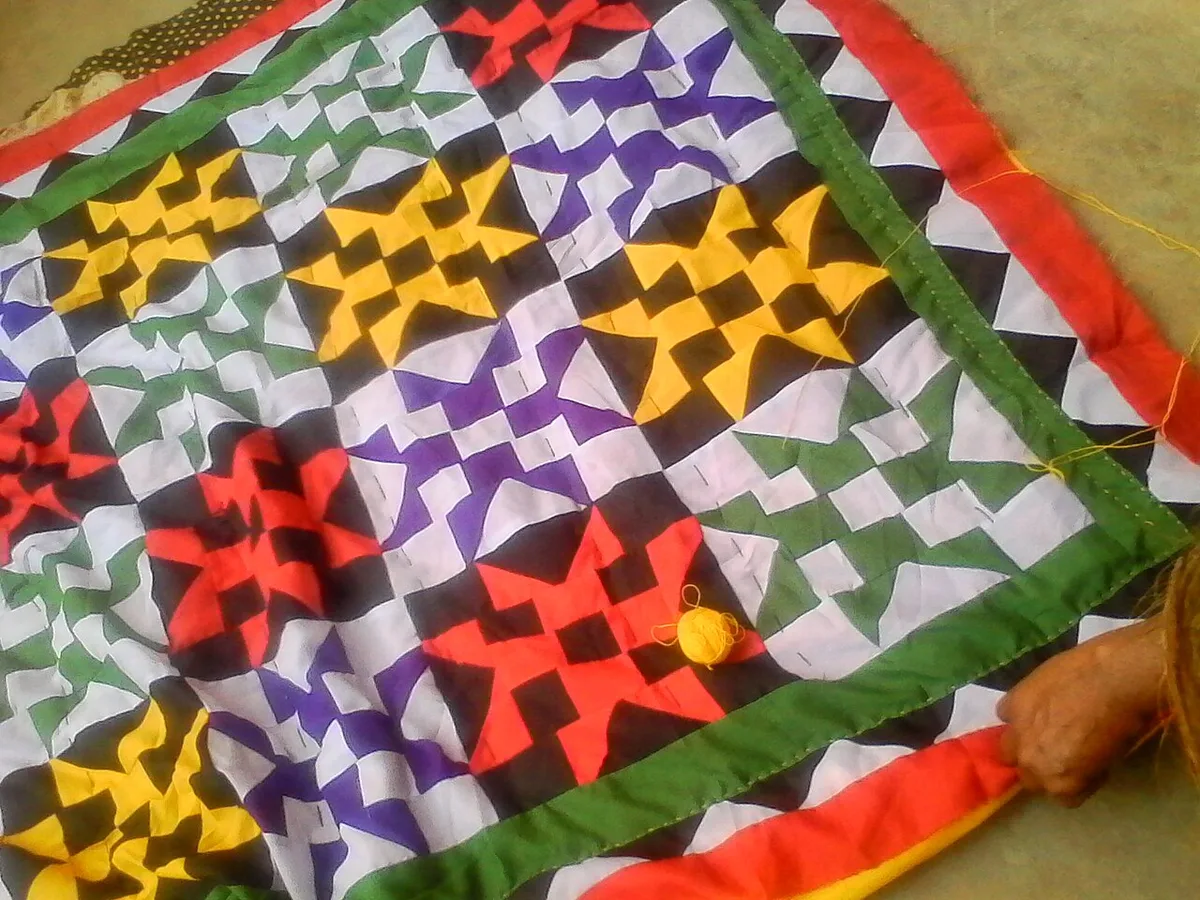
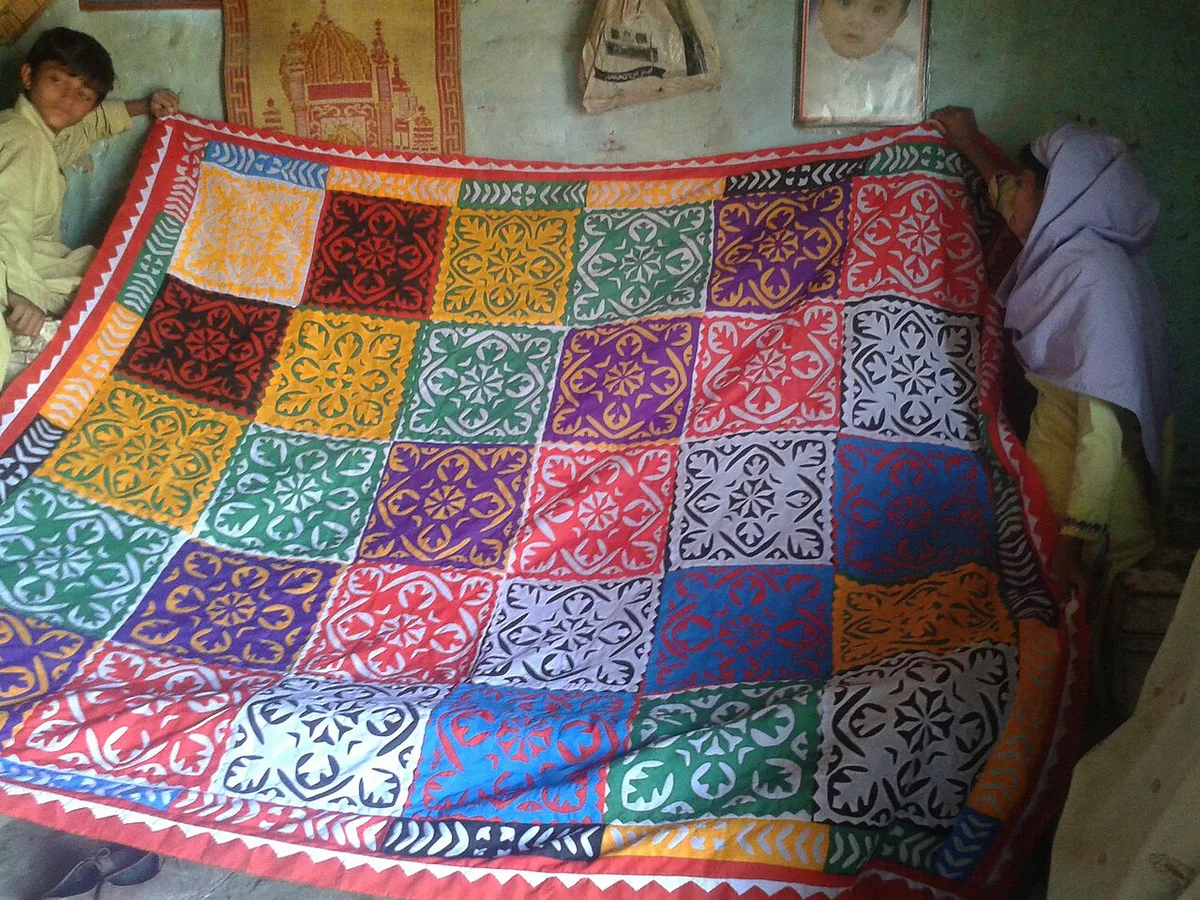
In appliqué, a shape cut from one cloth is sewn onto another. The World Quilts page on appliqué explains that a paste made from plants is sometimes dabbed on to stop the shape slipping while it is sewn. Designs range from circles, vines, peacocks and elephants to patterns with lines only a quarter of an inch wide.
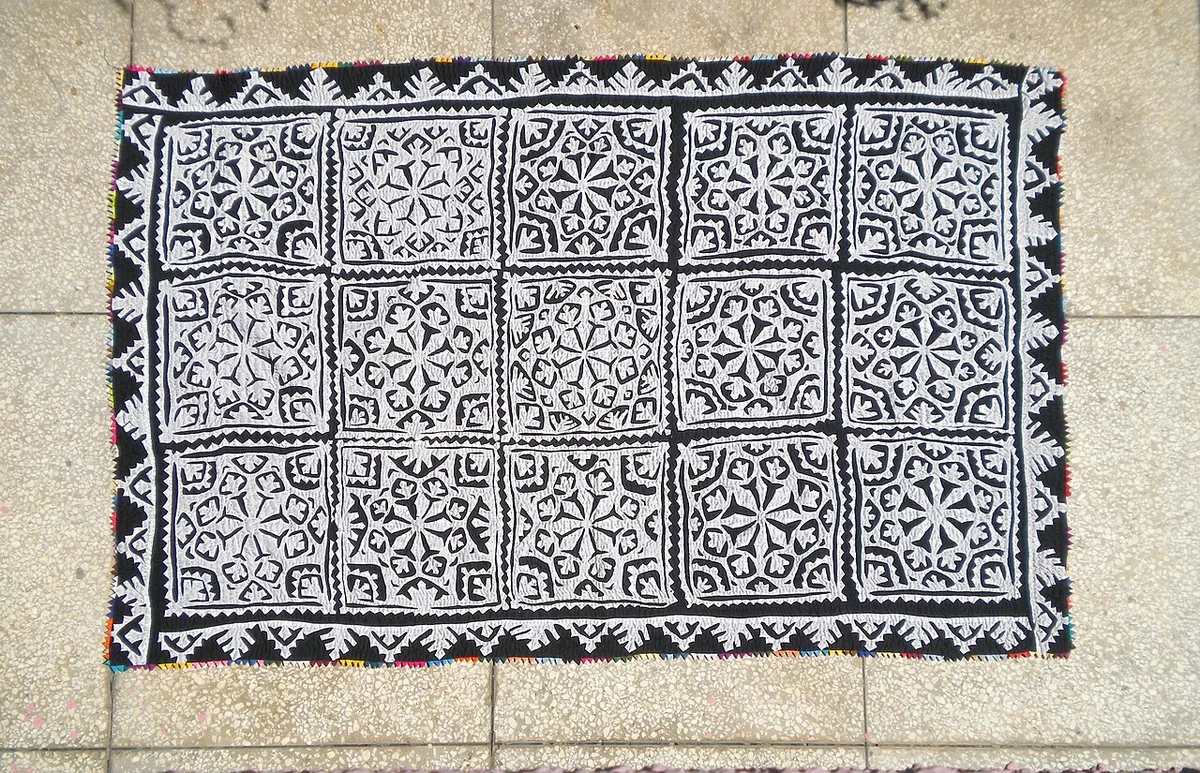
The finest cutwork is made much like a paper snowflake. The maker folds a square of cloth into quarters or eighths and cuts through all the layers at once. She unfolds it, tacks it down and sews it with a tiny hem stitch, turning the raw edges under as she goes. The museum names Upper Sindh and the Rahim Yar Khan area as the best known centres for this work.
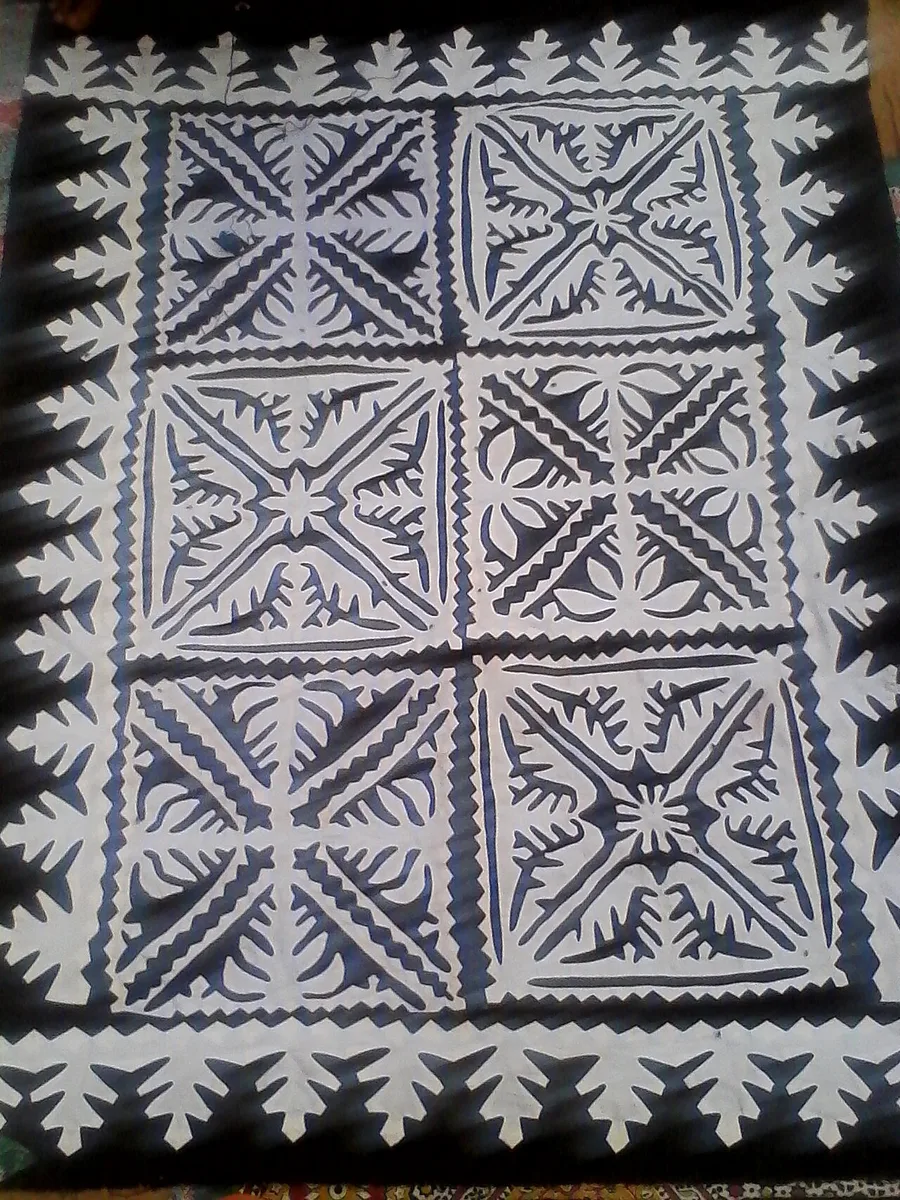
Upper Sindh also has a layered method. Stoddard explains that after the top shape is cut, but before it is sewn down, a cloth of another colour is slipped into the open spaces. Museum catalogues, such as that of the International Quilt Museum, often list this kind of work as reverse appliqué.
The 2023 study recorded the steps used by a family in Goth Zahir Barich near Hatri, outside Hyderabad. A plain cloth is cut to a design, laid on a contrasting cloth, and small colour patches are placed underneath before everything is hand sewn. The finished squares are then joined into a bedspread or other item.
Some quicker appliqué quilts use one large piece of black, blue or red cloth for the whole centre, decorated with cut shapes. Women call this style “new design”, according to the World Quilts exhibit, and many like it because it is finished sooner than a quilt of many separate blocks.
Embroidered Rallis of the Saami and Jogi
Stoddard names two groups from Lower Sindh as the best known makers of embroidered rallis. The Saami, who move with their herds, stitch on plain cloth that is usually black. They use a thick thread, and from a few steps away the pattern can be mistaken for a print. The Jogi, a community of snake charmers, more often work on brown cloth.
Their stitches include running stitch, chain stitch, feather stitch, herringbone and interlacing stitch. In Upper Sindh, embroidered blocks sometimes alternate with appliqué blocks, and the stitch there is often the interlaced hurmutch, also known as hoormutch.
Jogi quilts may also carry kanberi embroidery. The World Quilts exhibit says this stitch is meant to copy the track a snake leaves in sand. The V&A note on its Thatta rilli, where the stitch “represents the scales of a snake”, points to the same kind of imagery.
The Women Who Make Ralli Quilts in Sindh
Rallis are women’s work from start to finish. The World Quilts exhibit and its companion pages describe makers who mostly live in villages, care for children and animals, fetch water and fuel, and help in the fields. Many had little or no schooling.
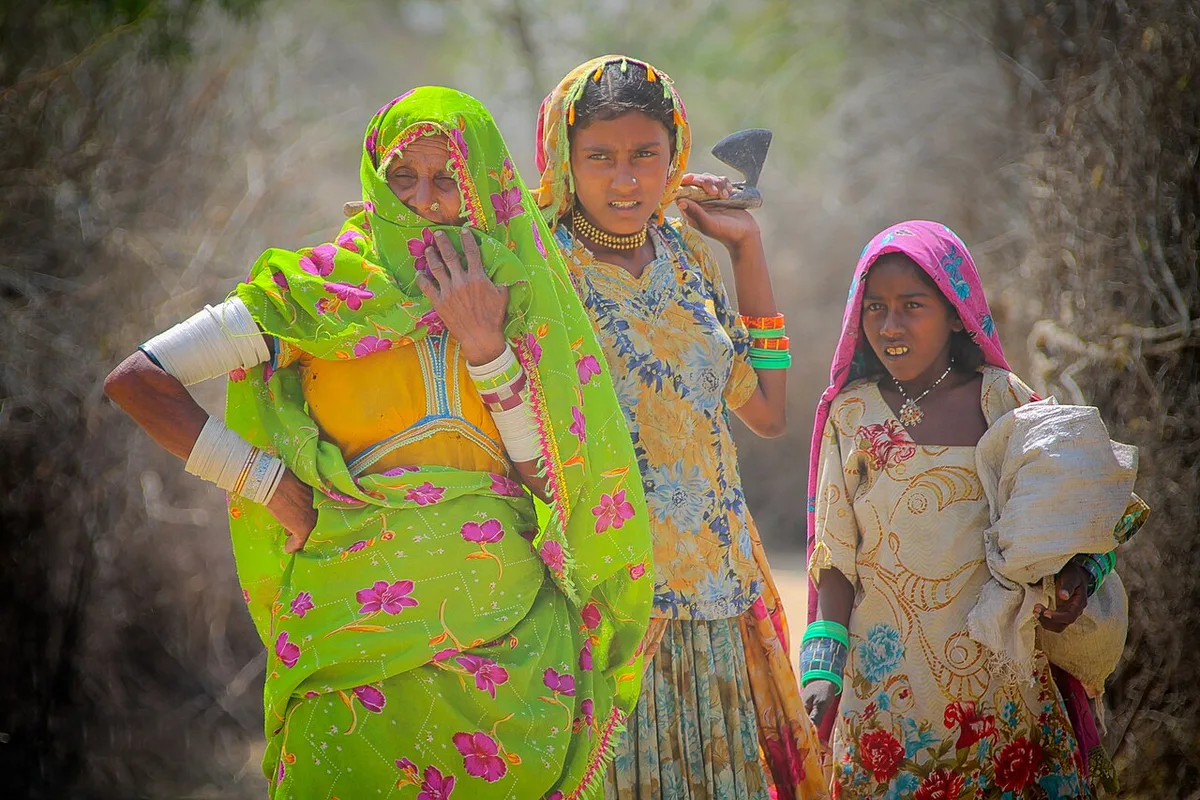
That matters for how patterns survive. Stoddard writes that the women use no paper or tools to plan a design. Each maker keeps a large mental store of patterns she has made or seen, and many describe them simply as “old patterns” or “new patterns”.
The skill passes from mother to daughter. In the 2017 Dawn report, Sajja Devi explained that her late mother taught her, that she taught her daughter Radha, and that Radha taught her own daughter Reena. Reena, then 17, could make bodices, sleeves, bags and cushion covers but had not yet finished a whole quilt alone.
Sajja Devi described the routine plainly. “We tend to the housework, cooking, cleaning, take care of the children, fields, to come back to our needlework,” she told Dawn. Every free moment went to the ralli.
The same report quoted Marvi Abida Samo of the Sormy Development Society for Women in Badin. She said many women who once worked in the fields now spend that time on handicrafts, especially rallis, once they learned what their skill could earn.
The 2023 study met a household near Hatri where 10 to 12 women, aged 10 to 70, were all skilled in ralli work. They told the researchers they sew whenever housework allows, and that a quilt sold for about 5,000 rupees, rising to 10,000 rupees for larger or more detailed pieces.
Motifs and Patterns Found on Ralli Quilts
Most ralli patterns rest on a square grid. Stoddard notes that some are built instead on circles, stars or flowers, and that a single small village can hold a great variety of patterns.
The edges of a ralli get as much care as the centre. Stoddard lists scallops, cones, interlocking circles and stepped squares, the last being typical of Upper Sindh. The World Quilts exhibit describes the mandherro border of Lower Sindh, a cross shaped motif based on the head of a milk churn.
Many appliqué shapes are simply called flowers, and the exact flower usually has no name. The eight petal lotus is the one flower the museum says is usually named.
Some patterns are named after daily objects. The International Quilt Museum holds a ralli made in about 1994 by a woman named Haleema of Phuleli village in Middle Sindh, who called her design biso bulo, the nose jewel and nose ring.
Scale is part of the skill. Lower Sindh patchwork, the World Quilts exhibit says, often uses pieces smaller than one and a half inches square, all cut and placed from memory.
Colours and Dyes Used in Ralli Quilts
Stoddard lists the most common ralli colours as white, black, red, yellow, orange, green, dark blue and purple. The World Quilts exhibit calls them solid, strong colours. Each region and community also has its own favourites, which often makes it possible to tell where a quilt was made.
The World Quilts exhibit says fabric was once dyed at home with plant dyes such as indigo for blue and madder for red. Chemical dyes reached local markets by the early 1900s. Today a maker may dye her own cloth or buy it from the village dyer, and some now choose synthetic cloth because it is cheaper and holds its colour.
The art historian Ghulam Ali Allana offered a local reading of this palette. As quoted in the 2023 study, he wrote that Sindhi people may take their colours from their surroundings: green from fresh fields, purple and blue from hills, yellow from ripe corn and crimson from the sunset.
Regional Variations Across Sindh and Thar
Sindh is often divided into three zones, and each has a recognisable ralli style. The World Quilts exhibit says these traditions are distinct enough that the area where a quilt was made can often be identified from its design alone.
Lower Sindh, Badin and the Thar Desert
Lower Sindh runs along the Arabian Sea and includes part of the Thar Desert, Thatta and Karachi. Makers here use a strong seven colour palette. Many of their quilts have mandherro borders, and the strips between blocks are often red appliqué laid over white.
Stoddard singles out Badin for detailed quilts in black, white, red and yellow. The 2023 study adds that in parts of Badin quilts are made in coloured squares and bands using the kanbiri stitch, and that a kanbiri ralli is traditionally presented to a spiritual guide by his followers.
The Thar Desert side has its own makers. At the 2017 Karachi exhibition, Sonu Meghwar of Mithi showed a silk ralli that he said took his wife, Nainoo, nine years to make. A ralli priced at 850,000 rupees had been finished in 18 months by 60 women in Umerkot, according to Dawn’s report on the exhibition. Our guide to Tharparkar history and culture covers the wider life of this desert district.
Middle Sindh Around Hyderabad and Sanghar
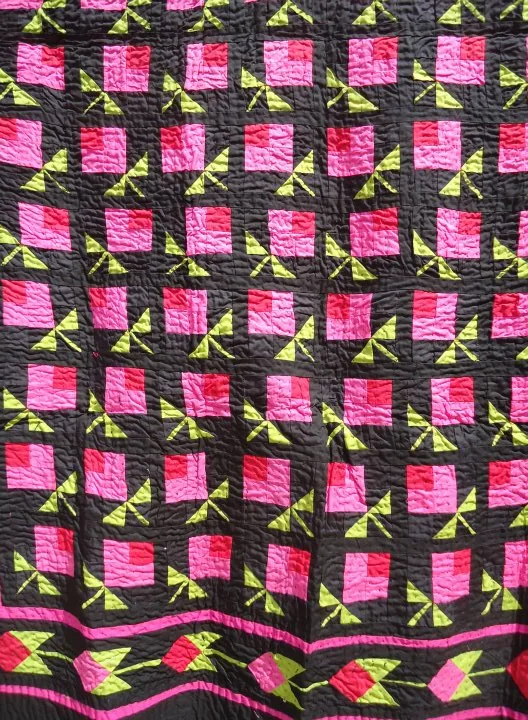
Middle Sindh is irrigated farmland along the Indus. The World Quilts exhibit says makers here prefer a brighter palette with pink and turquoise, and strips of white appliqué over a darker ground. Stoddard adds that Hindu makers in this zone use pink, and that backs are often green.
The 2023 study describes rallis from the central plains around Hyderabad, Hala, Nawabshah and Matiari as checked designs of squares with fine floral appliqué and a framed border. Quilts from the Nara Valley, from Samaro and Umerkot to Sanghar, are known for complex appliqué and lively patchwork colour.
Upper Sindh, Sukkur and Ghotki
Upper Sindh is famous for fine lined appliqué blocks set on the diagonal, sometimes alternating with embroidered blocks. Borders are elaborate and often use a stepped square motif. Stoddard adds that makers here like tassel borders at the corners or all around the quilt.
The 2023 study links the Mahar community near Ghotki, Sukkur and Mirpur Mathelo with especially elegant appliqué and patchwork layouts.
Beyond Sindh, Cholistan and Rahim Yar Khan
North of Sindh, in Rahim Yar Khan, Stoddard says the most common ralli mixes nine patch blocks with very fine appliqué blocks, often with an orange back. In the Cholistan Desert to the east, makers combine patchwork with fine appliqué in red, blue, yellow and white or in softer earth shades.
Rallis in Daily Life in Sindhi Villages
A ralli is first of all a working object. Stoddard says it is spread over the wooden charpoy or sewn into a storage bag. When it wears thin, it is reused as padding for workers or for animals. The British Museum notes add sitting mats, bedding, saddle covers for animals and a wrap in cold weather, and say a household may own from 5 to 50 quilts.
The 2023 study adds cradles, dowry bags, coverlets, saddle cloths and bundles for carrying clothes. At a petrol pump in Hyderabad, its authors photographed a ralli in use as a bedspread on a charpai.
Inside the home, the quilts are stored with some ceremony. The World Quilts exhibit describes them stacked neatly against a wall and sometimes covered by a special top ralli called a daraniyo. Stoddard notes that the ralli was not usually bought or sold. It was made for the family’s own use, though some women did sell their work.
Not every ralli is meant for winter nights. Zarina Bibi of Nawabshah told Dawn in 2017 that women also make them as wedding gifts for relatives, and that she still kept a ralli made by her husband’s great great grand aunt. The ralli shares this place in daily life with other Sindhi textiles, such as the Sindhi bharat embroidery on dresses and the Sindhi topi worn by men.
Rallis in Dowry, Weddings and Family Wealth
The ralli has a special role in marriage. The World Quilts page on dowry and wealth says both Muslim and Hindu families in the ralli region traditionally prepare a dowry, starting in a girl’s childhood. Clothing, cookware, jewellery and quilts all go with the bride to her new home.
The same page says families hope to give 15 to 20 rallis in a bride’s dowry, for the couple and their future children. The minimum is usually two quilts per person for everyday sleeping. Wealthy families may own hundreds, and spare quilts are lent to visiting guests.
Women often sing while sewing a wedding quilt. The museum records one song for the groom: “Come leisurely with graceful pace, Let my heart’s bud open, Your bed is set with the best rallis.”
Wedding rallis are often the most decorated. Stoddard notes that new cloth, sequins, beads and tassels mark a quilt made for an important occasion. Special rallis are also made as gifts to holy men.
The link between rallis and respect is spoken aloud. “The more ralli a bride has in her dowry, the more she is respected in our circles,” Zarina Bibi told Dawn. She planned to give her newest quilt, black and silver with fine mirror work, to her future daughter in law.
Ralli Quilts at Exhibitions and in the Market Today
Rallis have moved from village stacks into city shops and museums. The first Ralli Exhibition and Competition, organised by the Sindh culture, tourism and antiquities department, opened on the lawns of the Mohatta Palace in Karachi in late April 2017. Dawn reported that artisans came from Badin, Umerkot, Sanghar, Nawabshah, Khairpur and Mithi.
Prices at that event ranged from 5,000 rupees to 3 million rupees. Sonu Meghwar asked 2 million rupees for his wife’s silk quilt. He said the silk yarn was bought from Rajasthan in 1981 at 2,000 rupees per tola, and that he had earlier refused an offer of 800,000 rupees from a visiting Indian businessman.
The craft has also been shown abroad. The 2023 study records that Stoddard organised a ralli exhibition in Islamabad in 1998, followed by shows at the International Quilt Festival in Houston in 2003 and later in the United States and France. It also notes the Sindh Museum in Hyderabad, which displays Jogi, kata and Mahar group rallis, and the Sindh Indigenous Traditional Crafts Company, registered in 2010 to support local artisans.
After the 2010 floods, Stoddard writes, many women in relief camps made rallis to earn money to return to their villages. The 2023 study also mentions a group called Bichhuana that supported 35 ralli making families in Khamiso Kholoro near Dadu after those floods.
The same study raises a concern. Many makers do not know where to find fair buyers, and middlemen can take much of the value. Its authors call for government funding, better documentation and a textile museum to protect the craft. For now, the surest record of the ralli is still the quilts themselves, folded in village homes across Sindh and Thar.
Sources and Further Reading on the Ralli Quilt
- Patricia Ormsby Stoddard, introduction to Ralli Quilts: Traditional Textiles from Pakistan and India (2003), on the Quilt Index.
- International Quilt Museum, World Quilts, The Ralli Story.
- Shazia Hasan, How to make a Sindhi quilt, Dawn, May 2017, and Ralli holds great attraction at exhibition, contest, Dawn, May 2017.
- Anum Rauf and Asma Kamal, Preserving and Promoting the Sindhi Ralli Quilts, Journal of Design and Textiles, 2023.
- Victoria and Albert Museum, Quilt (rilli), Thatta, about 1900, IS.4 1981.
- British Museum, Quilt (ralli), As1976,03.3.


Leave a Comment