

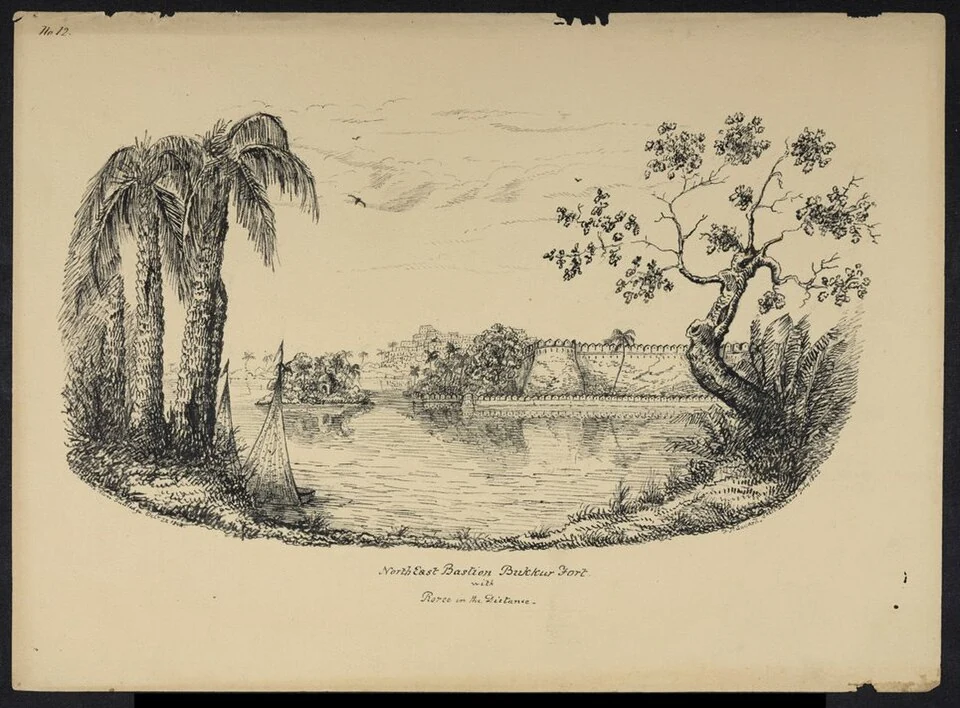
For seventy years, from 1520 to 1591, Sindh was ruled by one Central Asian family under two names. First came the Arghuns, then the Tarkhans. They were not two foreign invasions. They were two branches of the same house, and modern scholarship treats them as one rule. This is the story of the Arghun and Tarkhan Dynasties of Sindh, from Shah Beg’s crossing of the Indus to Jani Beg’s surrender to the Mughal emperor Akbar.
In this article (20)
- Arghun and Tarkhan Rulers at a Glance
- Who Were the Arghuns and Tarkhans of Sindh
- Shah Beg Arghun Takes Thatta in December 1520
- Shah Husain Arghun and the Siege of Sehwan
- Humayun in Sindh and the Birth of Akbar
- Sidi Ali Reis, the Ottoman Admiral in Sindh
- The Tarkhans Take Power in 1554
- The Portuguese Sack of Thatta in 1557
- Muhammad Baqi, the Cruellest Ruler of Sindh
- Jani Beg and the Mughal Conquest of Sindh
- Thatta, the Richest City of the Orient
- Makli, the Tombs of the Tarkhan Rulers
- Why the Arghuns and Tarkhans Still Matter
- Frequently Asked Questions about Sindh
- When did the Arghuns conquer Sindh?
- Who was Shah Husain Arghun?
- What happened in the sack of Thatta?
- Who was Mirza Jani Beg Tarkhan?
- Where are the Arghun and Tarkhan tombs?
- Sources and Further Reading on the Arghuns
The Samma dynasty came just before them. Jam Nizamuddin II died in 1508 or 1509, his young son Jam Feroz succeeded under the guardianship of Darya Khan, and a succession struggle with his cousin Jam Salahuddin, backed by Gujarat, left the kingdom divided and weak. Read our guide to the Samma Dynasty for that golden age. What follows begins where the Sammas end.
Arghun and Tarkhan Rulers at a Glance
| Ruler | Dates | What happened |
|---|---|---|
| Shah Beg Arghun | 1520 to 1524 | Conquers Sindh from the Sammas |
| Shah Husain Arghun | 1524 to 1555 | Holds Thatta; Humayun shelters in Sindh |
| Mirza Muhammad Isa Tarkhan | 1554 to 1567 | Elected by the nobles; Thatta sacked |
| Mirza Muhammad Baqi Tarkhan | 1567 to 1585 | Longest Tarkhan reign; upper Sindh lost |
| Mirza Jani Beg Tarkhan | 1585 to 1593 | Resists Akbar for two years, then surrenders |
Who Were the Arghuns and Tarkhans of Sindh
The Arghuns claimed descent from Arghun Khan, the 13th century Mongol ruler of Persia, a descendant of Genghis Khan. The genealogy given in the sources runs through a son of the Ilkhan Oljeitu named Ilchi. Ilchi’s son Eku Timur was killed fighting for Timur against Tokhtamysh, and Eku Timur’s son Shah Mulk received favours from the Timurids. It is from Shah Mulk’s children that the Arghun and Tarkhan lines diverged. This is the family’s own claimed descent, reported by modern historians, and it is not independently documented. The article gives it as a claim, not as a proven fact.
Their ethnicity is described in the sources as Mongol, Turkic, or Turko Mongol. The historian Bosworth calls them Turko Mongol. The scholar Davies calls them Mongol. They are called Turko Mongol here, with the note that the sources differ.
The Tarkhan branch takes its name from the title tarkhan, conferred by Timur on the family for service, with exemption from service and office. The founder of the family’s power in the region was Dhu’l Nun Beg Arghun, who ruled from 1479 to 1507. He was appointed governor of Ghur and Zamindawar in 1479 by the Timurid sultan of Herat, Husayn Bayqara, later receiving Kandahar and Farah as well. He consolidated power by conquering neighbouring areas, Pishin, Shal and Mastung around 1479, and began to ignore Herat’s authority.
His sons Shah Shuja Beg, called Shah Beg, and Muhammad Mukim Khan seized Sibi from the Samma dynasty in 1485, but the gain was only temporary. Dhu’l Nun Beg’s later attempt to conquer Sibi failed when the Arghuns were defeated by Darya Khan in the Battle of Jalwakhir near the Bolan Pass, and Sibi was recovered by the Sammas. Darya Khan had already beaten an Arghun army once before Shah Beg’s main invasion. That matters, because it makes Darya Khan’s death in 1520 the turning point it was.
Dhu’l Nun Beg was killed in battle against the Uzbeks under Muhammad Shaybani Khan in 1507. He was succeeded by his sons Shah Beg and Mukim. The Timurid prince Babur, expelled from Transoxiana by the Uzbeks, took Kabul in 1504. Babur attacked Shah Beg and Mukim in Kandahar in 1507 or 1508. The brothers saved their position by agreeing to submit to the Uzbek Muhammad Shaybani. Babur then spent years fighting the Uzbeks for Samarkand, giving the Arghuns respite. Shah Beg realised he could not hold Kandahar against Babur in the long term and decided to seek a new power base in Sindh.
Persian was the official language of the court. Arabic and Sindhi were also spoken. The dynasty was Sunni Muslim.
Shah Beg Arghun Takes Thatta in December 1520
The conquest began with an invitation. Jam Feroz, fearing his guardian Darya Khan, had taken into his service Mughal soldiers who had left Shah Beg’s party, among them Kibak Arghun, who had left Shah Beg after a murder. It was at the information and invitation of Kasim Kabaka, also called Kibak, that Shah Beg marched on Thatta. The defectors gave him the intelligence and the pretext.
The date of the crossing is the sharpest date dispute in this article. The Tarkhan nama dates the crossing of the Indus to 15 Muharram 927 AH, December 1520, and the Tuhfat al Kiram fixes the year with the chronogram Kharabi i Sind, meaning the ruin of Sind. Mir Ma’sum’s Tarikh i Sind, as translated in Elliot and Dowson, gives 15 Muharram 926 AH, 1519. The Wikipedia articles on Shah Beg and Jam Feroz give 21 December 1520. December 1520 is used here, with the 1519 variant noted.
Shah Beg’s army crossed the Indus near Thatta at a ford shown by a local man, and fought the Samma army on the bank of the Khanwah canal, about six miles south of Thatta. The Indus then flowed south of Thatta, so the crossing itself was part of the battle. The older Elliot and Dowson text calls the campaign the Battle of Fatehpur, but the fighting itself was on the Khanwah canal near Thatta. Fatehpur is not a separate second battle.
Darya Khan, the Samma commander, left Jam Feroz at the capital and advanced with a large army. The battle was severe and ended in Shah Beg’s victory. Darya Khan was killed. His sons Mahmud Khan and Motan Khan had joined him at Talti, about six to seven miles from Sehwan.
Jam Feroz fled across the river on hearing of the defeat. The Arghuns plundered the city until the 20th of Muharram. Women and children of respectable families were captured, including Jam Feroz’s own family. The plunder stopped only at the intercession of Qazi Qazan, also written Kazi Kazan, the most learned man of Thatta, whose family had also been taken. Shah Beg gave him an arrow to show round to the plundering Mughals as a token to stop.
Jam Feroz surrendered, coming out of Pir Ar with his brothers and kinsmen, a sword hanging round his neck as a mark of submission. Shah Beg handed back Thatta and the country up to the Lakhi hills to him, keeping the rest of Sindh, the north towards Bukkur, for himself. The two sources describe the division in opposite terms, but the substance is the same, a divided Sindh. Described geographically: Jam kept Thatta and the south, Shah Beg held the north from Bukkur.
Jam Feroz almost immediately broke the agreement. He was defeated again by Shah Beg and forced to flee, first to Kutch, then to Gujarat, where he presented his daughter to Sultan Qutb ud Din Bahadur Shah. This ended Samma rule in Sindh.
Shah Beg reigned in Sindh from 21 December 1520 to 26 June 1524. He was the first Arghun Shah of Sindh and, at the same time, the second Shah of Kandahar from 1507 to 1522. Babur took Kandahar after a drawn out siege in 1522 and annexed it. Shah Beg then made Bukkur his official capital. Bukkur is the island fortress between Rohri and Sukkur. Shah Beg rebuilt its fortifications using material from the ancient fort of Alor, also called Aror, five miles away, and from Samma period buildings.
Shah Beg died on 26 June 1524 at Agham, in present day Agham Kot, aged about 58 to 59. He was succeeded by his only surviving son, Shah Husain Arghun. His brother Muhammad Mukim does not appear as a ruler of Sindh. Shah Beg is also called Shah Shuja Beg. His son is called Shah Husain, Shah Hasan, Mirza Shah Husain and Mirza Shah Hasan in different sources. This article uses Shah Beg and Shah Husain throughout.
Shah Husain Arghun and the Siege of Sehwan
Shah Husain succeeded his father in 1524. From the beginning he acknowledged the suzerainty of Babur. He had the khutba, the Friday sermon, read in Babur’s name. This was a deliberate policy. The Arghuns kept good relations with the Mughals by claiming a shared Timurid and Turko Mongol ancestry.
In 1528, after an extended siege of more than a year, he took Multan, capital of the Langah Sultanate. The ruler was Sultan Husain II Langah. Some sources give the year as 1527. 1528 is used here. Shah Husain appointed a governor, but the sources disagree on the name. One gives Mirza Askari, another gives Khvaja Shamsuddin. Both agree that Langar Khan, a powerful amir of Sultan Mahmud Langah I, assisted him. Shortly after Shah Husain left for Thatta, the governor was thrown out of the city. The rebels under Sultan Mahmud II administered Multan independently for a time, then submitted to the Mughal Empire. Multan was finally taken by Sher Shah Suri in 1541, ending the Langah sultanate. The older account says Shah Husain devastated the city and carried its people into captivity. That devastation is reported in the source. A figure in the same account, that the captives were aged seven to seventy, is a literary figure, not a counted fact, and this article does not present it as one.
After Shah Beg’s death, Shah Husain moved against Jam Feroz in 1524. Jam Feroz’s men, Mannek the wazir and Shaikh Ibrahim, Jam Feroz’s son in law, organised a fleet to stop the Arghuns crossing the river. The Samma fleet was attacked and drowned with its commanders. Jam Feroz abandoned Thatta in September 1524 and left for Kutch. From exile he gathered an army of Jareja and other Samma tribes near Chach Khan, in Badin, in October 1524. Shah Husain met him at Khari Khabarlo, near Tando Bhago, in the final trial of strength. Jam Feroz fled the battlefield and took refuge in Gujarat. He died there in 1535 or 1536, captured by Mughal forces when Humayun invaded Gujarat, and killed during a night attack by Kolis and Gawars in the imperial camp at Khambhat. The claim in one social media summary that Jam Feroz was killed by the Arghuns around 1520 is wrong. He was not.
Meanwhile, while Shah Husain held Thatta, the Sur Empire’s Afghan generals Khawas Khan Marwat and Haibat Khan Niazi, under Sher Shah Suri, conquered upper Sindh including the fortress of Bhakkar, down to the regions approaching the Arabian Sea, more than half of Sindh, while Thatta was left to Shah Husain. This explains why Shah Husain’s kingdom shrank to lower Sindh in his later years.
Towards the end of his life Shah Husain became increasingly incapable of ruling. The sources say he suffered from continued fever and his health was so enfeebled that he relied increasingly on his slaves for administration. His nobles deserted him.
His death is dated three ways. Wikipedia and Davies give 1554. Mir Ma’sum specifies Monday 12 Rabi I, corresponding to 4 February 1555. The Ottoman admiral Sidi Ali Reis, an eyewitness, says Shah Husain died on the third day of a river voyage back from the siege of Thatta, in the first days of Jumada I 962 AH, between 24 March and 7 April 1555, and that he was alive in the first months of 1555 and did not die in 1554, as some authors had supposed. A discussion in the Indian Antiquary in 1931 judges Sidi Ali the more correct. 1555 is used here, with the variants noted. One source also says he died childless in 1556. That contradicts its own 1554 end date and is not repeated here as a death year.
Humayun in Sindh and the Birth of Akbar
After Sher Shah Suri defeated him at Kannauj in 1540, the Mughal emperor Humayun came to Sindh looking for a base, an army and a way back to Delhi. In January 1541 he arrived at Rohri, opposite the island of Bukkur, with a large following. He wrote to Shah Husain invoking the cordial relations between their fathers. Shah Husain invited him in, promised help with an army to attack Gujarat, but never came in person. His aim, the sources say, was to get rid of Humayun, since two lions in the same forest would not do.
The governor of Bukkur shut himself in the fortress, removed all boats from the Indus, and laid waste the neighbouring country. Shah Husain also destroyed cultivation on both sides of the river in northern Sindh up to Bukkur. Humayun waited five months at Rohri, lodged in the gardens of Babur Loee, also called Char Bagh, then attacked Sehwan. Shah Husain had prepared it, and Humayun besieged it for seven months without success.
Humayun spent altogether two and a half years in Sindh. The stalemate ended with Shah Husain supplying 300 boats, grain and safe passage, and Humayun left for Kandahar in 1543, then Persia, from where he returned to retake India.
During the Sindh sojourn Humayun married Hamida Banu Begum, daughter of the Sufi scholar Sheikh Ali Akbar Jami, near Rohri in 1541. After the couple crossed the Thar towards Umerkot, Hamida gave birth to Jalal ud din Muhammad Akbar on 15 October 1542 at Umerkot. Umerkot is in Sindh. The emperor who would one day annex Sindh was himself born there, during his father’s exile at the Arghun court. That irony runs through the whole story that follows.
Sidi Ali Reis, the Ottoman Admiral in Sindh
The best eyewitness to the last years of the Arghuns was a stranger. Seydi Ali Reis, also written Sidi Ali Reis, lived from 1498 to 1563. He was an Ottoman admiral under Sultan Suleiman the Magnificent. After two sea battles with the Portuguese in 1554 and a storm, his remaining six galleys drifted to the Gujarat coast, and he returned home overland with 50 men, travelling from December 1553 to May 1557.
He reached Sindh, then ruled by the Arghuns and in the middle of a civil war, hoping for a permit to cross into Iran. He received a letter of recommendation from Shah Husain addressed to Humayun in Delhi. His services and those of his companions were enlisted by Shah Husain, and they took part in the siege of Thatta on Shah Husain’s side.
He records that Thatta was then situated on an island, surrounded by two branches of the Indus, the Kalri channel flowing round the town on the north and north west, and the Baghar channel enclosing it on the east and south. Shah Husain’s artillery was ranged on the river bank opposite the town but the distance was too great to affect the defences.
The war lasted about a month, then a compromise was reached, according to Sidi Ali through his own intercession. He is the only source for his own role, and the Tarkhan nama gives a different account, so this article attributes the intercession to him. Sultan Mahmud, governor of Bukkur, commanded the king’s forces and returned towards Bukkur by land in the first days of Jumada I 962 AH, while Shah Husain went back by river and died on the third day of the voyage.
After the death, Sidi Ali’s party travelled with the king’s fleet towards Sehwan. The body was sent back to Thatta with 50 boats. His party was attacked by Chaghtais, marauders, beaten off by gunfire, and reached Nasrpur in ten days. There he heard Mirza Muhammad Isa and his son Mir Salih were coming north from Thatta in pursuit of Sultan Mahmud. He turned back, met Mir Salih, and after ten more days reached a village called Sind, where he had an interview with Isa. Isa treated him generously, accepted his explanation of the part he had played on Shah Husain’s side, and gave him seven boats, sailors and an official.
Sidi Ali wrote his travelogue Mir’at ul Memalik, The Mirror of Countries, in 1557, the first travel book in Ottoman Turkish. He later reached Delhi, was received with great pomp, met the 12 year old Akbar, and was in Delhi when Humayun died on 24 January 1556 after falling down the stairs of his library.

The Tarkhans Take Power in 1554
As Shah Husain became incapable, the nobles of Sindh decided to elect Mirza Muhammad Isa Tarkhan, a member of a senior branch of the Arghuns, as their ruler in 1554. Shah Husain was set aside. Isa was of the elder branch of the Arghun clan. The Tarkhans were the family’s senior line, the Arghuns the junior. That is why the change is better described as an election by the nobles than as a foreign takeover. One source calls it a violent coup by his kinsmen. The older histories describe an election followed by a short civil war and a compromise. The election and civil war version is used here. The word coup alone is misleading.
Shah Husain and Sultan Mahmud, the governor of Bukkur, were united in opposition to Isa. The war between them lasted about a month and ended in a compromise. Isa kept lower Sindh with his capital at Thatta, while Sultan Mahmud Kokaltash, also written Koka and Gokaldash, ruled upper Sindh from Bakhar, which is Bukkur. The whole of Sindh fell into Isa’s possession on Shah Husain’s death in 1555.
Sultan Mahmud Kokaltash had been appointed governor of Bukkur by Shah Beg Arghun in 1522. He was one of the most noted governors of Bukkur. In 1541, when Humayun arrived, he added an outer wall to the fort, increasing its circuit to 1,875 yards and adding four gates opposite those of the inner wall.
Mirza Muhammad Isa Tarkhan I ruled from 1554 to 1567. One source gives his reign as 1554 to 1565. 1554 to 1567 is used here. He moved the capital back to Thatta. The Arghuns had ruled from Bukkur. Under Isa, Thatta again became the capital of lower Sindh.
Isa died in 1567 and was succeeded by his son Muhammad Baqi. The succession was contested. Baqi fought his brother Khan Baba and other sons of Isa and was successful. No coins of Isa are known. The only known Tarkhan coinage is from Baqi’s reign.
The Portuguese Sack of Thatta in 1557
During the civil war between Shah Husain and Muhammad Isa Tarkhan, Isa sent ambassadors to the Portuguese at Bassein asking for help. The Portuguese governor of India, Dom Francisco Barreto, had sailed in 1555 with a fleet of 150 vessels to inspect the Portuguese fortresses on the north west coast. At Bassein he found Isa’s ambassadors, agreed to assist, and dispatched 700 soldiers on 28 ships under Pedro Barreto Rolim.
On arriving at Thatta in early 1557 the Portuguese found Isa had already resolved his conflict and had no need of them. The governor of Thatta refused to pay them, though the ambassadors had promised compensation for their expenses, and pressed them to leave.
Pedro Barreto Rolim disembarked his men and sacked the city, killing over 8,000 people, destroying property estimated at over 2,000,000 gold coins, and capturing one of the richest booties ever obtained by the Portuguese in Asia. The Portuguese suffered no dead, according to the account. Barreto remained in the region for eight days, devastating everything on both sides of the Indus. The fort of Lahori Bandar was captured and razed. The Portuguese then returned to Chaul in India.
The casualty and booty figures are Portuguese figures, from the historian Danvers and the scholar Subrahmanyam. Treat them as reported figures, not counted facts. The request and the despatch were in 1555. The sack itself was in early 1557. Many summaries compress this to 1555. The two dates are kept separate here.
The city recovered. Despite the sack, the Portuguese historian Diogo do Couto still described Thatta as one of the richest cities of the Orient afterwards.
Muhammad Baqi, the Cruellest Ruler of Sindh
Mirza Muhammad Baqi Tarkhan ruled from 1567 to 1585. He was the second Tarkhan ruler, the son of Isa I, and the longest reigning Tarkhan, eighteen years. His reign is consistently dated 1567 to 1585.
He is described in the sources as one of the cruellest rulers of Sindh. According to contemporary sources he had most of his predecessor’s nobles killed by deceit. Thatta witnessed, in the words of the sources, the cold blooded murder of the Arghuns and the persecution of people claiming nobility, or religious or scholarly eminence. Present this as the sources’ judgement, not as a counted fact. No names or numbers are given in the sources checked.
Akbar refused to marry his daughter to Baqi’s family, saying, according to contemporary sources, that he would not form matrimonial relations with a murderer’s daughter.
Baqi’s is the only Tarkhan coinage known. Copper falus coins were struck at the Thatta mint, dated AH 985, 1577 to 1578, reading Duriba Falus Baldah Tatta, meaning struck this falus at the capital city of Thatta. One surviving example is about 16 to 18 millimetres across and about 4 grams in weight, with an ornamented field, floral branches and a bird facing left. Coins of Isa and Jani Beg are not known. A coin is datable evidence of Baqi’s rule from Thatta.
During Baqi’s reign upper Sindh was annexed by Akbar. Bhakkar was taken in 1574. One source gives 1573. 1573 to 1574 is used here. After this, Baqi held only lower Sindh from Thatta. His father Isa’s division of Thatta and Bakhar had already split the kingdom. Akbar’s annexation made the split permanent.
Baqi is said to have committed suicide in 1585, by impaling himself on his own sword, according to a note summarising contemporary sources. The manner is reported, not certain. He was succeeded by his grandson Mirza Jani Beg Tarkhan, not his son. Jani Beg’s father was Mirza Paynda.
Jani Beg and the Mughal Conquest of Sindh
Mirza Jani Beg Tarkhan ruled from 1585 to 1593. He was the third and last independent Tarkhan ruler. He succeeded his grandfather in 1585. What he inherited was shrunken. During his reign Siwistan, which is Sehwan, also fell from Arghun Tarkhan rule, and the enduring land of Thatta was what Mirza Jani Beg inherited in 1585.
The Arghuns and Tarkhans had tried to keep good relations with the Mughals by claiming a shared ancestry, but Akbar refused marriage alliances with them. The Portuguese presence in the region was one reason Akbar aimed to subjugate them.
In 1586 the Mughal governor of Bhakkar, Nawab Muhammad Sadiq Khan, laid siege to Sehwan. Jani Beg used his flotilla to rescue his besieged troops and attack the Mughal army from the rear by river, cutting off its supplies and forcing it to retreat to Bhakkar. The two sides then reached a negotiated settlement. This was Jani Beg’s one clear victory, and it turned on river power. The Indus flotilla is the theme of his resistance.
In 1590 Akbar appointed Abdur Rahim Khan i Khanan, governor of Multan, to capture Thatta. Bukkur became the campaign’s northern naval base: a depot for grain and powder, an assembly point for heavy guns mounted on boats, and the hinge of the advance south.
Jani Beg assembled local tribesmen and hired Portuguese mercenaries to build a fleet to attack the rear of the Mughal army and cut its supply line. He held out for two years. The Mughal army invested Unarpur, also called Agham, 30 miles south east of Hyderabad. Fighting went on every day. Jani Beg’s men were reduced to eating their horses and camels, and many were killed by gun and musket fire. The Mughals dug approaches to the ditch and raised a mound of earth. Jani Beg lost his father Mirza Paynda and his son Abu’l Fath as casualties of the war.
Before suing for peace, Jani Beg wrote to his father and son to destroy the city and remove their families and people to Kalan Kot, a fortified town he had built for such occasions. This was done, and the splendid city of Thatta was reduced to ruins. The keys of the forts were then surrendered: Narun Kot from Muhammad Amin Tarkhan, Shahgarh from Abu’l Qasim Arghun.
After two battles Jani Beg was defeated and forced to surrender his land, including the forts of Thatta and Sehwan. The Simple Wikipedia article dates the surrender to 1591. The Sukkur history and the Akbar based account date it to 1592, when Jani Beg surrendered to Khan i Khanan. Akbar received him with honour, gave him a rank in the mansabdari system and made him governor of Thatta. Sindh became an imperial subah with Bukkur as the seat of its own sarkar. As a mark of submission Jani Beg offered his daughter in marriage to the son of Khan i Khanan and surrendered three masted ships. He was enrolled as a commander of 3,000 horse. One history says 6,000. He was appointed subahdar in 1594, serving until his death.
The end of Tarkhan rule is given as three dates. 1591 is the year Akbar sent the army and Jani Beg was defeated. 1592 is the surrender to Khan i Khanan. 1593 is Jani Beg’s abdication and the formal end of the dynasty. The timeline entry uses 1591. All three are given here: defeated in 1591, surrendered in 1592, and the dynasty formally ended in 1593.
After the annexation, Jani Beg involuntarily abdicated in 1593 and a Mughal subahdar, Rao Patar Das Khattari, was appointed. He was removed for unpopularity, and Jani Beg was appointed subahdar in his place in 1594. His son Mirza Ghazi Beg succeeded him as subahdar from 1601 to 1612 under Akbar and Jahangir. Sindh was organised as the Subah of Thatta, a first level imperial division. Mughal rule from Thatta lasted in lower Sindh until the early 18th century.
Jani Beg died on 1 February 1601 at Burhanpur. One source gives 1599 and says he died of delirium tremens. This article uses 1601 and notes the 1599 variant. He was buried at Makli.
Thatta, the Richest City of the Orient
Thatta was the capital of lower Sindh under Isa Tarkhan and his successors. It was sacked by the Portuguese in 1557 and destroyed by Jani Beg himself in 1591 to 1592 before his surrender. Later it became the Mughal provincial capital until the early 18th century. The Shah Jahan Mosque of 1647 is Mughal, not Arghun or Tarkhan. Do not attribute it to this period. Read our guide to the Shah Jahan Mosque Thatta for that building.
Thatta stood about 200 km from the river’s mouth, at 24 degrees 45 minutes north and 67 degrees 58 minutes east, some 98 km east of Karachi. In 1901 its population was 10,783, a far cry from the late 17th century, when the traveller Alexander Hamilton estimated the number of people resident there at some 150,000. That is a traveller’s estimate, not a census. The 16th century city was far larger than the modern town.
The Portuguese described Thatta as one of the richest cities in Asia, producing valuable buffalo leather, called Sindh Leather, and fine textiles on over 2,000 looms, exported across Asia and as far as Portugal. The figure of 2,000 looms is a contemporary Portuguese description, not a counted figure. The region around Thatta was a centre of textile manufacture, with raw cotton coming from the area around Bhakkar in the upper Indus valley. Sindh did not rival Gujarat in textile production, but its trade should not be underestimated.
The principal trade was westward to Hormuz, the great Persian Gulf entrepot on the island of Jarun. Coastal navigation also linked the Indus delta ports with Gujarat and Konkan. Sindh is mentioned in the accounts of early Portuguese writers such as Duarte Barbosa. Before the English came, the Portuguese were the only European element. They maintained a trade monopoly and did not allow foreign merchants to enter without a carta, a pass issued by them, often issued to merchants from Basra, Hormuz or Muscat.
Lahori Bandar, also written Lahari Bandar, was Thatta’s sea port, three days’ journey upstream from Thatta. It was one of the four main ports on the western coast of India, with Khambhat, Kollam and Calicut. Larger vessels anchored there with 200 to 300 tons of cargo, which was then carried to Thatta by smaller boats or overland by pack animals. The Ain i Akbari lists Lahari Bandar as a mahal in the sarkar of Thatta with a revenue of 5,521,419 dams. That revenue figure is Mughal period, after 1591, and is used here only as evidence of the port’s scale.
The Arghun and later Tarkhan rulers came from the Timurid cities of Khurasan and Central Asia, and their refined tastes enhanced Thatta’s cultural and architectural landscape. Persian was the court language. Persian poetry flourished in Sindh under the Arghuns, the Tarkhans and the Mughal agents. Thatta was a refuge of saints and scholars as well as a market town. A portrait survives from the Tarkhan court: Likeness of Mirza Ghazi, son of Mirza Jani, painted by Manohar, a Mughal painter at the Tarkhan court in the province of Thatta, around 1610, now in the Victoria and Albert Museum. It is evidence that the Tarkhan court at Thatta still employed a Mughal atelier after the annexation.

Makli, the Tombs of the Tarkhan Rulers
The Makli Necropolis is the physical record of Thatta’s dynasties. It covers 10 square km, holds about 500,000 tombs, and is a UNESCO World Heritage Site since 1981. The Samma tombs form the northern cluster. The Arghun, Tarkhan and Mughal tombs form the southern cluster. Read our guide to the Makli Necropolis for the whole site. This article covers only the Tarkhan tombs.
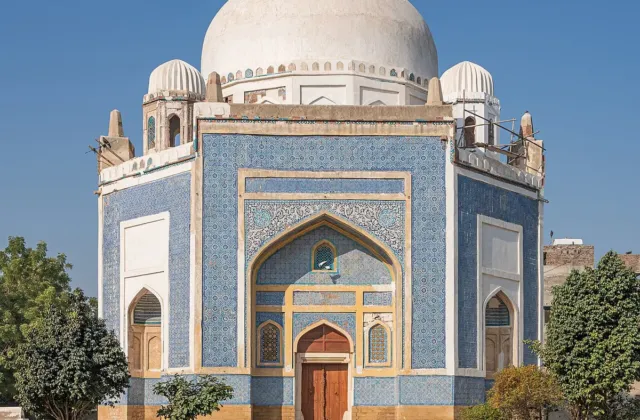
The 16th century pyramidal structures with minarets topped with floral motifs are in a style unique to tombs of the Turkic Tarkhan dynasty. Named tombs include Mirza Muhammad Baqi Tarkhan, who ruled from 1567 to 1585, in the enclosure that bears his name. Mirza Jani Beg Tarkhan, who died in 1601, has an octagonal brick tomb with a dome covered in blue and turquoise glazed tiles, shared with his son Mirza Ghazi Beg. Isa Khan Tarkhan I, who ruled from 1554 to 1567, has a tomb that represents a departure from the funerary architecture of the Sammas.
Two men named Isa are easily confused. Isa Khan Tarkhan the Younger, also called Isa Khan Hussain II, died in 1651 as a Mughal governor. His is a two storey stone building with cupolas and balconies, the largest structure at Makli, built before 1644, with masons said to have come from Agra. Diwan Shurfa Khan, who died in 1638, has what UNESCO calls the most colourful tomb at Makli. Other 17th century tombs of the Tarkhan family include Mirza Baqi Beg Uzbek, Sultan Ibrahim bin Mirza Muhammad Isa Tarkhan, and Amir Sultan Muhammad.
One claim must not be made. A source says the Arghun rulers have their tombs at Makli. A detailed architectural study says the Arghuns were buried at Mecca. The two claims conflict. The detailed Makli sources name Tarkhan tombs specifically. The Tarkhan tombs are at Makli. Shah Beg and Shah Husain have no identified tombs there. No Arghun tomb at Makli is claimed.

Why the Arghuns and Tarkhans Still Matter
The Arghun and Tarkhan Dynasties of Sindh ruled for only seventy years, but they changed Sindh. They brought a Central Asian court to Thatta and made it one of the richest cities of the Orient. They held the Indus against Humayun, against the Portuguese, and for two years against Akbar himself. Their tombs at Makli are still the finest record of the period, and their coins still turn up in the soil.
They also left a lesson about sources. What we know of them comes from a local history written a century later, from an Ottoman admiral who happened to be there, from Portuguese accounts of a sack, and from a handful of coins and tombs. Where those sources disagree, on the date of a conquest, on the year of a death, on the end of a dynasty, the honest answer is to say so. The Arghuns and Tarkhans are not a single certain story. They are a set of evidence, carefully weighed, and this article has tried to weigh it fairly.
Frequently Asked Questions about Sindh
When did the Arghuns conquer Sindh?
The Arghuns conquered Sindh in December 1520. Shah Beg Arghun crossed the Indus, defeated the Samma army on the Khanwah canal south of Thatta, and killed the Samma commander Darya Khan. Some sources give the year as 1519. The Tarkhan nama and the Tuhfat al Kiram give 15 Muharram 927 AH, December 1520.
Who was Shah Husain Arghun?
Shah Husain Arghun ruled Sindh from 1524 to 1555. He was the son of Shah Beg, the conqueror of Sindh. He took Multan in 1528, sheltered the Mughal emperor Humayun in Sindh for two and a half years, and died in 1555 during a civil war with the Tarkhans. Some sources give his death year as 1554.
What happened in the sack of Thatta?
In early 1557 the Portuguese sacked Thatta. Mirza Muhammad Isa Tarkhan had asked them for help in his civil war in 1555, but by the time their 700 soldiers arrived the war was over and Thatta refused to pay them. They sacked the city, killing over 8,000 people according to the Portuguese account, and took booty estimated at over 2,000,000 gold coins.
Who was Mirza Jani Beg Tarkhan?
Mirza Jani Beg Tarkhan was the third and last independent Tarkhan ruler of Sindh, reigning from 1585 to 1593. He resisted the Mughal emperor Akbar for two years, then surrendered in 1592. Akbar made him governor of Thatta, and he served as subahdar until his death on 1 February 1601 at Burhanpur.
Where are the Arghun and Tarkhan tombs?
The Tarkhan tombs are at the Makli Necropolis near Thatta, in the southern cluster, including the tombs of Muhammad Baqi and Jani Beg. The Arghun rulers have no identified tombs at Makli. One study says the Arghuns were buried at Mecca. Do not look for an Arghun tomb at Makli.
Sources and Further Reading on the Arghuns
- Wikipedia, Arghun Dynasty. en.wikipedia.org
- Wikipedia, Tarkhan Dynasty. en.wikipedia.org
- Wikipedia, Shah Beg Arghun. en.wikipedia.org
- Wikipedia, Mirza Jani Beg Tarkhan. en.wikipedia.org
- Wikipedia, Sack of Thatta. en.wikipedia.org
- Wikipedia, Seydi Ali Reis. en.wikipedia.org
- Dawn, Thatta: the ancient city of kings. dawn.com
- Live History India, Seydi Ali Reis. livehistoryindia.com
- SindhAtlas, Dynastic Sindh. sindhatlas.com
- Archnet, Makli Necropolis. archnet.org

Leave a Comment