

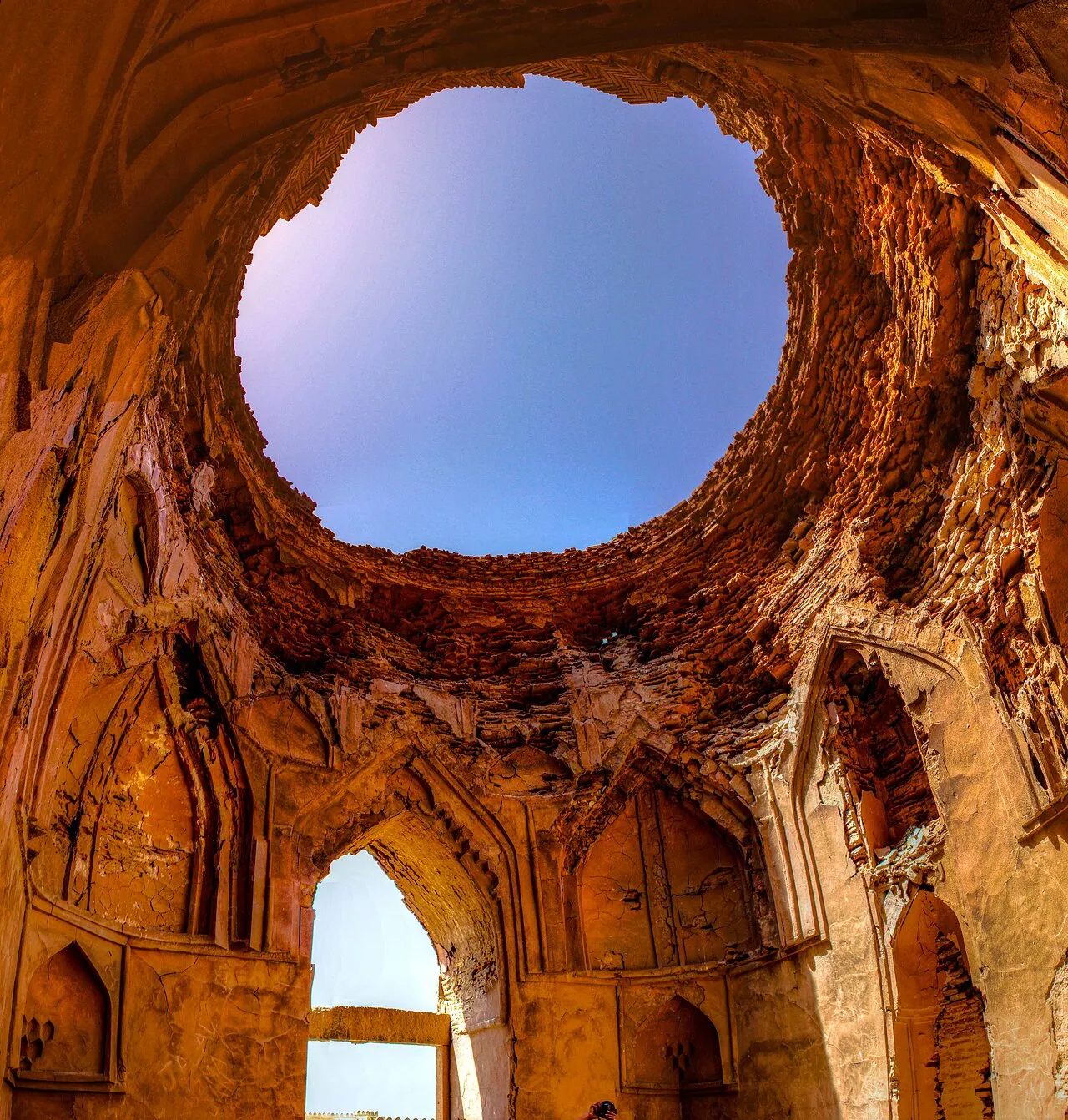
On a low limestone ridge just outside Thatta, the graves begin before you notice them. First come small stone markers among the thorn bushes, then carved platforms, and then, rising out of the dust, tombs the size of houses. This is the Makli Necropolis, one of the largest cemeteries in the world and one of Pakistan’s six cultural World Heritage Sites. UNESCO estimates that it holds around half a million tombs and graves.
In this article (13)
- Makli Necropolis at a glance
- Why Thatta needed such a vast cemetery
- The tombs, dynasty by dynasty
- The Samma period (14th to early 16th century)
- The Arghun and Tarkhan period (16th to early 17th century)
- The Mughal period (17th to 18th century)
- What makes Makli’s architecture special
- How to read a Makli grave
- Threats and conservation
- A note on visitor behaviour
- Visiting Makli Necropolis
- Why Makli matters
- Sources and further reading
For about four hundred years, from the fourteenth to the eighteenth century, the rulers, nobles, saints and scholars of Thatta were buried here. Their monuments trace the political history of lower Sindh dynasty by dynasty. They also show how builders in Sindh combined ideas from Gujarat, Persia, Central Asia and Mughal India into a style of their own.
Makli Necropolis at a glance
| Location | Makli Hill, on the edge of Thatta, Thatta District, Sindh. About 100 km east of Karachi on the National Highway. |
| Coordinates | approx. 24.76° N, 67.90° E |
| Area | About 10 km², along the edge of a plateau about 6.5 km long |
| Burials | Around 500,000 tombs and graves (UNESCO estimate) |
| Period | 14th to 18th century: Samma, Arghun, Tarkhan and Mughal periods |
| UNESCO status | World Heritage Site since 1981, under criterion (iii). Official name: “Historical Monuments at Makli, Thatta”. |
| Protection | Antiquities Act 1975. Managed by the Culture Department, Government of Sindh. |
Why Thatta needed such a vast cemetery
Thatta stood near the head of the Indus delta, on the river routes that linked the sea with upper Sindh and Punjab. UNESCO’s summary describes it as the capital of three successive dynasties before it came under the Mughal emperors of Delhi. A wealthy capital with a large court, many religious scholars and a busy trade produced a great many people who could afford a fine grave.
Tradition links the start of the cemetery to the Sufi scholar Shaikh Hammad Jamali, who lived and taught on the hill. The fourteenth-century Samma ruler Jam Tamachi is said to have revered him and wished to be buried near him. Others then followed. A popular story says the name “Makli” means “little Makkah”, after a pilgrim who felt the hill was as holy to him as Makkah. Historians such as Ali Ahmed Brohi have questioned this explanation, and there is no early record that confirms it.

The tombs, dynasty by dynasty
The largest monuments fall into two main groups. The Samma tombs stand together towards the northern end of the site. The tombs of the later Arghun, Tarkhan and Mughal periods are grouped further south.
The Samma period (14th to early 16th century)
The Samma were a local dynasty who ruled lower Sindh from Thatta and the surrounding area. Their greatest monument is the tomb of Jam Nizamuddin II, known locally as Jam Nindo, who ruled from 1461 to 1509. It is a square building of yellow sandstone, about 11 metres on each side. Its outer walls are covered in horizontal bands of carving: geometric and floral patterns, medallions and lines of Quranic text. A projecting balcony on one side, carved in the manner of Gujarati temple architecture, gives the tomb its unusual look.
Close to Jam Nizamuddin’s tomb stands the walled tomb of Darya Khan, his adopted son and leading general. Darya Khan rose from humble origins to become the most powerful man at the Samma court. He held off the first Arghun attacks on Sindh and was killed when Thatta fell in the 1520s. His tomb, a square enclosure with heavy walls, looks more like a small fort than a mausoleum.
UNESCO lists the stabilisation of Jam Nizamuddin’s tomb as one of the most urgent tasks at Makli. Its walls have leaned and cracked over the centuries.
The Arghun and Tarkhan period (16th to early 17th century)
In the 1520s the Arghuns, a dynasty of Turco-Mongol origin, took Sindh from the Sammas. They were followed by the related Tarkhans. Their tombs show a clear change. Stone canopies on pillars, enclosures with carved walls and cenotaphs covered in fine geometric patterns became common.
The best known is the two-storey stone tomb of Nawab Isa Khan Tarkhan the Younger, who served as a Mughal governor and died in 1651. UNESCO notes that his tomb and that of his father, Jan Baba, were built before 1644. A well-known legend says that Isa Khan had the hands of the masons cut off so that they could never build anything finer. It is a story told about several famous buildings in South Asia, and there is no evidence that it happened here.

The Mughal period (17th to 18th century)
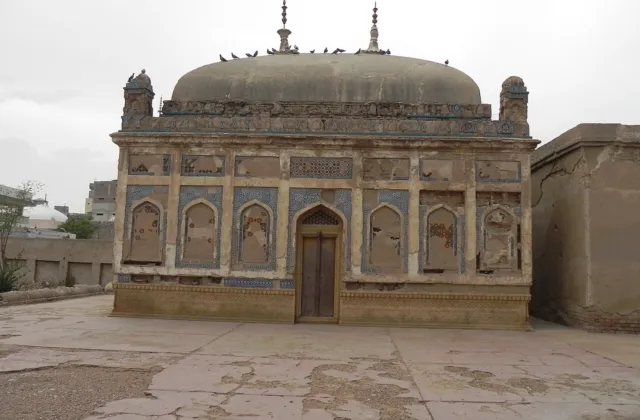
After the Mughal emperor Akbar’s forces took Thatta in 1592, the province was governed by officials sent from the imperial court. Their tombs are often built of brick and decorated with glazed tiles in blue, turquoise and white. UNESCO calls the tomb of Diwan Shurfa Khan, who died in 1638, the most colourful at Makli. The octagonal brick tomb of Mirza Jani Beg Tarkhan, who died around 1600, is another fine example of tilework.

What makes Makli’s architecture special
UNESCO’s main reason for listing Makli is that its monuments mix many influences into a local style. Visitors can pick out several of them:
- Gujarati stonework. Carved balconies, bracketed eaves and lotus designs recall the temples and mosques of Gujarat, the region just across the Rann of Kutch.
- Persian and Central Asian forms. Domed chambers, pointed arches and glazed-tile panels came with the Arghun, Tarkhan and Mughal elites.
- Carved stone that imitates tiles. UNESCO notes that Makli developed its own way of decorating stone, which may have been inspired by painted and glazed tile patterns.
- Canopy and enclosure tombs. Many graves sit under stone canopies (chhatris) or inside walled enclosures, rather than inside a closed tomb.
- Carved cenotaphs. Smaller graves are often stacked stone slabs carved with rosettes, geometric patterns and inscriptions, in the same tradition as the Chaukhandi tombs near Karachi.
How to read a Makli grave
Most of the half a million graves at Makli are not grand tombs but stone cenotaphs. With a little practice, they can tell you a great deal.
- Inscriptions. Many stones carry the name of the person buried, their father’s name and a date in the Hijri calendar, usually in Arabic or Persian. Some also add a verse of the Quran or a line of poetry.
- Men’s and women’s graves. On many carved graves in lower Sindh, a raised knob or a turban shape at the head marks a man’s grave, while a flatter top or carved jewellery marks a woman’s grave.
- Unusual carvings. Some larger graves are carved with horses, riders, swords, bows and arrows. Such images are rare on Muslim graves elsewhere, and are thought to honour the warrior status of the dead.
- Saints’ shrines. Several graves on the hill belong to Sufi saints and are still visited by pilgrims. They are often covered with cloth, flags and offerings of flowers.
Threats and conservation
Makli’s size makes it hard to protect. UNESCO lists the main threats as earthquakes, swings in temperature, salt-laden winds, humidity and heavy rain, as well as encroachment, vandalism and theft of carved stones. In its words, losses from pilferage had “assumed colossal proportions”. Floods in 2010 also brought displaced families onto the site, adding to the damage.
The World Heritage Committee reviewed Makli’s condition many times between 2006 and 2026. In 2019, after a joint UNESCO and ICOMOS monitoring mission, the Committee acknowledged that recent investment had improved the condition of the property. This included stabilising some monuments, building boundary walls and removing encroachments. It also asked Pakistan to put a full management plan in place, prepare an action plan for the tomb of Jam Nizamuddin II, and create secure storage for loose carved stones.
A note on visitor behaviour
Some of the damage at Makli is caused by visitors: names scratched on carvings, people climbing on fragile canopies and pieces taken home as souvenirs. Every carved stone that leaves the hill is lost from the record for good.
Visiting Makli Necropolis
- Getting there: Makli is about two hours by road from Karachi on the National Highway. Thatta and the Shah Jahan Mosque are a few minutes away.
- Best time: November to February, early in the morning or late in the afternoon. There is almost no shade on the hill.
- Time needed: At least two to three hours for the main southern group and the Samma tombs. The site is too large to walk in a single visit, so many people drive between groups.
- Dress and conduct: Makli is still a place of prayer and pilgrimage. Dress modestly and be quiet near shrines.
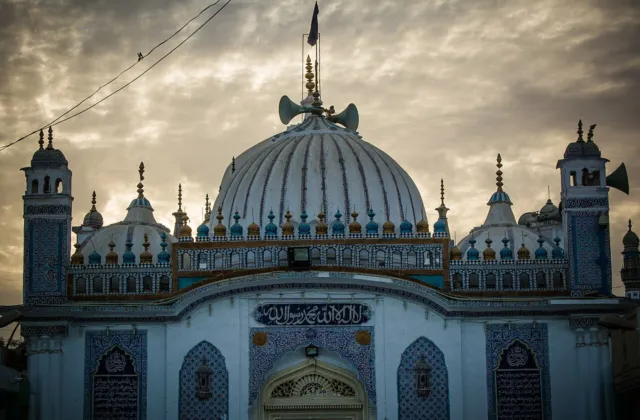
- Combine it with: The Shah Jahan Mosque in Thatta, built in the mid-seventeenth century and famous for its many domes and blue tilework.
Why Makli matters
Makli is more than a collection of beautiful tombs. Its inscriptions give names, titles and dates for four centuries of Thatta’s history, much of which is poorly recorded elsewhere. Its stonework shows how craftsmen in Sindh learned from their neighbours and created something distinctive. And its condition shows how fragile that record is. Protecting it needs steady funding, skilled conservation and visitors who treat the site with respect.
Related on PakSindh: Ranikot Fort, the Great Wall of Sindh, Kot Diji Fort and Sindhi Saqafat.
Sources and further reading
- UNESCO World Heritage Centre, “Historical Monuments at Makli, Thatta” (property 143, inscribed 1981). whc.unesco.org/en/list/143
- UNESCO World Heritage Committee, Decision 43 COM 7B.73 (2019), “Historical Monuments at Makli, Thatta (Pakistan)”. whc.unesco.org/en/decisions/7467
- UNESCO World Heritage Centre, documents and state of conservation reports for Makli, 1981 to 2026. whc.unesco.org/en/list/143/documents
- Urooj Qureshi, “In Pakistan, imposing tombs that few have seen”, BBC Travel, 8 August 2014.
- Ali Ahmed Brohi, History on Tombstones: Sind and Baluchistan, Sindhi Adabi Board, Jamshoro, 1986.
- Shaikh Khurshid Hasan, The Islamic Architectural Heritage of Pakistan: Funerary Memorial Architecture, Royal Book Company, Karachi, 2001.
- Annemarie Schimmel, Makli Hill: A Center of Islamic Culture in Sindh, Institute of Central and West Asian Studies, University of Karachi, 1983.

Leave a Comment