

The history of Sindh did not begin with the Arabs, and it did not end with the Indus Valley. Between the decline of Mohenjo Daro and the coming of Muhammad ibn al Qasim, more than two thousand years passed, and in that long stretch Sindh was ruled by Persians, Greeks, Mauryas, Buddhists, Rais and Chachs. This is the story of those Ancient Kingdoms of Sindh, from the first Persian satrap to the last Hindu king of Aror.
In this article (18)
- Ancient Kingdoms of Sindh at a Glance
- Persian Rule in Sindh, the Satrapy of Hindush
- Alexander the Great Sails Down the Indus
- Mauryan Rule and the Coming of Buddhism
- Buddhism in Sindh, Stupas and Monasteries
- Thul Mir Rukan, the Stupa near Daulatpur
- Seven Centuries between the Mauryas and the Rais
- The Rai Dynasty, Sindh’s Buddhist Kings
- The Chach Dynasty and the End of an Era
- The Chachnama, the Book Behind This History
- Why the Ancient Kingdoms of Sindh Still Matter
- Frequently Asked Questions about Sindh
- When did Alexander the Great come to Sindh?
- Where is Patala, Alexander’s port in Sindh?
- What is Thul Mir Rukan and how old is it?
- Who were the Rai and Chach dynasties?
- What is the Chachnama and can we trust it?
- Sources and Further Reading on the Ancient Kingdoms
The timeline on this site groups this period as the 6th century BCE to the 7th century CE. That range works for the period as a whole, since it opens with the Persian conquest in the 6th century BCE. But the reader should know at the start that the dates are not all certain. Some rest on a single book, the Chachnama, written five hundred years after the events it describes. Others rest on the accounts of Greek historians, on coins, and on the stones of stupas that still stand in the Sindhi countryside. Where the sources disagree, this article says so.
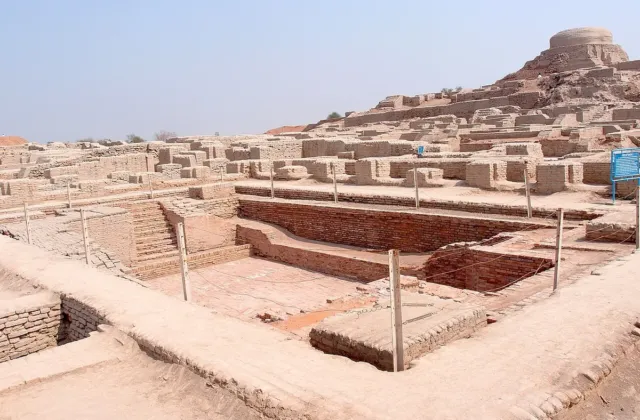
The Indus Valley cities came first. Read our guides to Mohenjo Daro and the Indus Valley Civilisation for that earlier age, and to Amri for the settlement that came before it. What follows begins where those cities end.
Ancient Kingdoms of Sindh at a Glance
| Period | Dates | What happened |
|---|---|---|
| Persian Rule | c. 535 to 325 BCE | Sindh becomes the satrapy of Hindush |
| Alexander the Great | 326 to 325 BCE | Campaign down the Indus to Patala |
| Mauryan Rule | c. 321 to 184 BCE | Chandragupta to Ashoka; Buddhism reaches Sindh |
| Buddhism in Sindh | 3rd century BCE onwards | Stupas and monasteries across lower Sindh |
| Thul Mir Rukan | Possibly 6th to 11th century CE | Buddhist stupa near Daulatpur |
| Rai Dynasty | c. 480 to 632 CE | Buddhist kings of Alor |
| Chach Dynasty | c. 632 to 712 CE | Brahman kings; ends with the Arab conquest |
Persian Rule in Sindh, the Satrapy of Hindush
Sindh entered written history under the Persians. The Achaemenid Empire conquered the Indus valley in stages. Cyrus the Great began the work in about 535 BCE, taking the lands west of the Indus. After his death in about 530 BCE, Darius I continued the conquest, and by about 518 BCE the Persians held Gandhara. The satrapy of Hindush, the province that covered the lower and central Indus, is dated from about 513 BCE, and it lasted for about two centuries, until Alexander came.
Hindush is the Old Persian form of Sindhu, the Sanskrit name of the Indus, and it means the land of Sindhu. Its territory is generally taken to be the lower and central Indus basin, the land of modern Sindh and southern Punjab, with Gandara to the north. A few writers place it further north, in the Punjab, but the usual view puts it where Sindh now stands. The Indus valley was organised into the satrapies of Gandara, Hindush and Sattagydia, and the wider region included Gedrosia and Arachosia.
The Greek historian Herodotus tells us what this rule was worth to the Persian king. In his Histories he records that the Indians formed the twentieth tribute district of the empire and paid 360 talents of gold dust, the largest tribute of any province, and the only one paid in gold. Gold was counted at thirteen times the value of silver. Herodotus also tells a story of gold digging ants in the region. That story is folklore, not history, and it has no place in a serious account.
Darius also sent out a voyage of discovery. He ordered the Greek sea captain Scylax of Caryanda to find where the Indus ran into the sea. Scylax set out from Caspatyrus, a place in the land of Pactyica that has never been identified, sailed down the Indus to the sea, and then westward around Arabia to Egypt. The voyage took thirty months, in about 515 to 518 BCE by modern estimates. Scholars read it as reconnaissance for the conquest that followed. Scylax was the first recorded Greek to sail the route. Two centuries later, Nearchus would sail it again, in the other direction of history, after Alexander.
Little is known about how Hindush was governed. From the Persepolis Administrative Archives we know of a man named Irdubama who issued travelling permits for people from Hindush in 499 and 498 BCE, probably acting as satrap. Local rulers remained important. By the time of Alexander, the chief local ruler was Sambus, who ruled from Sindimana and seems to have been the main Achaemenid satrap in the region. Alexander first reappointed him, then replaced him with his general Peithon after Sambus rebelled and fled. By about 380 BCE Persian hold on the region was weakening, but the land remained nominally part of the empire until Alexander’s invasion. The satrapy system itself outlived the Persians. Alexander adopted it, and the Indo Scythians and the Kushans adopted it after him.
Alexander the Great Sails Down the Indus
Alexander’s Indian campaign ran from 327 to 325 BCE. He crossed the Indus in the spring of 326 BCE, after the campaign in the Swat and Buner valleys and the siege of Aornos in April 326 BCE. In July 326 BCE he fought the Battle of the Hydaspes on the Jhelum river, near modern Bhera, and defeated King Porus. It was his last great battle, and possibly his costliest. Then his army refused to march further east, towards the Nanda Empire of Magadha. At the Hyphasis, the Beas river, the men mutinied. Alexander raised twelve altars to mark the eastern extent of his conquests, their location unknown, and turned back.
On the Hydaspes he built a fleet of 800 to 1,000 ships, and made Nearchus, a Cretan, its admiral. In November 326 BCE the army set off down the rivers, half the force on shipboard and half marching in columns down the two banks. In southern Punjab, in the country of the Malli near modern Multan, Alexander stormed a town and was severely wounded by an arrow. His surgeon was Kritodemos of Kos. His troops, believing him dead, massacred the town.
At the meeting of the five rivers of the Punjab, Alexander halted and built a town, Alexandria, identified with modern Uch, and received the submission of the neighbouring states. Then he went south through Sindh along the Indus to the sea. In the lower Indus in 325 BCE he met three rulers. Musicanus, a king of the lower Indus, first submitted and then revolted. Alexander sent Peithon against him. Musicanus was captured and brought to Alexander, and executed, according to Arrian. Sambus, another ruler, fled with thirty elephants beyond the Indus after Alexander destroyed his cities. Oxykanus, a third ruler, had his city taken by storm. Alexander also had groups of Brahmans hanged in Sindh for urging Musicanus and Sambus to revolt.
The Greek accounts of the campaign say nothing about Buddhism, and nothing about temples or idols in India, which is striking, since they describe both in Egypt, Mesopotamia and Iran. They do mention naked ascetics, and the philosopher Calanus, probably Kalyana, who joined Alexander and later died on a funeral pyre at Persepolis. They also record the everyday India the army saw: rice in paddy fields, sugarcane, which they called honey yielding reeds, cotton clothing, rock salt from the Salt Range, letters written on closely woven cloth, and Indian physicians who treated snake bite.
At the head of the Indus delta, Alexander built a harbour and docks at Patala and explored both arms of the Indus, which at that time probably ran into the Rann of Kachchh. At the mouth of the Indus he saw the tides for the first time. Where Patala stood is not known. Bahmanabad, Hyderabad and Thatta have all been proposed, but none of these sites has ever yielded any Hellenistic remains, and the Indus flowed about 25 miles east of its present course in the 4th century BCE. The honest answer is that the location of Patala is unknown.
In June 325 BCE Craterus left with a third of the army for Carmania. Alexander marched the rest through the Gedrosian desert, the Makran, in August to September 325 BCE, with terrible losses from thirst, hunger and a sudden monsoon flood in a dry river bed. On the Makran coast they met the Ichthyophagi, the Fish Eaters, who lived in huts of whale bones and ate raw seafood. Peithon was left as satrap of the Indus, a post he held until 316 BCE.
Nearchus sailed from Patala in September 325 BCE with 100 to 150 ships carrying 17,000 to 20,000 men. Contrary winds held the fleet at the mouth of the Indus for 24 days, and it then waited for the north east monsoon in late October. Its stops included Morontobara, identified with Manora Island off modern Karachi, and the Hingol river. Nearchus rejoined Alexander in Carmania, and the fleet sailed on to the mouth of the Tigris and Susa, the voyage ending in 324 BCE. His own account is lost. It survives through Arrian’s Indica and Strabo’s Geography. There is no Indian source for the campaign. The only surviving contemporary account is Nearchus’s report, preserved by Arrian, who wrote in about 150 CE from the writings of Alexander’s companions.

Mauryan Rule and the Coming of Buddhism
After Alexander died in 323 BCE, the Macedonian garrisons in India were destroyed or driven out. Chandragupta Maurya founded the Mauryan Empire in about 321 BCE and gained control of the Punjab and Sind, taking his empire up to the Indus. In about 305 to 303 BCE Seleucus I Nicator marched to the Indus to regain the eastern provinces. In the settlement that followed, Seleucus gave up Parapamisadae, Aria, Arachosia and probably Gedrosia to Chandragupta, and Chandragupta gave Seleucus 500 elephants. Some accounts add a marriage alliance. That detail is reported, not firmly established.
Bindusara, who reigned from about 298 to 273 BCE, succeeded Chandragupta. His reign is obscure. Ashoka, who reigned from about 268 to 232 BCE, took the empire to its greatest extent. His dominions stretched in the north west to the Hindu Kush and included most of modern Afghanistan, Baluchistan and all of Sindh. It was under Ashoka that Buddhism spread to Sindh.
The dynasty lasted until about 184 BCE, when the last emperor, Brihadratha, was killed by his commander in chief Pushyamitra, founder of the Shunga dynasty. Some popular histories say Mauryan rule in the north west ended in 232 BCE. That is the year Ashoka died, not the year the dynasty ended. The dynasty ended in about 184 BCE.
One thing must be said plainly. No Ashokan edict is known from Sindh itself. The nearest Ashokan inscriptions in Pakistan are the Major Rock Edicts at Shahbazgarhi, about 12 km from Mardan, and at Mansehra, both in Khyber Pakhtunkhwa, written in Kharoshthi script in the 3rd century BCE. Mauryan rule in Sindh is established from the known extent of the empire, not from any inscription found in Sindh. No writer should claim an Ashokan edict exists in Sindh.
Buddhism in Sindh, Stupas and Monasteries
Buddhism reached Sindh in the 3rd century BCE, under Ashoka. Tradition says Ashoka sent the monk Majjhantika from Varanasi to preach in the north west. It flourished under the Greco Bactrians and the Indo Greeks. King Menander’s remains were, by tradition, shared among his cities and enshrined in stupas. It reached a peak under the Kushans, in the 1st to 3rd centuries CE, above all under Kanishka, who patronised monasteries and convened Buddhist councils. Gandharan art, the Greco Buddhist art of the north west, spread through the region.
The Buddhist sites of Sindh are still there to be seen. Thul Mir Rukan near Daulatpur is the best known, and it has a section of its own below. Kahu jo Daro at Mirpur Khas, the Mirpur Khas stupa, is dated to the early 5th to early 6th century CE. Henry Cousens excavated it in 1909 to 1910 and found a relic chamber with a stone coffer, a crystal bottle and a gold cylinder. Terracotta images of the Buddha and Hindu artworks, including Brahma, were found there. The site had already been badly damaged in the 1890s, when railway contractors carted off its bricks for track ballast. Today 297 artefacts from the site are held by the CSMVS, the Prince of Wales Museum, in Mumbai. Other sites are known from surveys: Sudheran jo Thul near Hyderabad, Thul Hairo Khan in Dadu, Bhaleel Shah Thul, dated to the 5th to 7th century CE, Sirah ji takri near Rohri, Kot Bambhan Thul near Tando Muhammad Khan, and a stupa at Brahmanabad. Their individual dates are not all firmly established.
The best eyewitness account of Buddhism in Sindh comes from the Chinese pilgrim Xuanzang, who visited in about 640 to 642 CE. As quoted by the historian John Keay, he found innumerable stupas and several hundred sangharama, monasteries, occupied by about ten thousand monks. He also counted about thirty Hindu temples. He described the people as hardy and impulsive, and the kingdom as famed for its cereal production, its livestock and its export of salt. The ruler he met was a Shudra, and his capital is identified with Alor.
Buddhism in Sindh, as the scholar K. T. S. Sarao shows from the sources, was largely confined to lower Sindh, the central Indus delta, the west bank, and a belt along the east bank from Mirpur Khas to Sirar, just south of Aror. The overwhelming majority belonged to the Sammitiya sect of the Hinayana school, 350 of the 450 viharas. Xuanzang records more than 10,000 monks in these viharas. The Buddhists of Sindh were mostly urban people, merchants, traders, bankers, financiers and artisans, while the Brahmanical Hindus of the time were mostly rural farmers. Monasteries along the trade routes served as resting places and sources of loans for merchants. When trade declined before the Arab conquest, this mercantile Buddhism weakened with it.
The decline was gradual. Buddhism began to decline after the Alchon Hun invasions of the 5th to 6th centuries CE. Xuanzang reports that the Hun king Mihirakula ordered the destruction of Buddhism and the expulsion of monks, and that over a thousand monasteries were destroyed. That number is Xuanzang’s report, not a counted fact. By the time Xuanzang visited Gandhara in about 630 CE most monasteries there were deserted, but Buddhism in Punjab and Sindh remained strong in the 7th century. After the Arab conquest of Sindh in 711 to 712 CE it declined further. The numismatist Derryl MacLean, working from Indian and Arab coins found at Kahu jo Daro, argued that Buddhism was still thriving in Sindh around the 10th century. It had largely disappeared from the region by the 12th to 14th centuries.

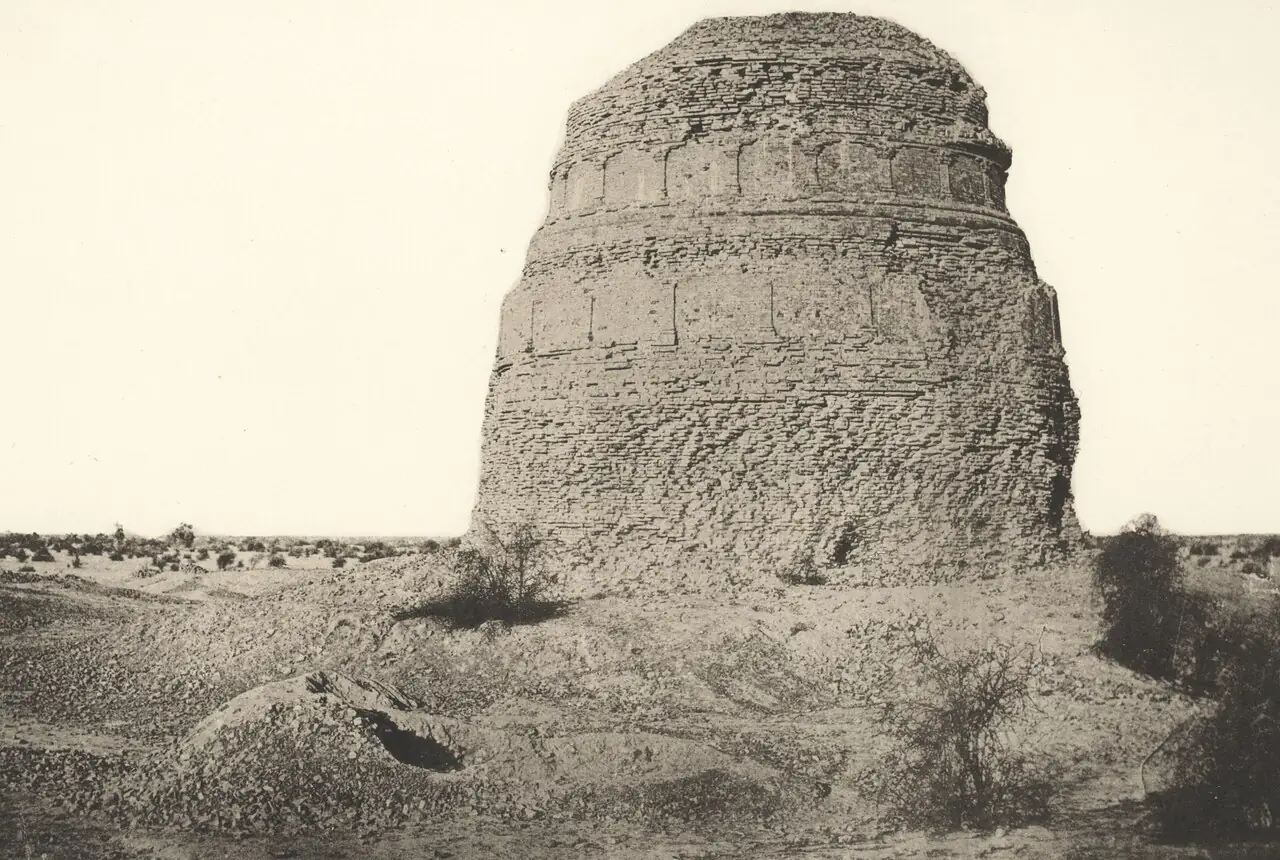
Thul Mir Rukan, the Stupa near Daulatpur
Thul Mir Rukan is a Buddhist stupa built of baked brick, near the modern towns of Kazi Ahmed, also written Qazi Ahmed, and Daulatpur in Sindh. It stands about 10 km east south east of Daulatpur Safan and about 13 km south east of Daulatpur town, in Taluka Sakrand, in District Shaheed Benazirabad, formerly Nawabshah. Another account puts it about 22 km south west of Bandhi railway station. Its coordinates are 26.4544778 degrees north and 68.1066389 degrees east.
The stupa is a domed structure built in four tiers, each tier smaller than the one below, surmounted by a dome. The tiers are ornamented with pilasters at intervals and separated by string courses. Its height is disputed. Wikipedia gives 60 feet. The Sindh Courier gives 66 feet, and the same article gives the circumference as 105 feet 5 inches. The honest figure is about 60 to 66 feet high.
Its date is not settled. The standard scholarly window is possibly between the 6th and 11th century CE. The Sindh Courier gives a much wider estimate, about 200 BCE to 1100 CE. The date is not settled, and the stupa is certainly not from the 6th century BCE, whatever the timeline card may seem to say. Excavations at the site yielded baked terracotta figurines and images of the Buddha, including representations of the birth scene. The site was a Buddhist religious centre.
On 27 February 1852 an excavation team camped near the stupa and dug down to the lowest level of the foundations without finding any significant relics. The British archaeologist Henry Cousens photographed the stupa in 1896, and later described it in his book The Antiquities of Sind, published in 1929, as built of brick in four tiers surmounted by a dome and greatly dilapidated. One article says Cousens first surveyed the stupa in 1909 to 1910. That date is wrong for Thul Mir Rukan. In 1909 to 1910 Cousens was excavating Kahu jo Daro at Mirpur Khas. The British Library photographs prove he was recording Thul Mir Rukan in 1896.
The Sindh Antiquities Department began conservation work at the site, and restoration was reported in 2017, but the work stopped for lack of budget. The bricks used in the conservation work were different from the old material. The stupa is a protected monument, and its artefacts have been removed.
A local tradition links the stupa to Emperor Ashoka and his 84,000 stupas. The figure of 84,000 stupas comes from the Ashokavadana, a Buddhist legend, not from archaeology, and no evidence links this stupa to Ashoka. The tradition is worth recording as a tradition. It is not history.
Seven Centuries between the Mauryas and the Rais
Between the end of Mauryan rule in about 184 BCE and the rise of the Rai dynasty in about the 5th or 6th century CE, roughly seven hundred years passed. The article must not jump silently across them. In those centuries Sindh passed through the Greco Bactrian, Indo Greek, Indo Scythian, Kushan, Sasanian and Hephthalite phases. Buddhism flourished under several of them, above all under the Kushans. Sasanian influence reached the region at least from the time of Shapur II, and the last Sasanian coins found in the region are those of Peroz I, who reigned from 459 to 484 CE. The Rais rose as Sasanian influence waned after the Hephthalite invasions. Little of this long stretch is documented in writing. What survives is coins, art and the stupas themselves.
The Rai Dynasty, Sindh’s Buddhist Kings
The Rai dynasty is known only from the Chachnama. No contemporary inscription, coin series or foreign account securely documents it. Everything known about it comes from that one 13th century Persian text, and the limits of that source are discussed in the section below. Its capital was Alor, also called Aror, near modern Rohri and Sukkur.
The kings, in order, were Rai Diwaji, Rai Sahiras I, Rai Sahasi I, Rai Sahiras II and Rai Sahasi II, the last. Nothing particular is known about the first three kings. Their names appear in a single line of the Chachnama, where the wazir Buddhiman, the Wise, describes the kingdom of Rai Sahiras II to Chach.
Rai Sahiras II is praised in the Chachnama for justice and generosity, with coffers overflowing with wealth. His kingdom was divided into four units, each under a governor or vassal, and is said to have included the seaport of Debal. Read our guide to Banbhore for the port and its riddle. Sahiras II died fighting an invasion by the Sasanian governor of Nimroz, towards Kirman, refusing to leave the battlefield even after his forces deserted him.
Rai Sahasi II succeeded him. After his death, his brother Rai Mahrit, ruler of Chittor, claimed the throne and attacked. That crisis is the moment in which Chach seized power, according to the Chachnama.
The Rais are described as a Buddhist dynasty and patrons of Buddhism. Numismatists attribute a gold and silver coin series with a fire altar on the reverse to the Rai period, about 524 to 632 CE. A recently published gold dinar reads Sri Jayataka. These attributions are speculative. The coins carry no dynastic name.
The dates of the dynasty are disputed. One source gives about 489 to 632 CE. Another gives about 524 to 632 CE. A list of monarchs gives 480 to 632 CE. The honest range is founded in about 480 to 524 CE and ended in about 632 CE. The end date is disputed too. The Chachnama puts Chach’s seizure of power in 632 CE. But Xuanzang found a Shudra king ruling Sindh in 641 to 642 CE, which has led researchers such as M. H. Panhwar to argue that the Rai dynasty ended around 641 to 642 CE, not 632. This is one of the sharpest chronological conflicts in the early history of Sindh, and the article states it plainly.
The Chachnama also claims that the Rai kingdom stretched from Kashmir in the north to the sea, and from Kandahar to Kanauj. That is the Chachnama’s own claim. It is not independently verified.
The Chach Dynasty and the End of an Era
The Chach dynasty, also called the Chacha dynasty or the Silaij dynasty, ruled from about 632 to 712 CE, from its capital at Aror. Its founder was Chach, who reigned from about 632 to 671. Chach was a Brahmin who had risen to be chamberlain and secretary at the court of Rai Sahasi II. After the king’s death he married the widowed queen Suhandi, also written Suhanadi, and seized the throne, killing the brother of Rai Sahasi II to secure his claim. All of this is according to the Chachnama.
Chandar, the brother of Chach, reigned from about 671 to 679. Dahir, also written Dahar, the son of Chach, reigned from about 679 to 712 and was the last Hindu king of Sindh. One source gives his accession as 695. The range used here is about 679 to 712, with the variant noted. Dahirsiya, who reigned from about 679 to 709 from Brahmanabad, is listed as a ruler alongside Dahir, apparently a brother or co ruler. He appears only in the rulers list, and should be treated with caution.
The longest of Chach’s campaigns, in the Chachnama’s telling, was against Agham, the Lohana ruler of Brahmanabad in the lower Indus. Under Chandar, the kingdom was threatened from the east by a king of Kanauj, urged on by the ruler of Siwistan, which is modern Sehwan.
The population of Sindh was mostly Hindu, with a significant Buddhist minority, and there were tensions between the Buddhist communities and the Brahman dynasty, which some regarded as usurpers. Local Buddhist clans such as the Jats, who had remained loyal to the Rai dynasty, later allied with the Umayyads against Dahir. Silver damma coins with a large trident and the legend Sri Yashaditya are attributed to Chach. A coin reading Pracandendra is attributed to the same period, and a Sri Tapana damma from Multan is dated to about 675 to 700. All of these attributions are numismatic and tentative.
The Arab conquest of 711 to 712 CE ended the dynasty. The cause given by the Chachnama was that Sindhi pirates seized tribute sent by the king of Serendib, Sri Lanka, to the Umayyad Caliph. The Caliph Abd al Malik granted an army to the governor al Hajjaj ibn Yusuf, but no invasion was attempted before the caliph’s death. Under his son al Walid I, the general Muhammad ibn al Qasim invaded Sindh in 711 to 712 CE. Raja Dahir was killed in battle at Aror. The Arab historian al Baladhuri places the decisive battle at Rawar. Sindh was annexed to the Umayyad Caliphate. The conquest itself is the subject of our post on Muhammad bin Qasim and the Arab Conquest of Sindh, and it is kept brief here.
Members of the family continued to administer parts of Sindh under the Umayyad Caliphate. Hullishah reigned from about 712 to 724, and Shishah from 724. Jaisiah, also written Jaisimba, the son of Dahir, reconquered Brahmanabad after the death of the governor Hajjaj in 714, during the reign of Caliph Sulayman, 715 to 717. He was later killed in battle with the Umayyad governor Junayd ibn Abd al Rahman, who reigned from 723 to 726.
Muhammad ibn al Qasim gave Brahmanical Hindus and Buddhists the protected status of dhimmis, the first time it was extended to faiths not mentioned in the Quran. Temples continued to function, and Hindu officials continued to collect the revenue.
The Chachnama, the Book Behind This History
Almost everything in the two sections above comes from one book, and the reader deserves to know what it is. The Chachnama, also called Fathnama i Sindh, Kitab Futuh us Sindh wal Hind, Tarikh i Sind, Tarikh i Qasimi and Minhaj al din wal mulk, is a Persian work by Ali ibn Hamid ibn Abi Bakr al Kufi. He says he translated it in 1216 CE, at Uch or Bakkhar, from an older Arabic history, and presented the finished work around 1226.
The Arabic original he claims to have used was an anonymous history of Sind compiled at Aror in the 9th century, dated by one study to about 830 to 868 CE, with some internal evidence suggesting it may be earlier than 753 CE. That Arabic original is lost. Only Kufi’s Persian version survives. Kufi says he found the Arabic manuscript among the possessions of Qazi Ismail al Thaqafi, of the clan of the Arab conqueror, at Aror or Bakkhar.
The book covers the pre Islamic Buddhist and Brahman dynasties, the early Arab raids on Makran and Sind, the campaigns of Muhammad ibn al Qasim, and a conclusion on his death and the fate of Dahir’s daughters. It is the only written source for the history of pre Islamic Sindh, and one of the only written sources for the Arab conquest. No contemporary Sanskrit histories of Sindh survive. The oldest surviving authentic account of the conquest is the 9th century Arabic Kitab Futuh al Buldan of al Baladhuri, supplemented by the 10th century chronicle of al Tabari.
Scholars disagree about how far the Chachnama can be trusted. Yohanan Friedmann found that its battle narratives agree with earlier Arab historians such as al Baladhuri, and that its chapters on the rise of Chach seem to preserve local traditions. The Encyclopaedia Iranica notes that the text contains two different traditions. The first quarter, the Rai dynasty, Chach’s revolt and the Silaij dynasty, is an indigenous Brahman tradition of Aror, the only source for it. It gives no chain of transmission for any of its information, and it accommodates romantic and mythic material of the kind usual in medieval north Indian historiography. It was probably a discrete, possibly oral, Brahmanical history of Chach’s family, organised around questions of caste purity and pollution. The conquest chapters, by contrast, transmit the classical Arab tradition, with Brahmanical interpolations added later.
Peter Hardy and Andre Wink questioned its reliability, pointing to geographical errors and inconsistencies. Manan Ahmed Asif, in his book A Book of Conquest, published in 2016, argues that the text is largely an original 13th century literary work of political advice, shaped by the politics of its own time, and not a work of translation, and that its dates, numbers and speeches should be treated with caution. Colonial era scholars read its conquest chapters as a straightforward record of the Muslim arrival and, in Asif’s view, ignored the long pre Islamic sections about Chach himself. The text has been used in Pakistan’s state sanctioned history textbooks.
Three rules follow for this article, and for any reader of the Chachnama. First, always attribute. Anything that comes only from it is given as according to the Chachnama. Second, dates are approximate, given with about, and the conflict between 632 and 641 to 642 CE is stated plainly. Third, cross check where possible, with Xuanzang, the contemporary eyewitness, with al Baladhuri for the conquest, and with coins for the Chach rulers. Its speeches, dialogues and casualty figures are not presented as fact.
Why the Ancient Kingdoms of Sindh Still Matter
The Ancient Kingdoms of Sindh left marks that are still visible. The Persian satrapy gave Sindh its first place in a world empire and its first written records. Alexander’s campaign brought the Indus into Greek literature, and the voyage of Nearchus joined Sindh to the sea routes of the ancient world. The stupas of the Buddhist centuries, Thul Mir Rukan among them, still stand in the Sindhi countryside, and the coins of the Rais and the Chachs still turn up in the soil. The Chachnama, for all its problems, is the only book that tells us how Sindh passed from Buddhist kings to Brahman kings and then to the Arabs.
These kingdoms also teach a lesson about history itself. What we know of them comes from Greek historians, a Chinese pilgrim, a Persian book written five hundred years later, and a handful of coins and bricks. Where those sources disagree, the honest answer is to say so. Sindh’s ancient history is not a single certain story. It is a set of evidence, carefully weighed, and this article has tried to weigh it fairly.
Frequently Asked Questions about Sindh
When did Alexander the Great come to Sindh?
Alexander the Great came to Sindh in 326 to 325 BCE, as part of his Indian campaign. He crossed the Indus in the spring of 326 BCE, fought the Battle of the Hydaspes in July 326 BCE, and then sailed down the Indus to Patala, reaching the sea in 325 BCE.
Where is Patala, Alexander’s port in Sindh?
The exact location of Patala is unknown. Bahmanabad, Hyderabad and Thatta have all been proposed, but none of these sites has ever yielded any Hellenistic remains, and the Indus flowed about 25 miles east of its present course in the 4th century BCE. Alexander built a harbour and docks there. He did not found the city.
What is Thul Mir Rukan and how old is it?
Thul Mir Rukan is a Buddhist stupa of baked brick near Daulatpur in Sindh, about 60 to 66 feet high, built in four tiers. It was built possibly between the 6th and 11th century CE. The date is not settled, and it is certainly not from the 6th century BCE. A local tradition links it to Emperor Ashoka, but no evidence supports that link.
Who were the Rai and Chach dynasties?
The Rai dynasty was a Buddhist dynasty that ruled Sindh from Alor, founded in about 480 to 524 CE and ended in about 632 CE, though one line of evidence puts the end in 641 to 642 CE. The Chach dynasty was a Brahman dynasty founded by Chach in about 632 CE. It ended in 712 CE, when Raja Dahir was killed and Muhammad ibn al Qasim annexed Sindh to the Umayyad Caliphate.
What is the Chachnama and can we trust it?
The Chachnama is a Persian work of 1216 CE by Ali al Kufi, who says he translated it from a lost 9th century Arabic history of Sindh. It is the only written source for pre Islamic Sindh. Scholars disagree about it. Some find its battle narratives agree with al Baladhuri. Others argue it is largely an original 13th century literary work. Its dates, numbers and speeches should be treated with caution, and everything taken only from it should be attributed to it.
Sources and Further Reading on the Ancient Kingdoms
- Wikipedia, Thul Mir Rukan. en.wikipedia.org
- Sindh Courier, Thull Mir Rukan, Sindh’s Buddhist Heritage. sindhcourier.com
- Pak Heritage, Thul Mir Rukan. pakheritage.org
- Wikipedia, Hindush. en.wikipedia.org
- Encyclopaedia Britannica, Alexander the Great. britannica.com
- Livius, Nearchus. livius.org
- Dawn, Sindh Before the Arabs Arrived. dawn.com
- Wikipedia, Rai Dynasty. en.wikipedia.org
- Wikipedia, Brahmin Dynasty of Sindh. en.wikipedia.org
- Encyclopaedia Iranica, Chachnama. iranicaonline.org
- Biagi, The Location of Patala. iris.unive.it

Leave a Comment