

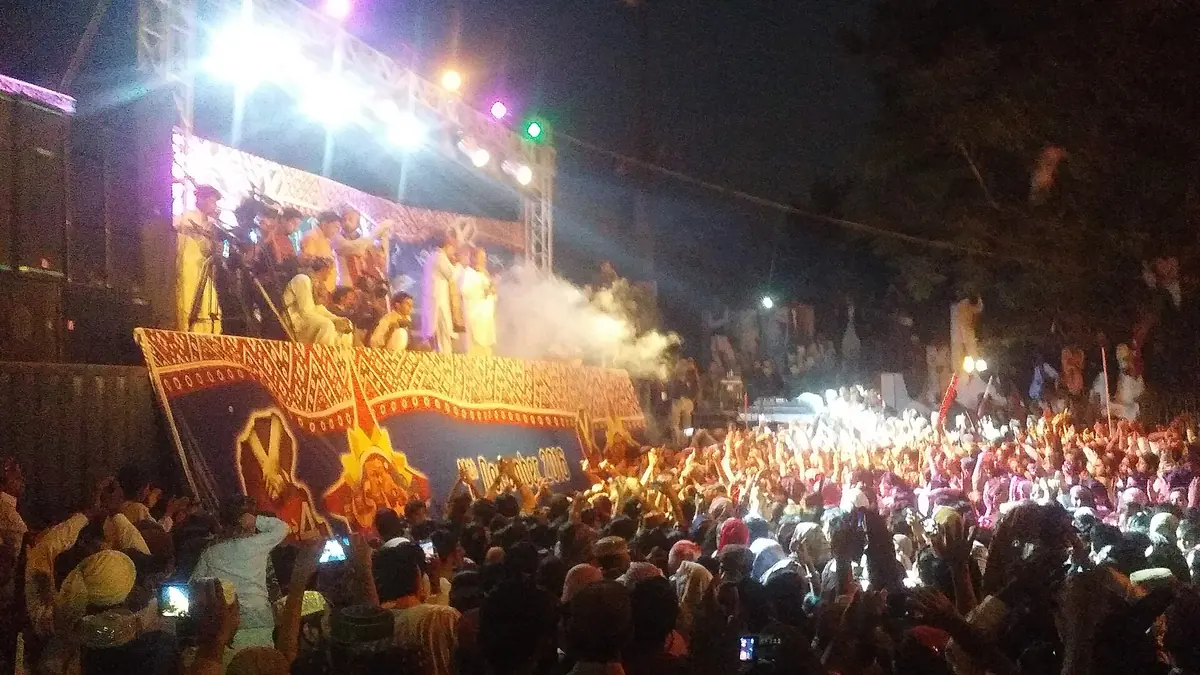
On the first Sunday of every December, the streets of Sindh fill with music, dance and colour. People step out in Ajrak and Sindhi Topi, and the whole province seems to dress up at once. This is Sindhi Cultural Day, a festival that honours the heritage, the language and the civilization of Sindh, and shows the world a peaceful side of its people.
In this article (22)
- Sindhi Cultural Day at a Glance
- What Is Sindhi Cultural Day in Sindh
- How Sindhi Cultural Day Began in 2009
- The First Sindhi Topi Day of 2009
- From Topi Day to Cultural Day
- How the Day Is Celebrated Across Sindh
- Karachi Press Club Gatherings
- Celebrations in Hyderabad and Sukkur
- Rallies in Larkana and Other Towns
- Ajrak and Sindhi Topi Symbols of the Day
- The Ajrak and Its Ancient Roots
- The Sindhi Topi and Its Meaning
- Ralli Quilts and Sindhi Crafts
- Music Poetry and Dance on Cultural Day
- The Songs of Shah Abdul Latif Bhittai
- Mach Katchehri and Folk Gatherings
- Sindhi Cultural Day Around the World
- Sindhi Cultural Day in Schools and Colleges
- Why Sindhi Cultural Day Still Matters
- How to Join the Celebration in 2026
- Questions About Sindhi Cultural Day
- Sources on Sindhi Cultural Day History
In 2026 the day falls on Sunday 6 December. Young as festivals go, it began only in 2009, yet it has already grown into one of the largest public celebrations in the province. Karachi, Hyderabad, Sukkur and Larkana all mark it, and so does every small town in between. Sindhi families abroad keep it too, from North America to Europe and the Gulf.
What follows is the full story. How the day began. Why it is also called Ekta Day. How people celebrate it, what Ajrak and the Sindhi Topi mean, and how you can take part in 2026.
Sindhi Cultural Day at a Glance
| Fact | Detail |
|---|---|
| Date | First Sunday of December every year |
| Date in 2026 | Sunday 6 December 2026 |
| First celebrated | 6 December 2009, as Sindhi Topi Day |
| Observed by | Sindhi people in Sindh and around the world |
| Main symbols | Ajrak, Sindhi Topi, Ralli, Sindhi language, Sufi poetry |
| Also called | Ekta Day, Sindh Culture Day, Ajrak Topi Day |
| Colours of the day | Maroon, red and black |
What Is Sindhi Cultural Day in Sindh
Every year, on the first Sunday of December, people put on Ajrak and Sindhi Topi and gather at press clubs and public squares. There is folk dancing and music, poetry and rallies, all for a culture that goes back centuries.
Unity is the point. The day is a display of solidarity among Sindhi speaking people, which is why it is also known as Ekta Day. Ekta means unity in Sindhi. Men and women take part, children and elders, and people from other communities often join in as well.
Nobody owns the festival. Political parties arrange events, and so do social organisations, media houses, schools, colleges and universities. The Sindh Culture Department supports programmes too, and Sindhi language television channels carry live shows and musical events through the day.
Strip away the noise and the message is simple. Sindhi culture is peaceful, open, and proud of its roots. Those roots run deep, to the Indus Valley Civilization, one of the oldest civilizations of the world, and to the Sufi poets and saints whose message of love and tolerance still shapes life in Sindh today.
How Sindhi Cultural Day Began in 2009
It began with a remark on television, and a response nobody had planned. Late in 2009, a television anchor criticised the President of Pakistan, Asif Ali Zardari, for wearing a Sindhi cap on his foreign tours. Across Sindh, the remark was read as an insult to a symbol of Sindhi identity.
People answered at once, condemning the comments in text messages, and the anger spread from town to town. Then a different idea took hold. Answer the insult without anger, by wearing the cap with pride. Ali Kazi, a prominent figure in Sindh, was the first to announce a celebration of the day, and people across Sindh backed him.
The First Sindhi Topi Day of 2009
Sunday 6 December 2009 was the first celebration. It was called Sindhi Topi Day, because the Sindhi cap stood at the centre of the whole affair. Hundreds of thousands of people came out on the roads in Karachi, Hyderabad and other towns, wearing Sindhi Topi and Ajrak.
Hyderabad joined in every language. Groups of young people danced in the streets to the song of Ahmed Mughal, Sindhi Topi Ajrak Wara Jiyan. Motorcade rallies moved through the city and ended in front of the Hyderabad Press Club, which became the main centre of the day. In Karachi, rallies came out from many areas of the city. Political parties, lawyers and ordinary families joined in large numbers.
Ayaz Soomro, the Sindh Minister for Law at the time, called on members of the Peoples Lawyers Forum to wear Sindhi topis and ajraks on 6 December, to highlight the culture, civilization and national heritage of Sindh. What came out of it was a new festival for the province. It had been born from a moment of anger. It was expressed through colour, music and pride.
From Topi Day to Cultural Day
A year later, the name changed. The celebration had grown wider than the cap alone, so what had begun as Sindhi Topi Day became Sindhi Cultural Day. Now it stood for the whole culture of Sindh: the language, the crafts, the music, the poetry and the history.
The date was fixed too. Dr Sarang Ansari, a Sindhi poet known as Sarang Bhittai who lives in New York, advised that the first Sunday of December should be the permanent date. Since then, the day has been held on the first Sunday of December every year.
Formal recognition came in 2010. The Chief Minister of Sindh, Syed Qaim Ali Shah, announced a public holiday for the occasion. In 2011, the Government of Sindh sponsored the event in collaboration with media centres. And by 2013, Sindhi language television channels and political parties celebrated the day together for the first time, on 8 December 2013.
How the Day Is Celebrated Across Sindh
On the day itself, the whole province turns into a stage. From the morning, people put on Ajrak and Sindhi Topi, and families gather for the events in their towns. Rallies move through the streets. Folk songs play from loudspeakers. Young people dance to the tunes of Sindhi music.
People gather at the press clubs, as they always have, and the main events take place outside them. In Karachi, the main event is held in front of the Karachi Press Club, where a large stage is set up and famous Sindhi singers perform. Crowds gather at the Press Club Chowk and the nearby streets. The celebrations often run into the evening, and then people head for the beach.
There is more than dancing. Literary gatherings, seminars, debates, folk music programmes, drama and theatre performances, tableaus and mach katchehri are all part of the day. A mach katchehri is a gathering where people sit in a circle around a fire built on sticks in the centre, and share poetry and stories. Ajrak stalls are set up in many towns, and people exchange gifts of Ajrak and Topi at ceremonies through the day.
Karachi Press Club Gatherings
Karachi hosts the largest gathering of all. A very large number of people, including women and children, come to the Karachi Press Club Chowk from different parts of the city. Small rallies arrive from many neighbourhoods, and Sindhi language television channels organise the main event.
Young people dance to the famous song Jiye Sindh Jiye Sindh Wara Jiyan Sindhi Topi Ajrak Wara Jiyan, written and sung in the voice of Ahmed Mughal. The shehnai and the tambura are played, and the streets around the Press Club, Fountain Roundabout, Metropole and Numaish fill with colour.
Government offices mark the day as well, and so do many localities of the city. The Sindh police have organised their own programme at the Central Police Office. The United States Consulate in Karachi has marked the day with a reception and a Qawwali concert.
Celebrations in Hyderabad and Sukkur
Hyderabad holds two major programmes, one outside the local press club and one at the Sindh Museum. Sindhi television channels have organised the programme at the press club, while Kawish television channel and newspaper have organised the programme at the Sindh Museum.
In 2018, the main event in Hyderabad was held at the Sindh Museum, and the theme of the year was Aekta, or unity. In 2019, a 20 feet long Ajrak was displayed in Hyderabad, and the largest and longest Sindhi Ajrak in the world, 130 metres long, was exhibited in Sukkur. Sukkur holds rallies and cultural programmes too, and its people take part with the same enthusiasm as the larger cities.
Rallies in Larkana and Other Towns
It is not only the large cities. In Larkana, events are held at the main gate of Jinnahbagh, jointly arranged by the Larkana Press Club and Sindhi media houses. People of all ages arrive wearing Ajraks and Sindhi caps. Events are also held in Qambar Shahdadkot and other towns of the district.
Rallies are taken out in Jacobabad, Kandhkot, Kashmore, Ghotki, Shikarpur, Mirpur Khas, Badin, Thatta, Sanghar, Umerkot and Nawabshah. In Badin, villagers have joined rallies on bullock carts, camel carts and horses. Kandhkot wears a festive look, with colourful buntings on the roads and roundabouts. In every town, the press club or the main square becomes the meeting point, and the celebrations end with music, dancing and shared food.
Ajrak and Sindhi Topi Symbols of the Day
No image defines the day more than the pair of Ajrak and Sindhi Topi. The two are worn together, and they have become the visible sign of Sindhi identity. The colours of the day are maroon, red and black, the deep colours of the Ajrak itself.
Neither is new. Each has a long history in Sindh, and each means far more than dress alone. The Ajrak stands for honour and respect. The Topi is a mark of pride and belonging. Together, they say that the wearer is a part of Sindh, and proud of it.
The Ajrak and Its Ancient Roots
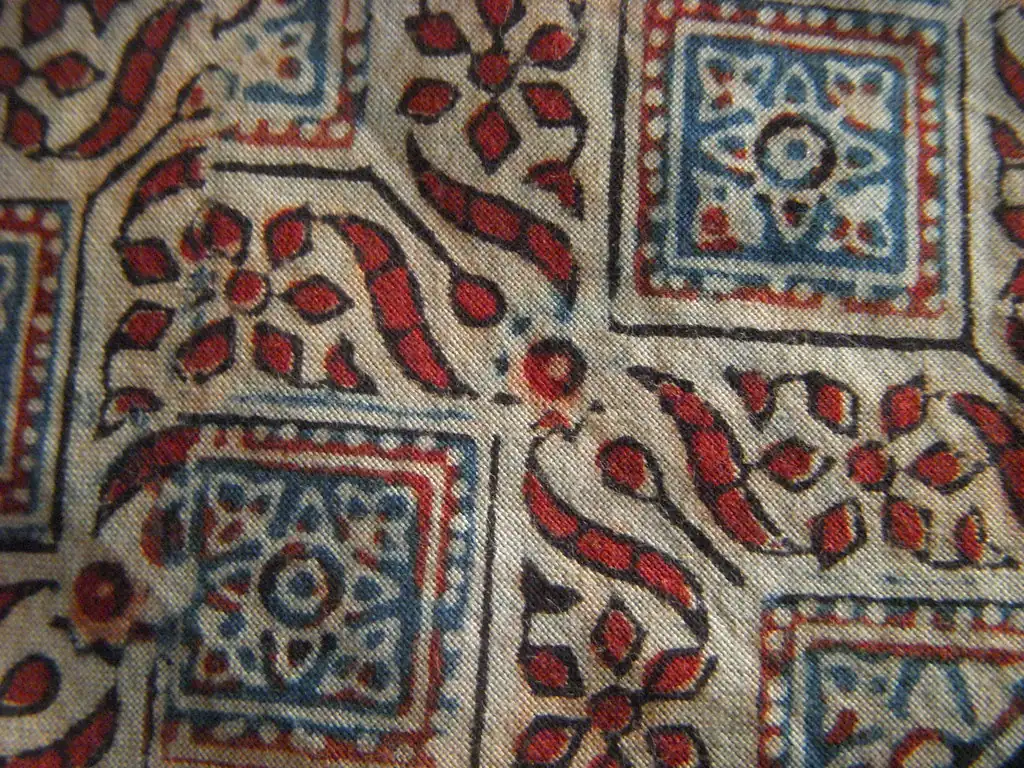
The Ajrak is a block printed shawl, made with carved wooden blocks and natural dyes. Look closely and you see dots, lines and shapes, repeated with care in a geometric design. Deep indigo and crimson dominate, with white and black used to give shape to the design. An Ajrak is usually about 2.5 to 3 metres long. It is worn as a shawl, a wrap or a turban, or presented to a guest as a sign of respect.
Its roots reach far back in time. The famous steatite bust known as the Priest King was found at Mohenjo Daro and is now kept in the National Museum of Pakistan. It shows a man with one shoulder draped in a cloth that looks like an Ajrak. On the cloth is a trefoil, three leaf shapes joined together, and small circles filled with red pigment. Many scholars read the trefoil as a sign of the unity of the gods of sun, water and earth. The dyeing and printing of cloth was already known at Mohenjo Daro, where a dyers workshop was found, and indigo grew along the banks of the River Indus.
Even the word Ajrak has a debated origin. One common account traces it to the Persian word ajar, meaning brick, because of the brick red colour of the cloth. Another account goes back to the Arabic word azrak, meaning blue, for the deep indigo of the cloth. What is certain is that the craft has been passed down through generations of artisans. It is still made by hand in many towns of Sindh, including Matiari, Hala, Bhit Shah, Moro, Sukkur, Kandiaro and Hyderabad.
On the day itself, the Ajrak is everywhere. It is draped over shoulders, hung on walls and stages, and wrapped around the monuments of cities. In Karachi, the Teen Talwar monument has been wrapped in Ajrak for the occasion. In 2025, the Government of Sindh introduced new vehicle registration plates with an Ajrak inspired design, to highlight the cultural heritage of the province. To read the full story of this cloth, see our guide to the Sindhi Ajrak.
The Sindhi Topi and Its Meaning
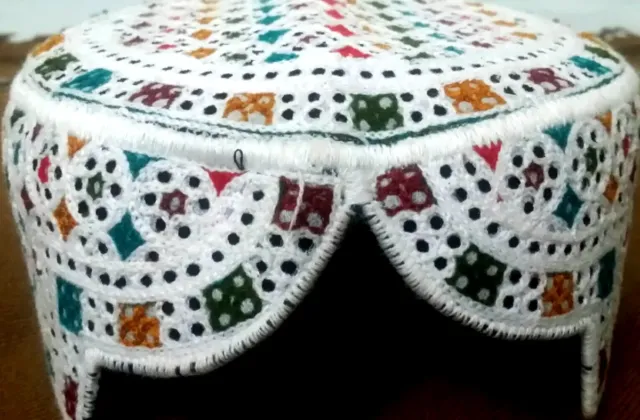
Beside the Ajrak stands the second symbol of Sindhi culture, the embroidered cap called the Sindhi Topi. Round in shape, often worked with mirror work and fine embroidery, it is worn with pride by men, women and children alike. On the morning of the festival, it is the first thing people put on.
The cap goes back to the rule of the Kalhora dynasty, when it took its present form. Over time, the cap and the Ajrak became the twin symbols of Sindhi culture. The cap is often given as a gift, or as a sign of respect, together with an Ajrak. To present a cap and an Ajrak to a guest is to honour the guest in the Sindhi way.
It was the cap that stood at the centre of the first celebration in 2009, and that is why the day was first called Sindhi Topi Day. The following year, when the name changed to Sindhi Cultural Day, the cap kept its place at the heart of the festival. Children in schools wear the cap for tableaus and performances, singers wear it on stage, and political leaders wear it at rallies. To learn more about its designs and history, read our guide to the Sindhi Topi.

Ralli Quilts and Sindhi Crafts
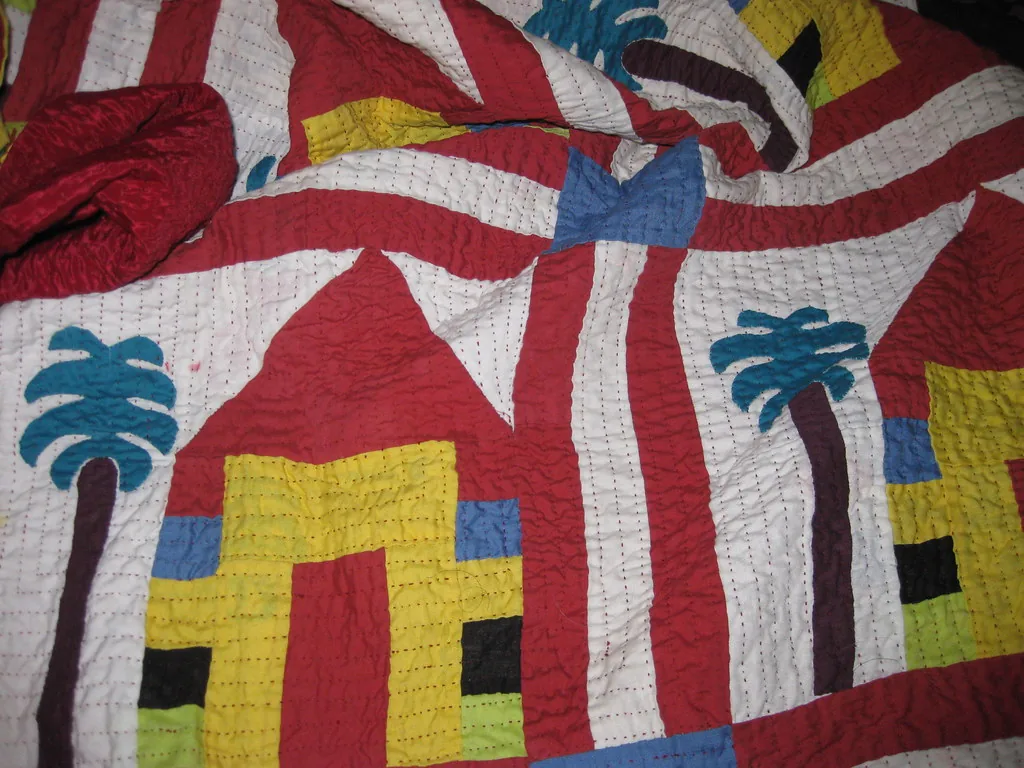
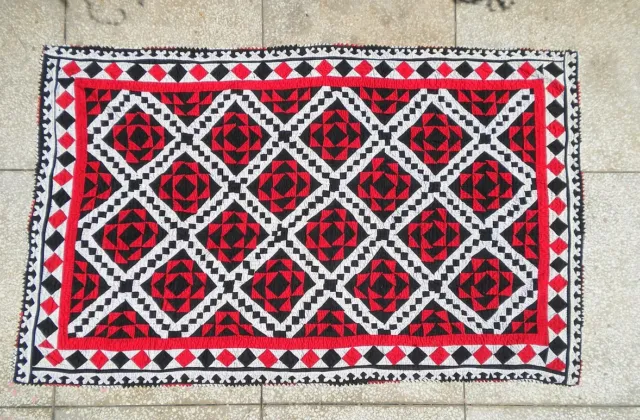
Beyond Ajrak and the Topi, the festival also honours the other crafts of Sindh. The Ralli is one of the finest of these. To make a Ralli, pieces of cloth are joined together into a quilt, often with applique work in bright colours and bold geometric shapes. Women in villages and towns across Sindh make it by hand, and it is used as a bed cover, a gift and a work of art.
On the day, stalls display Ralli quilts beside Ajrak and embroidery, and visitors who may never have seen the craft made can watch it up close. The Sindhi Bharat embroidery, the mirror work of the Topi, the pottery of Hala and the woodwork of the province are part of the same story. Each craft is a thread in the culture that the day celebrates. For the full history of the quilt, see our article on the Ralli Quilt.
Music Poetry and Dance on Cultural Day
Music is the soul of the festival. From the morning, folk songs play from the rallies and the stages, and by the afternoon the crowds are dancing. The songs carry the message of the day, peace, love and unity, and they come from the long tradition of Sindhi poetry and Sufi music.
The most loved song of all is the anthem written for the first celebration, Jiye Sindh Jiye Sindh Wara Jiyan Sindhi Topi Ajrak Wara Jiyan, sung by Ahmed Mughal, the brother of the late Rehman Mughal. It is played at almost every gathering, and the crowd joins in with the chorus. Other folk songs and modern songs written for the day are performed too, including songs released in 2020 by Ali Zafar, Urooj Fatima and Abid Brohi, and by Ghulam Asghar Khoso and Shuja Haider.
The Songs of Shah Abdul Latif Bhittai
At the centre of the music stands the poetry of Shah Abdul Latif Bhittai. Bhittai is the greatest Sufi poet of the Sindhi language, and his verses, collected in the Shah Jo Risalo, are sung at musical gatherings across Sindh. His message is one of love, tolerance and the unity of all people, which is the very spirit of the festival.
His shrine at Bhit Shah, near Hyderabad, is one of the most loved places in Sindh. Blue tile work covers the shrine, and singers gather there to sing his poetry through the night. On the cultural day, his songs are performed on stages across the province, and his name is remembered as the voice of Sindh. To read his life and poetry in full, see our article on Shah Abdul Latif Bhittai.

Mach Katchehri and Folk Gatherings
The day also keeps alive an older form of gathering, the mach katchehri. In a mach katchehri, people sit in a circle around a fire built on sticks in the centre, and they share poetry, stories and songs through the evening. No stage. No loudspeakers. It is a simple gathering, and it carries the oldest style of Sindhi social life.
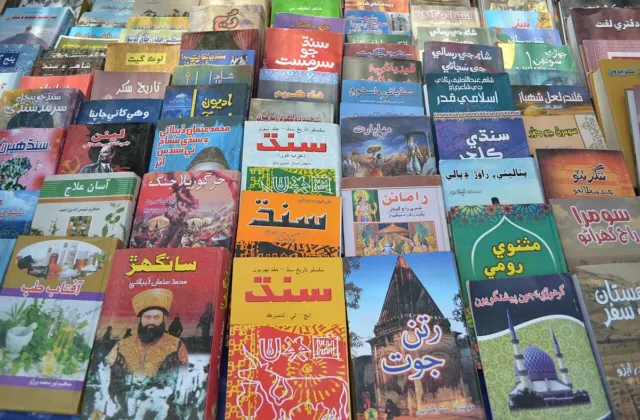
Literary gatherings are held in the same spirit. Poets read new work, scholars speak on the history of Sindh, and school children perform tableaus that show scenes from the past. Universities and cultural organisations arrange seminars and debates, and the history and heritage of Sindh are discussed in public. The Sindhi language itself is honoured at these gatherings, as the living voice of the culture. For the story of the language, read our guide to the Sindhi Language.
Sindhi Cultural Day Around the World
The festival is not limited to Sindh. Sindhi people living around the world celebrate it, and it has become a day when the diaspora shows its identity in public. In the United States, Canada, Britain, the Gulf states and many other countries, Sindhi families gather in community halls, wear Ajrak and Sindhi Topi, share Sindhi food and sing the songs of home.
The world has noticed. In 2022, the Prime Minister of Pakistan, Shehbaz Sharif, felicitated the people of Sindh on the day, and the Prime Minister of Canada, Justin Trudeau, sent greetings to the Sindhi community. The United States Consulate in Karachi has celebrated the day for years, with Qawwali concerts and musical programmes at the residence of the Consul General.
The diaspora helped to shape the day as well. Dr Sarang Ansari, the poet who advised the first Sunday of December as the fixed date, lives in New York. Sindhi media groups abroad, including the World Sindhi Congress, have supported the celebration from the start. For many families abroad, the day is a way to teach their children about Sindh, its language, its dress and its music, in a place far from home.
Sindhi Cultural Day in Schools and Colleges
Schools, colleges and universities play a large part in the festival. In the week before the day, teachers and students prepare tableaus, skits and songs, and they study the history, art and culture of Sindh. On the day itself, students, teachers and parents celebrate together, with children dressed in Ajrak and Sindhi Topi.
School celebrations are often the most joyful of all. Folk dances open the programme. Then the children recite the poetry of Shah Abdul Latif Bhittai, and later they take part in debates and quizzes about Sindhi history. In 2019, the theme of the day was Our Unity Day, and schools across the province held programmes on unity and peace.
The day has also become a part of the calendar of the province. In 2010, the Chief Minister announced a public holiday, and in later years the Sindh government has sponsored events with media centres. The Chief Minister of Sindh, Murad Ali Shah, has paid tribute to the vibrant culture of Sindh in his messages on the day, and has said that nations are recognised by their culture, and that the identity of Sindh is rooted in peace, love and brotherhood.

Why Sindhi Cultural Day Still Matters
The festival matters because it gives a young generation a public reason to learn about its own culture. Many young people live far from their villages, or grow up in cities where old crafts and old songs are rarely heard. On this day, those things come into the open, on the streets and on the screens.
It matters because of how it began, too. No government ordered the day. It began with ordinary people who answered an insult with pride and with peace. That origin is still part of its meaning. That beginning still shapes what the day means. People here learned early that a culture is kept alive by celebrating it, not by anger.
For the wider world, the day shows a Sindh that is often hidden behind the news. A province of poets and artisans, of music and craft, of hospitality and tolerance. The message of Shah Abdul Latif Bhittai, the colours of the Ajrak, the embroidery of the Topi and the patchwork of the Ralli all speak of a culture that values beauty, patience and peace.
To understand the day in its full setting, read our overview of Sindhi Culture, which covers the language, the crafts, the food and the festivals of the province.
How to Join the Celebration in 2026
Sindhi Cultural Day 2026 falls on Sunday 6 December 2026. If you wish to take part, the simplest way is to wear an Ajrak and a Sindhi Topi and join the gathering in your town. The main public gathering in Karachi is held in front of the Karachi Press Club, and similar gatherings are held outside the press clubs of Hyderabad, Sukkur, Larkana and other towns.
Families can celebrate at home as well. Dress the children in Ajrak and Topi, play the songs of Shah Abdul Latif Bhittai, and share a Sindhi meal. Schools and colleges usually announce their own programmes in the last week of November, so it is worth asking your school early.
Visitors to Sindh in December will find the weather pleasant and the province in a festive mood. December is one of the best months to visit Sindh, and the cultural day is a good time to see the crafts, the music and the dress of the province at their liveliest. Political parties have announced that they will celebrate the day in every district of Sindh in 2026, so events are expected across the province.
Questions About Sindhi Cultural Day
When is Sindhi Cultural Day 2026?
Sindhi Cultural Day 2026 falls on Sunday 6 December 2026. The rule never changes: the first Sunday of December, every year. So the calendar date shifts from year to year, while the rule behind it stays fixed.
Why is Sindhi Cultural Day celebrated?
It honours the heritage, language and culture of Sindh, and it shows the unity of Sindhi speaking people. It began on 6 December 2009 as Sindhi Topi Day, after a television anchor criticised the President of Pakistan for wearing a Sindhi cap on his foreign tours. People answered by wearing the cap with pride, and the day grew into a festival of the whole culture.
What do people wear on Sindhi Cultural Day?
Ajrak and Sindhi Topi. The Ajrak is a block printed shawl in deep indigo and crimson, and the Topi is an embroidered cap. Together, they are the best known symbols of Sindhi culture, and they are also exchanged as gifts on the day.
Where is the main celebration held?
The largest gathering is held in front of the Karachi Press Club, where a stage is set up and singers perform through the day. Large programmes are also held at the press club and the Sindh Museum in Hyderabad. Rallies and gatherings take place in Sukkur, Larkana, Mirpur Khas, Badin, Thatta and towns across the province.
Is Sindhi Cultural Day a public holiday?
A public holiday was announced for the day in 2010 by the Chief Minister of Sindh, Syed Qaim Ali Shah. Since then, the Sindh government has sponsored and supported events for the day each year, and schools, colleges and government offices hold their own programmes.
Sources on Sindhi Cultural Day History
- Wikipedia, Sindhi Cultural Day
- Wikipedia, Culture of Sindh
- Wikipedia, Ajrak
- Wikipedia, Sindhi cap
- Dawn, Sindhi Culture Day celebrated with enthusiasm across province, 2 December 2024
- Pakistan Press Foundation, Culture day celebrated across Sindh
- Pakistan Press Foundation, Celebrating Sindh, the land of hearts desire
- The Free Library, Sindhis take to the streets in celebration
- Sartiyoon, Sindh Culture Day 2026, Date and What to Wear
- The Express Tribune, The ageless ajrak
- The News, PPP to celebrate Sindhi Culture Day in every district of Sindh in 2026

Leave a Comment