

The emperor who conquered Sindh was born there. Akbar was born at Umerkot in Sindh in October 1542, while his father Humayun wandered in exile. Fifty years later Akbar’s armies took Thatta, and Sindh became a Mughal province for a century and a half. This is the story of Mughal Sindh, from the annexation of 1591 to the Kalhora return of 1701, with the trade of Thatta, the mosque of Shah Jahan, and the governors who ruled it.
In this article (19)
- Mughal Sindh at a Glance, 1591 to 1701
- Akbar’s Sindh Connection before the Annexation
- The Annexation of Sindh, 1591 to 1593
- Ghazi Beg and the Making of a Mughal Province
- How the Mughals Ruled Sindh, Sarkar and Subah
- Thatta the Trading City, Looms and Factories
- European Travellers in Mughal Sindh
- The Shah Jahan Mosque of Thatta, 93 Domes
- Mughal Tombs at Makli Necropolis
- Mir Masum Shah and the Minaret of Sukkur
- The Decline of Mughal Rule in Sindh
- Why Mughal Sindh Still Matters
- Frequently Asked Questions about Sindh
- When did the Mughals annex Sindh?
- Was Sindh a Mughal province from 1593?
- How many domes does the Shah Jahan Mosque have?
- Who was Mir Masum Shah of Bhakkar?
- When did Mughal rule in Sindh end?
- Sources and Further Reading on Mughal Sindh
The Tarkhan rulers came just before the Mughals. Mirza Jani Beg held lower Sindh from Thatta until Akbar’s army defeated him. Read our guide to the Arghun and Tarkhan Dynasties of Sindh for that story. What follows begins where the Tarkhans end.
Mughal Sindh at a Glance, 1591 to 1701
| Phase | Dates | What happened |
|---|---|---|
| Annexation | 1591 to 1593 | Akbar takes Thatta from Jani Beg |
| Jagir phase | 1593 to 1612 | Jani Beg and Ghazi Beg hold Thatta as jagirdars |
| Sarkar of Multan | 1593 to 1629 | Thatta ruled as a district of Multan |
| Separate subah | 1629 to 1737 | Thatta becomes its own Mughal province |
| Trade peak | 1635 to 1662 | English and Dutch factories at Thatta |
| Shah Jahan Mosque | 1644 to 1647 | The 93 dome mosque is built |
| Decline | 1701 | Kalhoras return; effective Mughal rule ends in upper Sindh |
Akbar’s Sindh Connection before the Annexation
Akbar was born at Umerkot, also called Amarkot, in Sindh, on 15 October 1542. Most modern sources give that date. Some sources give 14 October. His father, the emperor Humayun, had been driven from Delhi by Sher Shah Suri and was seeking refuge and help in Sindh. The Sodha Rajput ruler Rana Prasad Singh Sodha of Umerkot, also written Rana Parshad, gave Humayun refuge, and Akbar was born there to Hamida Banu Begum. The traditionally believed birthplace is marked by a small pavilion near Umerkot Fort.
Humayun spent two and a half years in Sindh, from 1541 to 1543. He camped on the Rohri bank facing the island fort of Bukkur, held by Shah Husain Arghun, also written Shah Hasan, who refused to hand it over. Humayun married Hamida Banu Begum near Rohri in 1541. He never took Bukkur. He left in 1543 for Kandahar and then Persia, from where he returned to retake India.
Akbar’s birth at Umerkot is a nice narrative hook, and nothing more. No source supports a causal link between his birthplace and his later policy towards Sindh. The Mughal connection with Sindh began with that birth and with Humayun’s wandering, but the annexation came from Akbar’s own imperial aims, not from sentiment.
Upper Sindh was annexed first. Akbar took the island fortress of Bhakkar in 1574, bringing upper Sindh under Mughal control while the Tarkhans still ruled lower Sindh from Thatta. One source gives 1573. The date is given here as 1573 to 1574. The Simple Wikipedia article dates the whole conquest 1574 to 1592 for this reason.
The Portuguese sack of Thatta in 1555 is also part of the background. During the civil war between Shah Husain Arghun and Muhammad Isa Tarkhan, Isa sent for Portuguese help from Bassein. A 700 man force under Pedro Barreto Rolim sailed up to Thatta, found the conflict already won, and, furious at the governor’s refusal to pay them, sacked the defenceless city. That sack explains why Akbar later saw the Portuguese presence on the Sindh coast as a reason to subdue Thatta.
The Annexation of Sindh, 1591 to 1593
The first Mughal attempt failed. In 1586 Nawab Muhammad Sadiq Khan, the Mughal governor of Bhakkar, laid siege to Sehwan. Jani Beg used his flotilla on the Indus to relieve his besieged troops, cut the Mughal army’s supply lines from the rear, and forced Sadiq Khan to lift the siege and retreat to Bhakkar. The two sides then reached a negotiated settlement.
After this defiance, Akbar bestowed the revenue of Multan and Bhakkar on his chief noble Abd al Rahim Khan i Khanan, son of Bairam Khan, with orders to proceed against Qandahar, and, in practice, against Thatta. Akbar’s motives, as given in the scholarship, were to complete his dominance of north west India, to use Sindh as a base against Qandahar, then under the Safavid Shah Abbas, and to curb growing Portuguese influence on the coast.
Khan i Khanan marched on Thatta in 1591. The first action took place on 3 November 1591, when the Sindhi forces were defeated. Jani Beg nevertheless held out. He raised an army of local tribesmen and hired European, that is Portuguese, mercenaries to build a flotilla that could attack the Mughal rear and cut its supply line, and he defended his kingdom for about two years. He lost his father Mirza Paynda and his son Abu’l Fath in battle in 1591.
After a war of attrition that the Mughal Empire’s resources made unwinnable for Thatta, Jani Beg met Khan i Khanan in November 1592 and surrendered the charge of his realm. The precise date given for the surrender of the Tarkhan forces at Thatta is 1 November 1592. This ended independent Tarkhan rule in Sindh. Jani Beg was taken to Akbar’s court and formally abdicated at Lahore in 1593.
The annexation year is given as 1591, 1592 or 1593 in different sources, and all three are correct for different moments. 1591 is when the army was sent and the first battle was fought. 1592 is the surrender at Thatta. 1593 is the formal abdication at Lahore. This article gives the sequence, not one year.
Akbar made Jani Beg a mansabdar of 3,000 zat and sawar, promoted to 3,500 in 1596 to 1597. Under the farman of submission, the sarkar of Sehwan, also called Siwistan, and the port of Lahari Bandar were taken into direct imperial administration. Jani Beg kept the remainder of his principality as a jagir, not as a subah. He was summoned to court and never allowed to return to Thatta. He ran the jagir through deputies who sent him the revenues.
Jani Beg died at Burhanpur on 1 February 1601, seventeen years into Mughal service, having never returned to Sindh. One source gives his death year as 1599, another as 1600. The 1601 date is the best supported, and it is the date used in the governor list, where his faujdari runs to 1 February 1601.
Ghazi Beg and the Making of a Mughal Province
Jani Beg’s son Mirza Ghazi Beg was only seventeen when his father died. Akbar’s farman granted him his father’s jagir. His succession was opposed by Mirza Isa Tarkhan, but Jani Beg’s vakil Khusraw Khan Chirgis, also written Khusro Charkas, supported him, and Isa was forced to leave Sindh. Ghazi Beg was brought to Agra and kept at court until Jahangir’s accession in 1605. Only then was he allowed to return to his jagir.
Once back in Thatta, Ghazi Beg behaved like an independent ruler. There was no other Mughal official sharing the government of his jagir. He dealt with internal opposition from his father’s old ministers, Arab Kokah, Mullah Gada Ali and Bhai Khan Lutfullah, by appointing Ahmad Beg Sultan as his chief deputy, wakil i kul, on Bhai Khan’s own recommendation, then winning him over.
Jahangir gave him the province of Multan including Bhakkar. When the Persian governor of Herat invaded Qandahar in 1605 to 1606, Jahangir appointed Ghazi Beg head of the imperial army to relieve Qandahar. He died on 12 April 1612.
Here is the point the popular story gets wrong. Jani Beg and Ghazi Beg are often called governors of Sindh. The scholarship is clear that they were jagirdars, holding their old principality as a Mughal mansab, and there was no suba of Sind at first. Thatta was a sarkar under the suba of Multan until 1629, when it became a separate subah. The first imperial faujdar was Rao Patar Das Khattari, who served from 28 March 1593 to 1594 and was removed for unpopularity among locals. Jani Beg was then reappointed as faujdar from 1594 to 1601 because of public unrest.
After Ghazi Beg’s death, Khusraw Khan Chirgis tried to hold Thatta, but Jahangir sent a series of Mughal mansabdars. Mirza Rustam Safavi was appointed faujdar in 1614 to 1615. One paper calls him the first Mughal governor of Thatta, who finally abolished the Arghun Tarkhan rule in Sindh. That label is loose. The governor list gives Muzaffer Khan in 1612 to 1614 before him, and Patar Das Khattari as faujdar from 1593. Rustam Safavi is best read as the first governor who ended Tarkhan influence, not literally the first imperial appointee.
A portrait survives from the Tarkhan court: Likeness of Mirza Ghazi, son of Mirza Jani, painted by Manohar, a Mughal painter at the Tarkhan court in the province of Thatta, around 1610. It is evidence that the Tarkhan court at Thatta still employed a Mughal atelier after the annexation.
How the Mughals Ruled Sindh, Sarkar and Subah
From 1593 Thatta was a sarkar, a district, of the suba of Multan. In 1629, under Shah Jahan, Thatta was made a separate subah, a province, divided into three sarkars, Sehwan, Bhakkar and Thatta, each administered by a faujdar reporting to the subahdar. The Thatta Subah lasted until 1737, when Sindh seceded under Noor Mohammad Kalhoro.
Irfan Habib’s Atlas of the Mughal Empire gives the Thatta sarkar’s area as 25,335 square km in 1601. Governors changed frequently. Most served one to four years. Izzat Khan Sayyid Abd al Razzaq Gilani served three separate terms, 1662 to 1664, 1666 to 1669, and 1673 to 1679. This rapid turnover is part of the story of weak, extractive rule in the later 17th century.
Notable governors include Amir Khan Mir Abul Baqa, the first subahdar, who served 1629 to 1631 and again 1643 to 1647. Prince Aurangzeb himself was subahdar of Thatta from 1649 to 1653. Mirza Sipihr Shikoh served 1655 to 1658. Hifzullah Khan, who served 1691 to 1701, was the last subahdar of this article’s period.
The Ain i Akbari gives the assessed revenue, the jama, of sarkar Bhakkar as 18,424,947 dams, sarkar Thatta as 25,999,891 dams, and sarkar Chachkan as 11,784,586 dams. A dam was a copper coin, and 40 dams made 1 rupee. The Chahar Gulshan gives sarkar Sehwan at 12,629,600 dams, with 21 mahals and 347 mauzas. These are the only hard revenue figures found. Use them as the Ain’s assessment, not as cash actually collected. Actual realisation was lower and varied. No total figure for Sindh’s revenue as a whole is verified, so none is given here.
Besides land revenue, realised in cash in most areas but in kind from the hill nomads, often camels and goats, the thesis lists urban taxes: custom duties, town tax, taxes on merchants, boat tax, toll tax, seal fee, mariners’ shares, and seigniorage at the mints. Mughal mints operated in Sindh.
The scholarship concludes that despite Sindh being a peripheral region, the centralised Mughal administrative pattern was fully in vogue there, with all the imperial officers found in other provinces. But the transitional jagir phase from 1592 to 1612 meant real central control arrived late.
A paper from the University of Sindh argues that the Mughal subedars did their worst to plunder Sindh, that conditions markedly deteriorated, and that this drove people to turn against Mughal government. That is a partisan, nationalist framed source. Use it as evidence of how the period is remembered in Sindhi scholarship, not as a neutral fact. The Mazhar i Shahjahani itself, written in 1634, does document the destruction of peasants in Sehwan, which supports the broad point that the revenue system pressed hard on cultivators.
Thatta the Trading City, Looms and Factories
Thatta was a river port on the Indus, about 200 km upriver from the sea. Lahari Bandar, also called Lahori Bandar and Larrybunder to the Europeans, was its seaport at the Indus mouth. Goods were transshipped there to small boats for the journey up to Thatta. De Laet wrote that Lahari Bandar was three days’ journey from Thatta. Nicholas Withington, in 1612 to 1616, and Thevenot, in the 1660s, agreed. Hamilton, in 1699, put Thatta about 40 miles from Lahari Bandar, which stood five to six leagues from the sea on a branch of the Indus. The exact location of Lahari Bandar is not determined, so it is not placed on a map here. Read our guide to Banbhore for Debal and the port’s background.
The Portuguese were supreme in the Arabian Sea in the 16th century. After the sack of Thatta and the fall of Ormuz, Portuguese power declined. By the early 17th century the English and Dutch were the active European traders at the Indus mouths. The English East India Company established a factory, a trading post, at Thatta in 1635, which operated until 1662. The English factory letters from 1635 to 1662 are a key source for the commercial, social and political conditions of Mughal Sindh. The Dutch East India Company had a small comptoir at Thatta from 1652 to 1660, competing with the English. The first Dutchmen employed by the company visited Sind in 1631. A Dutch party reached Thatta in March 1652 under Pieter de Bie.
Thatta in the 1650s had 2,000 looms producing cloth exported to Asia and Portugal, plus a thriving silk weaving industry and leather products exported throughout South Asia. Raw cotton came from around Bhakkar in the upper Indus valley. Augustinian friars visiting in the 1650s described Thatta as a wealthy city. Thatta is reported to have had 400 madrassas at its height. That figure is widely repeated but not verified against a scholarly source, so it is given here only as reported.
Alexander Hamilton, visiting in 1699, estimated Thatta’s population at about 150,000. The Thatta article gives a high of about 200,000 in the 18th century, falling to about 20,000 by the early 19th century and 10,783 in the 1901 census. The 2023 census gives Thatta city 51,723. Hamilton’s 150,000 is used here as the contemporary estimate for the Mughal period.
Thatta was the meeting point of several routes: river traffic down the Indus from Lahore, overland routes to Gujarat and Persia, and sea trade via Lahari Bandar to Hormuz, the Persian Gulf, Arabia and East Africa. Dutch East India Company records, as studied by Willem Floor, list Sindh’s exports as cotton textiles, saltpetre for gunpowder, indigo, leather, livestock, rice, wheat and medicinal herbs. Imports included spices and sugar from Java, metals for arms, iron, steel, zinc, tin, lead and mercury, Chinese silk, sandalwood, coconuts and imitation pearls.
Thatta’s decline came in three phases, not one event. First a political decline after the annexation, as Mughal rule shifted some trade towards other Mughal ports. Then a commercial revival under the European factories from 1635 to 1662. Then a physical end, when the Indus silted and shifted its course east in the second half of the 1600s, away from Thatta, and the city was abandoned as a seaport. Its Hindu merchants continued to trade, increasingly with their own ships rather than European ones, and were particularly active around Muscat in Oman.
Two disasters struck the province’s economic heart. A great hurricane struck Thatta on 15 August 1637, raising the level of the Indus and causing destruction. Many men, buildings and cattle perished, and one thousand ships were wrecked. An earthquake was reported in 1668 in the province of Thatta, especially in Samawani, under the jurisdiction of Lahari Bandar.
European Travellers in Mughal Sindh
Persian court histories record politics and administration but reveal little about ordinary life. The European travellers’ accounts are the main source for the social, economic and cultural history of Mughal Sindh. But they are based on the European travellers’ worldview and are therefore of limited use as sources for 16th or 17th century Indian history. They are used here for colour and for trade facts, with a note on whose eyes are doing the seeing.
Ralph Fitch was the first Englishman to reach India in search of trade. He visited Sindh in the 1580s, before the annexation, so his account is useful background, not Mughal period evidence. Walter Payton visited Sindh in 1613 and left an account of its communities, fauna, flora, rivers and customs.
Nicholas Withington was an English East India Company merchant sent from Ahmedabad to contact English ships at Thatta and Lahari Bandar. He travelled via Radhanpur and the Rann of Kutch to Nagarparkar, where his caravan was stopped by a local chief’s men. Three Indian merchants were killed and goods looted. He was sent back, fell ill in Radhanpur in March 1614, and returned to Ahmedabad in early April 1614. His account shows the dangers of overland travel and the limits of Mughal authority on the roads.
Sebastien Manrique, an Augustinian friar, visited Sindh in 1640 to 1641 and described its communities and institutions. Niccolao Manucci, the Venetian traveller, was in India from 1653 to 1703 and described Sindh. He placed Lahari Bandar 12 leagues upstream from Thatta. Alexander Hamilton, the Scottish sea captain, visited Thatta in 1699, estimated its population at about 150,000, and described Lahari Bandar’s position. His account is the latest traveller’s view in this article’s period, and it already shows a city past its peak.
The Shah Jahan Mosque of Thatta, 93 Domes
The Shah Jahan Mosque was built between 1644 and 1647, during the reign of Shah Jahan. An eastern addition was completed in 1659, during Aurangzeb’s reign. The foundation was laid in 1054 AH, 1644 CE, and the mosque completed in 1057 AH, 1647 CE. Construction was begun on Shah Jahan’s order. Read our guide to the Shah Jahan Mosque Thatta for the full story of the building. This article summarises it.
Shah Jahan ordered it as a token of gratitude for the hospitality he received from the people of Sindh when he took refuge in Thatta after rebelling against his father Jahangir, from 1622 to 1626. He surrendered in 1626 and became emperor in February 1628. Construction may also have been partly motivated by relief after the devastating storm of 1637. Shah Jahan was not in the region during construction, so he was unlikely to have been directly involved in its design. But the scale of tile work and brick work shows it was an imperial project paid for from the royal treasury. The total expenditure is reported as 900,000 Shahan shahi rupees. That figure comes from one popular source only, so it is given here as reported, not verified.
The mosque is built of red brick with blue glazed tiles, which probably came from Hala. It is considered to have the most elaborate display of tile work in South Asia, and is notable for geometric brick work unusual in Mughal period mosques. The style is Timurid and Central Asian, a reflection of Shah Jahan’s campaigns near Samarkand shortly before the mosque was designed. It was built in the style of a caravanserai: a great courtyard, about 52 by 30 metres, enclosed by domed apartments, with four iwans and the main prayer hall on the west side, and arcades of 33 arches.
The mosque has 93 domes, the most of any structure in Pakistan. That count is confirmed by Wikipedia, Archnet, pakheritage.org and Dawn. The mosque has no minarets. Some sources say 100 domes. The 100 figure appears on a plaque and in popular writing. 93 is used here, with the other figure noted. The main dome’s tiles are arranged in a stellate pattern to represent the night sky. The domes are arranged so that a person speaking at one end of the main dome can be heard at the other end when the speech exceeds 100 decibels. That is the mosque’s famous acoustic design, given here as it is widely reported, not as a measured laboratory fact.
The mihrab was initially incorrectly aligned with Mecca. Tradition says a Sufi of Hala was approached and corrected the alignment through prayer. Records show the mihrab was actually rebuilt about a century later. The correction is given here as popular tradition, and the rebuilding as the documented fact.
The mosque was restored in 1692, under Aurangzeb, inside this article’s period, and again in 1812 under the Talpur ruler Murad Ali Khan. It is on Pakistan’s Tentative List for UNESCO World Heritage since 1993. It is not an inscribed World Heritage Site. The Makli Necropolis nearby is inscribed, since 1981. Do not confuse the two. The mosque stands in eastern Thatta, about 100 km from Karachi.

Mughal Tombs at Makli Necropolis
The most architecturally significant tombs at Makli date from the Mughal era, between about 1570 and 1640. The royal mausolea fall into two clusters: the Samma cluster and the Arghun Tarkhan Mughal cluster. Mughal period tombs on the southern side include the mausoleum of Mirza Jani Beg and Mirza Ghazi Beg, the tomb of Nawab Shurfa Khan, also called Dewan Shurfa Khan, a Mughal governor, the enclosure of Mirza Muhammad Baqi Tarkhan, the enclosure of Mirza Jan Baba, and the restored tomb of Nawab Isa Khan Tarkhan the Younger, also called Isa Khan II, who died in 1651. Read our guide to the Makli Necropolis for the whole site. This article covers only the Mughal period tombs.
The tomb of Jan Beg Tarkhan, who died in 1600 or 1601, is an octagonal brick structure whose dome is covered in blue and turquoise glazed tiles. The Sindh Directorate of Archaeology describes it as an octagonal tomb on a high platform of dressed stone, with pointed cusped arches, a mihrab on the west, and extensive use of Thatta blue tiles.

Mir Masum Shah and the Minaret of Sukkur
Mir Muhammad Masum Shah Bakhri, also called Syed Nizamuddin Mir Muhammad Masum Shah, was a Sindhi historian from Bhakkar. He served at Akbar’s court as scholar, historian, diplomat and calligrapher, and wrote the Persian chronicle Tarikh i Masumi around 1600, one of the two key contemporary sources for Mughal Sindh. The other is the Mazhar i Shahjahani, a Persian gazetteer history of Sindh written by Yusuf Mirak in 1634. It covers Bhakkar, Siwi, Thatta and Sehwan, with chapters on the governors of Thatta and the causes of the peasants’ ruin. It survives in a single autograph manuscript, MS 7743, in the Punjab University Library in Lahore. It was published by Pir Husamuddin Rashidi in 1962 and translated with commentary by M. S. Akhtar in 1983.
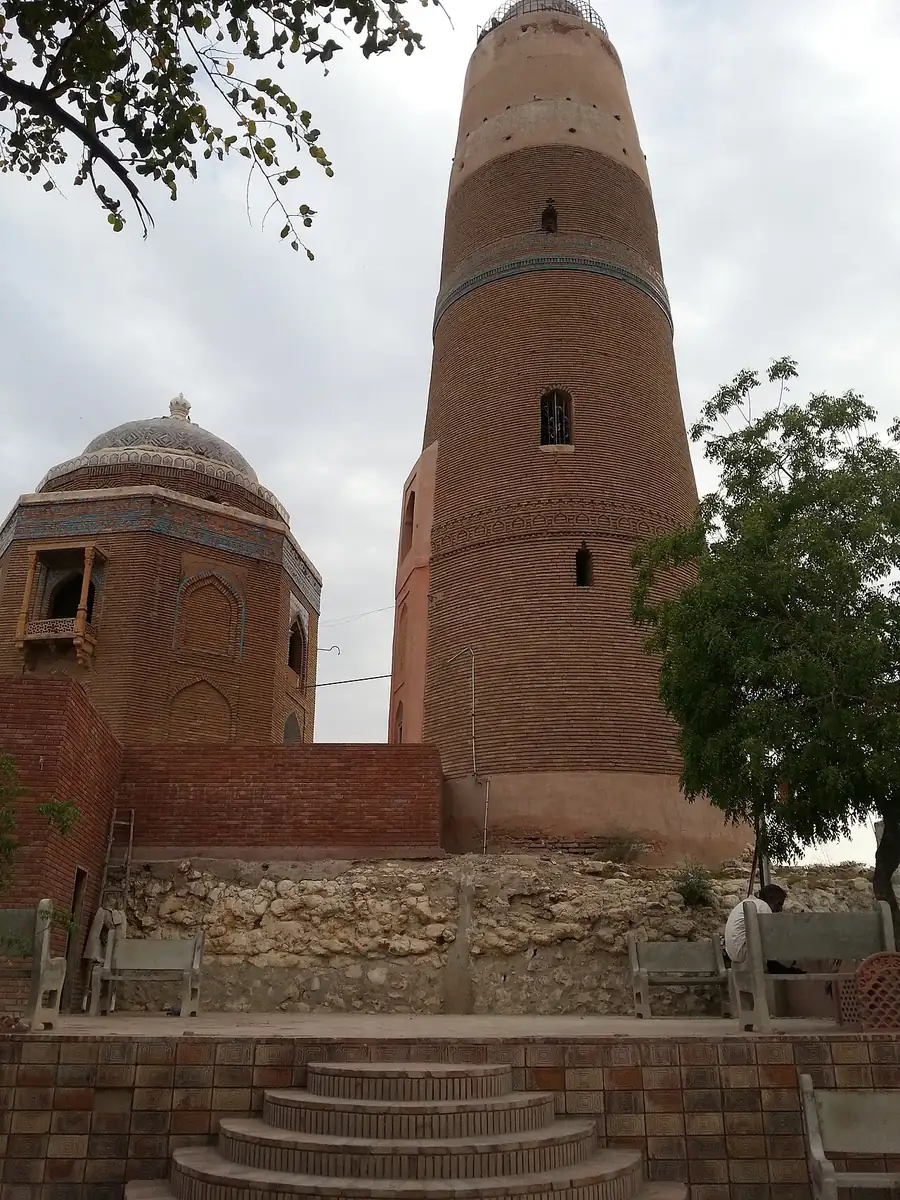
As faujdar of his home sarkar, Masum Shah built the Minaret of Masum Shah at Sukkur. It is a conical red brick tower, about 26 metres, or 84 feet, high, with 84 steps and a base circumference of about 84 feet, slightly off the perpendicular, surmounted by a dome reached by an internal staircase. It was used as a watchtower over the Indus. Construction began around 1593 to 1599. Masum Shah died in 1605 to 1606, and his son Mir Buzurg completed it in 1607. The courtyard around it is the cemetery where Masum Shah and his family are buried. A domed octagonal rest house beside it dates to AH 1004, 1595 to 1596. Henry Cousens described it in The Antiquities of Sind, published in 1929, as the most conspicuous feature in the landscape.
The height is given as about 100 feet in some sources, including Cousens. The 84 figure recurs for height, steps and circumference, which suggests the 84 feet figure is the traditional one. Cousens’s about a hundred feet may include the lantern on top. This article gives about 84 feet, or 26 metres, with the taller figure noted. The completion year is given as 1618 in one source, but that is likely a misreading of 1018 AH, which is 1609 to 1610 CE. 1607 is used here, completed by Mir Buzurg after his father’s death.
Masum Shah was more than a builder. He was a Sindhi scholar, poet, historian, physician and calligrapher at Akbar’s court. His calligraphy travelled as far as Kandahar and Agra. His Tarikh i Masumi is a primary source for the history of Sindh, and without it much of Mughal Sindh would be unknown.
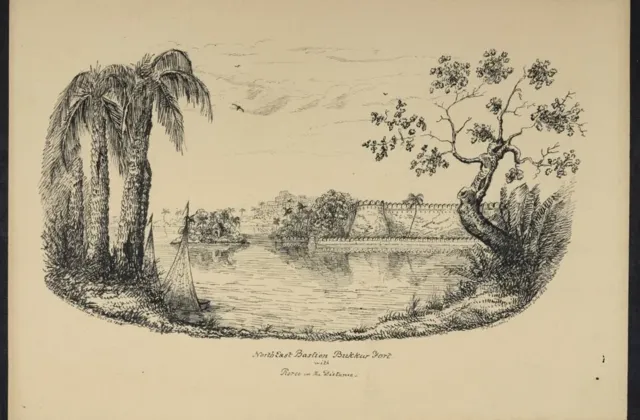
Bukkur fort, the island fort at Rohri and Sukkur, remained the key Mughal stronghold in upper Sindh. The governors of Bhakkar held it through the period. It was rebuilt by Shah Beg Arghun in 1520 to 1522 from the ruins of Aror, which is Arghun period background, not Mughal building. Thatta’s fortifications were already in ruins by the early 19th century. The mosque is the one monument that survives intact from Mughal Thatta. No other standing Mughal building in Thatta is claimed here.
The Decline of Mughal Rule in Sindh
Sindh was a peripheral province, far from Delhi and Agra, held by governors who changed every one to four years. The rapid turnover and the jagir phase meant the province was never tightly integrated. Then the river moved. In the second half of the 1600s the Indus silted and shifted its course east, away from Thatta. The city lost its port function and with it the trade revenue that had sustained it. The hurricane of 1637 and the earthquake of 1668 had already hit the province’s economic heart.
The resistance came from the Kalhora family of upper Sindh, hereditary leaders of a Sufi following, the faqirs. They built an organised movement, the Mianwal movement, from their centre at Hatri, in Taluka Bakrani, Larkana. Its founder, Mian Adam Shah Kalhoro, was killed on the orders of the Mughal governor of Multan. The movement began as a religious following and became a militant, land holding movement. One Sindhi paper frames it as a struggle for independence. This article uses the Sufi movement framing and notes the nationalist reading.
Nasir Muhammad Kalhoro, leader from 1657, who died in 1692, was the first Kalhora to hold local power in upper Sindh from about 1680. He was harassed by the Mughals of Bhakkar, fought Mirza Pini, governor of Siwi, and the Panhwars, and was exiled to Gwalior by Aurangzeb before escaping with Daudpota help and returning to lead the Mianwal movement.
Din Muhammad Kalhoro ruled from 1692 to 1700. In 1699 to 1700 the subahdar of Lahore and Multan, Prince Muhammad Mu’azzam, and the subahdar of Thatta, Hifzullah Khan, faced Din Muhammad at Khore. Din Muhammad was killed. His brother Yar Muhammad was exiled to Kalat. Two accounts differ on Din Muhammad’s death. The Thatta Subah article says he was killed at Khore in 1699 to 1700. The PakSindh Kalhora post says he was executed after surrendering at Multan in 1700. Both are stated here. The Khore version is the one in the Thatta Subah article.
Yar Muhammad Kalhoro returned to Sindh in 1701 after Hifzullah Khan’s death and, with his subordinate Shahdad Khan Talpur, retook his land and made Khudabad his capital. He was later pardoned by the Mughal court in exchange for loyalty, and after Aurangzeb’s death in 1707 he was given the administration of Sehwan Sarkar. Read our guide to the Kalhora Dynasty for the full story. This article closes with only a brief bridge to it.
The year 1701 is the conventional end of the Mughal period in the timeline. Say it plainly: 1701 is the end of effective Mughal rule in upper Sindh, not the end of the Thatta Subah, which lasted until 1737. Mughal governors continued at Thatta until 1737, but real power in upper Sindh had passed to the Kalhoras. Aurangzeb, the last great Mughal emperor, died in 1707, and the empire’s disintegration afterwards is the background to the Kalhora consolidation.
Why Mughal Sindh Still Matters
Mughal Sindh lasted only a century and a half, but it changed Sindh. It joined the province to the greatest empire India had known, and it gave Thatta its greatest building, the mosque of Shah Jahan, and its greatest historian, Mir Masum Shah. The revenue records of the Ain i Akbari, the gazetteer of Yusuf Mirak, and the factory letters of the English and Dutch are the first detailed records of how Sindh was actually governed, taxed and traded with.
It also left a lesson about how history is written. The Persian chronicles record the court. The European travellers record the market and the road. The coins and the tombs record what the chronicles leave out. Where those sources disagree, on the year of an annexation, on whether a man was a governor or a jagirdar, on the height of a minaret, the honest answer is to say so. Mughal Sindh is not a single certain story. It is a set of evidence, carefully weighed, and this article has tried to weigh it fairly.
Frequently Asked Questions about Sindh
When did the Mughals annex Sindh?
Akbar sent his army against Thatta in 1591, and the first battle was fought on 3 November 1591. Jani Beg surrendered at Thatta on 1 November 1592, and he formally abdicated at Lahore in 1593. All three dates are correct for different moments. The annexation is usually dated 1591 to 1593.
Was Sindh a Mughal province from 1593?
No. From 1593 Thatta was a sarkar, a district, of the suba of Multan. It became a separate subah, a province, only in 1629, under Shah Jahan, divided into three sarkars, Sehwan, Bhakkar and Thatta. Jani Beg and Ghazi Beg were jagirdars, not subahdars. The popular claim that Sindh was a suba from 1593 is wrong.
How many domes does the Shah Jahan Mosque have?
The Shah Jahan Mosque at Thatta has 93 domes, the most of any structure in Pakistan. The mosque has no minarets. Some sources say 100 domes. The 100 figure appears on a plaque and in popular writing. The scholarly consensus, from Wikipedia, Archnet and pakheritage.org, is 93.
Who was Mir Masum Shah of Bhakkar?
Mir Muhammad Masum Shah Bakhri was a Sindhi historian from Bhakkar who served at Akbar’s court as scholar, historian, diplomat and calligrapher. He wrote the Tarikh i Masumi around 1600, one of the two key contemporary sources for Mughal Sindh. As faujdar of Bhakkar he built the Minaret of Masum Shah at Sukkur, completed by his son Mir Buzurg in 1607.
When did Mughal rule in Sindh end?
Effective Mughal rule in upper Sindh ended in 1701, when Yar Muhammad Kalhoro returned after Hifzullah Khan’s death and retook his land. Mughal governors continued at Thatta until 1737, when Sindh seceded under Noor Mohammad Kalhoro. The Thatta Subah lasted until 1737, but real power in upper Sindh had passed to the Kalhoras in 1701.
Sources and Further Reading on Mughal Sindh
- Wikipedia, History of Sindh. en.wikipedia.org
- Wikipedia, Thatta Subah. en.wikipedia.org
- Wikipedia, Mirza Jani Beg Tarkhan. en.wikipedia.org
- Wikipedia, Shah Jahan Mosque, Thatta. en.wikipedia.org
- Archnet, Shah Jahan Mosque. archnet.org
- Encyclopaedia Britannica, Akbar. britannica.com
- Dawn, Thatta: the ancient city of kings. dawn.com
- Wikipedia, Makli Necropolis. en.wikipedia.org
- Sindh Directorate of Archaeology, Makli. doam.gov.pk
- UNESCO, Shah Jahan Mosque Tentative List. whc.unesco.org
- Academia.edu, Paliwal, The Transition of Sind to a Mughal Province. academia.edu

Leave a Comment