

In 1843 a British general with fewer than 3,000 men defeated an army ten times his size and took Sindh. For the next 104 years Sindh was ruled from Bombay, then from its own capital, and the province was remade. A fishing town became the largest wheat exporting port in the East. A barrage turned desert into farmland. A script was fixed for a language. And an assembly in Karachi passed the first Pakistan resolution of any province in British India. This is the story of British Sindh, from the conquest of 1843 to Partition in 1947.
In this article (23)
- British Sindh at a Glance, 1843 to 1947
- The Road to Conquest, 1839 to 1843
- The Battles of Miani and Dubbo, 1843
- Napier as Governor and the Peccavi Story
- The Fate of the Talpur Mirs after 1843
- Sindh under the Bombay Presidency
- Karachi, from Fishing Town to Port City
- Irrigation, Jamrao Canal and Sukkur Barrage
- The Uprising of 1857 in Sindh, Karachi Plot
- Language, Education and the Sindhi Script
- The Movement for Separation from Bombay
- The Sindh Assembly and the Premiers
- The Pakistan Resolution in Sindh, 1943
- The Hur Movement and Pir Pagaro
- Partition, 1947, and the End of British Rule
- Why British Sindh Still Matters
- Frequently Asked Questions about British Sindh
- When did the British conquer Sindh?
- Was Peccavi really Napier’s despatch?
- When was the Sukkur Barrage built?
- What did the Sindh Assembly resolve in 1943?
- When did Sindh become a separate province?
- Sources and Further Reading on British Sindh
The Talpur rulers came just before the British. Read our guide to the Talpur Dynasty for that story. What follows begins where the Talpurs end, with the general who defeated them.
British Sindh at a Glance, 1843 to 1947
| Phase | Dates | What happened |
|---|---|---|
| Conquest | 1843 | Napier wins Miani and Dubbo; Sindh annexed |
| Bombay Presidency | 1843 to 1936 | Sindh ruled as a division of Bombay |
| Karachi port | 1850s to 1899 | Harbour works, railway, cotton and wheat boom |
| Sukkur Barrage | 1923 to 1932 | Lloyd Barrage opens; perennial irrigation |
| Separation | 1 April 1936 | Sindh becomes a separate province |
| Assembly and resolution | 1937 to 1947 | First assembly; Pakistan Resolution 3 March 1943 |
| Partition | 1947 | Sindh joins Pakistan; British rule ends |
The Road to Conquest, 1839 to 1843
The British took Karachi before they took Sindh. On 3 February 1839 the East India Company captured the port after HMS Wellesley opened fire and destroyed Manora Fort, which guarded Karachi Harbour at Manora Point. Karachi then had a population of about 8,000 to 14,000, confined to the walled city in Mithadar, with suburbs in what is now the Serai Quarter. Manora Fort had been built by the Talpurs in 1797. Read our guide to Manora for the fort and the lighthouse that later stood there.
The background was the First Anglo Afghan War of 1839 to 1842. The Company wanted Sindh as a route and supply base for its Afghan campaign, and as a buffer against the Sikh kingdom of Lahore and against Russian influence from the north west, the rivalry later called the Great Game. British complaints about the Talpur Amirs during the Afghan war were the stated pretext for action.
Treaties were forced on the Amirs. In 1838 the British representative had them sign a political residency treaty, allowing a British residency in Hyderabad. In February 1843 the Governor General, Lord Ellenborough, forced the Amirs to sign a new treaty providing for the permanent annexation of British occupied bases in Sindh and for the transfer of large northern areas to Bahawalpur if Napier found the Amirs disloyal.
In September 1842 Major General Sir Charles James Napier was given full civil and military powers in Sindh. Napier was born in London on 10 August 1782 and died at Portsmouth on 29 August 1853. He was a veteran of the Peninsular War and the War of 1812, and had been military resident of Cephalonia from 1822 to 1830. He arrived in Sindh on 10 September 1842, aged 60.
Napier provocatively seized and razed the desert fortress of Imamgarh. This, with the onerous new treaty, turned a tense situation into open war. On 15 February 1843 about 8,000 Baloch attacked the British Residency at Hyderabad, defended by the British Resident, Sir James Outram. Outram escaped. This was the immediate trigger for the battles that followed.
The conquest was controversial from the start. Outram himself criticised the annexation, and the war was condemned in Britain as uncalled for and unjust. The Victorian Web account quotes the judgement that the war was “uncalled for, impolitic, and unjust”. Governor General Ellenborough was later recalled, but Sindh remained British. The Company’s directors awarded Napier 60,000 pounds in prize money, in silver rupees, for taking Sindh.
The Battles of Miani and Dubbo, 1843
The Battle of Miani, also spelled Meeanee, was fought on 17 February 1843. Napier’s force of about 2,800 troops, only about 500 of them British and the rest Indian sepoys, defeated a Talpur army of more than 20,000 men under Mir Nasir Khan Talpur, near Miani, close to Hyderabad. Some sources give the Talpur strength as 22,000 to 30,000. The battle is famous in British military annals precisely because of the numerical odds. Napier, aged 61, is reported to have fought with musket in hand and personally led his troops. The Talpur army was scattered and Hyderabad surrendered.
British casualties at Miani were 256 killed and wounded, 62 killed and 194 wounded. Talpur casualties are disputed. One account gives 2,000; others give 5,000 to 6,000 killed or wounded. The higher figure comes from older British accounts. This article gives the range and notes that the sources disagree. One popular source claims more than 20,000 Baloch were killed at Miani. That figure is contradicted by every other casualty count and is not used here.
Mir Jan Muhammad Talpur charged into the British camp at Miani and attacked Outram, who narrowly escaped. His grave is at Miani.
The second battle came five weeks later. On 24 March 1843 Napier, now with about 5,000 men, attacked Mir Sher Muhammad Talpur of Mirpur Khas, called the Lion of Mirpur and Sher i Sindh, at the hamlet of Dubba near Hyderabad. Sher Muhammad’s force is given as about 26,000. Napier won again. British losses were about 270. Talpur losses are estimated at about 5,000 killed or wounded. This ended organised Talpur resistance.
Hosh Muhammad Sheedi, a general of the Talpur army from the African origin Siddi community, fought at Dubbo alongside Mir Sher Muhammad and was killed in action. He is remembered for the war cry attributed to him, “Marvesoon par Sindh na desoon”, meaning “I may die but will not give up Sindh”. The cry is attributed to him in popular and school sources. No contemporary 1843 document for the exact words was found in the research, so it is presented here as the cry attributed to him, not as a verbatim contemporary record. His defiance is a central part of Sindh’s cultural memory of the resistance. Most sources place his death at Dubbo, though some popular accounts associate him with Miani. The Dubbo attribution is the better supported one.
After Dubbo, Sindh was annexed to British India and made part of the Bombay Presidency. Napier was knighted, made Knight Grand Cross of the Order of the Bath on 4 July 1843, and made Governor of Sindh.
Napier as Governor and the Peccavi Story
Napier was the first Governor of Sindh, serving from 1843 to 1847. He was succeeded by Robert Keith Pringle, who served from 1847 to 1850, then Henry Bartle Edward Frere, who served from 1851 to 1859. Frere had been nominated Chief Commissioner in December 1850.
As governor Napier established a model police force, encouraged trade, began work on a breakwater and water supply facilities for Karachi, and repulsed raids by hill tribes on Sindh’s northern border. The historian Kaye judged that at the close of his four years the province “ranked amongst the best administered and most contented” in India. That is a British judgement, and it is presented here as such.
Napier left for England in 1847 after clashing with the East India Company’s directors. He returned to India in 1849 as Commander in Chief, but the Second Sikh War had already ended. A quarrel with Governor General Dalhousie made him leave India finally in 1851.

The most famous story about Napier is also the most famous correction in this article. The one word despatch “Peccavi”, Latin for “I have sinned”, a pun on “I have Sindh”, was not sent by Napier at all. It was coined by Catherine Winkworth, a 16 year old English girl, who remarked to her teacher, the Reverend William Gaskell, husband of the novelist Elizabeth Gaskell, that Napier’s despatch could have been shorter than Caesar’s “Veni, vidi, vici”. Gaskell encouraged her to send it to the new humorous magazine Punch, which printed it on 18 May 1844 under the title “Foreign Affairs”, as if it were a factual report, with a cartoon of Napier.
The Oxford Dictionary of Quotations attributes the pun to Winkworth. Britannica states it is unlikely that Napier sent such a message and that the episode is thought to have been invented by Punch. The Aitken Gazetteer of the Province of Sind of 1907 states plainly that “the popular story that his despatch announcing the result contained the single word ‘Peccavi’ lacks historical support”. Investigations in the Calcutta archives found no such despatch. William Lee Warner commented on it in 1917 and Lord Zetland, Secretary of State for India, in 1936.
The story matters because most popular sources, including GKToday and many school texts, still present “Peccavi” as Napier’s actual despatch. It was a joke that became history.
The Fate of the Talpur Mirs after 1843
Mir Nasir Khan Talpur, who reigned from 24 December 1839 to 24 March 1843, was the last independent monarch of Sindh. He surrendered to Napier the day after Miani. He and the other Mirs were arrested and exiled. Nasir Khan was taken to Bombay as a state prisoner, then to Calcutta, where he died on 14 April 1845, aged 40. He was buried at Pune in trust, amanat, until 1855, when his body was moved to the family graveyard at the Tombs of the Talpur Mirs in Hyderabad.
Mir Sher Muhammad Talpur of Mirpur Khas, after his defeat at Dubbo, fled and kept up resistance for a time, then gave up attempts to regain control and entered into a treaty with the British.
The northern Khairpur branch survived. Under Mir Ali Murad Talpur it kept a degree of sovereignty as the princely state of Khairpur, formalised by treaty in 1853. Its ruler acceded to Pakistan on 3 October 1947 and the state was fully amalgamated into West Pakistan in 1955.
Contemporary accounts record that after the victory the Mirs’ houses were looted, including the women’s jewellery, before the families were imprisoned.
Sindh under the Bombay Presidency
Sindh was annexed into the Bombay Presidency in 1843 and remained part of it for 93 years, until separation on 1 April 1936. It was administered as the Sind Division, headed by a Commissioner after Napier’s governorship ended in 1847.
At annexation Sindh was divided into 3 districts under 1 division, Hyderabad, Karachi and Shikarpur, with Khairpur state excluded. Upper Sind Frontier district was carved out of Shikarpur in 1846 to 1847 with headquarters at Khangarh, now Jacobabad. Thar and Parkar district was created in 1882. Shikarpur district headquarters moved to Sukkur in 1883. Larkana district was created on 1 August 1901. Nawabshah district was created on 1 November 1912. Dadu district was created in 1931. Read our guide to Pakka Qila for Hyderabad, the city that was Sindh’s capital before the British moved it to Karachi.
The Commissioners after Napier were R. K. Pringle from 1847 to 1850, Henry Bartle Edward Frere from 1851 to 1859, Jonathan Duncan Inverarity from 1859 to 1862, and Samuel Mansfield from 1862 to 1867. Frere was the most consequential of them, and his work on Karachi is covered in the next section.
Distance from the provincial capital, Bombay, led to complaints that Sindh was neglected compared with the rest of the Presidency. Proposals to merge Sindh into Punjab were considered from time to time but turned down, because of British disagreement and opposition from Sindhis, both Muslims and Hindus.
The standard account gives two British objectives in Sindh, consolidating British rule, and using Sindh as a market for British products and a source of revenue and raw materials. Irrigation works were the largest single investment, and they are covered in their own section below.
One sentence found in the Wikipedia articles on the History of Sindh and on Sindh says that Sindh became part of the Bombay Presidency in 1909. That is wrong as a statement of annexation. Sindh joined the Presidency in 1843. The 1909 date is not repeated here.
Karachi, from Fishing Town to Port City
Before the British, Karachi was a small port under the Khan of Kalat, then occupied by the Talpur Mir Fateh Ali Khan in 1795, who built a fort at Manora in 1797. Henry Pottinger recorded that customs at the port yielded 99,000 rupees a year. Charles Masson wrote in 1830 that the port had about 100 vessels. There were no wharves, docks or jetties. The harbour lay on the western side of Keamari island, between the mainland and Manora.
Napier floated the idea of Karachi as a free port and began improvements, widening the harbour entrance, a timber pier, a mole, a causeway, connecting Keamari with the town, and a lighthouse at Manora. In his time 1,044 vessels reached Karachi Port. The mole was completed in 1854 and named Napier Mole.
Commissioner Bartle Frere, who served from 1851 to 1859, methodically made Napier’s vision real. Trade rose from 5.18 million rupees to 27.1 million rupees a year between 1850 and 1860.
The harbour engineer James Walker proposed a breakwater, the Keamari Groyne, a Native Jetty, closing Chinna Creek and a bridge over Napier Mole. The proposals were approved in 1859 to 1860 and work began. The completed works were the Chinna Creek entrance closed in 1863, an opening cut in the Napier Mole with a bridge across it in 1864, the Keamari Groyne in 1865, and the Manora Breakwater begun in 1870 and completed in 1873 to 1874. East Pier was built from April 1864 to November 1865. Merewether Pier was built later. Erskine and James wharves, three berths each, were completed in 1888 and 1895 respectively.
The Karachi Port Trust was established in 1887. In the same year the port underwent radical improvements, with railway connection, dredging and breakwater work.
The American Civil War of 1861 to 1865 cut off Lancashire’s cotton supply from the United States, and Karachi’s cotton exports boomed. The opening of the Suez Canal in 1869 brought Karachi nearer to Europe and trade grew further. By 1899 Karachi had become the largest wheat exporting port in the East.
The railway came with the port. The Scinde Railway Company was established by deed of settlement in March 1855 and incorporated by the Scinde Railway Act in July 1855. Work on the Karachi to Kotri line began in April 1858, ground broken by Frere on 29 April 1858. The line opened to the public on 13 May 1861, 108 miles, 174 km, the first railway line for public traffic in what is now Pakistan. The line was built largely to cut the journey time for cargo from Britain to Delhi and Calcutta, with steam navigation up the Indus to Multan and a further line to Lahore. The four companies, Scinde, Punjab, Delhi and Indus Flotilla, were amalgamated into the Scinde, Punjab and Delhi Railway, bought by the Secretary of State in 1885 and renamed North Western State Railway in January 1886.
Karachi’s population was about 14,000 in 1843, about 57,000 in 1856, about 105,000 at the end of the 19th century, 117,000 in the 1901 census with a further 109,000 in the municipal area, 387,000 in 1941, and about 400,000 at independence in 1947, with a slim Hindu majority of about 51 percent. Some estimates give 500,000 by 1947, including the Sindhi villages absorbed into the expanded city. Karachi was formally founded as the fortified village of Kolachi in 1729.
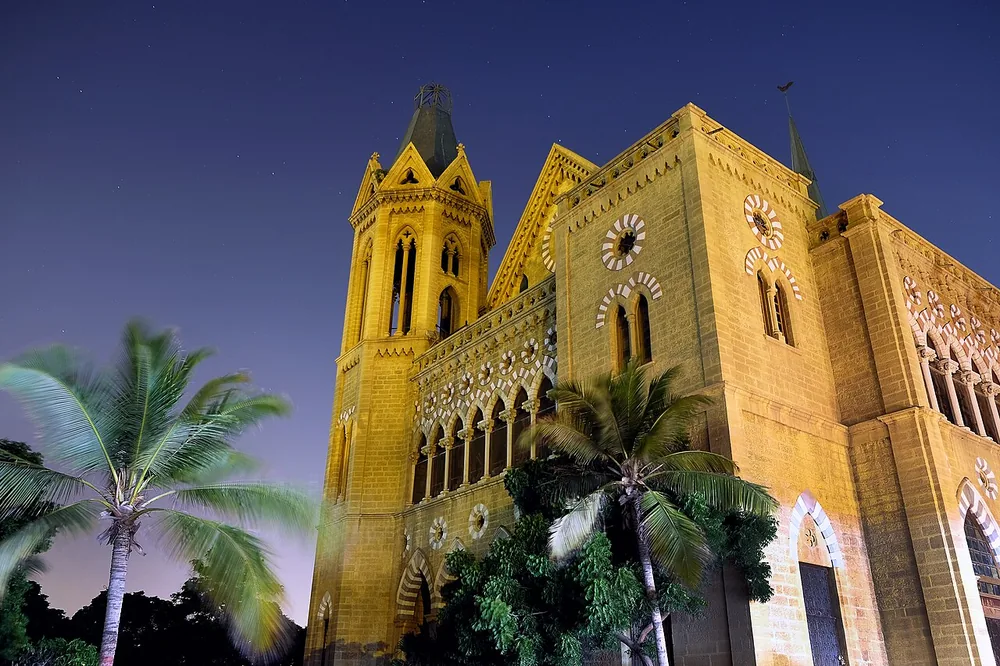
The civic landmarks of the Raj still stand. Frere Hall was built in 1865. Empress Market was built from 1884 to 1889 on the old parade ground. St Joseph’s Convent School was established in 1862. Denso Hall was built in 1886. Manora Fort was upgraded in 1888 to 1889. Karachi was connected to British India’s railway network in 1878, the through connection northwards.
Irrigation, Jamrao Canal and Sukkur Barrage
For centuries Sindh’s farming depended on inundation canals that filled only when the Indus rose in the summer flood. In a weak flood year the canals ran dry, crops failed and famine followed. The British answer was perennial irrigation, a barrage holding the river at a fixed level so canals could draw water all year round.
Colonel C. A. Fife, the leading British irrigation engineer in Sindh, proposed the Sukkur Barrage scheme as early as 1868. He conceived the idea that year. In 1855 and 1859 he connected the Eastern Nara Canal with the Indus by a link canal upstream of Rohri, the Nara supply channel, opened in 1859.
Fife’s Jamrao Canal project, to give perennial irrigation from the Nara river, was submitted in 1860 but had to wait until 1894. It was completed in 1899 and inaugurated on 24 November 1899. It was the first ever weir controlled perennial canal in Sindh, with a weir across the Nara and the canal off taking from a by pass channel.
The Sukkur Barrage itself was conceived by Fife in 1868. The project was finally sanctioned on 9 June 1923. The foundation stone was laid on 24 October 1923. It was built from 1923 to 1932 under the overall direction of Sir Charlton Harrison, chief engineer, with Sir Arnold Musto as the architect and engineer of the scheme. Musto was Executive Engineer from 1918 and Superintending Engineer from 1923. The design followed Bligh’s creep theory. The Head Works and canals were completed by 1932.
The barrage was opened on 13 January 1932 by the Viceroy, the 1st Earl of Willingdon. It was named the Lloyd Barrage after Sir George Lloyd, Governor of Bombay, who had launched the scheme. Musto was knighted in 1932. The Sindh Irrigation Department page twice writes “Lloyd George”. That is an error. David Lloyd George was the British Prime Minister, never Governor of Bombay. The correct name is Sir George Lloyd, and it is used here.
The barrage has 66 spans of 60 feet each, about 4,725 feet across the Indus. Some official sources give 4,925 feet. At its opening it was the largest barrage of its kind in the world and the largest single irrigation work in the world. It was the largest at its opening in 1932. Later barrages are larger. Construction cost is given as 200 million rupees, of which 40.4 million was for the Barrage Head Works.

The seven canals are four on the left bank, Khairpur Feeder West at 1,940 cusecs, Rohri Canal at 10,887 cusecs, Khairpur Feeder East at 2,094 cusecs, Nara Canal at 13,649 cusecs, and three on the right bank, Dadu Canal at 3,150 cusecs, Rice Canal at 10,658 cusecs, North Western Canal at 5,152 cusecs. One modern source names the third right bank canal Kirthar instead of North Western Canal. Both names appear in official sources. This article uses North Western Canal. The total original design diversion was 47,530 cusecs, later increased to 65,933 cusecs. Total canal length is 6,473 miles. Watercourses run 47,800 miles. The Nara Canal, at 226 miles, is the longest canal in Pakistan. Its bed width of 346 feet is one and a half times the Suez Canal, and its discharge is about equal to the Thames at London. The Nara is not wholly man made. It follows the old Hakra river course.
The barrage’s canals irrigate about 8 million acres, about 75 percent of Sindh’s agricultural land. The remaining 25 percent is watered by the Guddu and Kotri barrages, built after independence. The Sindh Irrigation Department gives the command area as 7.63 million acres. Other sources give 8 million, 8.24 million and 8.3 million acres. The figures measure slightly different things, net versus gross command. This article uses about 8 million acres. Read our guide to Sadh Belo for Sukkur, the city the barrage made the gateway to upper Sindh.
Major rehabilitation was carried out from 22 November 2004, completed ahead of schedule in July 2005 at a cost of 15 million US dollars. A further World Bank assisted rehabilitation was approved later. Those post 1947 facts are given here in one line only. The next article in this series covers Sindh after independence in detail.
The Uprising of 1857 in Sindh, Karachi Plot
In September 1857 sepoys of the 21st Native Infantry in Karachi, led by Hawaldar Ramdin Pandey and Hawaldar Sooraj Bali Tewari, planned to rise, attack the British officers and seize the citadel, in contact with soldiers in Delhi. On the night of 13 September 1857 two sepoys informed the British of the plan. The rising was crushed before it began.
The captured rebels were executed on the parade ground where Empress Market now stands in Saddar, Karachi. The executions took place on 17 September 1857 and continued over the following days. The men were hanged or blown from the mouths of cannon, the British method of execution for mutineers, in which the condemned were tied to the mouth of a cannon and fired.
The numbers involved and executed are disputed. One account says 24 local soldiers were captured on 14 September, of whom 14 were hanged and 4 blown up with a cannon. Another says about 22 freedom fighters were executed between 17 and 23 September. A third says 44 people were involved, 15 were hanged and Suraj Bali Tewari was blown from a gun with two accomplices, and three others were shot dead and their bodies thrown into the sea. The figures cannot be reconciled from the sources checked. This article gives the range and says the exact numbers are disputed.
The 1857 rising was also felt in Hyderabad, Shikarpur and Jacobabad. After the rising the East India Company was dissolved in 1858 and India passed to direct Crown rule.
The Sindhi Hindu freedom fighter Hemu Kalani, later called the Bhagat Singh of Sindh, belongs to the 1940s independence struggle, not to 1857. He is not placed in this section.
Language, Education and the Sindhi Script
Before the British, Persian was the court language under the Talpurs. Sindhi was taught in a small number of schools. B. H. Ellis, Assistant Commissioner in the 1850s, counted 23 such schools with 803 pupils, teaching Hindoo Sindee in the Khudawadi and other scripts. There were said to be 609 Perso Arabic schools with 6,479 pupils. Richard Burton, then a military officer in Sindh, noted that even in the Perso Arabic schools the pupil studied his mother tongue, Sindhi.
After the conquest the British decided Sindhi should be the language of administration, which meant British officers had to learn it. Two groups formed. One, led by Captain George Stack, wanted the Devanagari script. The other, including Burton, wanted the Arabic script. The matter was referred to the East India Company’s Court of Directors, which resolved on 8 December 1852 that a committee should adapt the Perso Arabic script.
In 1852 it was decided to go with the Arabic Sindhi script. A committee of seven was appointed, the Assistant Commissioner as chairman, the Maharashtrian educationist Jagannath Vaidya, three Sindhi Hindu and three Sindhi Muslim members. By 1853 a 52 letter Sindhized Arabic, Perso Arabic Sindhi, writing system was introduced, and Sindhi became the official language of Sindh under British rule. Civil servants were required to learn Sindhi, books were printed in it, and it became the medium of instruction in schools.
After the Court of Directors approved a budget of 10,000 rupees and the Arabic Sindhi script in December 1852, a network of schools was established in the three collectorates. In October 1854 an Anglo Vernacular school was established at Karachi, in the Katowal Building, with 68 boys. It was later renamed the Narayan Jagannath Vaidya School in 1874. Similar schools were established at Shikarpur and Hyderabad. In 1873 Hindu Sindhi type was devised and textbooks published to promote the Khudawadi script for the Hindu community.
In 1847 R. K. Pringle, Commissioner of Sindh, submitted a report on the language situation to George Russell Clerk, Governor of Bombay. Ellis’s full Report on Education in Sind was drawn up in 1852 and forwarded to the Government of Bombay in March 1856 by Commissioner Frere. Read our guide to the Sindhi Language for the full history of the language and its scripts. This article covers only the British period decisions.
The Movement for Separation from Bombay
Sindh’s amalgamation with the Bombay Presidency, and the extraordinary powers of the Commissioner, were seen as hindering Sindh’s economic and political development. The demand for separation emerged in the 1800s and grew stronger after the 1919 Montagu Chelmsford reforms fell short of expectations. The demand grew through the 19th century and became an organised movement from the 1910s.
The timeline of the movement runs as follows. In 1917 the question of separation was first raised at a Congress session in Karachi. In 1918 a Sindh Provincial Conference sub committee recommended Sindh become an autonomous province. On 26 December 1923 the Indian National Congress at its Kanpur session agreed to the principle of reorganising provinces on a linguistic basis and demanded Sindh’s separation from Bombay. On 30 to 31 December 1925 the All India Muslim League at Aligarh unanimously passed a resolution supporting Sindh’s separation. In 1927 the Delhi Muslim Conference, Jinnah’s Delhi Proposals, offered to give up separate electorates in return for, among other things, Sindh’s separation from Bombay, reforms in the NWFP and Baluchistan, one third of central legislature seats for Muslims, and population based seats in Punjab and Bengal.
In 1928 the Nehru Committee, the All Parties Conference, recommended separation of Sindh, on economic rather than communal grounds. The Hindu Mahasabha protested, fearing Hindus would become a minority in Sindh. On 18 June 1928 a conference of all communities in Karachi reached the Sindh Hindu Muslim Pact, signed by 26 prominent Hindu, Muslim and Parsi leaders, demanding joint electorates and separation. The Simon Commission visited Karachi on 12 November 1928 and co opted two Muslim members, Sir Shahnawaz Bhutto and Syed Miran Mohammad Shah.
In 1932 a conference of Sindh’s leaders in Karachi in April reported on the financial basis of separation. The question of Sindh’s deficit was the main obstacle. The report’s figure for the subsidy is incomplete in the copy consulted, so no figure is quoted here. In 1933 Sindh’s case was put before the Joint Parliamentary Select Committee on the Government of India Bill. In 1935 the Government of India Act was passed by the British Parliament, providing for Sindh as a separate autonomous province.
Separation came on 1 April 1936, under Section 40(3) of the Government of India Act, 1935. Sindh was separated from the Bombay Presidency and became a province with its own Legislative Assembly. A Sindh Administrative Committee worked out the mechanism of separation, and Mr Nixon examined the financial separation to determine the new province’s liabilities for debts and capital expenditure. Sir Lancelot Graham was appointed the first Governor of Sindh, serving from 1 April 1936 to 31 March 1941.
The All India Muslim League passed a resolution in 1925 urging separation, and Sindhi Muslim leaders were active in the movement. Dawn’s account calls the separation “the first step towards the foundation of Pakistan”. The separation was opposed by sections of Sindh’s Hindu community, who feared becoming a minority in a separate Muslim majority province. The 1928 Sindh Hindu Muslim Pact was the attempt to bridge this divide.
The Sindh Assembly and the Premiers
The first elections to the Sindh Legislative Assembly were held on 7 February 1937, for 60 seats. The first session met on Tuesday 27 April 1937 at 11 a.m. in the Assembly Hall of the Sindh Chief Court, Karachi. Dewan Bahadur Hiranand Khemchand presided over the first session as chairman.
The Ittehad Party, formed by Sir Shah Nawaz Bhutto, Sir Abdullah Haroon and Allah Bakhsh Soomro, won 24 of the 35 Muslim seats. Bhutto and Haroon both lost their own elections.
Although the Ittehad Party had the largest bloc, Governor Sir Lancelot Graham invited Sir Ghulam Hussain Hidayatullah, who had the support of only five members, to form the government. Hidayatullah served as the first Premier, from 28 April 1937 to 23 March 1938. His government was defeated on a no confidence motion during the budget session.
Allah Bakhsh Soomro became the first democratically elected Premier of Sindh on 23 March 1938, aged 38. He served from 23 March 1938 to 18 April 1940, for the Ittehad Party, and again from 7 March 1941 to 14 October 1942. He had represented upper Sindh in the Bombay Legislative Council from 1926 to 1936. As premier he renounced his titles Khan Bahadur and O.B.E., which brought him into conflict with the British administration. He was assassinated by four assailants in Shikarpur on 14 May 1943 while travelling in a tonga. The date and place are verified. Who ordered the assassination is not established in the sources checked, and this article does not speculate.
Mir Bandeh Ali Khan Talpur served as Premier from April 1940 to March 1941, for the Sind United Party, between Soomro’s two terms. Hidayatullah returned as Premier in October 1942, for the Muslim League, and served until 14 August 1947. He was Premier when the Assembly passed the Pakistan resolution in 1943 and when it voted to join Pakistan in June 1947. Muhammad Ayub Khuhro became Premier in 1947, around independence. He is usually listed as the last pre partition and first post partition premier. No precise date for his accession is given here, because the sources give it variously.
On the question of who was first, both statements are true in their own sense. Hidayatullah was the first Premier, in 1937. Soomro was the first to take office with a majority, in 1938. Dawn’s correction note says Hidayatullah was elected its first chief minister in 1937 and was succeeded by Allah Bakhsh Soomro, and that the two alternated as chief minister twice.
A study in the Grassroots journal of the University of Sindh, published in 2025, argues that after separation Sindh’s politics fell into factionalism, the leadership pursued national priorities over provincial development, and the benefits of autonomy never translated into development or welfare. That is a scholarly interpretation, not a bare fact, and it is presented here as such.
The Pakistan Resolution in Sindh, 1943
On Wednesday 3 March 1943, G. M. Syed, Ghulam Murtaza Syed, a member of the Muslim League working committee, moved the Pakistan Resolution in the Sind Legislative Assembly. It was the first resolution of its kind passed by any provincial legislature in British India.
The vote was 24 in favour and 3 against. The three against were the two Hindu ministers, Dr Hemandas R. Wadhwani and Rai Saheb Gokuldas, and one Hindu parliamentary secretary. All the European members remained neutral. The total membership of the Assembly was 60. Thirty eight members were present, per G. M. Syed’s own account in Struggle for New Sindh.
The wording, from the official proceedings, Volume XVII Number 6, 3 March 1943, was as follows. “This House recommends to Government to convey to His Majesty’s Government through His Excellency the Viceroy, the sentiments and wishes of the Muslims of this Province that whereas Muslims of India are a separate nation possessing religion, philosophy, social customs, literature, traditions, political and economic theories of their own, quite different from those of the Hindus, they are justly entitled to the right, as a single, separate nation, to have independent national states of their own, carved out in the zones where they are in majority in the subcontinent of India. Wherefore they emphatically declare that no constitution shall be acceptable to them that will place the Muslims under a Central Government dominated by another nation, as in order to be able to play their part freely on their own distinct lines in the order of things to come, it is necessary for them to have independent National States of their own and hence any attempt to subject the Muslims of India under one Central Government is bound to result in Civil War with grave unhappy consequences.”
The resolution followed the Lahore Resolution of the All India Muslim League of 23 March 1940 by almost three years. A Sindh Muslim League conference in Karachi in October 1938, presided over by Jinnah, had already adopted a resolution, moved by Shaikh Abdul Majeed Sindhi, recommending the League devise a scheme under which Muslims might attain full independence. G. M. Syed had joined the Muslim League in 1938.
One modern summary notes that an important point of the resolution was the proposal of complete autonomy for the provincial units joining Pakistan. Another account, summarising Syed, says nothing was said in the resolution about the autonomy of the provinces. The official text quoted above does not mention provincial autonomy. The autonomy point is a later interpretation, not in the text. In his closing speech Syed noted the coincidence that Gandhi would break his fast that day, Gandhi’s 21 day fast of February to March 1943.
The Hur Movement and Pir Pagaro
The Hurs, meaning free, from the Arabic hurr, are a Sufi community of Sindh, followers of the Sarwari Qadri order. The movement began under Syed Muhammad Rashid Shah, who died in 1819, known as Rozay Dhani, who rejected British authority. His successor Syed Sibghatullah Shah became the first Pir Pagaro, Pir of the Turban, Pir Pagaro I, who died in 1831, with the seat at Pir jo Goth in Khairpur.
Commissioner Mohammad Yaqub recommended applying the Criminal Tribes Act 1871 to the Hurs in 1898. It was applied in 1900 and remained in effect until 1952.
Pir Pagaro VI, Sibghatullah Shah Rashdi II, called Soreh Badshah, the Victorious King, was born in 1910. He succeeded his father Shah Mardan Shah I as sixth Pir Pagaro in 1922, aged 12. He organised the Hurs into a disciplined force, one account says nearly 6,000 armed volunteers, the Ghazis, with a parallel administration in rural Sindh, and launched a guerrilla campaign, attacks on police stations, military posts, railway tracks and government transport.
Pir Pagaro was arrested in Karachi in October 1941, one account gives 24 October 1941, under the guise of talks, and removed from the province. The Sindh Assembly passed the Hur Suppression Act in May 1942. Martial law was in effect in Sindh from June 1942 to May 1943. The British Indian Army, Indian Imperial Police and Royal Air Force were engaged in counter insurgency, bombing Hur strongholds in the Makhi forest and around Pir jo Goth. Thousands of Hurs were detained, many with their families, in camps. The community was effectively criminalised.
Pir Pagaro was tried by a military court in Central Jail Hyderabad on charges of conspiring to wage war against the King Emperor, found guilty and hanged on 20 March 1943. His burial site was not disclosed, to prevent his grave becoming a shrine. His two sons were kept in British custody in England.
After independence the Government of Pakistan lifted the ban, rehabilitated the Hurs and acknowledged their anti colonial struggle. The elder son, Pir Syed Shah Mardan Shah Rashidi II, became the 7th Pir Pagaro on 1 February 1952. The Criminal Tribes Act application to the Hurs ended in 1952. One account dates the Hur movement from 1843 to 1951, a 108 year history of resistance.
The slogan “Watan ya Kafan, Azadi ya Mout”, meaning “Land or a coffin, freedom or death”, is attributed to Soreh Badshah as his slogan in a Pakistan Today article. It is a reported slogan, not a documented quotation, and it is presented here as such. The Lahore Mail derailment of 1942 killed 22 people, according to one source. That figure is attributed to the one source. The standard academic source for the Hur movement is Sarah F. D. Ansari, Sufi Saints and State Power, The Pirs of Sind, 1843 to 1947, Cambridge University Press, 1992. That book was cited in the research but was not read directly. The details in this section should be checked against it.
Partition, 1947, and the End of British Rule
On 26 June 1947, at a special session, the Sindh Assembly decided to join the new Pakistan Constituent Assembly. Dawn’s contemporary report of 27 June 1947 quotes Premier Sir Ghulam Hussain Hidayatullah saying, “Thank God, Pakistan is a reality and Sind has joined Pakistan today [June 26].” Sindh was the first province to opt for Pakistan.
The vote is commonly given as 33 votes to 20. One popular article says the Assembly voted unanimously. The 33 to 20 margin is the commonly reported figure, and the conflict is noted here. The Mir of Khairpur acceded to Pakistan on 3 October 1947 as an autonomous princely state. It was fully amalgamated into West Pakistan in 1955.
At independence Karachi became the federal capital of Pakistan, from 1947 to 1959, and the capital of Sindh moved from Karachi to Hyderabad. Karachi’s population at independence was about 400,000 with a slim Hindu majority. Partition brought hundreds of thousands of Muslim refugees and the exodus of nearly all of its Hindu residents. British rule ended in August 1947. Sindh became a province of the Dominion of Pakistan on 14 August 1947.
The story of what happened next, the refugees, the language riots, One Unit and the long road to 1971 and beyond, belongs to the next article in this series, Sindh in Pakistan. This article closes here, with the British leaving and Sindh joining Pakistan.
Why British Sindh Still Matters
British Sindh lasted 104 years, and it changed Sindh in ways that are still visible. Karachi’s harbour, railway and markets were built in this period. The Sukkur Barrage still waters three quarters of Sindh’s farmland. The Sindhi script fixed in 1852 and 1853 is the script Sindhi is written in today. The assembly created in 1936 and the resolution passed in 1943 are the direct ancestors of Sindh’s politics in Pakistan.
It also left a lesson about how history is written. The “Peccavi” joke became a fact in school books. The casualty figures at Miani differ by a factor of three. The vote that took Sindh into Pakistan is given as both 33 to 20 and unanimous. Where the sources disagree, the honest answer is to say so. British Sindh is not a single certain story. It is a set of evidence, carefully weighed, and this article has tried to weigh it fairly.
Frequently Asked Questions about British Sindh
When did the British conquer Sindh?
The British captured Karachi on 3 February 1839, then defeated the Talpur army at Miani on 17 February 1843 and at Dubbo on 24 March 1843. Sindh was annexed to British India and made part of the Bombay Presidency in 1843.
Was Peccavi really Napier’s despatch?
No. The famous “Peccavi” was not Napier’s despatch at all. It was a joke by 16 year old Catherine Winkworth, printed in Punch on 18 May 1844. Britannica and the Aitken Gazetteer of 1907 both say the story lacks historical support, and no such despatch was found in the Calcutta archives.
When was the Sukkur Barrage built?
The Sukkur Barrage, named the Lloyd Barrage after Sir George Lloyd, Governor of Bombay, was built from 1923 to 1932 and opened on 13 January 1932. It has 66 spans of 60 feet each and its canals irrigate about 8 million acres, about 75 percent of Sindh’s farmland.
What did the Sindh Assembly resolve in 1943?
On 3 March 1943 the Sindh Assembly, on the motion of G. M. Syed, passed the Pakistan Resolution by 24 votes to 3. It was the first resolution of its kind passed by any provincial legislature in British India. The official text is quoted in full in the section above.
When did Sindh become a separate province?
Sindh was separated from the Bombay Presidency on 1 April 1936 under the Government of India Act, 1935, after a movement for separation that became organised from the 1910s. Its first Legislative Assembly was elected on 7 February 1937.
Sources and Further Reading on British Sindh
- Wikipedia, History of Sindh. en.wikipedia.org
- Britannica, Charles James Napier. britannica.com
- Victorian Web, Napier in Sindh. victorianweb.org
- Wikipedia, Battle of Miani. en.wikipedia.org
- Wikipedia, Peccavi. en.wikipedia.org
- Sindh Irrigation Department, Sukkur Barrage. irrigation.sindh.gov.pk
- Dawn, Sindh’s role in the Pakistan movement. dawn.com
- Murasla, Pakistan Resolution in Sindh Assembly, official proceedings. murasla.pk
- Wikipedia, Hurs. en.wikipedia.org
- Dawn, Sindh separated from Bombay. dawn.com
- Wikipedia, Sind Division. en.wikipedia.org

Leave a Comment