

Bhit Shah at a Glance
| Fact | Detail |
|---|---|
| Place | Bhit Shah, a small town in Matiari District, Sindh |
| Main sight | The shrine of Shah Abdul Latif Bhittai |
| Shrine entry | Free, open 24 hours |
| Best months | November to February |
| Best evening | Thursday, for Shah Jo Raag |
| Urs | 13 to 15 Safar, main day 14 Safar, expected 17 to 19 July 2027 |
| Distance from Hyderabad | About 50 to 60 km, 45 to 60 minutes by road |
| Distance from Karachi | About 200 to 212 km, about 3 hours by road |
| Museum | Bhit Shah Museum, in the Cultural Complex near the shrine |
| Day trip | Combine with Hala, about 10 km by road |
Bhit Shah is a small town in Matiari District, Sindh, built around the shrine of Shah Abdul Latif Bhittai. The town stands on a mound, and the Sindhi word bhit means a sandhill, so the poet who settled here about ten years before his death gave the place its name, Bhit Shah, the Mound of the Shah.
In this article (15)
- Bhit Shah at a Glance
- Who Was Shah Abdul Latif Bhittai
- The Shrine of Shah Abdul Latif Bhittai
- The Tilework and the Architecture
- Shah Jo Raag, the Nightly Singing
- The Statue by the Rest House
- Bhit Shah Museum
- The Urs of Shah Abdul Latif Bhittai
- How to Reach Bhit Shah
- Best Time to Visit Bhit Shah
- Where to Stay and Eat
- A Day Trip, Hala and Bhit Shah Together
- Visiting Etiquette at the Shrine
- Frequently Asked Questions about Bhit Shah
- Sources and Further Reading on Bhit Shah
The shrine is the reason most people come, and it is a living shrine rather than a ruin. Faqirs still sing the poetry of Bhittai there every night, a tradition that has gone on for about 300 years, while visitors sit quietly at the edge of the courtyard and listen. The blue tiles of the shrine catch the light all day, and the white dome rises above the flat roofs of the town.
This guide covers the shrine and its tilework, the nightly Raag, the museum, the Urs, and the practical details of a visit. Bhit Shah is one of the best places to visit in Sindh for a traveller who wants history, music and a living shrine in one day. It gives the distances as ranges, because the sources disagree, and it marks every fare and timing it could not verify, so readers know what to expect on an ordinary day and what changes during the Urs.
Who Was Shah Abdul Latif Bhittai
Shah Abdul Latif Bhittai is widely considered the greatest poet of the Sindhi language. He was a Sufi mystic and scholar, born around 1689 or 1690 at Hala Haweli, near Hala, and he died on 21 December 1752 at Bhit Shah at the age of 63. He was buried on the mound where he had lived, and his resting place lies under the main dome of the shrine.
Bhittai wrote the Shah Jo Risalo, the best known collection of Sindhi verse, which holds about 3,000 couplets and about 200 wa’i verses arranged in 30 chapters called surs, each tied to a musical mode. The Risalo retells Sindhi folk tales. Sassui and Punhun is one, Marui and Umar another, Noori and Jam Tamachi a third, and Sohni and Mehar a fourth. These tales carry the moral teaching of the poet, and they speak of love, loyalty, courage and the search for truth.
The Risalo was first printed in 1866, long after the death of the poet, and before that it lived in memory and in song, carried from village to village by faqirs who still sing it at the shrine today. The book is now read in Sindhi homes, schools and universities, and translations exist in English, Urdu and other languages.
Bhittai left his home about ten years before his death and settled on the sandhill a few miles from Hala Haweli, where he lived simply, praying, writing and teaching, while people came to him for counsel. After his death, his grave became a place of pilgrimage and the town grew around it. The title Bhittai means the dweller of Bhit, and it marks the place where he chose to live and die.
Read our guide to the life and poetry of Shah Abdul Latif Bhittai for the full story of the poet and his work. This guide stays with the place itself. It tells visitors what to see, what to hear and how to plan the trip.
The Shrine of Shah Abdul Latif Bhittai

The shrine of Shah Abdul Latif Bhittai stands at the centre of Bhit Shah, and it is the heart of the town, with every road leading toward it. The complex holds the tomb of the poet, the tombs of his family and followers, a mosque and a large courtyard. Domed arcades run around the courtyard, and visitors enter through tiled gateways, where the blue of the tiles is the first thing they notice.
Mian Ghulam Shah Kalhoro ordered the shrine to be built in 1772, and the work was completed in 1792. Ghulam Shah was the ruler of Sindh in the late 1700s, and he belonged to the Kalhora dynasty. The dates need one note. An earlier tomb stood on the same spot, and one account says it was built in 1754 while another says 1765. The present shrine complex is the building ordered in 1772 and finished in 1792, so the earlier tomb was replaced, not forgotten, and the grave itself has stayed in the same place.
The resting place of Bhittai lies under the main dome. The tomb of his father Shah Habib stands in the complex, and so do the tombs of his female relatives and the tomb of his Khalifah Tamar Faqeer. Each tomb has its own covering and its own visitors, and people place flowers and cloth on the graves, pray quietly and recite Surah Al Fatiha at the sanctum.
The shrine is open to everyone. There is no ticket, and it is open 24 hours, so devotees come at all hours of the day and night. The busiest times are the evenings, when the singing begins, and the quietest times are the early mornings. A visit in the morning shows the tilework in clear light, while a visit in the evening shows the shrine at its most alive.
The courtyard is large, and it can hold thousands of people during the Urs, though on an ordinary day it holds small groups, with families sitting in the shade of the arcades, children running between the pillars, and old men sitting near the tomb and talking in low voices. The sound of the tamboora drifts across the courtyard in the evening, and it is the sound that defines Bhit Shah.
The Tilework and the Architecture

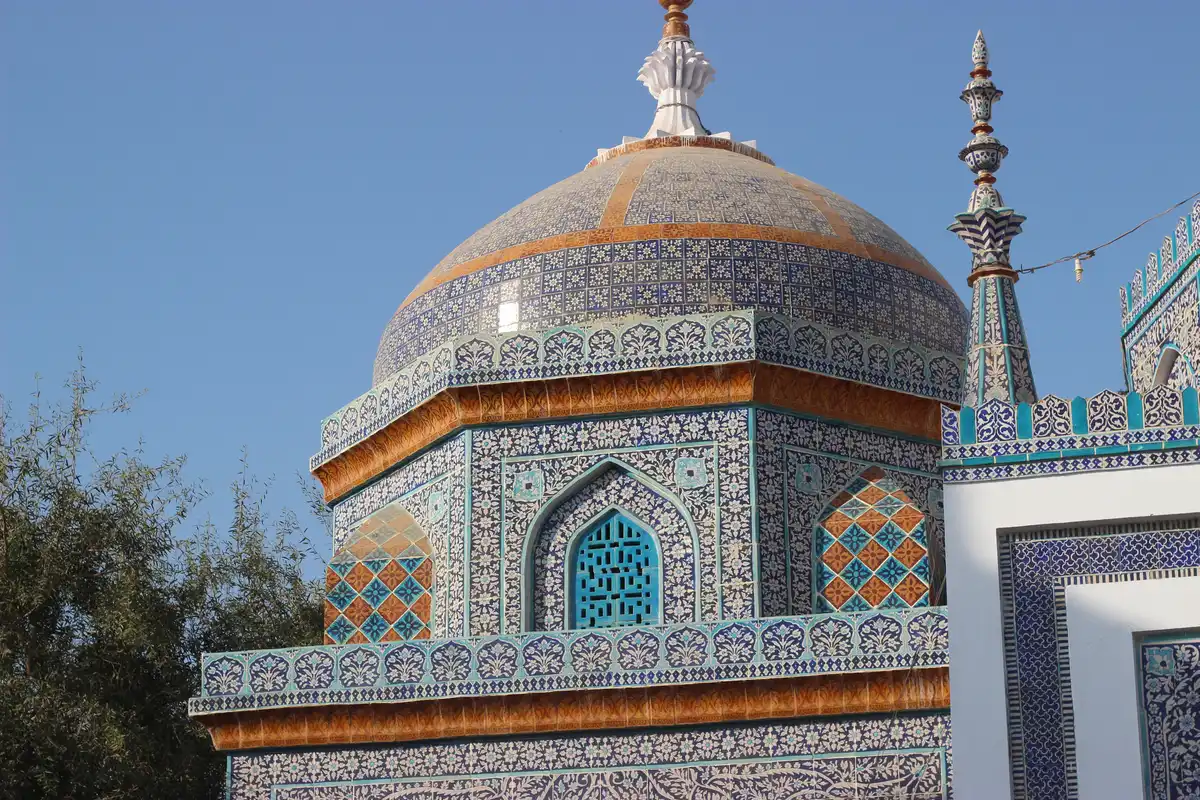
The shrine is covered with traditional Sindhi kashi tiles, which are glazed tiles in blue and turquoise, and the tiles carry floral patterns in blue, white and turquoise, with some panels adding amber and gold. The white onion dome sits above the tiled walls, carved wooden doors open into the tomb chamber, and the interior ceiling is covered with mirror work, where the mirror pieces catch the lamps and throw the light back across the room.
The dome is the landmark of the town, and it can be seen from the road before the town itself appears. The tiles on the dome are laid in a tight pattern, with blue and white stars repeating across the surface, and a white finial tops the dome. A slender minaret stands beside it, also tiled, carrying the same blue and white pattern, and together the dome and the minaret mark the shrine from every direction.
The doorways deserve a slow look, because the main entrance is framed by bands of tile, each band with its own pattern, and floral panels sit beside geometric panels. A carved stone plaque sits above the blue door. The door itself is painted a deep blue, and the arch above it is filled with pierced tilework in a star pattern, so the light falls through the pierced tiles and makes patterns on the floor inside.
The rear of the complex shows another side of the building, with white domes rising above tiled walls that carry tall blue panels with cypress designs, and a covered grave stands in the courtyard in front of the rear wall. The rear view is quieter than the front, and it shows how the complex grew over time, because different domes belong to different tombs while the tilework ties them together into one building.
The tilework is not decoration alone, because it is the craft of Hala and the towns around it, and the same kashi tradition appears on the Shah Jahan Mosque at Thatta and on tombs across Sindh. At Bhit Shah, the tiles serve a living building, they are cleaned and repaired as the shrine is used, and a visitor who looks closely can see new tiles beside old ones, so the craft is still practised and the building is still maintained.
Photography inside the shrine needs care, because one visitor review says a DSLR camera is forbidden and a mobile phone camera is allowed, though that is a single report, not a confirmed rule. Ask the caretakers before taking photographs inside, do not photograph people without asking them first, and keep the camera away during prayers and during the singing.
Shah Jo Raag, the Nightly Singing

Shah Jo Raag is the nightly singing of the surs of Bhittai at the shrine, and it is the heart of a visit to Bhit Shah. The singing takes place after evening prayers, the musicians are faqirs, and they have sung the poetry at the shrine for about 300 years. They sit in a circle near the tomb and play the tamboora, a long necked stringed instrument that Bhittai himself is said to have introduced, and the singers take turns, one voice leading while the others answer, as the verses rise and fall in the night air.
Thursday evening is the regular weekly session, when musicians and dervishes gather and the singing runs longer than on other nights. Visitors who want the full experience should plan for a Thursday, arrive before sunset, and find a place at the edge of the circle, where they should sit quietly, because the singing is a form of prayer rather than a performance for an audience, and silence is part of it.
The timing of the nightly Raag varies, because one guide says it is performed nightly after Isha prayer, while one visitor review says the singing usually starts around 9 in the evening and continues till morning. The two accounts do not agree exactly, so the safest plan is to arrive after Isha and stay as long as the singing lasts. The evening session is the one most visitors attend, and the late night session belongs to the faqirs and the devotees who stay.
The instruments are simple. The tamboora leads, and a harmonium may join it while a dholak keeps the beat, yet the voices carry the melody. The surs are tied to musical modes, each sur has its own mood, some surs are slow and mournful and tell of separation and longing, while others are brighter and tell of union and joy. A listener who knows no Sindhi can still follow the feeling, because the music carries it.
The faqirs wear black. They sit cross legged on the floor, and their tambooras rest against their shoulders. A cap lies on the floor beside one of them, and a metal cup stands near another, and these small details belong to the life of the shrine. They show that the singing is daily work, not a show put on for visitors, and the same men return night after night, some having sung at the shrine for decades.
Visitors may listen from the edge of the circle, though they should not walk in front of the singers, talk while the singing goes on, or keep their phones out. A recording does not capture the sound of the courtyard, because the sound needs the walls, the night air and the quiet of the listeners around it. Sit still. Listen. That is the whole of it.
The Statue by the Rest House

A white statue of Shah Abdul Latif Bhittai stands near the Bhit Shah rest house, showing the poet seated and playing the tamboora, wearing a turban with his head bent toward the instrument. The statue is 16 feet high. It was unveiled during the 274th Urs in 2017, and the sculptor was Nadir Ali Jam.
The statue is a good meeting point, where visitors gather before entering the shrine and photographs are taken in daylight. The white stone stands out against the blue sky, and the tamboora in the hands of the statue repeats the instrument of the nightly Raag, so the statue and the singing belong to the same story.
The rest house stands beside the statue, and it serves visitors during the Urs, though whether ordinary visitors can stay there is not confirmed. Do not plan a stay at the rest house without asking locally first. The statue itself is open to view at all hours, it takes a few minutes to see, and it is worth the stop on the way to the shrine.
Bhit Shah Museum
The Bhit Shah Museum stands in the Cultural Complex near the shrine. It was established on 10 July 1996, and the then President of Pakistan, Farooq Ahmed Leghari, inaugurated it. The museum belongs to the Sindh Tourism Development Corporation. It is also called the Shah Latif Cultural Museum, and it sits in the Shah Abdul Latif Bhittai Cultural Complex, which also houses the Shah Jo Raag School and rooms for cultural research.
The museum shows the poetry of Bhittai in scenes, and the soormis of the Risalo are shown thematically, with Sohni and Mehar appearing in the displays and Umar and Marui appearing too. The exhibits include the life of the poet, musical instruments, manuscripts and translations of his poetry. The museum is small, and it is meant to be seen after the shrine, not instead of it, because it gives the stories behind the verses that visitors hear sung at night.
The timings of the museum are not settled, and the sources disagree. One listing says 9 in the morning to 5 in the evening, Monday to Sunday, closed on public holidays. Another says 9 in the morning to 6 in the evening every day, while a third gives split hours on Friday, 9 to 12 in the morning and 3 to 6 in the evening. Treat the hours as about 9 in the morning to 5 or 6 in the evening, confirm the hours locally before going, and remember that Friday hours differ in one listing.
The ticket is also uncertain, because one listing says the museum costs PKR 50 per person, though that is a single low authority source. Treat the figure as reported, not certain, and confirm it on arrival. The shrine itself is free, the museum is a separate building with its own entry, and the two should not be confused.
There is no photograph of the museum on Wikimedia Commons, and the guides that cover Bhit Shah note the same gap, so this guide carries no museum image for that reason. A photograph would need to be taken on a visit. The museum is still worth the visit, because it is the one place in Bhit Shah where the folk tales of the Risalo are shown as scenes, and visitors who have heard the singing at night will recognise the stories in the displays.
The Urs of Shah Abdul Latif Bhittai
The Urs is the death anniversary festival of Bhittai, and it runs for three days, 13 to 15 Safar, with the main day on 14 Safar, the day of his death. Up to 500,000 devotees come over the three days, a figure that comes from several sources, and Dawn reported close to 500,000 devotees at the 272nd Urs. The crowd includes visitors from across Sindh and from abroad.
The 283rd Urs opened on Wednesday 29 July 2026, which was 14 Safar 1448, and the Sindh government declared a provincial public holiday while the Sindh Governor inaugurated the festival. So 13 Safar 1448 fell on Tuesday 28 July 2026, and 15 Safar fell on Thursday 30 July 2026.
The next Urs is expected in July 2027, and four independent Hijri converters agree on the dates, with 13 Safar 1449 falling on Saturday 17 July 2027, 14 Safar on Sunday 18 July 2027, and 15 Safar on Monday 19 July 2027. The dates are expected, not announced, because no official announcement exists yet, and two sources give dates one day later, 18 to 20 July 2027. This guide says expected 17 to 19 July 2027 and notes the disagreement. The dates may shift by one day with the moon sighting, and they are confirmed only when the month begins and the authorities announce them.
Note one difference in the sources. Some say the Urs begins on 13 Safar, while one guide says it begins on 14 Safar and lasts three days. This guide uses 13 to 15 Safar, with 14 Safar as the main day, and that matches the majority of the sources.
What happens at the Urs is a mix of music, learning and charity, with Qawwali and Sindhi music running around the clock and Shah Jo Raag filling the nights. A literary conference, Sugharan Ji Kachehri, brings poets and scholars together, the Latif Award is given, communal langar feeds the visitors, and stalls and a crafts fair line the streets. Exhibitions show the life of the poet, government officials visit, gifts are given to the poor, and horse races have been part of the Urs in the past.
The Urs falls in July in 2027, which is peak summer heat in Sindh, so winter visits are far pleasanter. Visitors who come for the Urs should plan for heat, crowds and long waits. They should carry water, arrive early, and expect the town to be full. Hotels in Hyderabad fill up during the Urs, so book ahead.
Visitors who want the music without the crowds should avoid the Urs days, because an ordinary Thursday evening gives the same Raag with a fraction of the people. The shrine on a quiet winter evening is the best of Bhit Shah, while the Urs is the biggest of Bhit Shah, and the two visits are different, so choose the one that fits the trip.
How to Reach Bhit Shah
Bhit Shah lies between Hyderabad and Hala, and it is best reached as a day trip from Hyderabad. The road is good, the drive is short, the town is small, and a few hours are enough for the shrine and the museum, while an evening stay adds the Raag.
The distance from Hyderabad is reported differently by different sources, with the figures running from 40 km to 66 km, so the honest figure is a range. Bhit Shah is about 50 to 60 km from Hyderabad, and the drive takes 45 to 60 minutes by road. The most carefully sourced figure is 58 km, about 50 minutes. It comes from routing data checked in November 2026, and it matches the figure used in our keyword research. Use the range when planning, and do not rely on a single figure.
Karachi is farther, with Bhit Shah about 200 to 212 km from Karachi and the drive taking about 3 hours by road in good traffic. One routing figure gives 212 km and about 2 hours 36 minutes, while another guide says about 3 hours. Take the M9 Motorway from Karachi to Hyderabad, then take the N5 north, and a branch road leaves the National Highway about 30 minutes beyond Hyderabad before it leads to Bhit Shah, which lies on the road between Hala and Hyderabad.
Public transport runs from Hyderabad, with buses and vans running toward Matiari. One account describes a minibus from Hyderabad and then a qingqi ride from the main road into the town, with the whole trip taking about 40 minutes. Another guide says to take a local bus or van from the main bus terminal in Hyderabad toward Matiari, then a short rickshaw ride to the shrine. The details vary, though the pattern is the same, because a bus or van covers the main road while a rickshaw or qingqi covers the last stretch.
No fare could be verified for any bus, van or taxi on this route, and no source gives a fare, so this guide states no fare. Ask at the bus terminal in Hyderabad before travelling, because fares change with fuel prices, a figure printed here would be out of date quickly, and it would also be a guess. This guide does not guess.
Bhit Shah has a railway station, which stands about 1.1 km from the shrine, though whether trains currently stop there is not verified. A campaign in July 2026 called for the reopening of the Bhit Shah railway section, and that suggests the service is suspended. Do not plan a train trip without checking Pakistan Railways first, because the road is the reliable way to reach Bhit Shah.
A car or a hired van is the easiest option for a family, because the road from Hyderabad is straight and parking is near the shrine. A driver from Hyderabad knows the route, so agree the fare before leaving Hyderabad and keep the driver for the return trip. Evening transport back to Hyderabad is harder to find after the Raag ends.
Best Time to Visit Bhit Shah
November to February is the pleasant season, when the air is cool, the light is clear, and the tilework looks its best in winter sun. October to February is the comfortable window. One guide gives November to February and another gives October to February, yet both agree on the point. Winter is the time to come.
Summer is hot and dry, with May to September bringing heat of 35 to 45 degrees Celsius, though the figure is reported by one weak source, so treat it as reported. The point stands without the number, because summer in Sindh is harsh and the courtyard offers little shade at noon. The Urs in July 2027 will be hot, so visitors in summer should come early in the morning or late in the evening.
Thursday is the best evening of the week, because the weekly Raag session runs on Thursday, the musicians gather, and the singing runs longer. Visitors who can choose their day should choose a Thursday, arrive before sunset, and stay for the singing after Isha.
Evenings are better than middays at any time of year, because the shrine wakes up in the evening, the faqirs gather, the tamboora sounds, the tiles cool down, and the courtyard fills with listeners. A daytime visit shows the architecture in 30 to 45 minutes, while an evening visit shows the life of the shrine. Allow one to two hours for a daytime visit, allow longer in the evening, and stay for the Raag if the day allows it.
Avoid the Urs days unless the festival is the purpose of the trip, because the town fills with up to 500,000 visitors over three days, the roads jam, the courtyard crowds, and the heat in July adds to the strain. The Urs is worth seeing once, though it is not the best first visit, and a quiet Thursday in winter shows Bhit Shah at its best.
Where to Stay and Eat
Staying in Bhit Shah itself is limited, and most visitors come for the day from Hyderabad or Hala. Hyderabad is about an hour away and has hotels, while Bhit Shah has little visitor accommodation. The town is small. Its rooms serve pilgrims during the Urs, they are basic, and they are not the kind of rooms a guide can recommend by name.
No hotel in Bhit Shah or Hyderabad was verified from a live source for this guide, so no hotel is named here. A weak directory listing says some hotels stand around the shrine with very basic facilities and electricity issues, though that is not enough to recommend a place. A guide should not name a hotel it cannot verify, so visitors should book in Hyderabad, where hotels are listed and reviewed.
The rest house near the statue serves visitors during the Urs, though whether ordinary visitors can stay there is not confirmed. Do not present it as bookable accommodation, and ask locally if a stay in Bhit Shah is needed. The safe plan is a day trip from Hyderabad, so leave Hyderabad in the morning, reach Bhit Shah before noon, see the shrine and the museum, stay for the evening Raag on a Thursday, and return to Hyderabad at night.
Food is simple around the shrine, where small eateries surround the shrine and simple food stalls operate near the entrance, though a fuller meal is best planned in Hyderabad. No restaurant in Bhit Shah was verified by name, so no restaurant is named here. The stalls serve tea, snacks and simple meals. They serve the visitors and the faqirs, and they are part of the life of the town.
Langar is served at the shrine, where a traditional Sindhi community kitchen operates daily and free food is given to visitors and to the poor. The langar is part of the shrine, it runs on donations, and visitors may eat there, though they should respect the order of the queue, eat simply and leave quietly. The langar feeds thousands during the Urs, and it feeds a steady stream on ordinary days too.
A Day Trip, Hala and Bhit Shah Together

Hala lies about 10 km by road from Bhit Shah, and the two towns make one day trip. Hala is the birthplace of Bhittai. Hala Haweli stands near Hala, and Hala is known for Ajrak and pottery. The pottery workshops of Hala are worth a morning, and the Ajrak makers of Hala are worth a visit too. Read our guide to Sindhi Ajrak for the history of the craft.
A good plan runs like this. Leave Hyderabad in the morning, drive to Hala first, visit the pottery workshops, see the Ajrak being made, and visit Hala Haweli, the birthplace of Bhittai. Eat a simple lunch in Hala, then drive to Bhit Shah in the afternoon, a drive that takes a short time, see the shrine in the afternoon light, visit the museum, stay for the evening Raag, and return to Hyderabad at night.
The sweet shop in the town shows another side of Bhit Shah, because the shops near the shrine sell sweets, dry fruit and prayer goods. Trays of colourful sweets stand in rows, sacks of dry fruit stand behind them, and a shopkeeper weighs the sweets for visitors. Many visitors buy sweets to take home. The sweets are part of the pilgrimage, and they are shared with family after the return.
The bazaar around the shrine is small, and it sells Ajrak, caps, prayer beads and books of the Risalo. The stalls are run by local families, prices are modest, and bargaining is gentle. Buy a copy of the Risalo if the visit has sparked an interest in the poetry, because the book is sold in Sindhi and in translation, and it is the best souvenir of Bhit Shah, lasting longer than a photograph.
Sehwan Sharif lies about 125 km from Bhit Shah, which is too far for the same day, though it makes a second day trip from Hyderabad. Read our guide to Sehwan Sharif and the shrine of Lal Shahbaz Qalandar for that trip, and read our Urs guide for the festival at Sehwan. The two shrines belong to the same Sufi landscape of Sindh, Bhittai and Lal Shahbaz Qalandar are the two great names of that landscape, and a traveller who visits both will understand Sindh better.
Hyderabad itself is worth a day, with Pakka Qila standing in the city, Mukhi House standing there too, and the tombs of the Talpur Mirs standing there as well. Read our guide to Pakka Qila for the fort and its present state. Bhit Shah, Hala and Hyderabad together make a full weekend, the route is short, the history is deep, and the music is the thread that ties it together.
Visiting Etiquette at the Shrine
A shrine is a place of prayer before it is a place to visit, and the rules are simple. Remove shoes before entering the tomb area, dress modestly, cover the head if asked, keep the voice low, and do not walk in front of worshippers. Ask before photographing people, and this matters most during the music, because the singers are praying, not posing.
Recite Surah Al Fatiha at the sanctum, because that is the custom, and stand aside after praying so others can approach. Do not touch the tomb covering without need, and do not leave litter in the courtyard. The caretakers keep the shrine clean, and visitors should help them by keeping it clean.
Women and men both visit the shrine, families visit together, and children visit with their parents. The shrine is open to everyone, and the same respect is expected of everyone. Sit where the caretakers direct, follow the flow of visitors during the Urs, because the crowd moves in one direction, and do not push against it.
Giving is part of the visit, and donations go to the langar and to the upkeep of the shrine. Give what is easy, and do not give to beggars at the gate if the shrine asks visitors not to. The langar feeds the poor every day, and a donation to the langar reaches them better than cash at the gate.
The faqirs are the keepers of the Raag, and they are not guides, so they will not explain the poetry to a visitor in the middle of the singing. A question can wait until the singing ends, and a greeting is enough. A listener who sits quietly for an hour will learn more than a visitor who asks ten questions in ten minutes.
Frequently Asked Questions about Bhit Shah
Where is Bhit Shah and how far is it from Hyderabad?
Bhit Shah is a small town in Matiari District, Sindh, lying between Hyderabad and Hala. It is about 50 to 60 km from Hyderabad, and the drive takes 45 to 60 minutes by road. The most carefully sourced figure is 58 km, about 50 minutes, though the sources give figures from 40 km to 66 km, so this guide uses the range because no single figure is agreed.
When is the Urs of Shah Abdul Latif Bhittai in 2027?
The Urs runs for three days, 13 to 15 Safar, with the main day on 14 Safar. In 2027, the Urs is expected from Saturday 17 July to Monday 19 July, and 14 Safar falls on Sunday 18 July 2027. The dates are expected, not announced, because two sources give dates one day later, 18 to 20 July, and the dates may shift by one day with the moon sighting, so they are confirmed only when the month begins and the authorities announce them.
Is there an entry fee for the shrine of Shah Abdul Latif Bhittai?
No, the shrine is free. It is open to everyone, and it is open 24 hours. The Bhit Shah Museum is separate. It stands in the Cultural Complex near the shrine, and one listing says the museum costs PKR 50 per person. That is a single low authority source, so treat the figure as reported and confirm it on arrival.
What is Shah Jo Raag and when can visitors hear it?
Shah Jo Raag is the nightly singing of the surs of Bhittai at the shrine, where faqirs sing the poetry after evening prayers and play the tamboora, and they have sung it there for about 300 years. Thursday evening is the regular weekly session, and it runs longer than other nights. Visitors should arrive after Isha prayer, and they should sit quietly at the edge of the circle.
How much time should a visit to Bhit Shah take?
A daytime visit to see the shrine architecture takes 30 to 45 minutes, while one to two hours is enough for the shrine and the museum together. An evening visit takes longer, so stay for the Raag if the day allows it. A combined day trip with Hala takes a full day, so leave Hyderabad in the morning, visit Hala first, reach Bhit Shah in the afternoon, stay for the evening Raag, and return to Hyderabad at night.
Where should visitors stay when visiting Bhit Shah?
Most visitors stay in Hyderabad and come to Bhit Shah for the day, because Hyderabad is about an hour away by road and it has hotels, while Bhit Shah has little visitor accommodation. No hotel in Bhit Shah was verified for this guide, so no hotel is named here. The rest house near the statue serves visitors during the Urs, though whether ordinary visitors can stay there is not confirmed, so book in Hyderabad and travel to Bhit Shah by road.
Sources and Further Reading on Bhit Shah
- The shrine of Shah Abdul Latif Bhittai, history and Urs. en.wikipedia.org
- Shah Abdul Latif Bhittai, his life and death. en.wikipedia.org
- Bhit Shah, the town and the shrine. en.wikipedia.org
- Bhit Shah Museum, its founding and exhibits. en.wikipedia.org
- Bhit Shah, a practical place guide with distances and the Raag. trek.pk
- The Urs of Shah Abdul Latif Bhittai, dates and the 283rd Urs. trek.pk
- Bhit Shah, a travel guide with history and itineraries. dailylife.pk
- Bhit Shah shrine, a day trip guide from Hyderabad. opentravelguide.com
- The shrine of Shah Abdul Latif Bhittai, practical details for visitors. opentravelguide.com
- Shah Abdul Latif Bhittai, oral history and the Risalo. sindhatlas.com
- The Risalo, its surs and its folk tales. sindhatlas.com
- The shrine of Shah Abdul Latif Bhittai, a pilgrim guide. nooreilahi.com
- Bhit Shah Museum, timings and ticket. traventigo.com
- Hijri calendar for Safar 1449, the 2027 Urs dates. hijri-gregorian.com
- The statue of Shah Abdul Latif Bhittai at Bhit Shah. theopenroads.net

Leave a Comment