

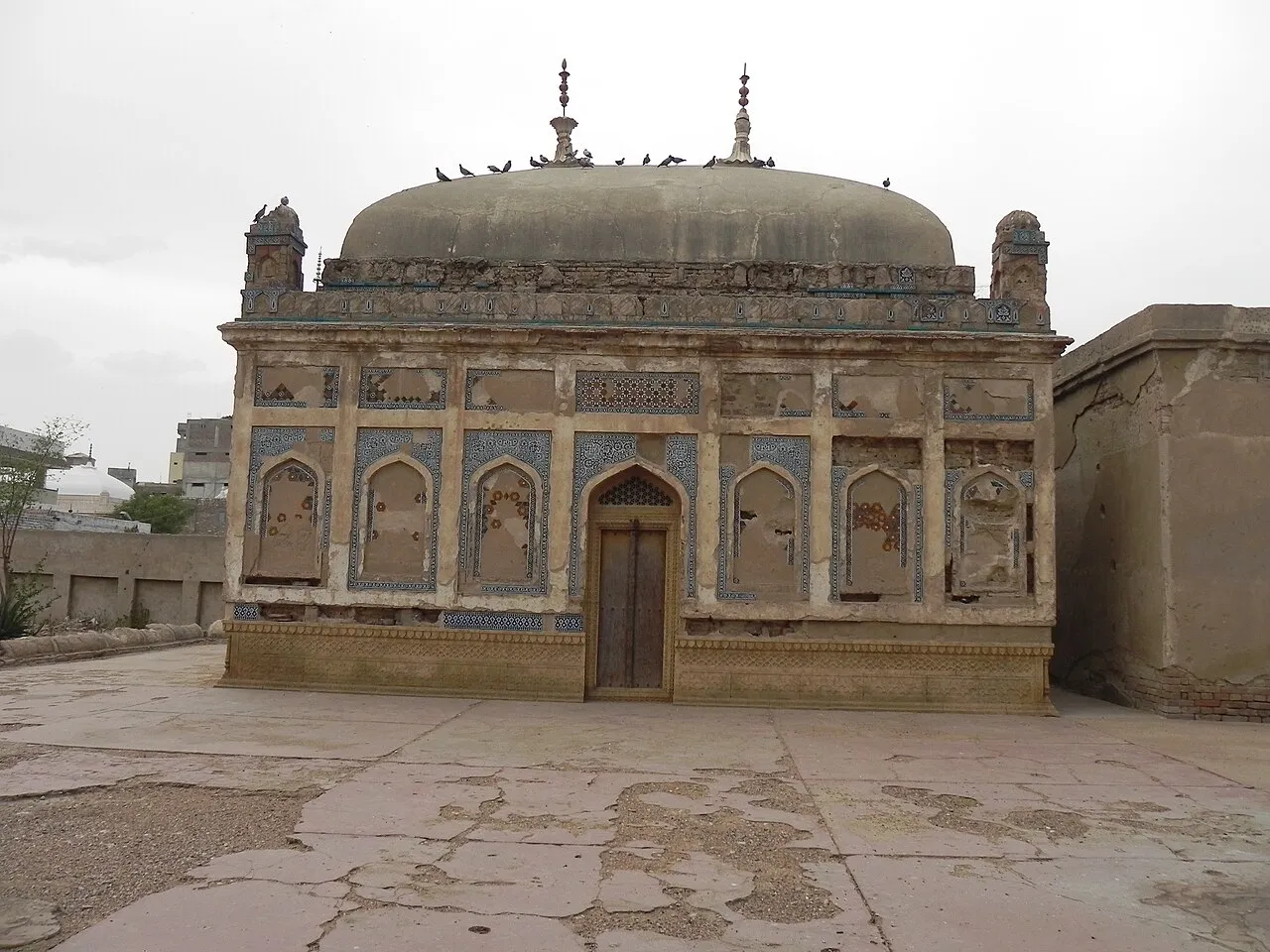
In a walled compound in Hyderabad stand a group of domed tombs covered in blue and white tiles. They belong to the Talpur Mirs, the Baloch family who ruled Sindh for sixty years, from 1783 until the British conquest of 1843, and whose Khairpur branch remained a princely state for more than a century after that. Forts such as Kot Diji, palaces such as Faiz Mahal and the rebuilt walls of Ranikot all date from their time.
In this article (11)
- The Talpur dynasty at a glance
- From Kalhora commanders to rulers of Sindh
- The Chauyari: rule of the four brothers
- One family, several states
- Life and culture under the Mirs
- The British arrive
- Napier and the conquest of 1843
- The “Peccavi” story
- Khairpur: the branch that survived
- How the Talpurs are remembered
- Sources and further reading
The Talpur period is remembered in very different ways. British writers often described the Mirs as idle and greedy rulers. Many Sindhi historians see them as the last independent government of Sindh, overthrown by an aggressive colonial power. This article sets out the main facts of the dynasty and points to where the record is disputed.
The Talpur dynasty at a glance
| Period | 1783 to 1843 over most of Sindh. The Khairpur branch ruled a princely state until 1955. |
| Founder | Mir Fateh Ali Khan Talpur |
| Origin | Baloch tribe, long settled in Sindh and in the service of the Kalhora rulers |
| Main seats | Hyderabad, Khairpur and Mirpur Khas. A smaller branch was based at Tando Muhammad Khan. |
| Court language | Persian. Sindhi and Balochi were spoken widely. |
| Religion | Islam (the ruling family followed Shia Islam) |
| End of rule | Battles of Miani (17 February 1843) and Dubbo near Hyderabad (24 March 1843). Sindh annexed by the British East India Company. |
From Kalhora commanders to rulers of Sindh
The Talpurs were a Baloch family who had lived in Sindh for generations. During the eighteenth century they served the Kalhora rulers of Sindh as military commanders and landholders. Their relations with the Kalhoras broke down in the 1770s, when the ruler Mian Sarfaraz Kalhoro ordered the killing of the Talpur chief, Mir Bahram Khan, and his son Mir Sobdar Khan.
The killings started years of conflict. Mir Bijar Khan Talpur, a son of Bahram Khan, led the family for a time and was himself assassinated. In 1783 his kinsman Mir Fateh Ali Khan Talpur defeated the last Kalhora ruler, Mian Abdul Nabi, at the Battle of Halani, near present-day Naushahro Feroze. Fateh Ali Khan made Hyderabad, the former Kalhora capital, his seat. For much of the following period the Talpurs recognised the Durrani rulers of Afghanistan as their overlords and paid them tribute.
The Chauyari: rule of the four brothers
Mir Fateh Ali Khan shared power in Hyderabad with his three brothers, Mir Ghulam Ali, Mir Karam Ali and Mir Murad Ali. This arrangement became known as the Chauyari, the rule of the four friends. After Mir Fateh Ali Khan died in 1801, leadership in Hyderabad passed in turn to his brothers Mir Ghulam Ali, Mir Karam Ali and Mir Murad Ali. It then passed to the next generation, including Mir Noor Muhammad and Mir Naseer Khan, who led the Hyderabad Mirs at the time of the British conquest. Shared rule among close relatives remained a feature of the Talpur state. It reduced the risk of civil war, but it also made quick decisions difficult, a weakness that later mattered in dealing with the British.
One family, several states
The Talpurs did not govern Sindh as a single centralised kingdom. Different branches held different regions, each with its own court:
- Shahdadani Talpurs of Hyderabad. The senior branch, descended from Mir Fateh Ali Khan and his brothers. It controlled central and lower Sindh, including Thatta and later Karachi.
- Sohrabani Talpurs of Khairpur. Founded by Mir Sohrab Khan Talpur in upper Sindh. He built the forts of Kot Diji, Shahgarh and Imamgarh to guard his frontiers.
- Manikani Talpurs of Mirpur Khas. Founded by Mir Thara Khan in the south-east. His son Mir Ali Murad founded the town of Mirpur Khas.
- Shahwani Talpurs of Tando Muhammad Khan. A smaller branch, founded by Mir Muhammad Khan Talpur.
The arrangement kept the family in power, but it also meant that the branches sometimes acted against each other.

Life and culture under the Mirs
The Talpur state was based on land. The Mirs granted estates, or jagirs, to relatives, Baloch chiefs and supporters, who in return provided soldiers. Persian was the language of government, and the courts at Hyderabad and Khairpur supported poets and scholars. Hunting was a passion of the ruling family. Large areas along the Indus were kept as hunting reserves, or shikargahs, a practice that British observers criticised because it kept good land out of cultivation.
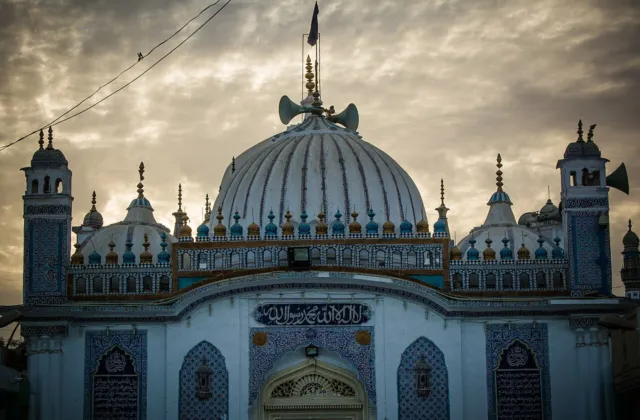
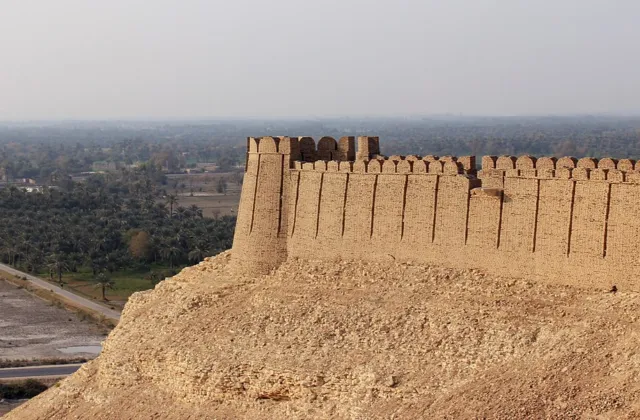
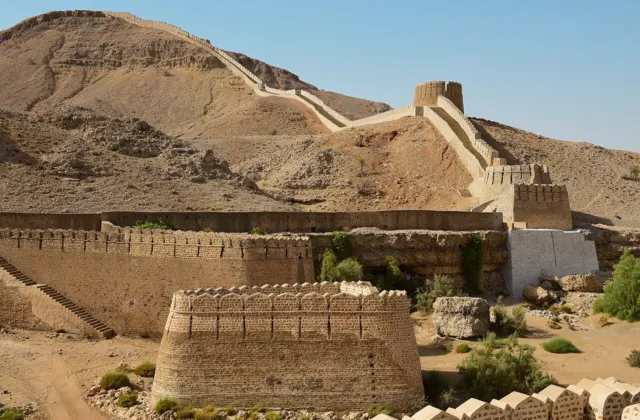
The Talpurs left a strong mark on Sindh’s buildings. In Hyderabad they built tombs with domes and tile work, and the shrine of Qadamgah Mola Ali, which tradition says houses a footprint of Imam Ali gifted by the Qajar ruler of Persia. In Khairpur, Faiz Mahal was built as a royal residence and is still owned by the Talpur family. In the south-east, the graveyard at Chitorri near Mirpur Khas has carved stone tombs that combine Islamic and Rajasthani styles. At Ranikot, the Talpurs built or rebuilt large sections of the great wall. Sindhi historians place the completion of this work between about 1815 and 1819, and a radiocarbon date from a pillar at the Sann Gate falls between about 1720 and 1828, which fits building in the Kalhora or Talpur period.

The British arrive
From the early nineteenth century the British East India Company took a growing interest in Sindh. The Indus offered a trade route to Punjab and Central Asia, and Sindh lay on the road to Afghanistan. A first treaty in 1809 committed the Mirs to keep the French out of Sindh. A treaty of 1832 opened the Indus to British trade, on condition that no armed vessels or military stores would use it.
That promise was broken during the First Anglo-Afghan War. In 1838 and 1839 British armies marched through Sindh on their way to Afghanistan, and British forces took Karachi in February 1839. The Mirs were made to accept new treaties, pay large sums and allow British troops to be stationed in their territory. Rivalries within the family helped the British: the historian R. A. Huttenback describes how British agents dealt with each branch separately.
Napier and the conquest of 1843
In 1842 General Sir Charles Napier took command in Sindh. He pressed the Mirs to accept a new treaty that would have taken away large areas of their land and their right to mint coins. Napier’s own journal shows that he regarded the coming conquest as unjust but useful. In a much-quoted entry, he wrote: “We have no right to seize Scinde, yet we shall do so, and a very advantageous, useful, humane piece of rascality it will be.”
On 15 February 1843 Baloch forces attacked the British Residency in Hyderabad, defended by Major James Outram. Two days later, on 17 February, Napier’s army of about 2,800 men met a much larger Talpur force at Miani, north of Hyderabad. Better weapons, training and discipline gave the British victory, and the Talpur army suffered very heavy losses. On 24 March 1843 Napier defeated Mir Sher Muhammad Talpur of Mirpur Khas at Dubbo, near Hyderabad. Among those killed at Dubbo was the commander Hosh Muhammad Sheedi, who is remembered in Sindh for the slogan “Marsoon marsoon, Sindh na desoon” (We will die, but we will not give up Sindh).

Sindh was annexed and later placed under the Bombay Presidency. Most of the Hyderabad Mirs were sent into exile in British India, and much of the family’s land was confiscated.
The “Peccavi” story
A famous story says that Napier reported his victory with a one-word message in Latin, “Peccavi” (“I have sinned”, a pun on “I have Sindh”). The joke actually appeared in the British magazine Punch in 1844. Napier never sent such a message.
Khairpur: the branch that survived
The Khairpur branch took a different path. Mir Ali Murad Talpur, a younger son of Mir Sohrab Khan, had made his own agreements with the British and sided with them in 1843. As a result, Khairpur was not annexed. Ali Murad later lost a large part of his lands after the British accused him of wrongdoing over a treaty, but he kept the core of the state around Khairpur city and ruled until his death in 1894.
Khairpur continued as a princely state under British rule. In October 1947 it acceded to Pakistan, and in 1955 it was merged into the new province of West Pakistan, ending 172 years of Talpur rule in upper Sindh. In the same year, the last ruler, Mir Ali Murad Khan Talpur II, handed Kot Diji Fort over to the government.
How the Talpurs are remembered
The Talpur era has been judged in sharply different ways. Many British writers of the 1840s and 1850s portrayed the Mirs as harsh and backward, partly to justify the conquest. Later historians, including Sindhi scholars and western historians such as H. T. Lambrick and R. A. Huttenback, have taken a more balanced view. They point to the Mirs’ real failings, such as divided authority and heavy taxation, but also to the way the British broke treaties and provoked the war.
Today the Talpur legacy is visible across Sindh: in forts and palaces, in tombs and shrines, in family names and in local memory of Miani and Dubbo. For visitors, the tombs in Hyderabad, Faiz Mahal in Khairpur and the fort at Kot Diji are the best places to start.
Related on PakSindh: Shah Abdul Latif Bhittai, who lived under the Kalhoras just before the Talpur era, and Makli Necropolis, the cemetery of Sindh’s earlier dynasties.
Sources and further reading
- UNESCO World Heritage Centre, “Kot Diji Fort”, Tentative List entry (background on the Talpur dynasty and the Khairpur branch), 2026. whc.unesco.org/en/tentativelists/6968
- Department of Archaeology and Museums, Government of Pakistan, “Kot Diji Fort” site record. doam.gov.pk
- Robert A. Huttenback, British Relations with Sind, 1799-1843: An Anatomy of Imperialism, University of California Press, 1962.
- H. T. Lambrick, Sir Charles Napier and Sind, Clarendon Press, Oxford, 1952.
- Aftab Nabi, “The Battle of Miani and the Conquest of Sindh”, Pakistan Horizon. pakistan-horizon.piia.org.pk
- Paolo Biagi and Renato Nisbet, “Ranikot Fort (Jamshoro, Sindh): An AMS Radiocarbon Date from Sann (Eastern) Gate”, Journal of Asian Civilizations 32(2), 2009. PDF via harappa.com
- William Napier, The Life and Opinions of General Sir Charles James Napier, John Murray, London, 1857.
- Richard F. Burton, Sindh, and the Races that Inhabit the Valley of the Indus, W. H. Allen, London, 1851.

Leave a Comment