


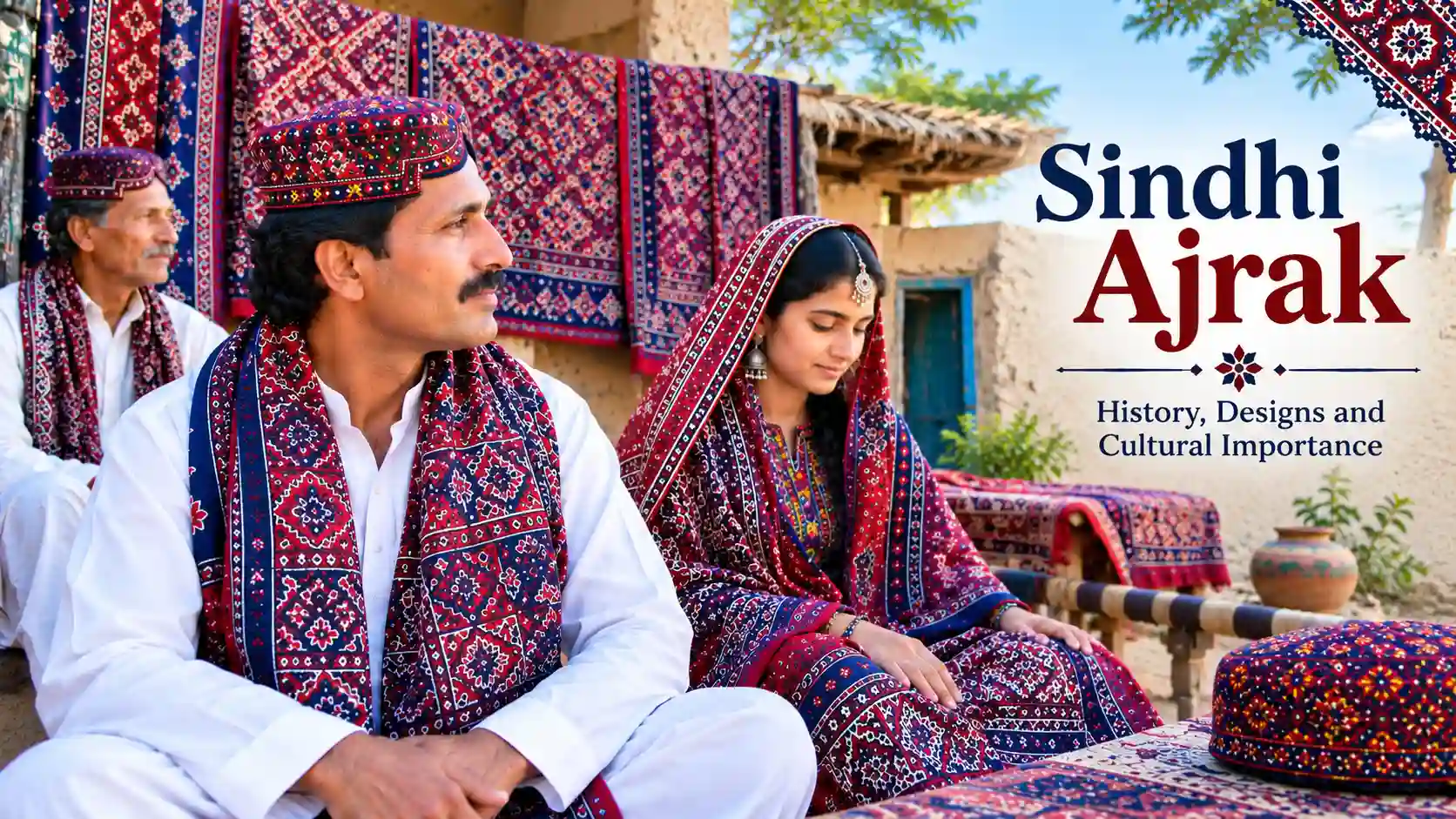
Sindhi Ajrak is one of the most recognised symbols of Sindhi culture. Its deep red, indigo blue, white, and black patterns can be seen in homes, markets, cultural events, and family gatherings across Sindh. For many Sindhi people, Ajrak is more than a piece of printed cloth. It is closely tied to Sindhi culture and its traditions. It represents respect, hospitality, identity, and a strong connection with the land and traditions of Sindh.
When a guest arrives at a Sindhi home, the host may welcome them with Ajrak. At weddings, cultural gatherings, and public events, people often wear it with pride. Elders give Ajrak to younger family members as an expression of affection, while communities present it to guests and respected people as a mark of honour. These customs have helped Ajrak remain an important part of everyday life.
However, Ajrak’s appeal is not limited to its colours or patterns. Behind every traditional piece is a long process that may involve preparing cloth, treating it with natural or other dyes, printing designs, washing, drying, and repeating several stages. The work requires patience, experience, and knowledge of how different materials behave.
Ajrak also tells a wider story about Sindh. Its patterns reflect local artistic traditions, while its production links cloth printers, dyers, traders, and customers. It links traditional knowledge with modern markets and brings cultural heritage into daily life.
To learn about Sindhi Ajrak, we need to look beyond its appearance. We need to look at its history, its place in Sindhi society, the people who make it, the meaning of its designs, and the challenges facing traditional textile work today. This wider view helps explain why Ajrak continues to matter to Sindhi people and why preserving its textile tradition is important for future generations.
The History and Cultural Role of Sindhi Ajrak
Ajrak has a strong place in the cultural identity of Sindh. It is widely recognised across the province and is closely connected with traditional clothing, hospitality, celebrations, and public life. Its distinctive designs make it easy to recognise, but the cultural meaning behind it is what gives it lasting importance.
The exact history of Ajrak is difficult to describe through one simple date or a single historical event. A useful external reference is the National Register of Intangible Cultural Heritage of Pakistan, which lists Ajrak as a traditional textile of Sindh. Textile printing developed over long periods in different parts of South Asia, and many communities contributed to the wider history of dyeing, weaving, and printing cloth. Sindh became known for its own textile traditions, including the patterned cloth that is now commonly associated with Ajrak.
It is important to separate cultural connection from historical evidence. The ancient civilisation of the Indus Valley is an important part of Sindh’s past. Archaeological discoveries from places such as Mohenjo Daro provide evidence of a highly developed society with skilled textile traditions and trade. The Smithsonian’s collection record for a printed Ajrak textile also offers a museum reference for the cloth. However, the existence of ancient textile work does not by itself prove that modern Ajrak has remained unchanged since that time.
The history of Sindhi Ajrak is most clearly understood through the wider history of textile production in the region, the continued practice of traditional printing, and the cultural value that communities have given to this cloth. Its present form reflects knowledge passed between generations as well as changes in materials, designs, and markets.
Readers interested in the wider history of Sindh can also read Mohenjo Daro and its history. It offers background on the ancient civilisation that developed along the Indus River, while Ajrak belongs to the wider and continuing story of Sindhi textile tradition and culture.
What makes Ajrak different from ordinary printed cloth
Many kinds of cloth carry printed designs, but traditional Ajrak is known for its repeating geometric patterns, balanced shapes, and strong use of colour. Traditional designs often include stars, small squares, circles, flowers, borders, and repeated shapes arranged in a carefully planned layout.
The design is not simply placed on cloth without preparation. In traditional printing, the maker must consider how the pattern will appear after dyeing and washing. Some parts of the cloth need to accept colour, while other parts must remain protected during particular stages. This makes the printing process different from applying a finished image to fabric in one step.

The familiar combination of red and indigo blue is one of Ajrak’s most recognised features. White areas create contrast, while darker details give the design a clear structure. Different makers and regions may use different colour combinations, and modern products sometimes introduce colours that are less common in traditional pieces.
Traditional Ajrak is also known for its repeated patterns across the cloth. The design often looks balanced from one side to the other, with borders framing the central area. This balance gives the cloth a finished appearance when it is folded, worn over the shoulders, or displayed during a cultural event.
The quality of a piece depends on several factors. These may include the cloth, the clarity of the printing blocks, the care taken during dyeing, the strength of the colours, and the finishing. A good design alone does not guarantee good quality. The printing must also be clear, the fabric should suit its intended use, and the finished cloth should be handled properly.
The meaning of the name Ajrak
The word Ajrak is closely associated with the traditional patterned cloth of Sindh and nearby regions. Different explanations of its name are found in popular accounts, but not every explanation has strong historical evidence. It is better to avoid presenting an attractive story about the name as a confirmed fact unless reliable research supports it.
For most people today, the word immediately brings to mind a familiar style of cloth with strong colours and detailed geometric designs. It also brings to mind Sindhi identity. The word has become part of cultural language, used in conversations about traditional clothing, festivals, art, and heritage.
The meaning of Ajrak goes beyond the dictionary definition of the word. Its cultural meaning comes from the way people use it, give it, wear it, and recognise it. A person may receive an Ajrak as a gift without knowing the technical details of textile printing, yet still know that the gift carries respect.
This connection between an object and a shared cultural meaning is one reason traditional textile practices can remain important even as lifestyles change. Ajrak continues to be used because people see value in both its appearance and what it stands for.
Ajrak as A mark of respect and hospitality
Hospitality is an important part of social life in Sindh. Guests are welcomed into homes, offered food and tea, and treated with respect. In many settings, Ajrak is part of this welcoming tradition.
Presenting an Ajrak to a guest can be one way to say that the person is valued. It also helps introduce Sindhi culture to visitors who may not know much about the province. The cloth carries a visual identity that is easy to recognise and can be remembered long after a visit has ended.
Ajrak is also given to teachers, community leaders, artists, public figures and guests at ceremonies. The meaning depends on the occasion, the relationship between the people, and local customs. It may be given during a cultural programme, a school event, a public meeting, or a family celebration.
The gift is often simple, but its meaning can be strong. Unlike an item chosen only for its price, a traditional Ajrak may communicate respect through its cultural connection. The person giving it is sharing something associated with the history and identity of Sindh.
This custom has helped Ajrak move beyond everyday clothing. It is now seen in photographs, public ceremonies, cultural programmes, and meetings where people want to express their connection with Sindh.

Ajrak in family life
Ajrak has a place in family gatherings as well as public events. It may be worn by elders during visits, kept ready for guests, or selected for a special occasion. Families may also keep older pieces because of their connection to a person or an important event.
In some families, an Ajrak received from a parent or grandparent becomes more valuable because of the memories attached to it. The cloth itself may be replaceable, but the story behind that particular piece cannot be replaced. It may remind a person of a wedding, a family visit, a celebration, or a loved one.
These personal connections are an important part of cultural heritage. Heritage is not preserved only in museums or official records. It is also kept alive in homes through habits, stories, clothing, songs, food, and everyday acts of care.
Ajrak provides a simple example of this process. A child may first see it being worn by older relatives. Later, that child may receive one as a gift, wear it during a cultural event, or present it to another person. Through these ordinary experiences, a cultural tradition continues.
How families help keep the tradition alive also helps explain why Ajrak remains familiar to people who do not work in the textile industry. They may not know how to print the cloth, but they know when it is appropriate to wear it and what it means to offer it to someone else.
Ajrak and Sindhi identity
Sindhi identity includes language, literature, music, poetry, clothing, food, history, and many forms of artistic expression. Ajrak is one visible part of this larger cultural picture.
For Sindhi people living outside Sindh, Ajrak can offer a strong connection to their place of origin. It may be worn at community gatherings, cultural celebrations, or family events. A person living in another Pakistani province or another country may use Ajrak to show where their family comes from and what traditions they value.
The same cloth can have different meanings for different people. For one person, it may be a useful piece of clothing. For another, it may be a link to home. For a textile worker, it may represent a source of income and a body of professional knowledge. For a cultural researcher, it may offer insight into the links between art, society, and trade.
These meanings can exist together. A traditional textile practice does not need to have only one purpose. Its ability to serve practical, social, economic, and cultural needs is part of what keeps it relevant.
Ajrak is also a way for people to express cultural pride without needing a long explanation. Its patterns are recognisable, and its association with Sindh is widely understood. This makes it an important part of how Sindhi culture is represented in public life.
The relationship between Ajrak and Sindhi culture
Ajrak is one part of a much wider cultural tradition. Sindh has a rich history of embroidery, weaving, pottery, woodwork, metalwork, music, poetry, and other forms of skilled work. Each tradition has its own methods and local variations.
The article on Sindhi culture and its traditions provides a broader introduction to the customs and cultural practices associated with Sindh. Looking at Ajrak alongside other traditions helps readers see that no single textile tradition can represent every aspect of a society.
Sindhi embroidery relies on stitching to create patterns on fabric, while Ajrak printing uses blocks and dyeing methods to create designs. Both involve skill and careful planning, but their techniques are different. Their finished products can also serve different purposes.
Sindhi folk music and poetry carry cultural knowledge through sound and language. Traditional clothing communicates identity through materials and design. Local food preserves knowledge through ingredients and cooking methods. These traditions are different, but they all show how culture can be passed from one generation to another.
Ajrak stands out because it is used in many situations. It can be part of ordinary clothing, a formal gift, a decorative item, or a cultural symbol. This flexibility allows it to remain visible even when other traditional practices become less common in everyday life.
Ajrak and the Indus River
The Indus River has shaped the history and life of Sindh. It has supported agriculture, settlement, trade, and the growth of communities across the region. The river and its surrounding region have also influenced the way people view their relationship with the land.
Ajrak is often discussed in connection with the identity of Sindh and the wider Indus region. This connection is important because the textile tradition belongs to a society whose history has been closely linked with the river. However, cultural association should not be confused with proof that a particular modern textile pattern existed in exactly the same form in ancient times.
A careful view of heritage makes room for both cultural pride and historical accuracy. People can value Ajrak as a traditional Sindhi textile tradition without claiming that every design or method has remained unchanged for thousands of years.
Textile traditions develop as makers respond to available materials, changing tastes, trade, and new tools. Even when a design changes, the knowledge and cultural relationships behind the textile tradition can remain important.
The story of Ajrak is not only about looking backward. It is also about how a traditional practice has continued, adapted, and found new uses in changing times.
How traditional textile knowledge is passed on
People often learn traditional textile skills through observation and practice. A young person may begin by watching an experienced printer prepare cloth or arrange printing blocks. Over time, the learner may be given simple tasks before being trusted with more difficult parts of the process.
This form of learning can include details that are difficult to explain through written instructions alone. A skilled worker learns how much pressure to apply to a block, how to recognise a problem in a print, and how a particular fabric responds during washing or dyeing.
The work also involves judgement. Two pieces of cloth may appear similar at first, yet respond differently during production. A maker must know the materials and adjust the process when necessary.
Such knowledge can take years to develop. It is not simply a list of steps that anyone can follow without experience. Written guides and videos can help new learners, but practical training remains important for learning the finer points of traditional printing.
This is one reason support for skilled artisans matters. If a textile tradition is kept alive only as a design printed by machines, some of the knowledge associated with traditional hand production may gradually disappear.
Preserving textile knowledge does not mean refusing all modern tools. It means recognising which skills have cultural and practical value and making sure that people have a reason to continue learning them.
Ajrak in traditional clothing
Ajrak is often worn over the shoulders, around the neck, or as part of a traditional outfit. It can be paired with simple clothing or used as a colourful feature in a more formal look. Its patterns make it noticeable without requiring additional decoration.
In different parts of Sindh, people may wear Ajrak in different ways. Personal preference, local custom, age, weather, and the nature of the event can all affect how it is used. There is no single way that every person must wear it.

Some people prefer the familiar red and blue combination, while others choose darker or lighter versions. The choice may depend on the design, the fabric, and the clothing with which the Ajrak will be paired.
Ajrak can also be used in contemporary fashion. Designers and clothing makers may adapt traditional patterns for shirts, waistcoats, jackets, scarves, bags, and other products. These uses can introduce the textile tradition to customers who do not usually wear a full traditional outfit.
The important question is how these adaptations are made. Modern clothing can respect traditional designs while offering new uses. However, businesses should avoid presenting mass-produced copies as handmade traditional work when they are not.
Clear information about materials and production helps customers decide with accurate information. It also allows traditional artisans to receive proper recognition for their skills.
Ajrak in weddings and special gatherings
Weddings and family celebrations provide many opportunities for traditional clothing and gifts. Ajrak may be worn by relatives, presented to guests, or included in gifts given to respected family members.
Its use can vary from one family to another. Some people choose Ajrak for its cultural meaning, while others select it because its colours match their clothing. In either case, the cloth offers a link to a recognisable tradition.
During public celebrations, Ajrak may be seen in group photographs, cultural performances, and community gatherings. When several people wear it together, the repeated patterns and familiar colours create a strong visual connection.
This does not mean that every celebration follows the same custom. Traditions change between families and areas, and people make their own choices about clothing and gifts.
Ajrak remains popular because it can fit many different situations. It can be used for a formal occasion without becoming impractical, and it can be worn casually without losing its cultural meaning.
Ajrak and cultural events
Cultural events often provide a public space for traditional clothing, music, language, and textile traditions. Ajrak is a familiar sight at Sindhi cultural programmes, educational activities, exhibitions, and gatherings organised by community groups.
These events can help younger people learn about the textile tradition. A student who has seen Ajrak throughout childhood may know that it represents Sindh but may not know how it is made. A demonstration or exhibition can introduce the printing process and explain the work involved.

Cultural events can also create opportunities for artisans to sell their products directly. This can help customers see the difference between a traditionally printed piece and a cheaper product that only copies the appearance.
However, an event should not treat Ajrak only as a colourful decoration. It is more useful when people learn about the makers, materials, production methods, and economic challenges behind it.
Schools, colleges, museums, cultural organisations, and local communities can all help by arranging workshops, talks, and exhibitions. These activities can be inexpensive. Even a small display showing printing blocks, cloth samples, and examples of different patterns can help visitors appreciate the skill involved.
Ajrak as a gift to visitors
When people visit Sindh, they may receive Ajrak as a gift from a host or community representative. This practice can introduce visitors to an important part of local culture and give them a useful object to take home.
A good cultural gift does more than remind someone of a place. It can encourage them to learn about the people who made it and the traditions associated with it. If the gift comes with a short explanation of its production and cultural role, the recipient may learn more about the textile tradition.
Visitors should also know that traditional textiles are not all made in the same way. Some pieces involve hand printing and several dyeing stages, while others use modern printing techniques. Both can have a place in the market, but they should be described honestly.
Buying from a responsible seller or directly from a textile producer can help customers learn more about the product. It can also connect the buyer more directly with the maker.

The documentary record of Ajrak
Documentaries and cultural films can help record traditional textile practices, especially when they show the people who make them and explain the methods they use. A documentary about Ajrak can preserve information about printing, dyeing, design, and the daily lives of artisans.
One known example is Sun, Fire and River: Ajrak, Cloth of the Soil of Sindh, a 1998 documentary listed by Sahapedia. Readers can read the record on Sahapedia’s page about the Ajrak documentary.
Such material is useful because traditional production is not always fully recorded in books. A film can show how cloth is handled, how printing blocks are applied, and how artisans organise different stages of the work. It can also help audiences see the relationship between a textile tradition and the community in which it developed.
However, a documentary is only one source of information. A full account of Ajrak also requires attention to textile workers, historical research, local knowledge, textile studies, and the economic conditions in which production takes place.
The purpose of studying a research on a traditional textile practice should not be limited to describing its appearance. It should also consider the knowledge required to make it, the people who depend on it, and the ways the tradition may change in the future.
Why Ajrak deserves careful documentation
Traditional knowledge can be lost when experienced artisans stop working and younger people do not learn their skills. This is especially important when a process depends on practical experience rather than written instructions.
The National Register of Intangible Cultural Heritage of Pakistan includes Ajrak and provides a useful official reference. Documentation can also help record the names of tools, the sequence of production, the use of printing blocks, the preparation of dyes, and the differences between regional styles. It can also preserve interviews with textile workers who explain how they learned their profession.
Good documentation should involve artisans directly. They are not simply subjects to be observed. They are the people with direct knowledge of the work who can explain details that outsiders may overlook.
Researchers should also distinguish between established information, personal memories, and interpretations. A maker’s account is valuable evidence about their experience and practice, but claims about ancient history may require additional historical or archaeological support.
This careful approach does not make cultural heritage less interesting. It makes the record more reliable and helps readers see what is known, what has changed, and what remains uncertain.
Documentation is most useful when it supports living textile practice. Films, books, photographs, and digital records can preserve knowledge, but they cannot replace the income, training, and working conditions that allow artisans to continue making Ajrak.
Ajrak as a living tradition
A living tradition is one that people continue to use and adapt. It is not frozen at one point in history. It changes as communities respond to new materials, customer needs, technology, and social conditions.
Ajrak offers a clear example of this process. Traditional patterns continue to appear on familiar pieces of cloth, while related designs are used on modern clothing and decorative products. Some makers maintain older production methods, while others combine traditional designs with newer techniques.
These changes do not automatically weaken the tradition. New uses can introduce Ajrak to younger customers and create opportunities for producers. Still, it is important to protect the skills and knowledge that make traditional production distinctive.
Careful change allows the textile tradition to develop without losing its connection to Sindhi culture. It respects the experience of artisans, recognises the value of traditional methods, and gives customers honest information about the products they buy.
This is how Ajrak can remain relevant in modern life while continuing to carry the cultural meaning that has made it important to generations of Sindhi people.
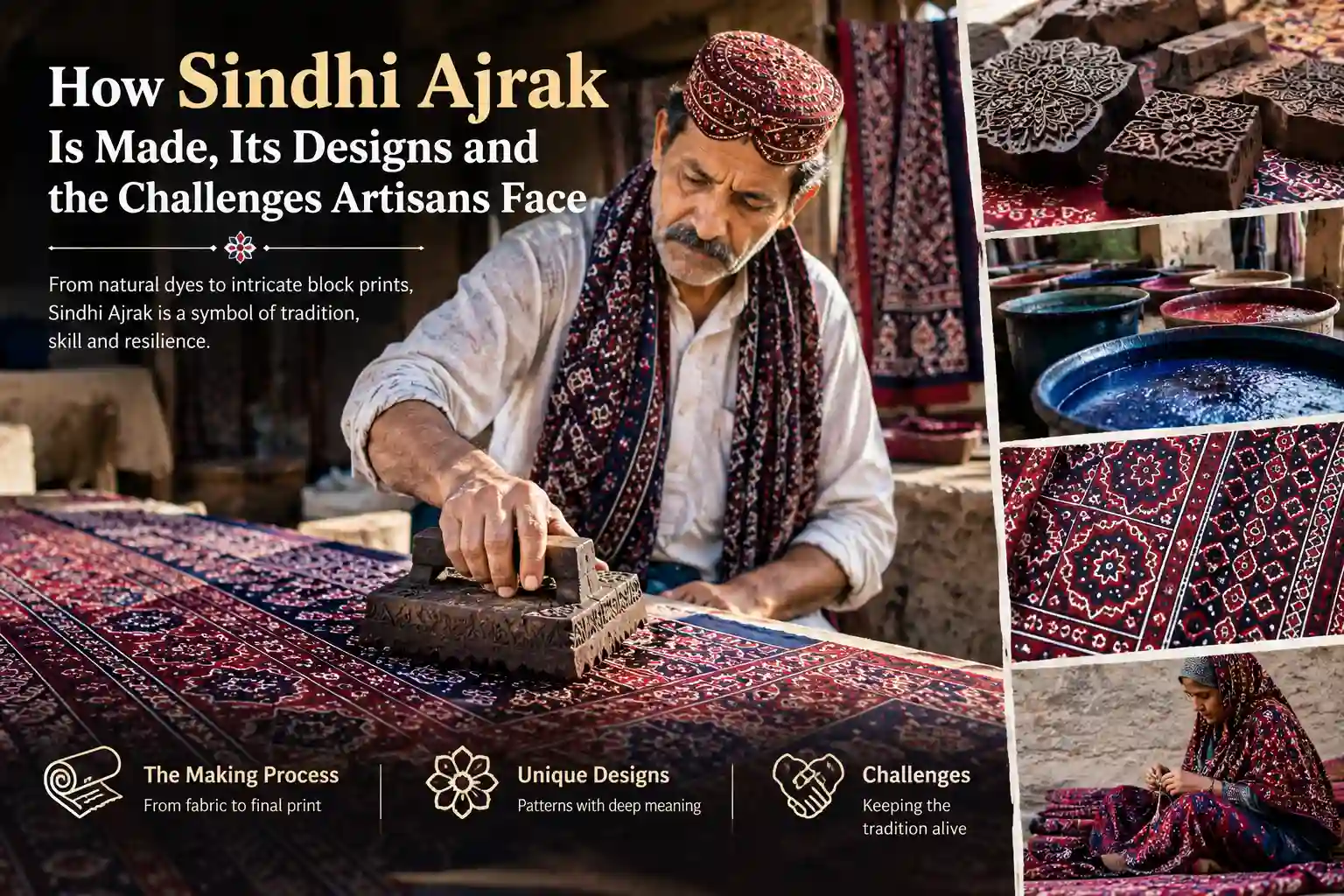
How Sindhi Ajrak Is Made, Its Designs and the Challenges Artisans Face
people behind traditional Ajrak
The people behind traditional Ajrak
The finished cloth often receives the most attention, but the people who produce it are central to its story. Traditional Ajrak production can involve several types of work, including preparing the fabric, arranging printing blocks, applying resist materials, dyeing, washing, drying, and finishing the cloth.
Depending on the workshop, different workers may be responsible for different stages. Some specialise in printing, while others focus on dyeing or preparing materials. In smaller workshops, one person may carry out several tasks.
Each stage affects the quality of the finished product. If the cloth is not prepared properly, the print may not appear as intended. If a block is applied unevenly, the pattern may become blurred. If the dyeing process is poorly controlled, the colours may not develop as expected.
Experienced workers learn to recognise these problems and respond to them. Their knowledge is part of the value of traditional Ajrak, even though it may not be visible when a customer looks only at the finished cloth.
Supporting the textile tradition means supporting the people who do the work. It includes paying fair prices, giving artisans access to markets, recognising their skills, and creating opportunities for younger workers to learn.
Preparing the fabric
The production process begins with the fabric. Traditional Ajrak is commonly made on cotton cloth, although materials and product types can vary. The cloth must be suitable for printing and dyeing, and its condition can affect the final result.
Before printing, the fabric may need to be washed or treated to remove substances that could interfere with dye absorption. The exact preparation depends on the materials and methods used by the workshop.
Clean and properly prepared cloth helps the printing process work more consistently. If the fabric contains unwanted residues, the dye may not behave evenly. A maker must pay attention to the condition of the material before moving to the next stage.
This part of the process may seem simple compared with the detailed patterns, but it is important. The quality of the finished Ajrak depends on decisions made from the beginning, not only on the final print.
Fabric preparation also shows why traditional textile production requires more than artistic ability. The maker needs practical knowledge of cloth, water, dyes, and the conditions under which the work is carried out.
Wooden Printing Blocks
Wooden printing blocks are among the most recognisable tools associated with traditional Ajrak production. A block carries a carved pattern that can be transferred to cloth with the help of a suitable printing material.
The block must be designed carefully. Its raised surfaces determine which parts of the pattern are printed, while the carved spaces create areas that remain open. The arrangement of these shapes influences how the design repeats across the fabric.
Some patterns are relatively simple, while others contain many small details. Complex designs require careful handling because even a small mistake can affect the appearance of the finished cloth.
The person printing the fabric must position the block correctly and apply consistent pressure. If the block moves during printing, the design may appear blurred or doubled. If too little material is applied, parts of the pattern may be incomplete.
A workshop may use several blocks for one design. Different blocks can be used for borders, central patterns, and details that need separate treatment. The sequence of printing matters because each stage must work with the others.
These blocks are not only tools. They also preserve a visual language built from repeated shapes and patterns. When blocks are reused and maintained, they can connect current production with the experience of earlier makers.
How traditional printing works
Traditional Ajrak production often uses a method known as resist printing. Google Arts & Culture’s guide to block printing on textiles describes how resist and mordant methods are used in Ajrak printing. In this approach, a material is applied to selected parts of the cloth to prevent or limit dye from reaching those areas during a particular stage.
The basic idea is simple, but carrying it out successfully requires skill. The printer must know where the resist material should be applied and how the design will appear after later stages. The cloth may pass through several rounds of printing and dyeing before the final pattern becomes clear.
In a typical traditional process, the fabric is prepared, printed with a resist material, dyed, washed, and then treated again for further colours or details. The exact sequence varies according to the design, the materials available, and the practices of the workshop.
A piece with several colours may require more than one printing stage. Each stage must be planned so that the colours and protected areas work together. This is one reason traditional printing can take considerable time.
The cloth may look unfinished after an early stage. Some parts of the design become visible only after the material has been washed or dyed again. The maker must anticipate how the final result will develop before all the stages are finished.
Traditional printing involves physical work and careful planning. The artisan needs to see the design as a whole, not just the part being printed at that moment.
How dyeing shapes Ajrak
Dyeing gives Ajrak much of its familiar character. Traditional pieces are often associated with deep indigo blue, red, black, and white, although the exact shades can vary.
Indigo is especially important in the visual identity of many Ajrak designs. It produces a deep blue colour that contrasts strongly with red and lighter areas. Achieving a consistent result requires knowledge of the dye, the fabric, and the conditions in which dyeing takes place.
Red shades may be produced through different materials and methods. Traditional workshops have used natural dye sources, while modern production may use other dyeing materials. It is not accurate to assume that every piece sold as Ajrak uses only natural dyes.
The same care is needed when assessing claims about environmental benefits. Natural dyes may be part of a more traditional process, but the effects on the environment depend on the materials, water use, preparation, and disposal practices involved. A traditional design alone does not prove that a product is environmentally friendly.
Dyeing is one of the stages where practical experience matters greatly. The artisan must know how the colour develops and how it interacts with the fabric and earlier printing work.
Different workshops may follow different recipes or use different materials. These differences are part of the variety found in textile production, but they also make it important to describe individual products accurately.
Why washing and drying matter
Washing helps remove excess dye and printing materials after particular stages of production. It can also reveal details that were hidden while the cloth was being processed.
The quality of washing affects the appearance of the finished piece. If the cloth is not handled properly, unwanted marks may remain or the final colours may not appear as intended. The process must be suited to the materials and dyes being used.
Drying is another important stage. Cloth must be dried in suitable conditions, and the method can vary according to the workshop and the production process. The maker needs to protect the fabric from unwanted marks and handle it carefully during this stage.
Repeated printing, dyeing, washing, and drying can make traditional production time consuming. The number of stages depends on the design and the method used.
This helps explain why a traditionally made piece may cost more than a cheaply printed copy. The price can reflect the time, skill, materials, and work involved. However, price alone does not prove that an item is handmade. Customers should look at the seller’s information and ask questions when they want to learn how a product was made.
The final inspection
Before a piece is sold, it should be checked for printing quality, colour consistency, fabric condition, and finishing. Traditional production does not mean that every piece will be identical. Small differences may occur because the work involves materials and manual processes.
Some variation can be part of the character of a handmade item. However, this should not be used as an excuse for poor workmanship. A well-made piece should still have a clear pattern, suitable finishing, and fabric appropriate for its intended use.
The edges, borders, and printed areas all contribute to the full appearance. A maker may need to correct minor issues or reject a piece that does not meet the expected standard.
This final check also affects the reputation of the workshop. Customers who receive a well-made product may return or recommend the seller to others. Poor quality can damage trust and make it harder for traditional producers to compete in the market.
Quality control is not separate from cultural preservation. It helps maintain confidence in the textile tradition and gives customers a reason to choose work made with care.
Common patterns found in Ajrak
Ajrak is known for geometric designs arranged in repeating forms. Depending on the pattern, a piece may contain small stars, squares, circles, floral shapes, and other decorative elements.
Many designs use symmetry and repetition to create a balanced appearance. A small shape may appear several times across the cloth, forming a larger pattern. Borders often frame the main design and give the piece a clear structure.
The same basic shape can look different depending on its size, spacing, colour, and position. A design with small repeated forms may appear detailed and dense, while larger shapes can create a more open appearance.
Traditional patterns are often the result of long experience with printing blocks and cloth. Their appearance depends not only on the individual shapes but also on how those shapes work together across the whole piece.
Modern products may adapt these patterns for different uses. A design that works well on a full-sized Ajrak may need changes before it can be used on a shirt, bag, or smaller accessory. The scale and placement of the pattern can affect the final result.
It is useful to appreciate both the individual motifs and the full layout. Looking closely at a piece can reveal how the printer has arranged the borders, repeated shapes, and colour areas to create a unified design.
Why borders matter
Borders are an important feature of many traditional Ajrak designs. They frame the central pattern and help the cloth look finished when it is folded or worn.
A border may contain repeated geometric shapes that differ from those in the centre. The contrast gives the design structure and creates a clear edge around the fabric.
Printing a border accurately requires care. If the pattern becomes uneven or the spacing changes unexpectedly, the finished cloth may look less balanced. The printer must keep the design aligned as the block is moved along the fabric.
Borders can also affect how a person uses the cloth. When an Ajrak is placed over the shoulders, a border may remain visible along the edge. When it is folded, the arrangement of the pattern can change what the viewer sees.
These details show that traditional design is practical as well as decorative. The pattern is created for a piece of cloth that will be folded, worn, handled, and viewed from different angles.
Why geometric patterns work so well
Geometric patterns have a strong visual quality because repeated shapes create order. When the same shape appears at regular intervals, the eye begins to recognise a rhythm across the fabric.
Ajrak designs often combine repetition with contrast. Dark and light areas help the shapes remain clear, while the arrangement of the motifs gives the cloth its general character.
The pattern must also work with the printing process. A design that looks attractive on paper may be difficult to transfer cleanly to fabric if its details are too small or its shapes are difficult to align.
The printer and block maker need to consider both appearance and production. The design should look balanced, but it should also be possible to reproduce it using the available tools and materials.
This relationship between art and practical skill is found in many traditional textile practices. The finished product may look simple from a distance, yet the work behind it involves careful decisions about shape, spacing, colour, and technique.
Traditional colours and their appeal
The familiar red and indigo combination is one of the strongest visual features of Ajrak. The deep blue creates a strong background or pattern area, while red provides warmth and contrast. White spaces help separate shapes, and dark details can give the design a sharper appearance.
Different makers use different combinations, and the colour of a piece may depend on its materials and production method. Some modern products include brighter or less traditional shades to meet changing customer preferences.
Colour can affect the way an Ajrak is used. A darker piece may be chosen for a formal appearance, while a lighter or more colourful version may suit a different style. Personal taste also plays a major role.
It is important not to treat one colour combination as the only traditional option in every situation. Traditional textile practices can include variations, and products may differ according to their region, maker, and intended use.
Still, customers who want a particular traditional style should ask about the production method and materials rather than relying only on colour. A cloth can copy the familiar colours of Ajrak without being made through traditional block printing.
Natural dyes and modern dyes
Natural dyes have a long history in textile production, and some traditional textile production processes use materials obtained from plants or other natural sources. These materials may require preparation before they can be used successfully.
Modern dyes are also common in textile manufacturing. They may offer different colour options, production speeds, and levels of consistency. Their use does not automatically mean that the product is poor quality, but it does mean that the product should be described accurately.
Customers may sometimes see a claim that a piece is made with natural dyes. If this matters to them, they can ask the seller which dyes were used and whether the information relates to every colour in the design.
It is also worth remembering that natural does not always mean harmless, and synthetic does not automatically mean unsafe or environmentally damaging. The effects depend on the specific materials and how they are handled.
Responsible production requires suitable practices for dye preparation, water use, waste management, and worker safety. These questions matter regardless of whether the dyes are natural or synthetic.
A balanced view helps customers value traditional methods without accepting unsupported claims. It also gives responsible producers an opportunity to explain what makes their work distinctive.
Hand printed Ajrak and machine-printed cloth
Modern printing technology has changed the textile market. Machines can reproduce patterns quickly and produce large quantities of cloth with a consistent appearance. This can make products more affordable and easier to supply to large retailers.
Traditional hand printing usually involves more direct work by artisans. Printing blocks must be positioned and applied carefully, and the cloth may pass through several stages before the design is finished. This can make the process slower than many machine-based methods.
Neither method should be judged by appearance alone. A machine-printed product may have a clear design and serve customers who need affordable cloth. A hand-printed piece may offer the value of traditional skills and a connection to a particular workshop or textile work community.
The main issue is honest description. A machine-printed fabric should not be sold as hand-printed if that is not how it was made. Customers who want to support traditional artisans need clear information about the production method.
For buyers, a few questions can help. Ask whether the cloth was printed by hand or machine, what type of fabric was used, whether the colours are likely to fade, and how the product should be washed.
For sellers, transparency can build trust. It allows different products to compete on their actual qualities rather than on misleading claims.
What makes a handmade piece special
A handmade piece can carry evidence of the process used to create it. Small variations in printing or colour may occur, and the design may reflect the skills and choices of the person who made it.
These differences are not always defects. In a traditional textile practice, they can show that the work involved manual handling rather than a fully automated process. However, the term handmade should still be used carefully and should reflect the actual production method.
The value of a handmade Ajrak may include the time spent on printing, the experience of the artisan, and the continued use of traditional tools. For customers who care about textile heritage, these factors can be as important as the finished pattern.
A responsible purchase also considers the people behind the product. Buying directly from an artisan or a trustworthy seller may help create a clearer link between the customer and the maker.
This does not mean that every customer must buy the most expensive product. Budgets differ, and affordable products have a place in the market. The important point is that buyers should know what they are paying for and that traditional work should receive fair recognition.
Regional differences in Ajrak production
Sindh contains many communities with their own local traditions and working practices. Textile production can vary between workshops and areas because of differences in materials, experience, design preferences, and access to markets.
Some areas are known for particular forms of textile tradition, but production is not limited to one town or one group of makers. Traders, suppliers, and textile workers may also operate across regional boundaries.
When discussing the origin of an Ajrak, it is better to rely on clear information from the maker or seller rather than assume that every piece comes from the same place. The design alone may not be enough to identify where the cloth was produced.
Regional variation is part of the wider story of Sindhi textile tradition. It shows that a shared cultural tradition can contain many local practices rather than one fixed method used by everyone.
Researchers and buyers can help preserve this diversity by recording where products are made, how artisans describe their methods, and which designs are associated with particular workshops or communities.
Ajrak and the local economy
Traditional Ajrak production supports more than the person who prints the cloth. Depending on the workshop and supply chain, the work may also create demand for fabric suppliers, block makers, dye suppliers, washers, finishers, traders, shopkeepers, and transport services.
When customers buy traditional cloth, their money can move through this wider network. The amount that reaches the artisan depends on how the product is sold and how many businesses are involved.
A piece sold directly by a maker may create a different financial result from one sold through several middlemen. Both types of sales can be useful, but the conditions of production and the share received by the artisan deserve attention.
Traditional textile work can provide jobs for people who have developed specialised skills. However, the income may be uncertain when demand changes, material costs rise, or cheaper products take over part of the market.
This is why cultural appreciation alone may not be enough to preserve a textile tradition. Artisans also need practical opportunities to earn a reasonable income from their work.
A strong market can help make traditional knowledge worth passing on. If younger people see that skilled work can support a stable livelihood, they may be more willing to learn it.
The challenges faced by Ajrak artisans
Traditional artisans can face several challenges. Material costs may rise, customers may prefer cheaper products, and handmade work may take longer to produce than machine-printed alternatives.
Access to customers can also be difficult. Some artisans may rely on local traders or shops and have limited opportunities to sell directly to people outside their immediate area. They may have the skills to make a good product but lack the resources to promote it or manage online orders.
Changing customer preferences create another challenge. Some buyers want familiar traditional designs, while others prefer new colours, smaller patterns, or products designed for modern clothing. Makers must decide how to respond without losing the qualities that distinguish their work.
Training is also important. When younger people see limited financial returns from traditional work, they may choose other occupations. If experienced artisans retire without passing on their knowledge, particular skills can become harder to find.
These problems do not mean that Ajrak is disappearing everywhere. The situation can vary between workshops and markets. Some makers may have regular customers, while others may struggle to find enough work.
Learning about these differences is more useful than making a general claim that all artisans face the same conditions. Local research and direct conversations with textile workers can show what support is needed in each area.
The pressure of cheaper products
Cheaper printed fabrics can attract customers who want the appearance of Ajrak without paying the price of traditional production. This is understandable in a market where household budgets matter.
The problem arises when a product is presented in a misleading way or when customers cannot easily tell how it was made. A machine-printed piece may use similar colours and shapes, making it difficult for an inexperienced buyer to recognise the difference.
Traditional artisans may find it difficult to compete with large producers on price alone. Hand printing involves time and skill, and the cost of labour must be included in the final price.
One solution is better product information. Sellers can explain the materials, printing process, and origin of the cloth. Customers can then choose based on price, quality, and their interest in supporting traditional production.
Artisans can also develop different product ranges. Some customers may prefer a traditional piece, while others may be interested in smaller items that are easier to afford. The challenge is to find practical ways to reach different buyers without making false claims.
Fair competition depends on honesty. Traditional and machine-printed products can both have a place in the market, but customers should be able to see what makes each one different.
The need to protect traditional skills
A textile tradition can remain visible in shops while the skills behind it become less common. A market may continue selling cloth with Ajrak patterns even if fewer people know how to make traditional printing blocks or carry out the full process by hand.
This is why protecting the appearance of Ajrak is not enough. The knowledge, tools, and working practices involved in traditional production also need attention.
Training programmes can help younger people learn from experienced artisans. Workshops can provide practical instruction, while cultural organisations can record techniques and support demonstrations.
Apprenticeships are especially valuable because they allow learners to develop skills through regular practice. A short demonstration may introduce a method, but it cannot replace the time needed to learn the materials and correct mistakes.
Support should also consider the economic needs of learners. Training is more likely to continue when people have a realistic opportunity to earn money after learning the textile tradition.
Traditional knowledge is more likely to survive when it remains useful to the people who hold it. Preservation efforts should involve artisans in decisions about training, product development, documentation, and marketing.
How younger generations can support Ajrak
Young people can help keep Ajrak relevant by learning about its history and the work behind it. They do not need to become textile printers to play a useful role.
Students can research local textile traditions, interview artisans with permission, visit workshops, and document the tools used in production. Schools and colleges can arrange exhibitions or invite textile workers to explain their skills.
Young designers can find ways to use traditional patterns in clothing and products while respecting their cultural background. Business students can study how small textile producers reach customers, manage costs, and build reliable sales channels.
Digital skills can also be useful. Clear product photographs, accurate descriptions, and honest information about production methods can help artisans present their work to wider audiences.
Social media can introduce customers to the people behind the cloth rather than showing only the finished product. Short videos can explain the printing process, while interviews can record the experiences of makers.
However, digital promotion should not replace payment for skilled work. A video that receives many views may increase interest, but the textile maker still needs a fair return for producing the cloth.
The strongest support combines cultural learning with practical opportunities. Young people can help preserve Ajrak by valuing it, sharing accurate information, and supporting the people who continue to make it.
Ajrak in modern fashion
Modern fashion offers opportunities to use Ajrak in new ways. Traditional patterns can be adapted for shirts, jackets, waistcoats, scarves, bags, cushion covers, and other products.
These adaptations can help reach customers who may not usually buy a full piece of traditional cloth. A smaller item can be an introduction to the textile tradition and may encourage someone to learn more about its origins.
Designers should consider the pattern, scale, and fabric before adapting it. A design that works well across a large piece of cloth may need to be rearranged for a smaller product. The final item should still look balanced and make suitable use of the traditional visual elements.
It is also important to describe the product accurately. If a garment uses machine-printed fabric inspired by Ajrak, that should be clear. If the fabric is traditionally block printed, the maker or seller can explain the method and its benefits.
Modern fashion does not need to reject tradition. It can offer new ways to use traditional designs while helping customers learn about the people and skills behind them.
The most successful approach is one that respects the textile tradition, provides value to customers, and gives artisans a fair chance to benefit from growing interest.
Using Ajrak in home decoration
Ajrak is also used in home decoration. It can appear as a wall hanging, cushion cover, table accessory, or decorative fabric. Its strong patterns can add colour to a room without requiring many other decorative items.
When using Ajrak in the home, it is useful to consider the scale of the pattern and the colours already present in the space. A large patterned piece may become the main feature of a room, while smaller items can add colour more quietly.
The cloth should also be used in a way that suits its material and construction. Items that receive frequent handling or washing may need more durable fabric and suitable finishing.
Home decoration can create additional opportunities for artisans because it gives customers more choices beyond traditional clothing. However, product development should be based on real demand and should not rely on unsupported claims about the origin or production method.
A decorative product can still carry cultural meaning. When people use Ajrak in their homes, they bring a familiar part of Sindhi visual culture into everyday life.
Choosing a good quality Ajrak
Customers do not always know how to judge a traditional textile, especially if they are buying one for the first time. A few practical checks can help them make a better choice.
First, look at the fabric. It should feel suitable for the intended use and should not have obvious damage. If the cloth is meant to be worn regularly, comfort and durability are important.
Second, examine the printing. The pattern should be clear enough to match the style being sold. Minor differences can occur in handmade work, but large areas of missing print or poor finishing may indicate a quality problem.
Third, check the colours and ask about care. Some dyes may lose colour if the cloth is washed incorrectly. A responsible seller should be able to give basic instructions and explain any special care requirements.
Fourth, ask about the production method if traditional hand printing matters to you. A seller should be able to say whether the piece was hand-printed, machine-printed, or produced through a combination of methods.
Finally, consider the price in relation to the materials and work involved. A very low price does not automatically mean poor quality, just as a high price does not guarantee traditional production. Clear information is more useful than price alone.
Questions to ask before buying
A customer interested in traditional Ajrak can ask a few simple questions.
Where was the cloth made? Was it printed by hand or machine? What material was used? Are the colours produced with natural dyes, synthetic dyes, or a combination? How should the cloth be washed? Is the seller able to identify the workshop or artisan responsible for the product?
Not every seller will know every technical detail, especially if several businesses are involved in production and sale. However, the answers can help customers see what information is available.
These questions are not meant to make buying difficult. They help create a more transparent market in which traditional work can be recognised and customers can choose products that match their needs.
For people buying Ajrak as a gift, it may also be useful to consider the recipient’s preferences. Some may value a traditional pattern, while others may prefer a modern colour combination or a product that can be used in different ways.
The aim is to buy a piece that offers good value and is honestly described.
How to care for Ajrak
Proper care can help keep an Ajrak looking good for longer. The correct method depends on the fabric, dyes, and production process, so the seller’s instructions should be followed when available.
If the cloth is new, it is sensible to avoid washing it together with light coloured clothing until you know how well the colours hold. Some fabrics may release excess colour during early washes.
Use a washing method suitable for the material. Harsh cleaning products, very hot water, or strong rubbing may damage some fabrics or affect their colours. If the item has special care instructions, follow them rather than assuming that every Ajrak can be washed in the same way.
Dry the cloth carefully and avoid leaving it in conditions that may damage the material. Store it in a clean, dry place when it is not being used.
If the Ajrak is an older family piece with sentimental value, handle it with extra care. Older cloth may be more delicate, especially if it has been washed many times or stored for a long period.
Good care is a practical way to extend the life of the cloth and preserve the memories attached to it.
Ajrak and responsible shopping
Responsible shopping means thinking about more than the appearance of a product. Customers may also consider the people who made it, the production methods used, and the way the product is described.
When possible, buying from a maker or a reliable seller can provide clearer information about the origin of the cloth. It may also help customers learn about the work involved in making it.
This does not mean that every traditional product sold by a shop is less valuable than one sold directly by an artisan. Shops can provide useful services, connect producers with customers, and help products reach wider markets. The important question is whether the supply chain is transparent and whether the maker receives a fair return.
Customers should be cautious about broad claims such as entirely handmade, fully natural, or environmentally harmless unless the seller can explain what those claims mean.
Accurate information benefits everyone. It helps customers choose with confidence, supports responsible sellers, and allows traditional producers to explain the value of their work.
Ajrak and cultural tourism
Cultural tourism can introduce visitors to local traditions, textile traditions, food, music, and historic places. Ajrak can be part of this experience when visitors learn about the cloth from the people who make it.
A visit to a workshop can show that traditional textile production involves more than choosing a pattern. Visitors may see printing blocks, prepared fabric, dyeing areas, and the different stages required to finish a piece.
Such visits should be arranged with respect for the workers and their time. Artisans should not be expected to provide demonstrations or explanations without appropriate arrangements. Their work is a profession, and cultural tourism should create value for the community rather than treat it only as a display.
Local markets can also benefit when visitors buy products directly from producers or from responsible sellers. However, tourism should not be the only source of demand. A healthy textile market also needs local customers and regular sales.
Cultural tourism is most useful when it connects learning with fair economic opportunities. Visitors gain a clearer picture of Sindhi culture, while artisans receive recognition and an opportunity to earn from their skills.
How schools and colleges can help
Schools and colleges can help students learn about traditional textile practices as part of their cultural and social studies. Ajrak offers an accessible way to discuss design, history, local economies, and the relationship between tradition and modern life.
Students can compare traditional printing with other textile methods. They can study repeated patterns, see how colours create contrast, and learn why the production process requires several stages.
A classroom activity might involve examining photographs of different Ajrak designs, mapping the stages of production, or interviewing a textile worker with permission. Students can also research how traditional textiles are presented to customers and what challenges small producers face.
These activities help students move beyond memorising a cultural symbol. They encourage them to ask how the textile tradition continues, who makes it, and what it needs to continue.
Educational projects should use reliable sources and distinguish between documented facts and popular stories. This helps young people develop respect for cultural heritage while learning how to evaluate information carefully.
How Museums and Cultural Organisations Can Help
Museums and cultural organisations can help preserve textile traditions by collecting examples, recording production methods, and presenting information to the public. Their work can make textile knowledge accessible to people who may never visit a printing workshop.
A useful display can include finished cloth, printing blocks, photographs, explanations of the production process, and information about the people who make the products. Where possible, artisans should be involved in preparing the display so that their knowledge is represented accurately.
Collections should also record basic information about each item, such as its materials, origin when known, production method, and date of collection. These details help researchers trace how the tradition has changed over time.
Museums can also arrange talks and demonstrations that bring makers into direct contact with visitors. This creates opportunities for questions and allows textile workers to explain their own experiences.
The purpose should not be to present Ajrak as something that belongs only to the past. A traditional textile is still part of present-day life, and exhibitions can show both its history and its modern uses.
How Digital Media Can Help
Digital media can help introduce Ajrak to people who live far from the communities where it is made. Websites, online shops, educational videos, and social media posts can show different designs and explain the work involved in production.
Good digital content should provide more than attractive photographs. It can include information about materials, printing methods, care instructions, and the people responsible for making the cloth.
Short videos can show steps that are hard to explain through writing alone. However, a video should not be treated as proof of every historical claim made in its narration. Viewers still need to consider the quality of the information and the source behind it.
Online sellers should also use accurate product descriptions and clear photographs. If an item is machine-printed, that information should not be hidden. If it is handmade, the seller can explain what parts of the process are done by hand.
Digital media works most suitable when it connects customers with reliable information and real products. It can support traditional textile makerss, but it cannot replace the skills required to produce the cloth.
How Local Businesses Can Support Artisans
Local businesses can support traditional textile production by buying from artisans, sharing accurate information about their products, and giving customers clear choices. Shops can display information about the printing process and explain differences between product types.
Businesses may also work with artisans to develop products that suit changing customer needs. This could include different sizes, gift packaging, or items designed for daily use. Such work should involve the people with knowledge of the textile tradition so that new products remain practical and respectful of the original designs.
Fair purchasing arrangements matter. If a business wants regular supplies, it should discuss prices, quantities, delivery times, and quality expectations clearly. This helps both sides plan their work.
Businesses can also help artisans reach new markets through reliable online listings and customer service. However, marketing should not make unsupported claims about handmade production, natural dyes, or historical origins.
A healthy relationship between artisans and businesses can help traditional production reach more customers while ensuring that the people who make the cloth receive proper recognition.
Why accurate cultural information matters
Traditional textile practices often attract stories about their origins, meanings, and ancient history. Some stories may reflect genuine local memory, while others may have developed through repeated retelling.
It is important to treat these stories carefully. A popular explanation can be culturally important without being a documented historical fact. Readers should be able to tell the difference between a documented source, a personal account, and an interpretation.
Ajrak can be described as an important part of Sindhi cultural identity without claiming that every modern pattern has existed unchanged since ancient times. The first statement reflects its current cultural role. The second makes a historical claim that requires specific evidence.
Accurate information does not reduce cultural pride. It provides a stronger foundation for learning about and preserving heritage.
Writers, teachers, sellers, and cultural organisations can all help by checking their sources and avoiding exaggerated claims. They can also acknowledge uncertainty when reliable information is limited.
This approach makes it easier for readers to trust what they learn and helps ensure that the story of Ajrak is presented with both respect and care.
What lies ahead for Sindhi Ajrak
What lies ahead for Ajrak will depend on several connected factors. Traditional knowledge must continue to be passed on, artisans need opportunities to earn from their work, and customers need access to reliable information about the products they buy.
New markets can help create demand, but growth should not come at the cost of misleading descriptions or unfair treatment of textile workers. Traditional and modern products can exist together when their differences are clearly explained.
Education is another important part of the future. When young people learn how Ajrak is made and why it matters, they may become more interested in learning the textile tradition, buying traditional products, or helping artisans reach new customers.
Research and documentation can also support this process. Written records, photographs, interviews, and films can preserve information about production methods and local experiences. These records are most useful when they are created with the involvement of artisans and are based on careful research.
No single action will guarantee the survival of a traditional textile practice. The strongest approach combines practical support, fair markets, education, cultural respect, and opportunities for skilled workers.
Ajrak does not need to remain exactly as it was in the past to stay important. It can find new uses while continuing to reflect the skill and identity associated with Sindh.
Why Sindhi Ajrak matters today
In modern life, people have access to many types of clothing and printed fabric. Traditional textiles compete with products that can be made quickly and sold at lower prices. This makes it important to see what gives a textile tradition its particular value.
Ajrak offers more than a pattern. It carries cultural meaning, represents skilled work, and connects people with the traditions of Sindh. Its role in hospitality, family life, clothing, and public events shows how a textile tradition can become part of everyday social experience.
Still, it is important to recognise the people who produce it. Cultural appreciation has greater value when it includes support for the workers whose skills keep the tradition alive.
Customers can help by buying honestly described products, asking about production methods, and treating traditional work with respect. Educational organisations can help by teaching accurate information, while businesses can create fair opportunities for artisans.
These actions may seem small, but together they can help maintain interest in traditional textile workss. They can also make it easier for younger people to see Ajrak as both a cultural heritage and a possible profession.
Sindhi Ajrak remains important because it brings together art, identity, skill, and community. Its future will be strongest when people value not only the finished cloth but also the knowledge, effort, and human stories behind it.
For Sindh, Ajrak is not simply a link to the past. It is a living part of cultural life that continues to be worn, shared, adapted, and passed on. Protecting this heritage means giving traditional artisans the respect and practical support they need to continue their work.

Leave a Comment